Command Palette
Search for a command to run...
No Need to reshoot/remake: From Character Replacement to Scene Editing, Viggle Remake Allows Video Reconstruction in One Sentence; the Qwen Team Has Released the BlenderWorld Dataset to Evaluate 3D Visual agents.

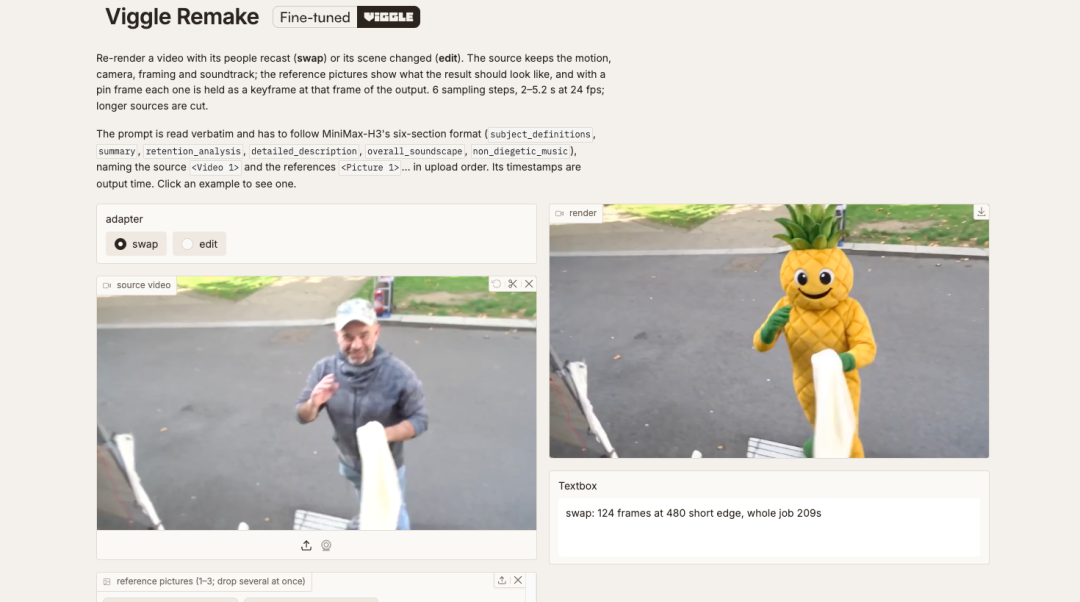
Want to change the protagonist in an existing video, or modify its props, background, and weather, without regenerating the entire footage? Viggle Remake offers a more direct approach: using the original video as the basis, specify the modifications through text descriptions and reference images, so the video presents new visual effects while retaining the original motion, shot composition, camera movement, and soundtrack.
Viggle Remake was released by Viggle AI in October 2026, is built on MiniMax-H3, and implements different types of video editing through two LoRA adapters. Among them, Swap can replace people in the video with new characters, while Edit supports adding or removing objects and adjusting the scene, weather, and lighting. In addition, the model supports pinning reference images to specified frames in the output video as keyframes, making character appearance and visual changes more controllable.
The HyperAI tutorial section has launched “Viggle Remake: Remake Any Video with One Sentence.” Come try it out~
Use online: https://go.hyper.ai/uLIBO
November 16–November 20, hyper.ai official website update roundup:
-
Featured public datasets: 4
-
Featured tutorials: 8
-
Popular encyclopedia entries: 5
-
Top conferences with December deadlines: 1
Visit the official website: hyper.ai
Featured Public Datasets
1. Jabarti-LLM Arabic & English Pretraining Corpus Dataset
The Jabarti-LLM Arabic & English Pretraining Corpus Dataset was released by Abu Bakr Soliman. It contains contiguous Arabic and English text segments (120 to 1,500 characters each) and combines an Egyptian historical corpus with general knowledge from multilingual Wikipedia, targeting pretraining, domain adaptation, and supervised fine-tuning of bilingual large language models.
Run online: https://go.hyper.ai/ZlQgN
2. ExeWorldBench Executable 3D World Modeling Evaluation Dataset
The ExeWorldBench Executable 3D World Modeling Evaluation Dataset was released in 2026 by the University of Science and Technology of China in collaboration with The Chinese University of Hong Kong. Built on Blender, it covers three types of tasks: mechanical device reproduction, multi-stage mechanical system composition, and goal-driven executable world generation. It is used to evaluate models’ ability to build runnable 3D worlds from visual or textual instructions.
Run online: https://go.hyper.ai/O4is2
3. BlenderWorld 3D Scene Generation and Visual Agent Evaluation Dataset
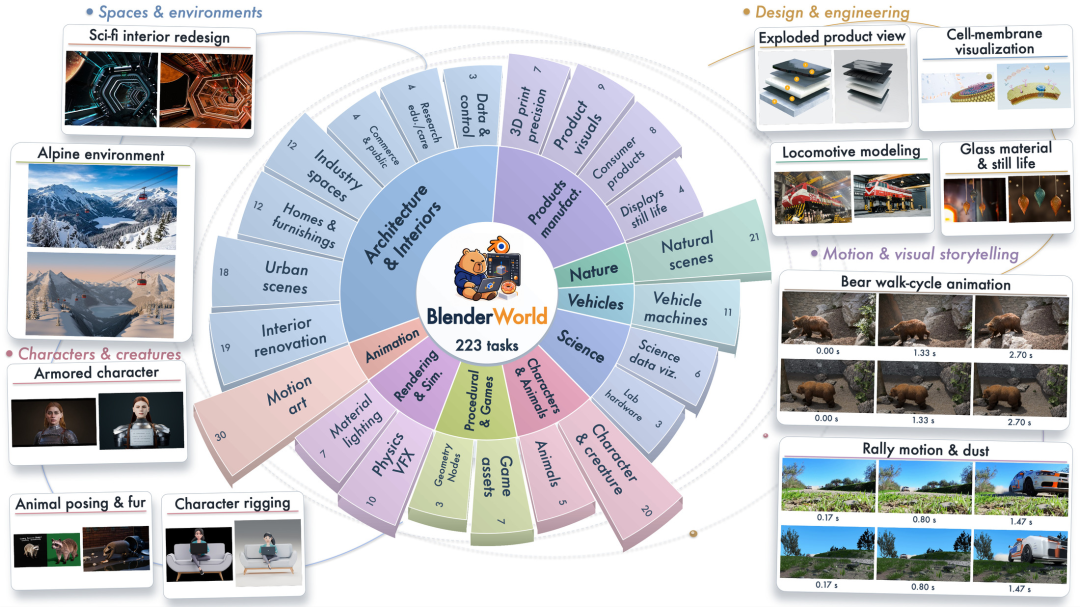
The BlenderWorld 3D Scene Generation and Visual Agent Evaluation Dataset was released by the Qwen team in 2026. It contains 223 3D creation tasks, covering 9 main categories such as architecture, products, natural environments, and characters, and uses multi-view rendering and 2,651 evaluation criteria to measure model performance in geometric structure, spatial layout, and instruction following.
Run online: https://go.hyper.ai/eXJpC
4. Scorpion toxin binder design Scorpion Toxin Binder Design Dataset
The Scorpion toxin binder design Scorpion Toxin Binder Design Dataset was released by Anthropic in 2026. It records 211 protein samples designed de novo with Claude assistance and experimental validation results, covering five scorpion toxins: Cn2, Ts1, AaH II, AaH I, and LqhIII, ultimately screening out 17 protein designs that met binding criteria.
Run online: https://go.hyper.ai/zfhOD
Featured Public Tutorials
1. Idol: Generate 3D Objects from a Single Image
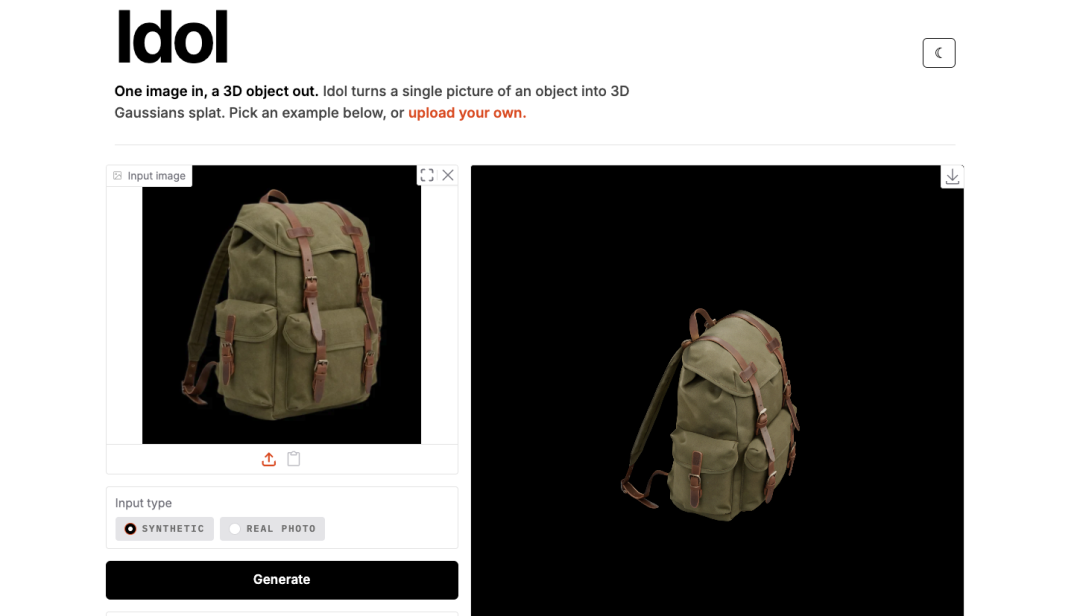
This tutorial demonstrates Idol, an image-to-3D generation model released by Speridlabs in October 2026. The model converts a single object image into a 3D Gaussian splat with up to 1.04 million Gaussians and reconstructs backside details never visible in the image. It is suitable for game and film 3D assets, e-commerce product displays, and concept design.
Run online: https://go.hyper.ai/sjkql
2. Viggle Remake: Remake Any Video with One Sentence
This tutorial demonstrates the video remaking model released by Viggle AI in October 2026. Based on the MiniMax-H3 foundation model, it uses two LoRA adapters, swap and edit, to replace characters, add or remove objects, and change scenes and lighting, while preserving the source video’s motion, camera, composition, and audio track during remaking.
Run online: https://go.hyper.ai/uLIBO
3. Qwen3.5-4B-3D-Coder: Generate Interactive Three.js 3D Scenes
This tutorial demonstrates the 4B multimodal language model released by independent developer CCORE in October 2026. Fine-tuned from Qwen3.5-4B, it can generate interactive Three.js 3D scenes from natural language descriptions and also supports reference-image-guided scene generation.
Run online: https://go.hyper.ai/PpRdd

4. DeepSeek-V4-Pro-Qwen3.5-9B-UNCENSORED-heretic: A 9B Reasoning Model Distilled from DeepSeek-V4-Pro
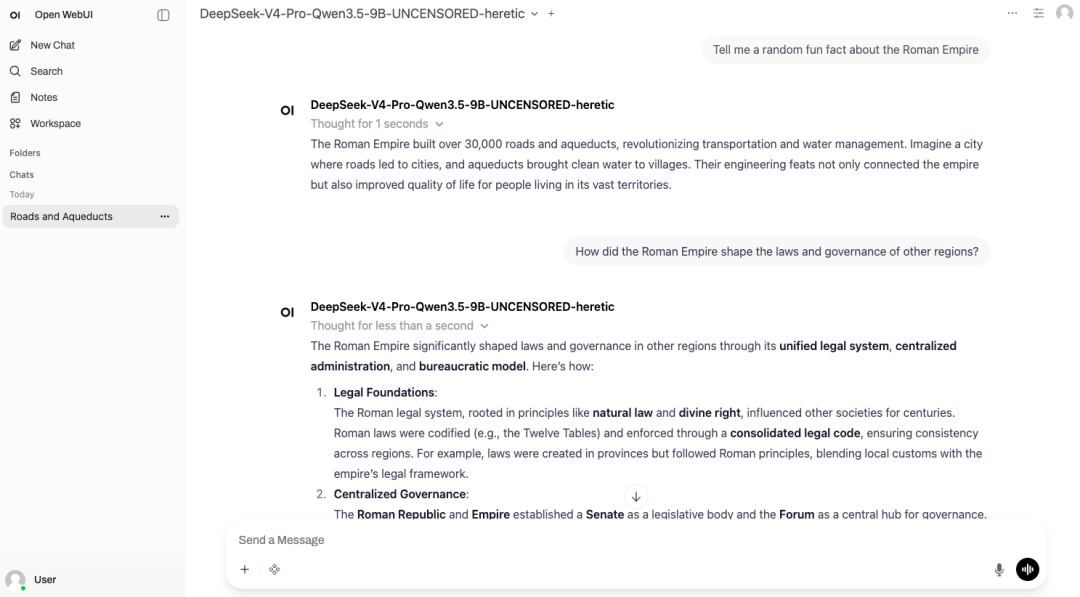
This tutorial demonstrates the 9B math and STEM reasoning model released by user xtools-at in October 2026. The model is distilled from DeepSeek-V4-Pro, fine-tuned on about 250,000 math and science samples (94.50% GSM8K accuracy), integrates a multi-token prediction (MTP) head, and has undergone uncensoring processing.
Run online: https://go.hyper.ai/oH81m
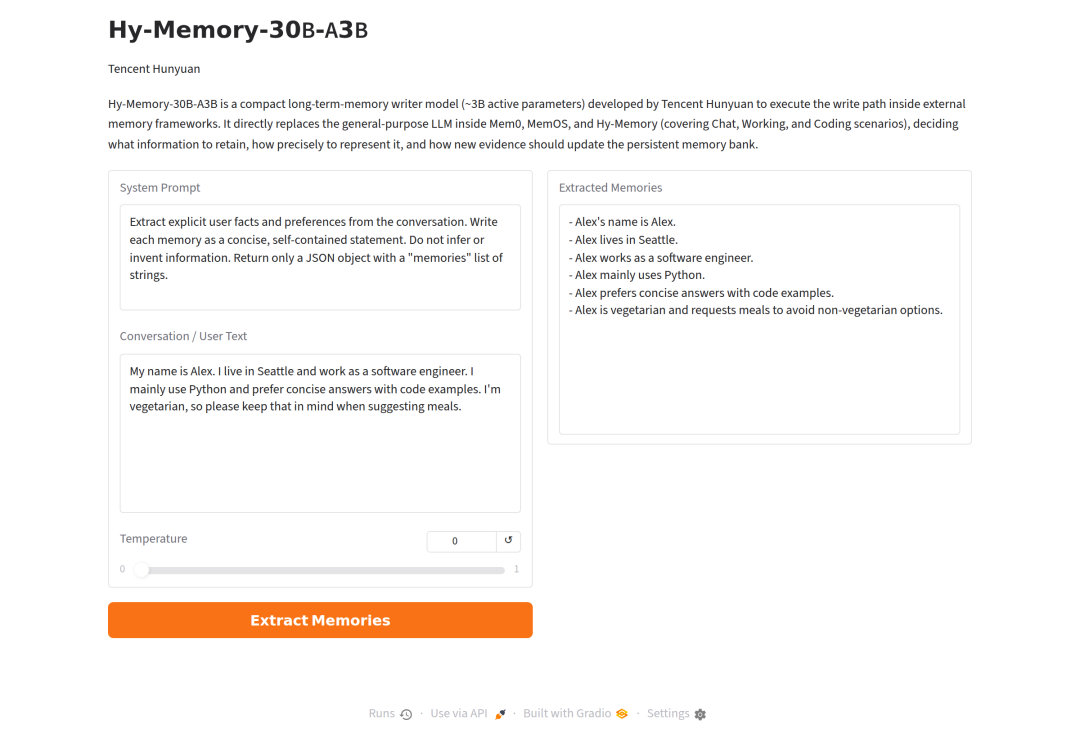
5. Hy-Memory-30B-A3B: Long-Term Memory Writing Model
This tutorial demonstrates Hy-Memory-30B-A3B, a long-term memory writing large language model released by Tencent Hunyuan in October 2026. The model uses a MoE architecture (about 30B total parameters, about 3B activated per token), handles the write path in memory frameworks, and can plug-and-play replace general-purpose LLMs in frameworks such as Mem0 and MemOS.
Run online: https://go.hyper.ai/dJeif
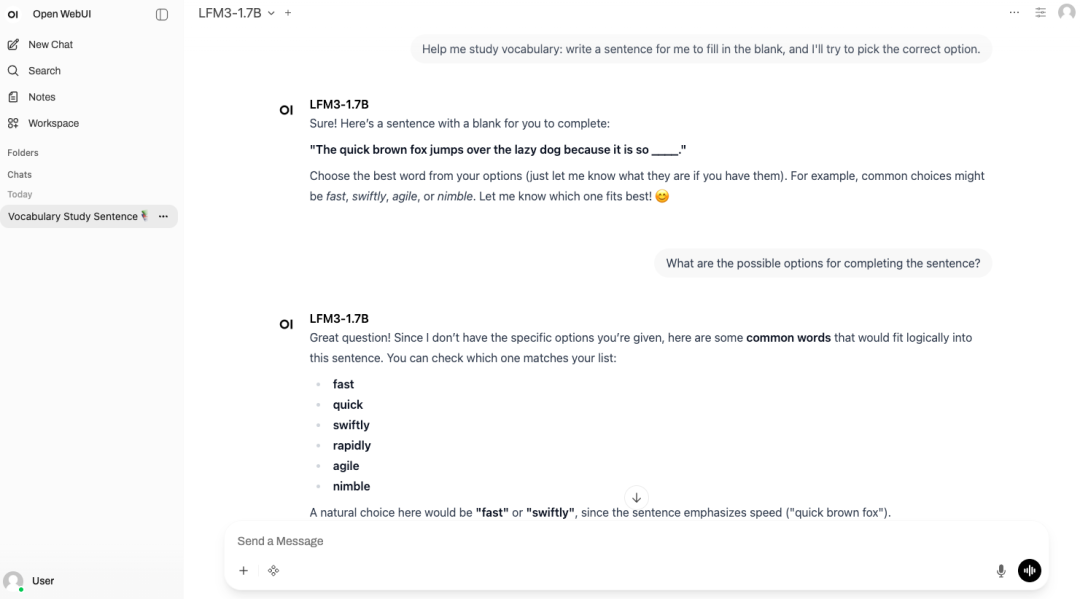
6. LFM3-1.7B: A Text Model for Local Agents and Specialized Applications
This tutorial demonstrates the 1.73B-parameter text model released by Liquid AI in October 2026. The model uses a tri-hybrid architecture (gated short convolution + sliding-window attention + global attention), supports a 256K token context, has been post-trained for tool calling and structured output for agent frameworks, and can run with about 1 GB of memory after 4-bit quantization.
Run online: https://go.hyper.ai/rb1vc
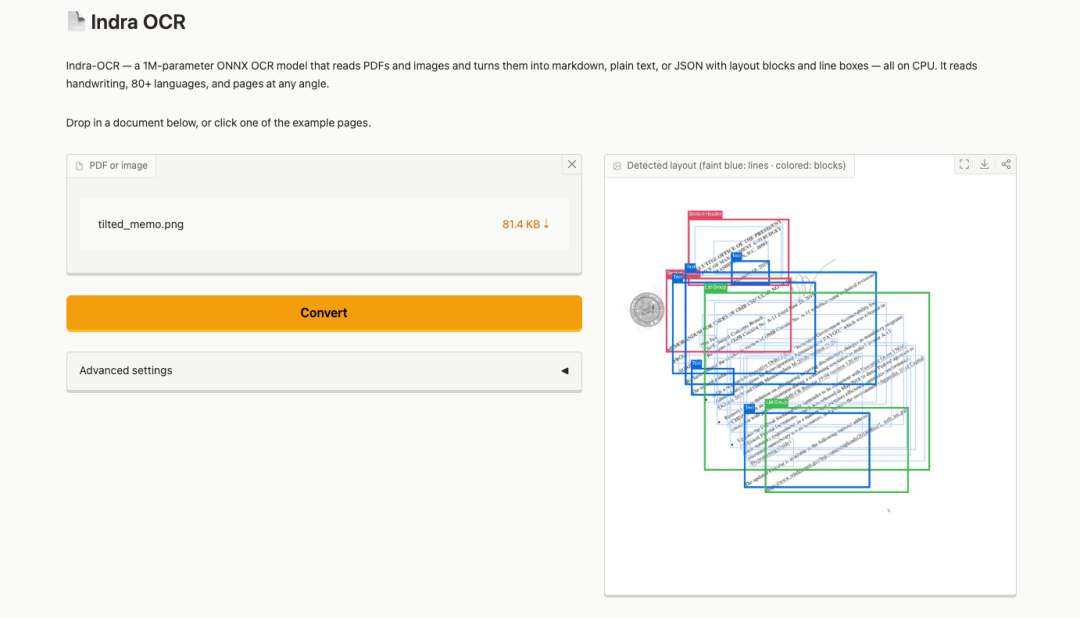
7. Indra OCR: A 1M-Parameter CPU ONNX OCR Model
This tutorial demonstrates Indra OCR, a 1M-parameter CPU OCR model released by Datalab in October 2026. The model runs purely on CPU (about 44 pages/second on 32 cores), converts PDFs and images into Markdown, plain text, or JSON with bounding boxes, and supports 80+ languages, handwriting, layout understanding, and skew correction.
Run online: https://go.hyper.ai/4Ccpa
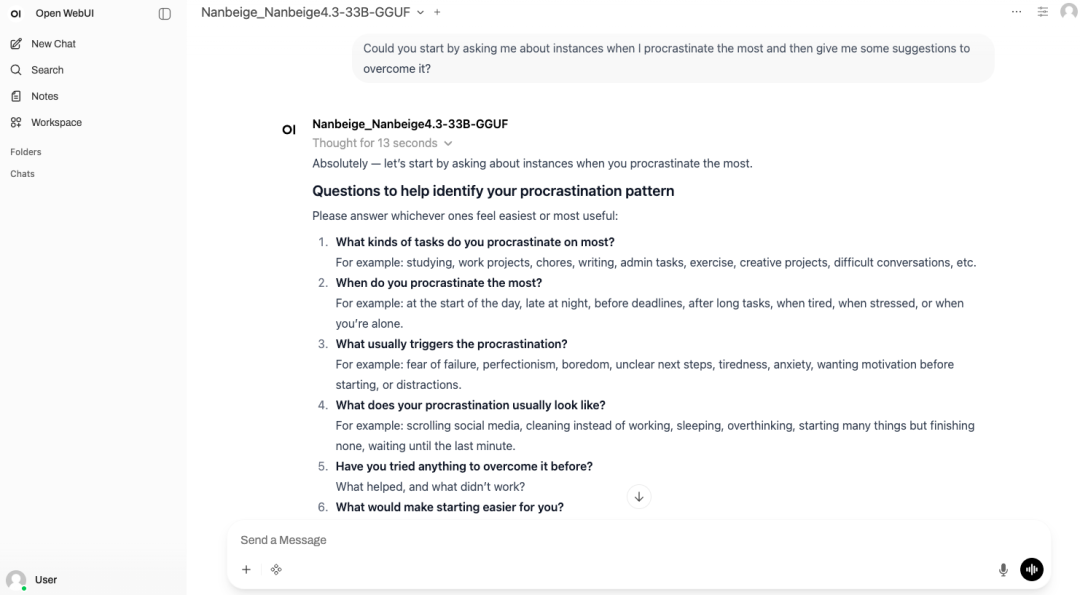
8. Nanbeige4.3-33B: A Flagship Model for Complex Coding and Agent Collaboration
This tutorial demonstrates Nanbeige4.3-33B, an open-source 33B large language model released by the Nanbeige team in October 2026. The model is the flagship teacher model of the Nanbeige4.3 series, achieves leading agent performance among open-source models at the roughly 30B parameter scale, excels at complex coding and specialized collaborative tasks, and supports up to a 512K token context, thinking mode, and tool calling.
Run online: https://go.hyper.ai/3geCl
Featured Popular Encyclopedia Entries
-
World Action Model WAM
-
Robustness
-
Generative Pre-trained Transformer GPT
-
Video Generation
-
Embedding Models
Hundreds of AI-related entries are compiled here to help you understand “Artificial Intelligence”:
Top Conferences with December Deadlines
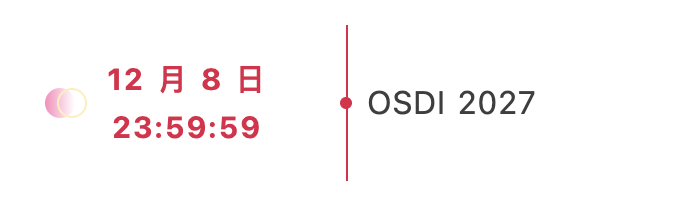
- Deadline times are in AoE time
One-stop tracking of top AI academic conferences: https://go.hyper.ai/event
That’s all for this week’s editor’s picks. If you have resources you’d like to have included on the official hyper.ai website, feel free to leave a comment or submit them to let us know!
See you next week!