Command Palette
Search for a command to run...
OCR Tutorial Compilation | Covering Long Documents, End-to-end, and multi-language Scenarios, Featuring high-performance open-source Models From Baidu, Xiaohongshu, Huazhong University of Science and Technology, and Others for Different Scenarios, Enabling Accurate Multimodal Document parsing.
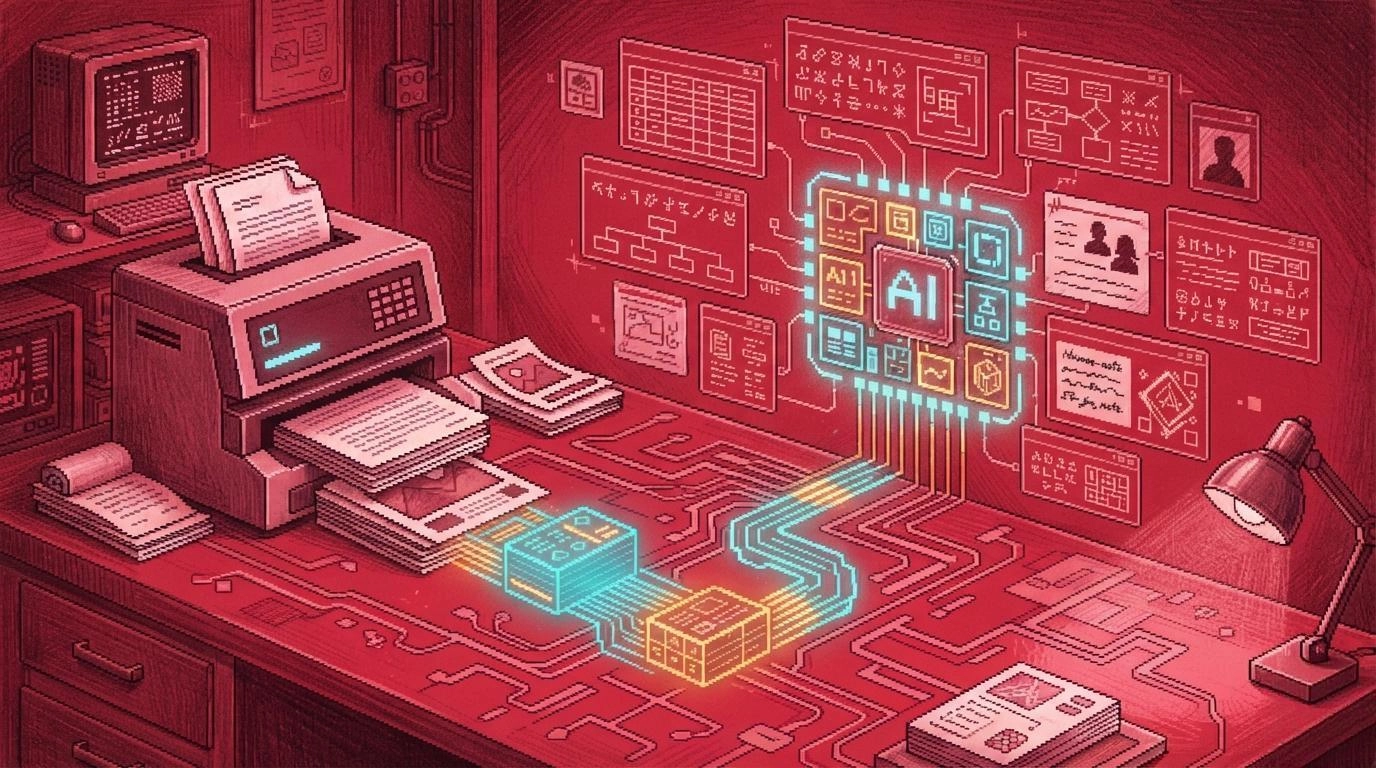
In today's rapidly evolving landscape of large-scale models, while vast amounts of information are digitized, they are often merely images or scanned documents, unsearchable and unable to directly integrate into AI workflows. How can this visual data be transformed into machine-understandable information? OCR (Optical Character Recognition) is a key technology in this field.
In recent years, the development of multimodal models has been redefining the capabilities of OCR.**The new generation of visual language models is beginning to integrate character recognition, layout analysis, information extraction, and content understanding into a single system.**This has transformed OCR from a traditional information collection tool into a crucial gateway connecting visual data with intelligent applications. This shift is driving the adoption of OCR in more fields, including scientific research, finance, healthcare, and AI agents.
Meanwhile, the development of the open-source ecosystem has made OCR technology more user-friendly. From general text recognition to complex document parsing, from multilingual processing to structured content generation, OCR models in different areas are continuously being optimized for specific scenarios. This article selects five representative open-source OCR models.It covers multiple areas such as document parsing, complex layout understanding, multilingual recognition, handwritten text processing, and structured output.
**The HyperAI official website (hyper.ai) tutorial section has compiled practical content on multiple open-source OCR models.**This article will systematically outline the characteristics and application scenarios of these models to help developers quickly understand the current OCR technology ecosystem and choose a solution that suits their needs.
Click to see more high-quality tutorials:
1.Unlimited-OCR One-click deployment of long document OCR and layout parsing
Run online:https://go.hyper.ai/E1qZ5
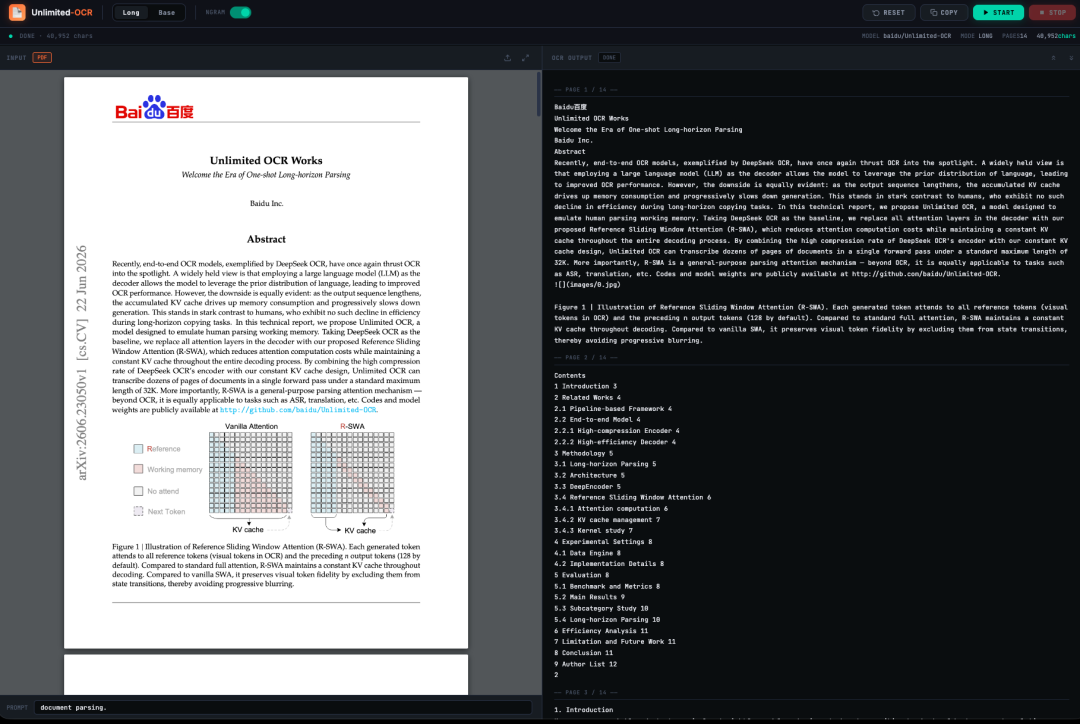 Unlimited-OCR is an OCR and document structure parsing project released by the Baidu team in June 2026.**This project primarily targets scenarios involving long document OCR recognition and structured document parsing.**The core objective is to maintain the stability and efficiency of the OCR recognition process in long contexts or multi-page document environments.
This model is designed for practical document processing tasks, including text detection, structured OCR output, document layout recognition, PDF page parsing, and Markdown format result summarization. Compared with traditional single-image OCR processing methods,Unlimited-OCR is more advantageous when processing long documents, presentations, scanned reports, and multi-page PDF files.
2.Chandra-ocr-2 accurately converts mathematical/spreadsheet/handwritten content into structured content.
Run online:https://go.hyper.ai/zpuqa
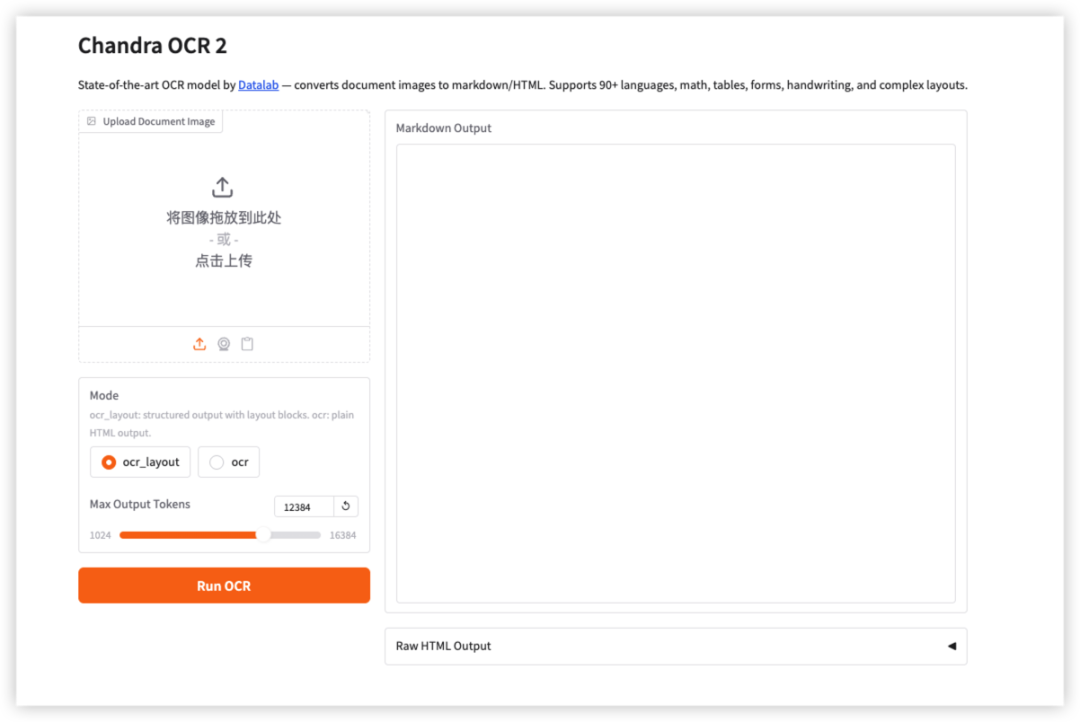 Chandra-ocr-2 is a next-generation optical character recognition (OCR) system developed by the Datalab team in March 2026, focusing on text recognition and structured output in complex scenarios. This model is optimized based on advanced vision-language pre-training technology.It boasts seven core advantages: multi-scenario text recognition capability, structured output capability, efficient inference performance, intelligent image preprocessing, flexible Prompt system, and simple interactive interface.
In practical applications, Chandra-ocr-2 provides technical support in multiple fields: its document digitization function can quickly extract text content from scanned materials; in the education field, the system supports tasks such as recognizing exam paper content and entering question lists; in the scientific research field, it can help researchers extract text information from images and charts in papers; and developers can integrate the system into automated text extraction tasks.
3.dots.mocr Multimodal Document Parsing Tutorial
Run online:https://go.hyper.ai/JQt6b
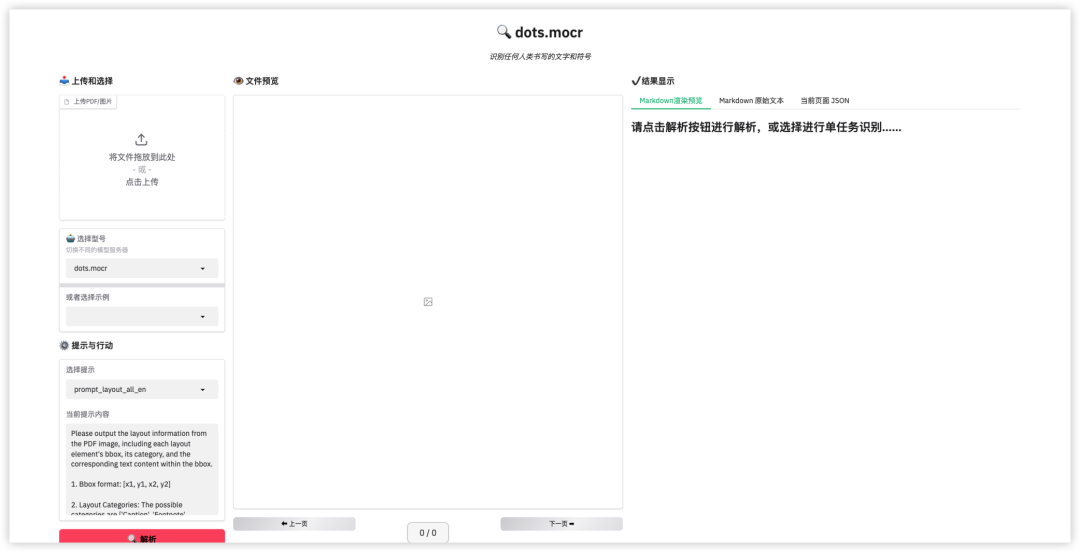 dots.mocr is a multimodal OCR document parsing model jointly released by Huazhong University of Science and Technology and the Rednote HI-Lab team in March 2026.**This model achieves state-of-the-art (SOTA) performance in handling multilingual document parsing tasks.**Its main technical features include multilingual support, structured parsing, conversion of graphics to SVG format, scene text detection, and webpage parsing.
In addition to its document parsing capabilities, dots.mocr also possesses powerful structured graphics understanding capabilities, enabling it to directly convert visual content such as charts, UI layouts, and scientific diagrams into SVG code. In general visual tasks, dots.mocr maintains performance comparable to Qwen3-VL-4B.
4. Qianfan-OCR End-to-End Intelligent Document Model
Run online:https://go.hyper.ai/QAuH4
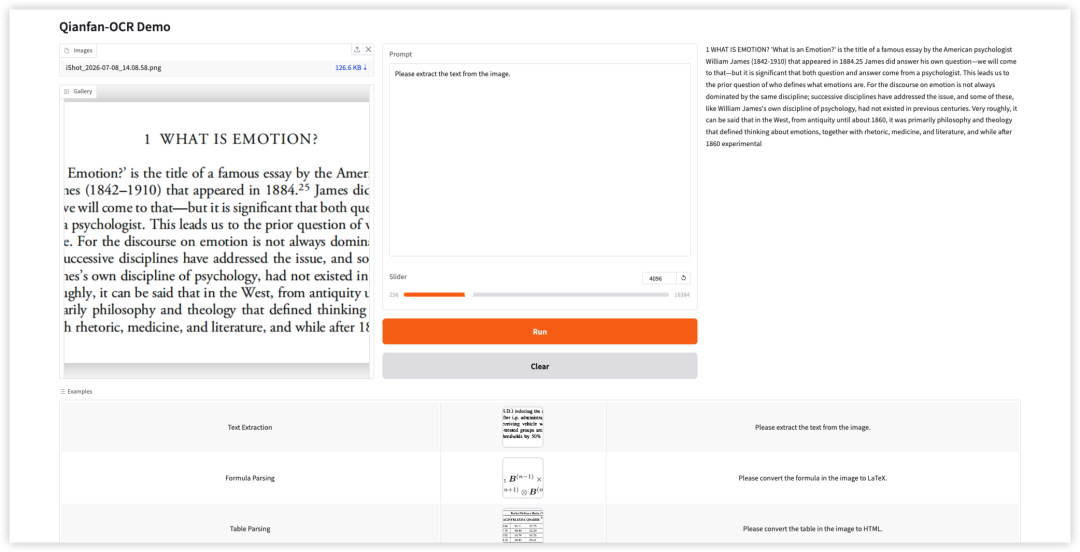 Qianfan-OCR is an end-to-end document intelligence model open-sourced by the Baidu AI Cloud Qianfan team in March 2026. Based on a 4 billion parameter (4B) visual language processing architecture, the model integrates document parsing, layout analysis, text recognition, and semantic understanding.This model proposes a "Layout-as-Thought" mechanism, which enables explicit modeling of document layout structure and supports the understanding and parsing of complex tables, charts and other content.
**In the OmniDocBench v1.5 benchmark, Qianfan-OCR ranked first among end-to-end models with a score of 93.12.**On multiple public leaderboards in the field of key information extraction, Qianfan-OCR's total score has surpassed commercial models such as Google Gemini 3-Pro.
5.FireRed-OCR Document Structure Parsing Model
Run online:https://go.hyper.ai/awl4v
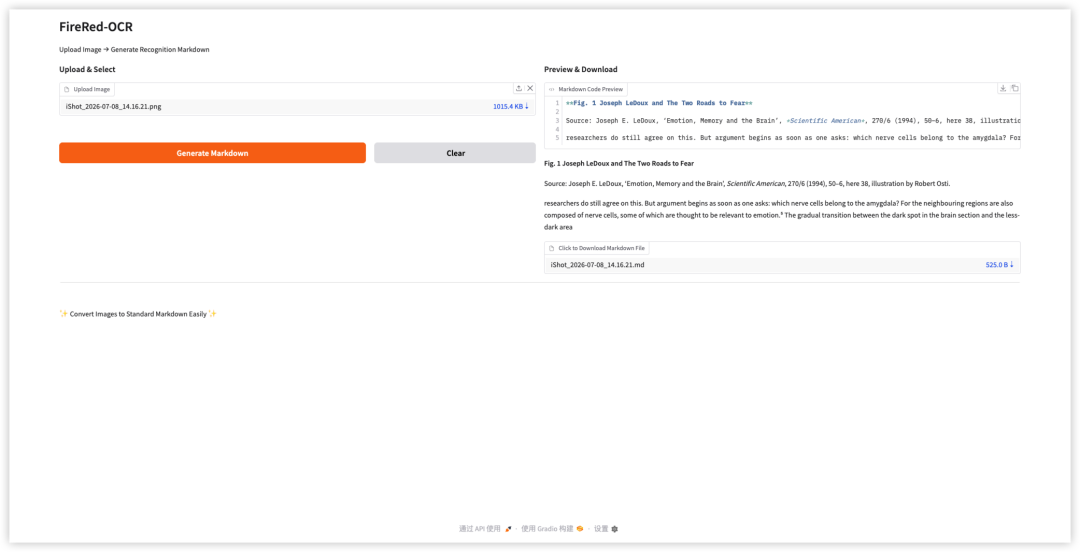 FireRed-OCR is a structured OCR project released by FireRedTeam in December 2025.**The core objective of this project is to parse complex document images into high-quality, structured Markdown output.**Unlike traditional "detection + recognition + layout analysis" processing workflows, FireRed-OCR focuses more on understanding the document as a whole, and can handle multi-column layouts, tables, formulas, and mixed text and images. Furthermore, this tool supports direct export of Markdown files, facilitating subsequent editing, publishing, and migration.
In practical applications, FireRed-OCR is suitable for scenarios such as academic papers, textbooks, scanned documents, product manuals, and enterprise business archives. It can quickly convert images or scanned documents into editable and publishable structured documents. Users can complete a series of operations—upload, generate, preview, and export—through the official Grado Space online interactive interface, intuitively see the conversion effect, and download the results, reducing manual processing costs.