Command Palette
Search for a command to run...
TimesFM 3.0 Zero-Shot Time Series Forecasting Covers Multi-Scenario Analysis Needs; VLX-Seek Integrates Target Localization With Fine-Grained Understanding, Expanding Embodied Visual Perception Capabilities

VLX-Seek is a fine-grained perception vision-language model launched by OmAI Lab in July 2026, designed for embodied vision applications on edge devices such as robots and drones. To address the challenge of determining exactly which object an instruction refers to in real-world tasks, this model combines language understanding with region-level visual perception, supporting object search based on target features and referring relationships, as well as text recognition, content description, and counting around selected regions. Additionally, the model introduces a rejection mechanism for cases where the target object is missing, providing a basis for subsequent search and task adjustment. VLX-Seek further extends the application focus of vision models to the identification and interaction with specific objects, offering foundational capabilities for embodied intelligent systems to connect environmental perception with action decision-making.
The HyperAI official website has now launched "VLX-Seek: Fine-Grained Perception Vision-Language Model" — try it out now~
Online use: https://go.hyper.ai/oeM9
September 18 – September 24, hyper.ai official website update highlights:
-
High-quality public datasets: 5
-
Featured tutorials: 8
-
Popular encyclopedia entries: 5
-
Top conferences with October deadlines: 5
Visit the official website: hyper.ai
Featured Public Datasets
1. GooseReason-0.7M Reinforcement Learning Verification Reasoning Dataset
GooseReason-0.7M is a large-scale reinforcement learning verification reasoning (RLVR) dataset released by NVIDIA in 2026, designed to address the bottleneck of scarce verifiable training data by synthesizing unlimited RLVR tasks from rich reasoning-oriented internet text via the Golden Goose pipeline. The dataset contains over 700,000 tasks spanning mathematics, programming, and general science, with data scale at the 0.7M level. It is primarily used to train the GooseReason-4B-Instruct model, which achieved new state-of-the-art results for 4B-level models across 15 benchmarks covering mathematics, programming, STEM reasoning, instruction following, and logic puzzles.
Online use: https://go.hyper.ai/eQ6X7
2. GR1-100 Robot Manipulation Demonstration Dataset
GR1-100 is a robot manipulation dataset released by NVIDIA in 2025, containing 92 video clips designed to provide high-quality video data for robot training. The data is in MP4 format with a total size of approximately 142.3 MB, suitable for research in computer vision and robot learning. The dataset primarily records third-person perspective videos of a Fourier robot named GR1-T2 performing various tasks in a laboratory environment.
Online use: https://go.hyper.ai/BulTI
3. GraspGen: Scaling Sim2Real Grasping Dataset
GraspGen: Scaling Sim2Real Grasping is a large-scale simulated grasping dataset released by NVIDIA in 2025, containing over 57 million grasp samples generated from 8,515 objects in the Objaverse XL (LVIS) dataset, designed for the Franka Panda, Robotiq-2f-140 industrial gripper, and single-point contact suction gripper (30 mm radius). It aims to improve the transferability of robot grasping skills from simulation to reality through large-scale simulated data. The dataset is in WebDataset format, containing over 57 million simulated grasp samples in total, covering three different types of robot grippers, and is suitable for research in robot grasping, simulation-to-reality transfer (Sim2Real), and robot learning.
Online use: https://go.hyper.ai/81LdN
4. LiveCodeBench-CPP Code Generation Evaluation Dataset
LiveCodeBench-CPP is a C++ code generation evaluation dataset released by NVIDIA in 2025, designed to provide a benchmark for evaluating large language models' code generation and debugging capabilities based on the latest programming problems. The dataset contains 454 programming problems, primarily from AtCoder (287 problems) and LeetCode (167 problems), covering competitions and problems from October 2024 to May 2025. The data includes problem descriptions, platform sources, difficulty levels, test cases, and related metadata, primarily used to evaluate models' code generation and problem-solving capabilities in real programming tasks.
Online use: https://go.hyper.ai/YdSXz
5. HelpSteer Helpfulness Alignment Dataset
HelpSteer is a dataset released by NVIDIA in 2023 for large language model alignment, designed to improve the helpfulness, correctness, and coherence of model responses while supporting adjustment of response complexity and detail level. The dataset contains 37,120 samples covering various task types including rewriting, summarization, classification, extraction, and question answering. Each sample contains a prompt, model response, and human-annotated attribute scores for helpfulness, correctness, coherence, complexity, and verbosity, with scores ranging from 0 to 4. The data was annotated by Scale AI and is primarily used for large language model training, evaluation, and model alignment research.
Online use: https://go.hyper.ai/B5OPS
Curated Public Tutorials
1. TimesFM 3.0: Zero-Shot Time Series Forecasting
TimesFM 3.0 is a time series foundation model launched by Google Research in August 2026, using a pre-trained zero-shot forecasting approach that can predict new time series without task-specific fine-tuning. The model natively supports univariate, multivariate, and covariate inputs, and strengthens zero-shot generalization capabilities, making it applicable to time series analysis scenarios such as retail sales, financial analysis, weather and energy demand, and supply chain forecasting.
Run online: https://go.hyper.ai/DRk3i
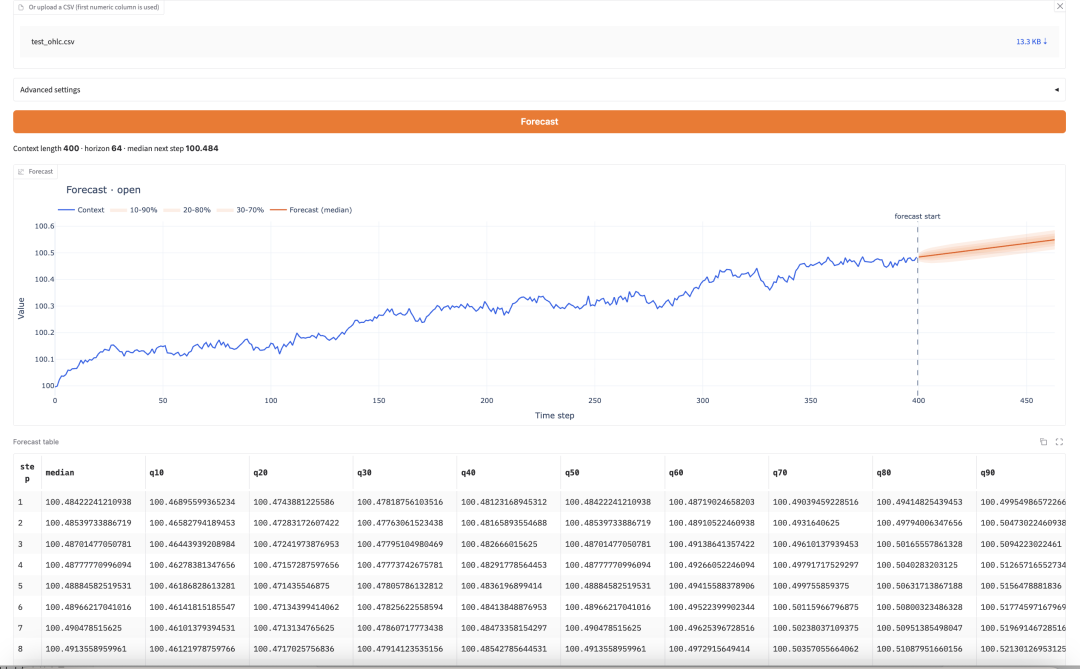
demo page
2. VLX-Seek: Fine-Grained Perception Vision-Language Model
VLX-Seek is a fine-grained vision-language model (VLM) launched by OmAI Lab in July 2026, designed for on-device embodied vision scenarios. It understands image content while performing object localization, instance discrimination, and fine-grained visual perception. The model supports object detection, referring expression comprehension, region description, region OCR, counting, and reasoning detection, and outputs None when the target is absent through an open-vocabulary rejection mechanism. It can be used in embodied intelligence scenarios such as robots and drones.
Run online: https://go.hyper.ai/oeM92
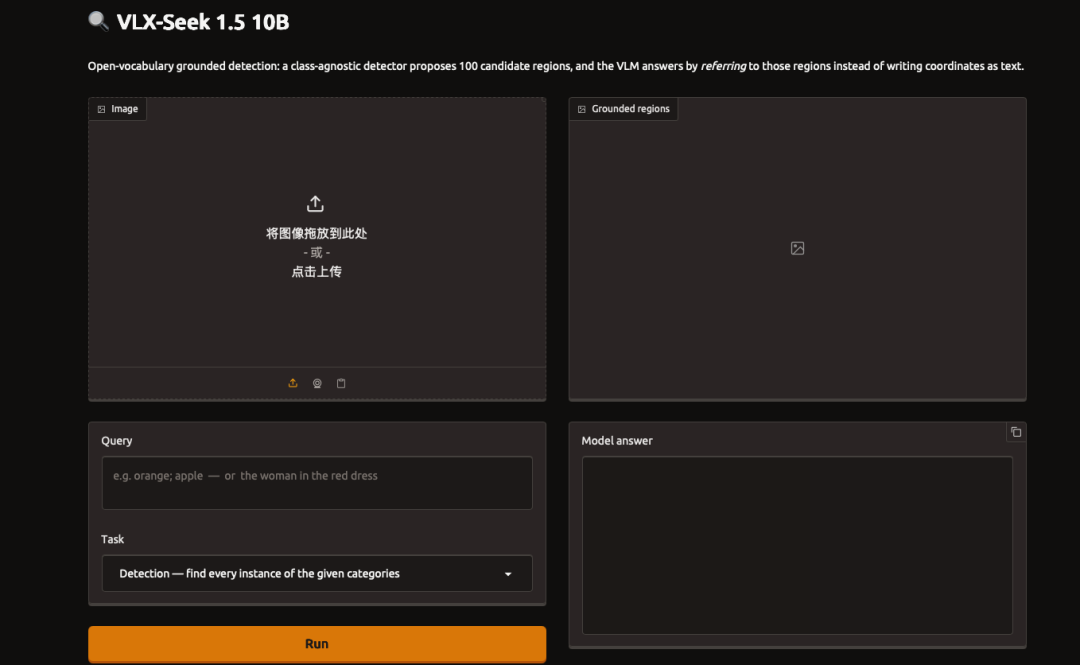
demo page
3. Breeze TTS 2 — Open-Source Real-Time Text-to-Speech Model
Breeze TTS 2 is an open-weight text-to-speech model launched by the BreezeBlue team in August 2026, designed for real-time voice interaction scenarios. It supports voice design, voice cloning, and emotion control through natural language. The model supports bilingual Chinese and English, allowing adjustments to tone, speaking rate, and emotion via text instructions, and supports sound events such as laughter and sighs, as well as ultra-low-latency streaming generation. It can be used in scenarios such as real-time voice assistants, audio content, dubbing localization, and accessibility services.
Run online: https://go.hyper.ai/JStch
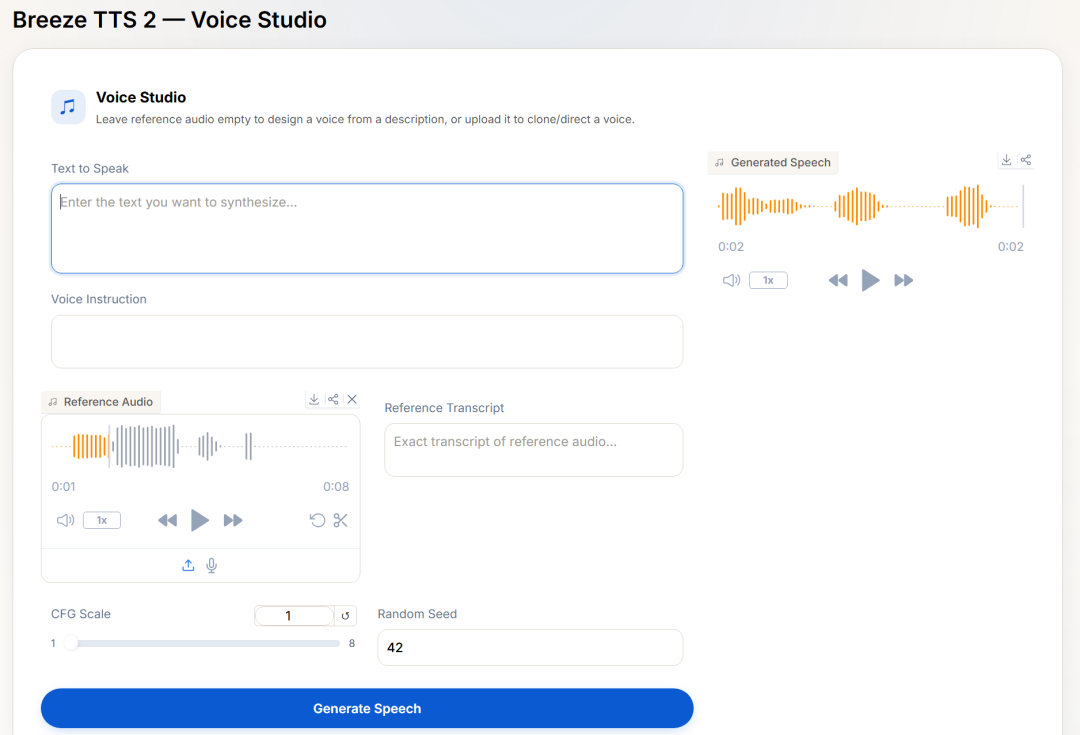
demo page
4. Introductory Tutorial to Statistical Learning
This tutorial was published by Kaggle user DATAI in 2018, using the Breast Cancer Wisconsin Diagnostic Dataset as an example to explain the fundamentals of statistical learning and common analysis methods from scratch. The tutorial covers data exploration and visualization, descriptive statistics such as mean and variance, cumulative distribution functions, effect size and correlation, hypothesis testing and p-values, as well as normal distribution and Z-score calculation. It is suitable for beginners in statistical learning.
Run online: https://go.hyper.ai/fVzMx
5. EfficientDet Training Tutorial: Wheat Spike Object Detection
This tutorial is based on the training pipeline built by Alex Shonenkov for the Kaggle Global Wheat Detection competition, providing hands-on practice with the EfficientDet object detection model from scratch. The tutorial covers environment configuration and GPU checks, competition dataset loading, Albumentations data augmentation, EfficientDet-D5 model construction, and the complete training pipeline. It is suitable for developers who want to learn object detection model training and practical implementation.
Run online: https://go.hyper.ai/AtDMM
6. YuE2-3B: Cutting-Edge Open-Source Music Generation Model
YuE2-3B is an open-source music generation model launched by the Multimodal Art Projection (m-a-p) team in 2026, capable of generating complete songs with vocals and accompaniment based on lyrics and style prompts. The model adopts an AR–NAR Mixture-of-Transformers architecture, supporting three modes: melody and chords, melody-only, and direct generation, and supports 48 kHz stereo output. It can be used in scenarios such as text-to-music generation, song covers, and intelligent music editing.
Run online: https://go.hyper.ai/t4G7M
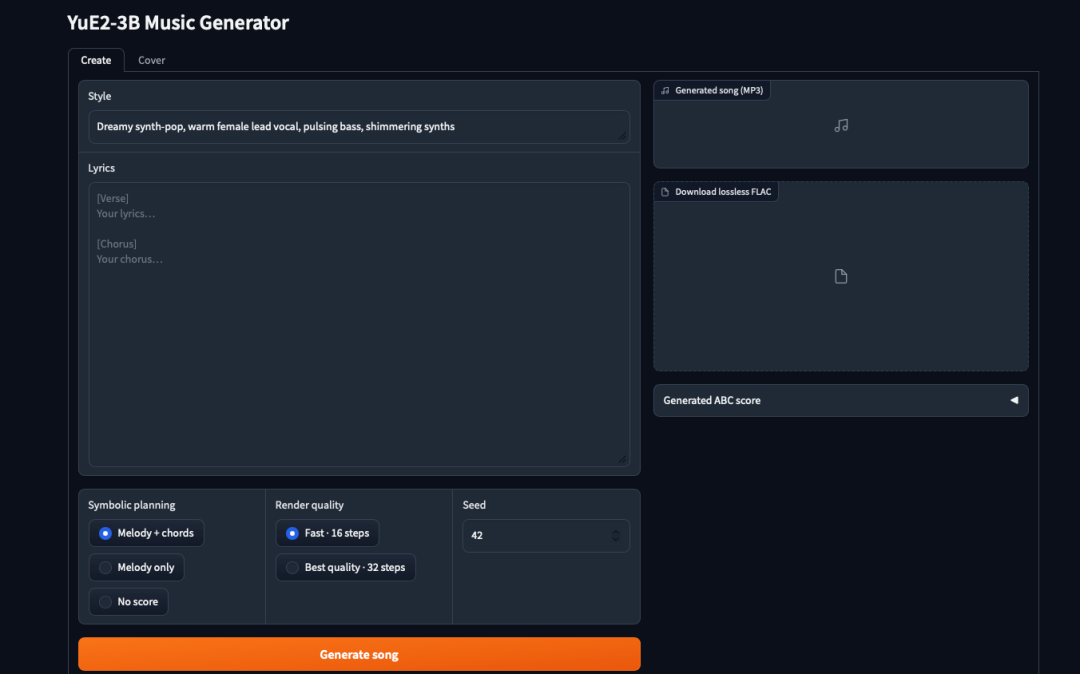
demo page
7. FFmpeg Video Player Development Tutorial: From Frame Capture to Seeking
This tutorial series is adapted from the classic tutorial "An ffmpeg and SDL Tutorial" published by Stephen Dranger in 2015, reimplementing the core content using Python and FFmpeg command-line tools to explain the working principles of digital audio and video from scratch. The tutorial covers fundamental concepts such as containers, streams, codecs, packets, frames, and timestamps, and gradually practices video synchronization, audio synchronization, and media seeking through runnable experiments. It is suitable for learning player development, transcoding, streaming media, and computer vision-related technologies.
Run online: https://go.hyper.ai/rtrW4
8. MiniCPM5-2B: On-Device 2B-Level SOTA Large Model Inference
MiniCPM5-2B is a 2B-level open-source large language model launched by OpenBMB in September 2026, and is the second model in the MiniCPM5 series. It adopts the standard LlamaForCausalLM architecture and is designed for edge deployment, local inference, and resource-constrained scenarios. The model supports up to 131K context and features code and mathematical reasoning, tool calling, and Agent capabilities, making it suitable for applications such as local AI assistants, programming assistance, knowledge Q&A, and intelligent agent use cases.
Online demo: https://go.hyper.ai/D8jnq
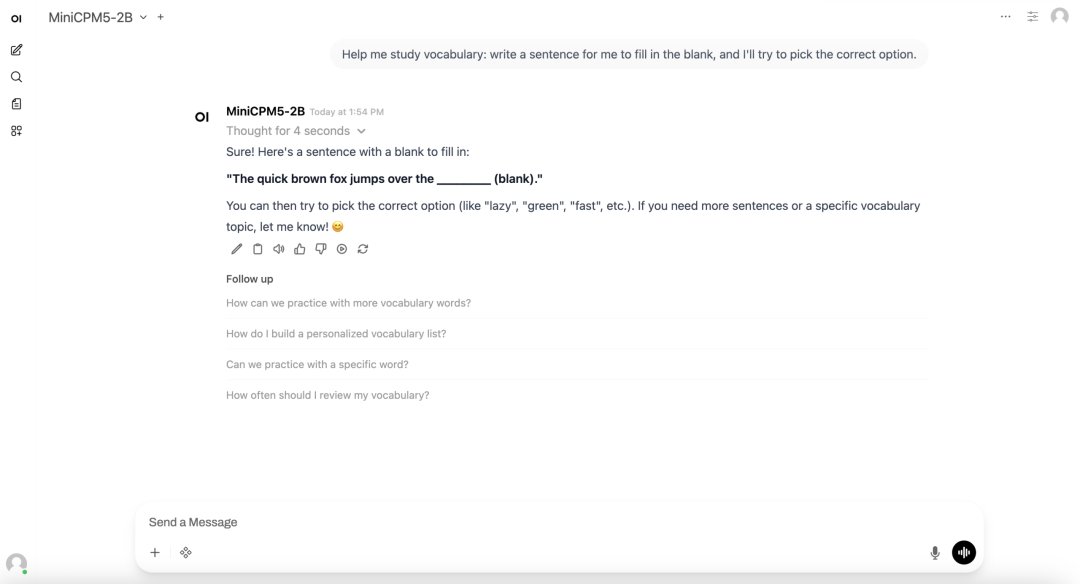
Demo page
Featured Popular Encyclopedia Entries
1. Optical Character Recognition (OCR)
2. World Action Model (WAM)
3. Remote Sensing
4. Glitch Token
5. Generative Pre-trained Transformer (GPT)
Here we have compiled hundreds of AI-related entries, allowing you to understand "Artificial Intelligence" at a glance:
Top Conferences with Deadlines in October
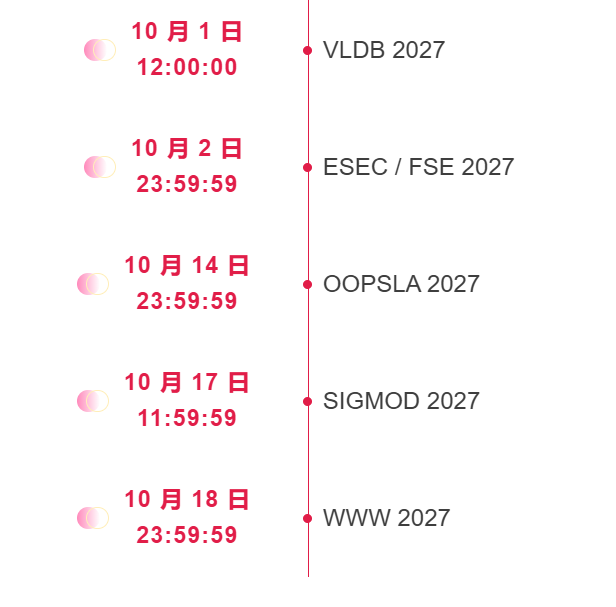
*Deadline is in AoE time
One-stop tracking of top AI academic conferences: https://go.hyper.ai/event
That's all for this week's editor's picks. If you have resources you'd like to include on the hyper.ai official website, feel free to leave a comment or submit them to us!
See you next week!