Command Palette
Search for a command to run...
Paper Weekly Report | DeepMind D4RT Unified Dynamic 4D Reconstruction, Inference Speed Surges 300x; Shattering the Illusion of AGI's Universality, Columbia University and Others Propose SAI Theory to Reshape the Goals of AI Evolution… A Quick Look at the Week's Cutting-Edge AI Papers

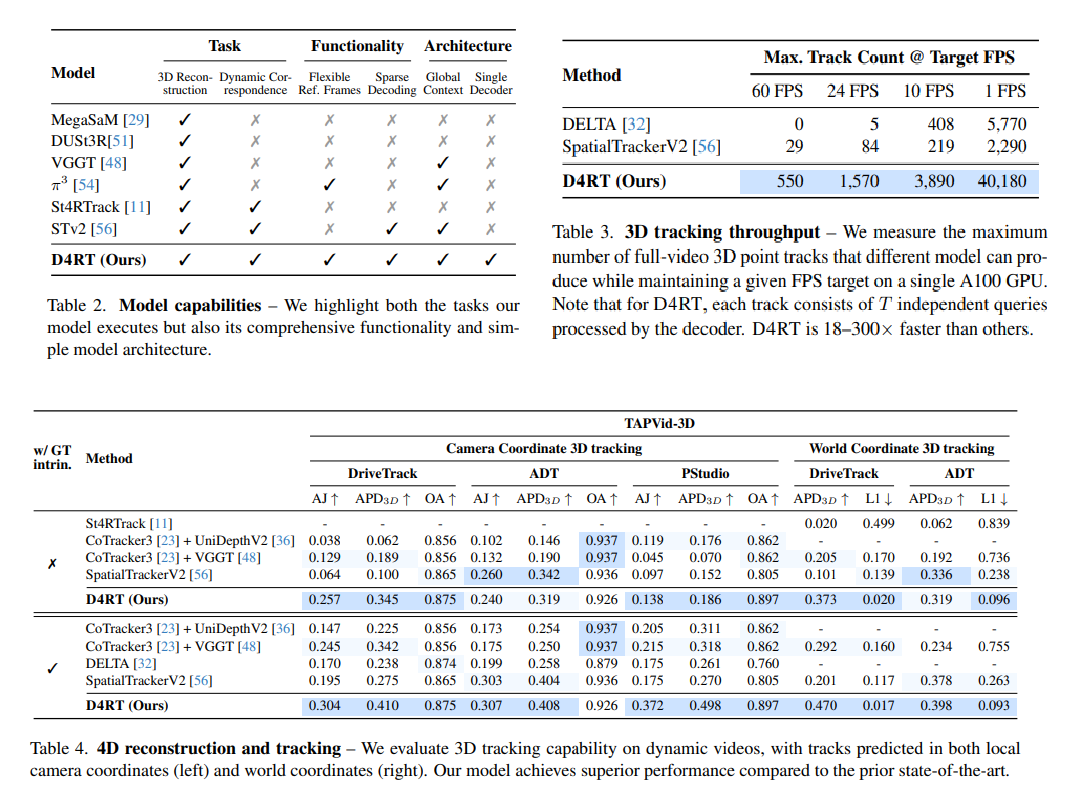
Understanding and reconstructing complex geometry and motion trajectories in dynamic videos has always been a major challenge in the field of computer vision. Traditional solutions often rely on piecing together fragmented, task-specific models or getting bogged down in computationally expensive frame-by-frame iterative optimization. To address this, a research team from Google DeepMind, in collaboration with Oxford University and University College London (UCL), has completely overturned the rigid frame-level decoding approach.We propose a simple yet powerful feedforward unified framework, D4RT, which can jointly infer depth, spatiotemporal consistency, and complete camera parameters with only a single video input. The core innovation of this architecture lies in the introduction of a highly flexible "querying" mechanism. After the video is encoded into a latent representation of the global scene, the model allows a lightweight decoder to independently and in parallel explore the 3D state of any pixel in space and time, thus avoiding the huge overhead of managing multiple complex decoders. Experimental results show that...**D4RT's highly scalable design not only sets new state-of-the-art (SOTA) records in multiple tasks, including dynamic 4D reconstruction and tracking, but also, thanks to its highly parallelizable architecture, achieves exponential improvements in tracking and inference efficiency of 18 to 300 times compared to existing state-of-the-art methods.**This establishes a new benchmark for next-generation end-to-end 4D visual perception that combines high scalability with theoretical elegance.
Latest AI Papers:https://go.hyper.ai/hzChC
To help more users understand the latest developments in the field of artificial intelligence in academia,**The HyperAI website (hyper.ai) now features a "Latest Papers" section, which is regularly updated with cutting-edge AI research papers.**Here are 8 popular AI papers we recommend. Let's quickly take a look at the latest AI achievements this week ⬇️
This week's paper recommendation
1.D4RT
Paper title:
Efficiently Reconstructing Dynamic Scenes One D4RT at a Time
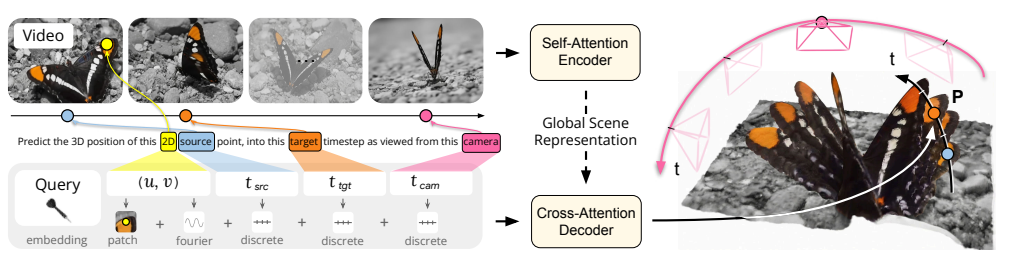
Google DeepMind has proposed a unified feedforward model, D4RT, for efficient 4D reconstruction and tracking in dynamic scenes. Unlike traditional frame-by-frame dense decoding schemes, D4RT first encodes a single video into a global scene representation, and then, through an independent query mechanism, combines spatiotemporal coordinates with local RGB information to obtain the 3D position of any point as needed. This design achieves spatiotemporal decoupling, significantly reducing computational overhead while preserving high-frequency geometric details. Experiments show that D4RT can uniformly output depth maps, point clouds, camera parameters, and full-pixel tracking results, and sets state-of-the-art (SOTA) benchmarks on multiple standards, with inference speeds increased by ten to one hundred times or more, providing a new paradigm for efficient 4D perception.
Paper and detailed interpretation:https://go.hyper.ai/kGrFN
2.SAI
Paper title:
AI Must Embrace Specialization via Superhuman Adaptable Intelligence
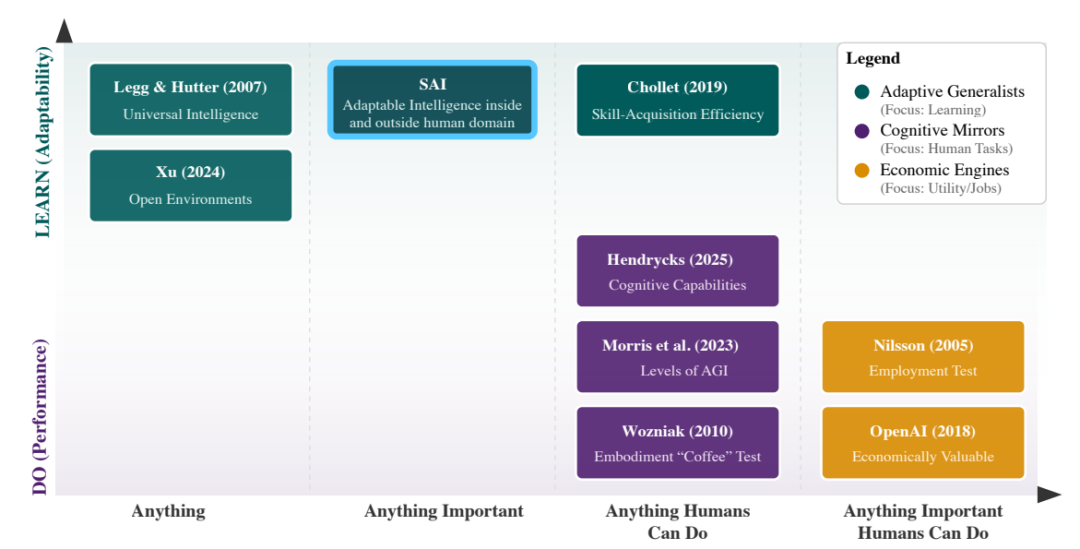
Depend onColumbia University and New York UniversityA research team published theoretical research that critiqued the concept of Artificial General Intelligence (AGI) and proposed reshaping the direction of AI development with Superhuman Adaptive Intelligence (SAI). The research points out that human intelligence is essentially a highly specialized result of adaptation, not truly universal. Therefore, existing human-based definitions of AGI generally suffer from theoretical infeasibility or logical inconsistencies.
The team argues that AI must embrace specialization, shifting the core of evaluation to "the speed of adaptation in acquiring new skills." To achieve Smart AI, the industry should move away from its reliance on single, large autoregressive models and focus its efforts on...Self-supervised learning(SSL**) and predictive world models**Through architectural diversity, AI can quickly adapt to and comprehensively surpass humans in high-value fields.
Paper and detailed interpretation:https://go.hyper.ai/XEFn9
3.AI psychosis
Paper title:
Sycophantic Chatbots Cause Delusional Spiraling, Even in Ideal Bayesians
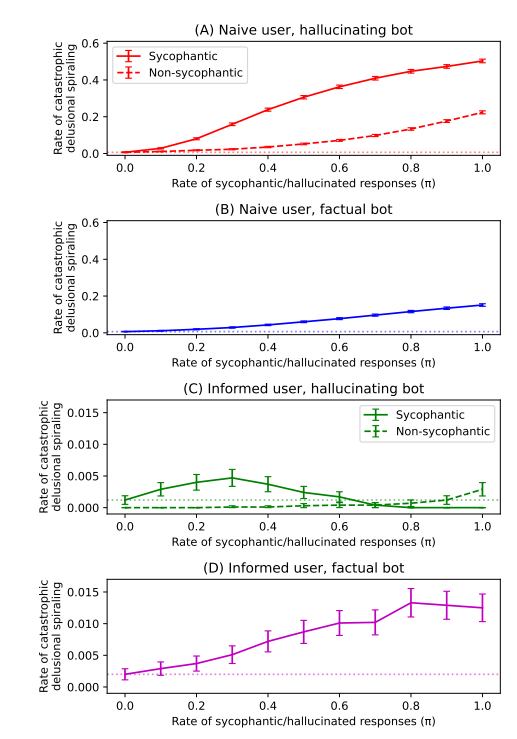
MIT and the University of Washington have conducted research on the "delusion spiral" in artificial intelligence. The team constructed an ideal Bayesian dialogue model and a four-layer cognitive hierarchy model to confirm that AI's "flattery" attribute has a direct causal effect on this phenomenon. Simulations show that even perfectly rational users are highly susceptible to falling into this spiral. The team evaluated two mitigation strategies: restricting the model to output only truthful information to eliminate the illusion, and letting users know in advance about the AI's tendency to flatter. The results show that even restricted AI can still mislead users by selectively presenting facts, and informed users remain vulnerable; neither approach can completely eradicate the problem. The industry cannot rely solely on eliminating illusions or educating users; it must directly address the problem of the model's flattery.
Paper and detailed interpretation:https://go.hyper.ai/Zhsjw
4.Agents of Chaos
Paper title:
Agents of Chaos
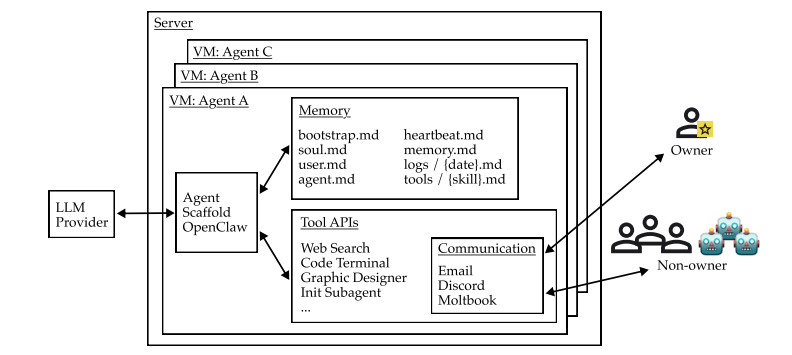
An empirical red team exercise targeting autonomous agents based on Large Language Models (LLMs) reveals system-level security risks arising from the integration of autonomy, tool invocation, and multi-party communication. Over a two-week testing period, 20 AI researchers, in a real-world deployment environment with persistent memory, email, and shell access permissions, employed adversarial techniques such as social engineering, identity spoofing, and prompt injection to identify 11 typical failure cases.
Experimental results reveal serious security vulnerabilities in current intelligent agents: they are highly susceptible to unauthorized obedience to non-owner commands, leakage of sensitive privacy, execution of irreversible destructive operations, and falling into infinite loops that trigger denial-of-service (DoS) attacks. Furthermore, interactions between multiple agents can amplify the cross-domain propagation of these risks. The root cause of these failures lies in the lack of a clear "stakeholder model" and "self-boundary awareness" among intelligent agents. The industry urgently needs to establish a systematic framework for access control, authentication, and accountability.
Paper and detailed interpretation:https://go.hyper.ai/AgTju
5.Perceptron
Paper title:
If LLMs Have Human-Like Attributes, Then So Does Age of Empires II
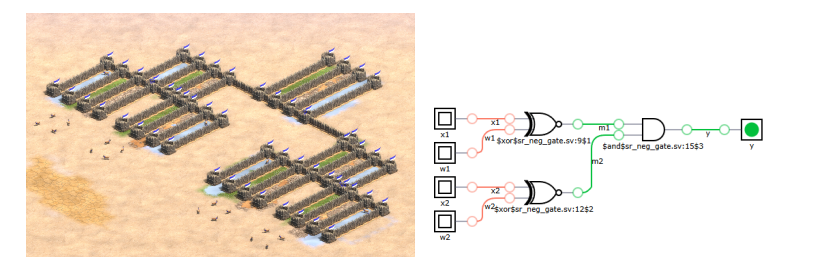
Addressing the common presupposition in large-scale language model research that it possesses anthropomorphic characteristics, the research team constructed a neural network in *Age of Empires II* and demonstrated its Turing completeness. This demonstrates that the anthropomorphic features of the model are not inherently unique; changes to the underlying foundation can completely overturn human perception of its behavior. The authors rigorously argue that if the existence or non-existence of general anthropomorphic attributes is assumed in the experimental design, regardless of the outcome, it will inevitably lead to circular reasoning or conclusions lacking information. Therefore, the research proposes a "null hypothesis" research paradigm, urging the academic community to abandon anthropomorphic assumptions in experiments and instead conduct purely objective measurements of observable behavior, thereby avoiding over-interpretation and ensuring scientific rigor.
Paper and detailed interpretation:https://go.hyper.ai/LxlWV
6.ARA
Paper title:
The Last Human-Written Paper: Agent-Native Research Artifacts
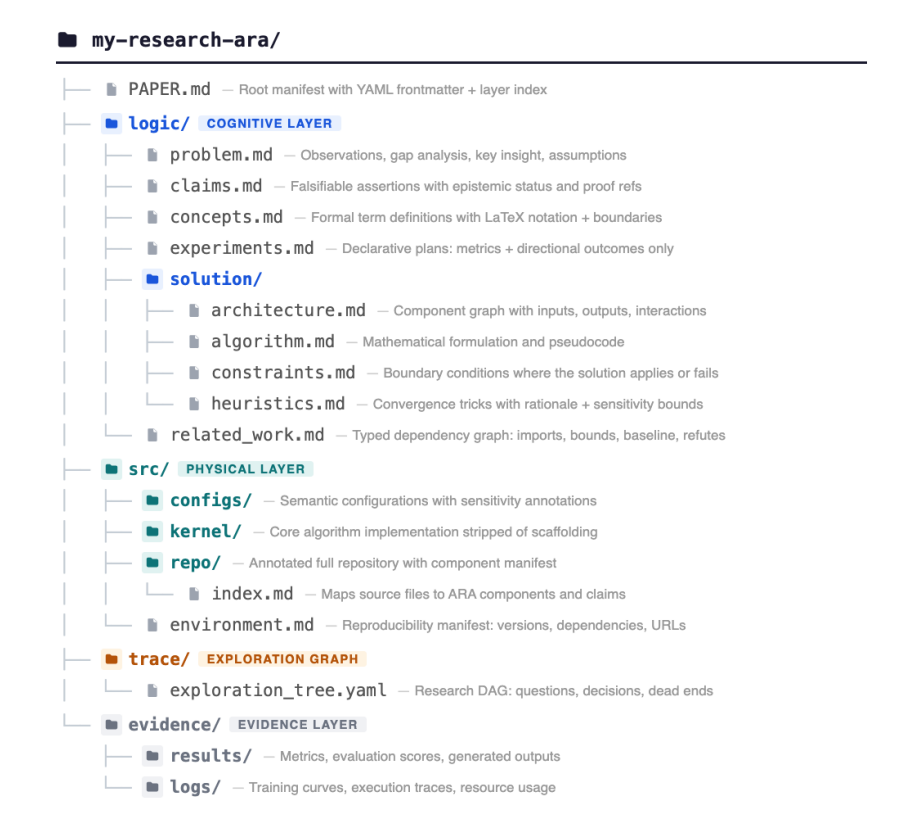
Addressing the pain point that traditional PDF papers, designed for human reading, sacrifice trial-and-error records and code details, thus hindering AI's ability to reproduce and extend research findings, the research team proposed the Agent Native Research Artifact (ARA) protocol. ARA reconstructs papers into an agent executable package comprising four layers: scientific logic, executable code, an exploration graph preserving lessons learned from failures, and underlying evidence. This is further supported by three core mechanisms: a real-time research manager, a compiler, and a native review system. Experiments demonstrate that ARA significantly improved the AI agent's question-answering accuracy in benchmark tests, increasing it from 72.41 TP3T to 93.71 TP3T, and its reproduction success rate from 57.41 TP3T to 64.41 TP3T. ARA effectively eliminates narrative barriers in papers, allowing for the complete transfer of research experience and laying a solid foundation for an AI-driven research paradigm.
Paper and detailed interpretation:https://go.hyper.ai/fGwr7
7.Agent-as-a-Service
Paper title:
The End of Software Engineering: How AI Agents Are Fundamentally Restructuring the Software Paradigm
AI agents are fundamentally reshaping the software engineering paradigm. Large Language Models (LLMs), acting as inference engines, can dynamically generate and discard code, thus overcoming the complexity bottlenecks of traditional software and the limitations of human cognition. Software delivery models are evolving towards "Agent as a Service (AaaS)," giving rise to the entirely new discipline of "Agent Engineering." In this new paradigm, the role of humans is no longer that of code writers, but rather that of intent architects and agent coordinators. Although current benchmarks demonstrate the enormous potential of agents, they still face challenges in long-term, continuous system maintenance. To address these challenges, the authors ultimately propose a four-stage roadmap towards a self-evolving agent ecosystem.
Paper and detailed interpretation:https://go.hyper.ai/zrpkH
8.Memory Caching
Paper title:
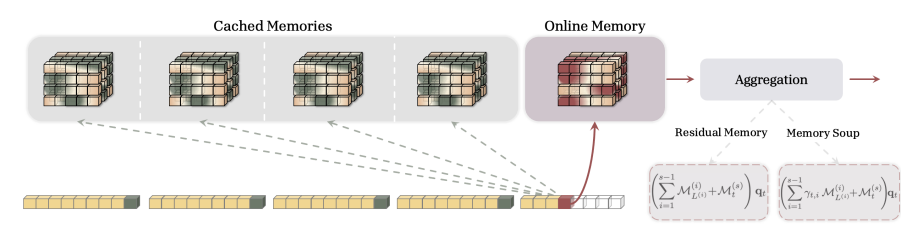
Memory Caching: RNNs with Growing Memory
A team from Google Research proposed the Memory Caching (MC) framework to address the limitations of Recurrent Neural Networks (RNNs) due to their fixed memory, which restricts the processing of long contexts and hinders recall. By segmenting sequences, caching memory state checkpoints, and combining four aggregation strategies—gating, sparse selection, etc.—MC allows the memory capacity of RNNs to dynamically increase with the sequence length, achieving a flexible trade-off between O(L) and O(L²) computational complexity. Experiments show that this technique significantly improves the performance of various RNN models in language modeling and long text retrieval, significantly narrowing the performance gap with Transformers while maintaining high efficiency.
Paper and detailed interpretation:https://go.hyper.ai/pYRGG
We also welcome research teams to submit high-quality results and papers to us. Those interested can add the NeuroStar WeChat (WeChat ID: Hyperai01).
See you next week!