Command Palette
Search for a command to run...
MiniMax H3 Breaks Through the Boundaries of Video Generation, Generating Audio and Video Content in an Integrated Manner; Ornith-1.5-35B-A3B Explores a New Mode of self-evolutionary Training for Inference models.

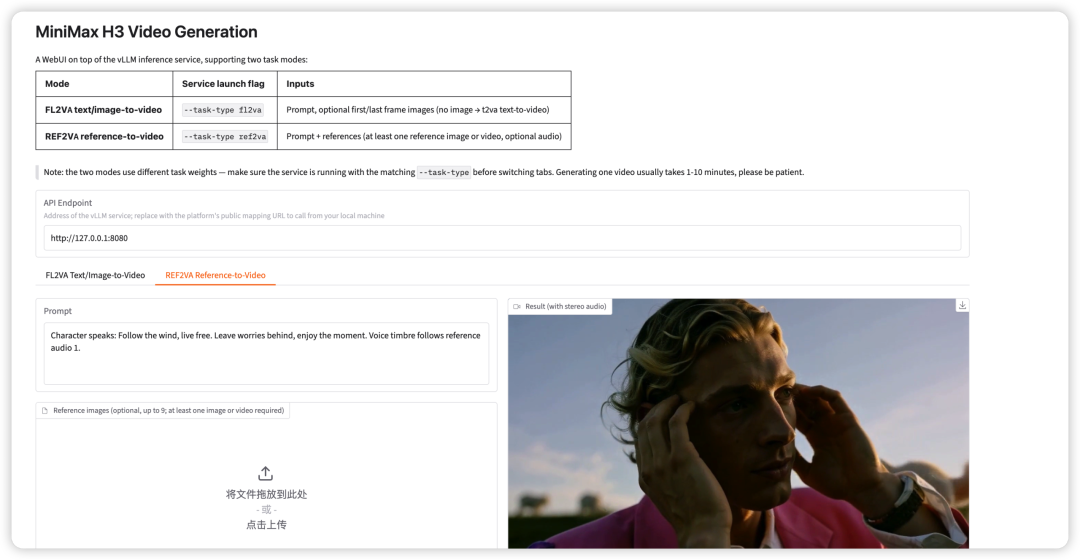
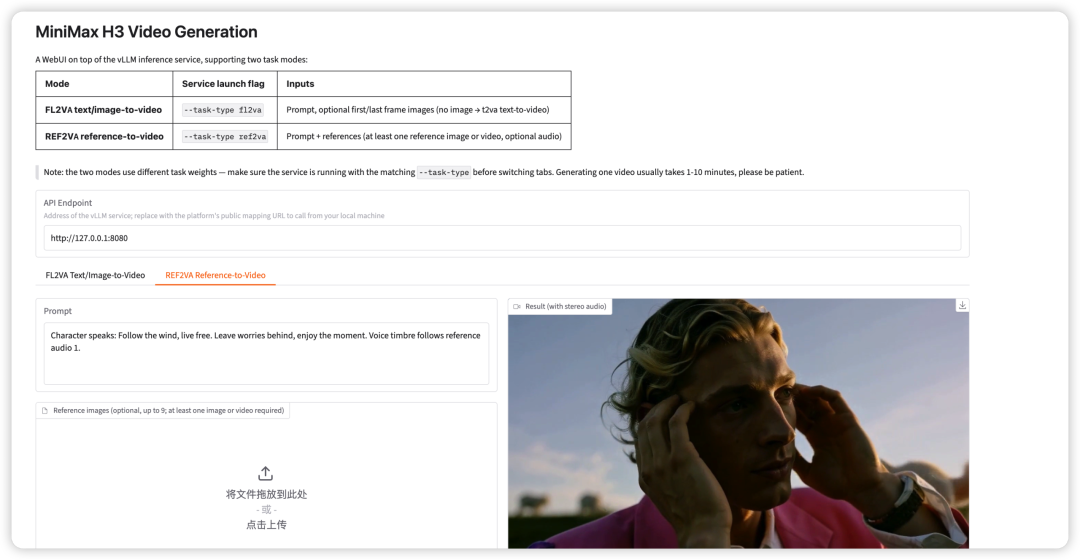
**MiniMax H3 is a general-purpose full-modal generative model launched by MiniMax.**This allows the model to move from "understanding content" to "unified generation".**It can simultaneously process complex inputs such as text, images, video, and audio, and directly generate videos based on multimodal context.**It supports up to 2K resolution, 24 FPS, and a duration of 15 seconds. Unlike traditional video generation models that focus on a single task, H3 unifies text-generated video, image-generated video, reference-generated video, and video editing capabilities into a single model. It also employs a joint audio-visual generation mechanism to generate visuals, audio, sound effects, and music in a single process. In practical applications, the model further enhances its capabilities in following complex instructions, rendering text and brand logos on screen, and video motion transfer, providing a more complete generation solution for advertising, brand content, and multimodal creation.
The "MiniMax H3: Full-Modal Video Generation Model" is now available on the HyperAI website. Give it a try!
A quick overview of hyper.ai's official website updates from August 21st to August 27th:
* Selected high-quality tutorials: 2
* Community article analysis: 2 articles
* Popular encyclopedia entries: 5
Top conferences with September deadlines: 6
Visit the official website:hyper.ai
Selected Public Tutorials
1. MiniMax H3: A Full-Modal Video Generation Model
MiniMax H3 is a general-purpose, multimodal generative model released by MiniMax in July 2026. It can jointly understand complex multimodal contexts such as text, images, video, and audio, and directly generate videos up to 2K resolution, 24 FPS, and 15 seconds long. The model features four key characteristics: multimodal understanding, integrated audio-visual generation, unified task design, and commercial-grade output quality. It supports tasks such as text-generated video, image-generated video, reference-generated video, and video editing, and can generate video footage, 32kHz stereo audio, speech, sound effects, and music in one go.
Run online:https://go.hyper.ai/mQAmh
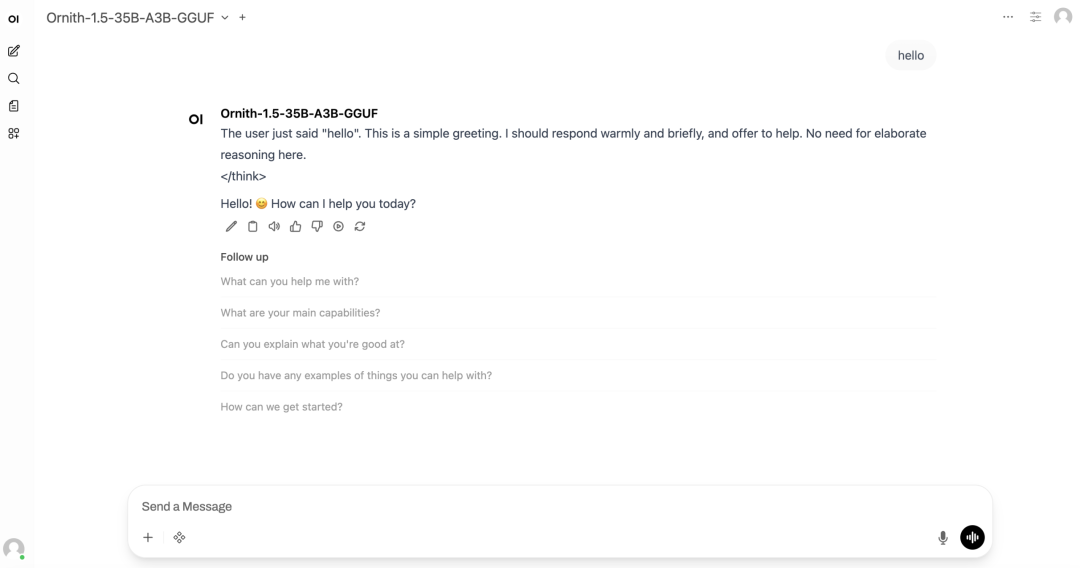
Ornith-1.5-35B-A3B-GGUF is a quantized version of the self-evolving MoE inference model GGUF, released by ornith-ai in February 2026. Based on the Qwen3.5/Gemma4 architecture, the model employs a complete training pipeline of continuous pre-training, mid-training, and post-training, and constructs an end-to-end self-improvement loop, continuously enhancing model capabilities through "task generation → Scaffold construction → Rollout joint optimization." Unlike traditional training methods that rely on fixed manual task sets, Ornith-1.5-35B-A3B can autonomously generate training tasks and iteratively optimize, providing a new technical path for the self-evolving training of inference models.
Run online:https://go.hyper.ai/WCZQo
Community article interpretation
1. 27B AI's ability to reproduce scientists' papers surpasses GPT-5.5/Claude Opus 4.8; Faraday explores long-term scientific innovation.
Paper reproducibility faces three major challenges: incomplete information, open-ended exploration, and a lack of explicit reward functions. Inherent Labs has launched Faraday, an AI scientist agent that uses LLM-driven paper reproducibility and outperforms Claude Opus 4.8 and GPT-5.5 on multiple tasks. With only 27 billion parameters, Faraday can effectively guide models with 5 trillion parameters, demonstrating stronger scientific research capabilities.
Run online:https://go.hyper.ai/OY0zO
2. Covering 11 disciplines and 60 research tasks, Tsinghua University, MIT, Harvard, and others have proposed the ASI-Bench to test AI's independent research capabilities.
With the rapid development of large language models and intelligent agent technologies, AI is gradually moving from assisting scientific research to autonomous research. However, existing benchmarks mostly focus on knowledge-based question answering or executing predetermined processes, making it difficult to determine whether AI truly possesses the ability to independently design research solutions. To address this, more than ten institutions, including Tsinghua University, MIT, Harvard University, CMU, and Microsoft Research, jointly launched ASI-Bench, built by over 40 experts with a cumulative investment of over 31,000 hours. This benchmark evaluates AI's research performance from explicit guidance to complete autonomy by progressively reducing the methodological information provided by humans, focusing on measuring its ability to autonomously explore, design solutions, and solve open-ended scientific problems.
Run online:https://go.hyper.ai/vzWBd
Popular Encyclopedia Articles
1. Optical Character Recognition (OCR)
2. World Action Model WAM
3. Remote Sensing
4. Glitch Token (a term used to describe a glitch-related term)
5. Generative Pre-trained Transformation Model (GPT)
Here are hundreds of AI-related terms compiled to help you understand "artificial intelligence" here:
The above is all the content of this week’s editor’s selection. If you have resources that you want to include on the hyper.ai official website, you are also welcome to leave a message or submit an article to tell us!
See you next week!