Command Palette
Search for a command to run...
From Code Development to Automated Execution, Muse-Glimmer-30B Makes Local Agents More Powerful; Qwen3.8-27B-FP8 Released, Pushing the Limits of Efficient Inference With 27 Billion parameters.

**Muse-Glimmer-30B, developed by Meta Superintelligence Labs, is a 30 billion-parameter causal language model designed for agent-based tasks.**By incorporating Muse Spark distillation and a dedicated perceptual encoder design, multi-step inference, tool invocation, multimodal understanding, and task recovery capabilities into a single model. The model can complete long-cycle tasks locally without relying on cloud infrastructure or network connectivity, demonstrating strong performance in benchmarks such as DeepSearch QA, MCP-Atlas, and SWE-Bench. Furthermore, the Muse-Glimmer-30B supports interleaved text and image input, can understand complex information such as screenshots, charts, and documents, and features optimized tool invocation capabilities for intelligent agent frameworks, providing new solutions for local AI assistants, code-based intelligent agents, and multimodal applications.
The HyperAI website now features "Muse-Glimmer-30B: A Multimodal Visual Language Model." Give it a try!
Online use:https://go.hyper.ai/iuoeS
A quick overview of hyper.ai's official website updates from August 14th to August 20th:
* High-quality public datasets: 3
* A selection of high-quality tutorials: 18
* Community article analysis: 1 article
* Popular encyclopedia entries: 5
Visit the official website:hyper.ai
Selected public datasets
1. MatrAIx Persona 1M Portrait Dataset
MatrAIx Persona 1M is a persona dataset released by MatrAIx, designed to provide fine-grained and diverse persona data for scenarios such as synthetic data generation, crowd modeling, personalized dialogue, simulation, and evaluation. The dataset contains 999,847 personas, of which 599,847 are derived from real-world records, and 400,000 are fully DAG-based composites. Each persona is described by 1,290 categorical attributes, covering dimensions such as demographics, language, profession, skills, personality, values, interests, behavior, health, and developer characteristics. Records of individuals under 18 years of age have been removed.
Online use:https://go.hyper.ai/e4BKj
2. Vehicle-Level Temporal Image Sequences dataset
Vehicle-Level Temporal Image Sequences is a dataset of vehicle image sequences designed to provide standardized data for research on dangerous driving behavior recognition (aggressive braking, forced entry, sudden braking, and weaving) and vehicle-level video temporal classification. It primarily supports research in intelligent transportation systems, advanced driver assistance systems (ADAS), and class imbalance learning. The dataset contains 434 vehicle-level temporal image sequences, covering both normal and dangerous driving behaviors. It is organized according to 94 internally labeled source video groups, with each sequence corresponding to a tracked vehicle and accompanied by a behavior label metadata file.
Online use:https://go.hyper.ai/e5TRV
3. Dual-modal Roadside Traffic Target Detection Dataset
Dual-modal Roadside Traffic is a dual-modal roadside traffic target detection dataset. It collects roadside traffic data using spatially calibrated, temporally synchronized RGB and event cameras, aiming to provide standardized data support for RGB and event multimodal fusion, event camera perception, and robust traffic scene understanding under adverse lighting and motion conditions. The dataset consists of aligned data and raw data. Each sample in the aligned data contains three modalities: spatially and temporally corresponding RGB images, event representations, and target annotations, and is further divided into training, validation, and test sets.
Online use:https://go.hyper.ai/bby5e
Selected Public Tutorials
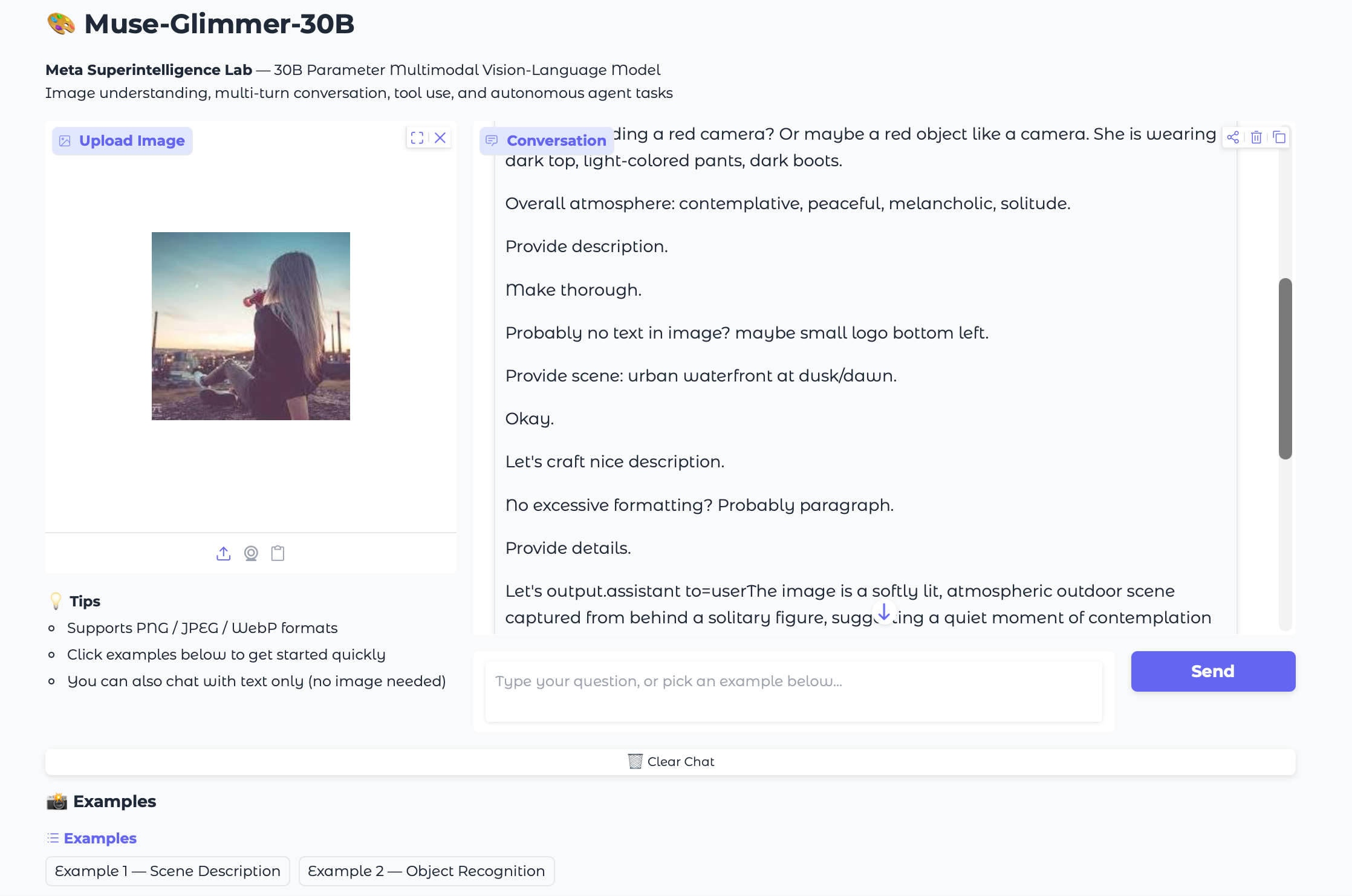
1. Muse-Glimmer-30B: A Multimodal Visual Language Model
Muse-Glimmer-30B is a 30 billion parameter local agent model launched by Meta Superintelligence Lab. Based on Muse Spark distillation and equipped with a dedicated perceptual encoder, it integrates multi-step inference, tool invocation, multimodal understanding, and task recovery capabilities. The model can perform complex agent tasks on consumer-grade hardware without relying on cloud services, and supports multimodal information understanding such as screenshots, documents, and charts, providing new options for local AI assistants, code development, and automation tasks.
Run online:https://go.hyper.ai/iuoeS
Datamol is an open-source molecular processing library developed by the Hadrien Mary/Valence Discovery team. Built on RDKit, it aims to simplify cheminformatics workflows. This tool provides a concise and easy-to-use Python API, encapsulates common molecular operations, and supports automated parallel computation, efficient file processing, and large-scale molecular data processing. Datamol can be widely used in scenarios such as virtual screening, drug discovery, molecular data cleaning, cheminformatics analysis, and visualization.
Run online:https://go.hyper.ai/jf67y
3. AI for Beginners: An Introduction to Artificial Intelligence Tutorial Series
Microsoft AI for Beginners is a systematic artificial intelligence learning course for beginners, consisting of 12 weeks and 24 lessons, covering a complete knowledge system from traditional symbolic AI to modern deep learning. The course combines practical examples and quizzes with Jupyter Notebook, covering core areas such as neural networks, computer vision, natural language processing, and reinforcement learning, and provides runnable code based on PyTorch and TensorFlow. It is suitable for AI self-study, university teaching support, and enterprise technical training.
Run online:https://go.hyper.ai/Ms9so
4. Introduction to Text Preprocessing
This tutorial systematically introduces the text preprocessing workflow in NLP tasks, covering key techniques from raw text cleaning to standardization. The course focuses on reducing text noise and improving model input quality, explaining in detail 17 commonly used methods, including case conversion, punctuation and stop word removal, stemming, lemmatization, emoji and URL processing, HTML cleanup, chat language conversion, and spell checking, helping learners build higher-quality text data processing workflows.
Run online:https://go.hyper.ai/SfMvS
5. Speech Representation and Data Exploration
This tutorial is based on the TensorFlow Speech Recognition Challenge practical case released by Kaggle author DavidS, using the Speech Commands v0.01 dataset for speech recognition analysis. The course focuses on speech classification tasks, introducing methods from raw waveforms and spectrograms to visualization of MFCC features, and covers processes such as silence detection, audio cropping, downsampling, feature extraction, and statistical analysis of data distribution. It is suitable as an introductory tutorial for speech command recognition, audio feature engineering, and exploratory analysis of speech data.
Run online:https://go.hyper.ai/ndnf9
6. Recommendation candidate re-ranking based on RAPIDS and manual rules
Candidate ReRank Model is a recommendation system solution released by Kaggle Grandmaster Chris Deotte in November 2022, built on data from the OTTO Recommender System competition. This model combines GPU-accelerated co-occurrence matrix calculation with a manual rule-based re-ranking strategy. It efficiently generates user behavior association features on the GPU using RAPIDS cuDF and designs ranking rules based on historical behaviors such as clicks, adding to cart, and purchases to achieve accurate recommendations for candidate products. This solution is suitable for e-commerce recommendations, conversational recommendation systems, and large-scale user behavior data analysis.
Run online:https://go.hyper.ai/fAIYz
7. Introduction to Sound Event Detection: AudioSet Pre-trained Model Based on PANNs
This tutorial introduces the basic concepts and practical methods of Sound Event Detection (SED). Unlike sound classification, which only determines audio category, SED can identify sound events in audio and pinpoint their start and end times. The course is based on pre-trained audio neural networks (PANNs) and utilizes a CNN14 model trained on large-scale audio data from AudioSet to achieve frame-level sound prediction and weak label detection. It can be applied to scenarios such as urban noise monitoring, industrial anomaly detection, bioacoustic analysis, and smart home sound recognition.
Run online:https://go.hyper.ai/HOoPr
8. XGBoost Starter – Credit Card Default Prediction Tutorial
The AMEX Default Prediction credit card default prediction solution is built upon Kaggle user Chris Deotte's XGBoost Starter Notebook, achieving a CV score of 0.792 and a LB score of 0.793 in the competition. The solution revolves around feature engineering, model training, and prediction. It generates statistical features by aggregating historical user data, leverages XGBoost's GPU-accelerated training and five-fold cross-validation to improve efficiency, and combines AMEX's proprietary evaluation metrics to optimize model performance. This method is applicable to machine learning prediction tasks such as financial risk control and credit assessment.
Run online:https://go.hyper.ai/Jkrtu
9. Introduction to Computer Vision: From CNN Principles to Practical Image Classification
Intro-Computervision is an open-source computer vision project by Cezanne Camacho, released under the MIT License. It systematically explains the principles of Convolutional Neural Networks (CNNs) for deep learning beginners. The project uses visualizations to demonstrate how operations such as convolution and pooling extract image features, and provides an image classification exercise using the FashionMNIST dataset as an example. The content covers the complete process from data loading and model training to performance evaluation, making it suitable for computer vision learning, course instruction, and as a basic introduction to object detection and image segmentation.
Run online:https://go.hyper.ai/rRCrg
10. Breast Cancer Risk Prediction: A Practical Machine Learning Tutorial Series
Breast Cancer Risk Prediction is a machine learning diagnostic project built on the Wisconsin Breast Cancer Diagnostic dataset from the UCI Machine Learning Repository, released by Jean Njoroge. The project achieves a diagnostic accuracy exceeding 981 TP3T by comparing various machine learning classification algorithms and optimizing hyperparameters using GridSearchCV. It covers the entire process from data loading, exploratory analysis, model building, evaluation, and optimization, using 30 features extracted from cell nucleus images to predict breast cancer risk, providing a reference for medical data analysis and machine learning practice.
Run online:https://go.hyper.ai/fE5ti
11. TileLang Puzzles: Learn GPU Kernel Programming with 10 Puzzles
TileLang is a high-performance GPU kernel programming domain-specific language (DSL) developed by the Tile-AI team, designed to lower the barrier to entry for GPU kernel development. TileLang Puzzles guide learners through 10 progressively challenging exercises, starting with basic copy operations and gradually mastering modern GPU kernel programming methods such as GEMM and FlashAttention. It provides the `@tilelang.jit` decorator and advanced operators such as `T.copy`, `T.gemm`, and `T.Parallel`, simplifying low-level thread scheduling and memory management, making it suitable for beginners in GPU programming and high-performance computing.
Run online:https://go.hyper.ai/1UJuc
12. Train YOLOv8 using custom data
YOLOv8, released by Ultralytics in January 2023, is a unified vision model that supports four tasks: object detection, instance segmentation, pose estimation, and image classification. The model utilizes the Ultralytics Python API and YOLO CLI to unify the training, validation, inference, and model export processes, making it more convenient to use. Its architecture incorporates a C2f backbone module, an anchor-free decoupled detection head, and stops Mosaic data augmentation at the end of training, improving performance on vision tasks while maintaining efficient inference.
Run online:https://go.hyper.ai/k5x7O
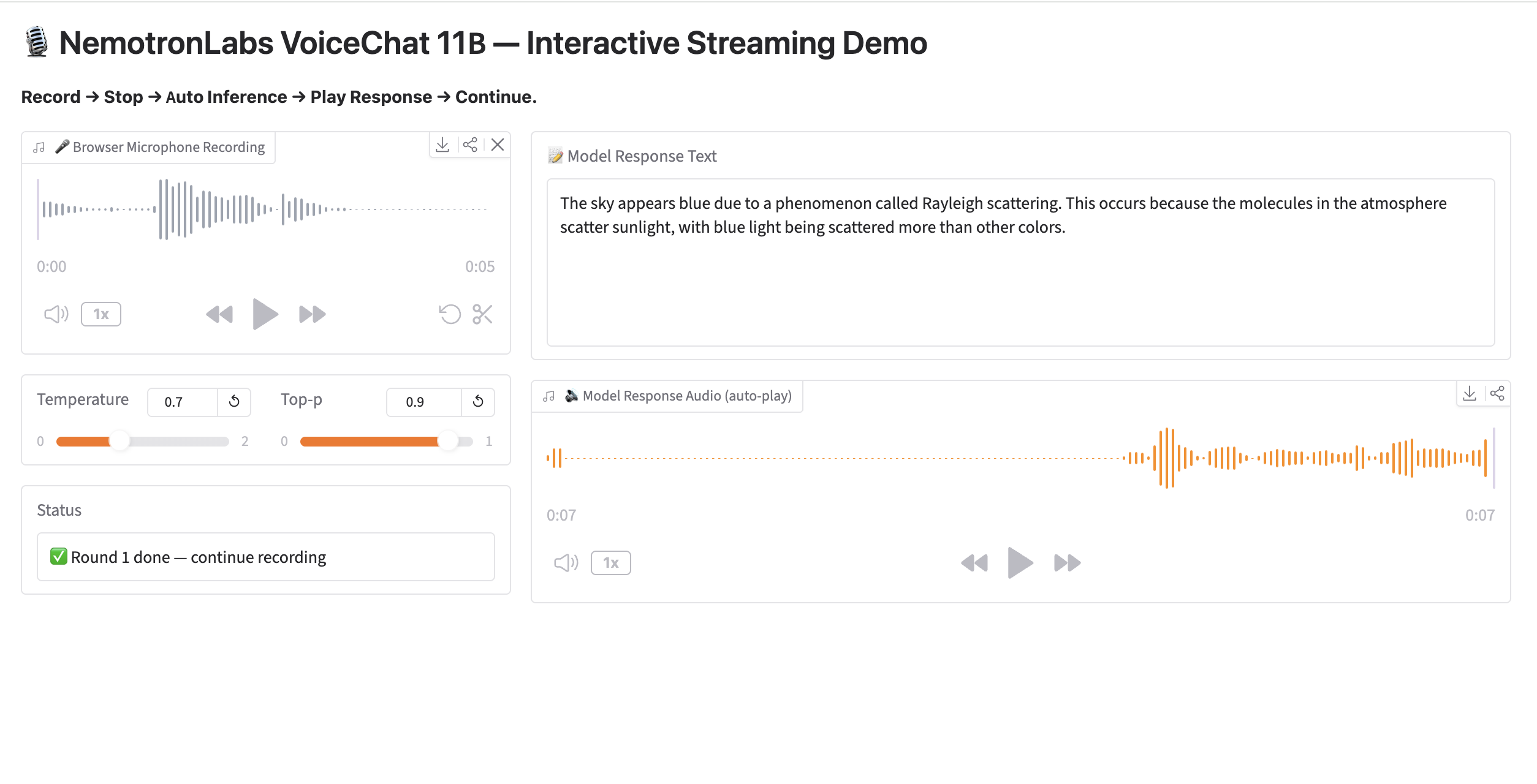
13. NVIDIA NemotronLabs VoiceChat 11B: End-to-end real-time full-duplex voice dialogue model
NVIDIA NemotronLabs VoiceChat is an end-to-end full-duplex speech model with 11 billion parameters. It uses a unified architecture to achieve real-time speech understanding and generation with a response latency as low as approximately 450 milliseconds. The model supports natural interruption, turn-based dialogue, and voice function calling, breaking through the limitations of traditional ASR+LLM+TTS workflows. It can be used in real-time interactive scenarios such as intelligent assistants and voice agents.
Run online:https://go.hyper.ai/hW6ZK
Qwen3.8-27B-FP8 is a compact flagship model in the Qwen3.8 series launched by the Alibaba Cloud Tongyi Qianwen team. Built on the Qwen3.5 architecture, it integrates native visual language capabilities and a parameter scale of 27 billion. With the support of FP8's fine-grained quantization, the model maintains performance close to the BF16 version while significantly reducing GPU memory usage, making it suitable for multi-GPU deployments. The model supports ultra-long context, multimodal understanding, flexible inference control, and tool calls, and can be used for code development, professional task processing, scientific research analysis, and complex agent workflows.
Run online:https://go.hyper.ai/2c0bx
15. IEEE-CIS Fraud Detection: Complete Exploratory Data Analysis (EDA)
The IEEE-CIS Fraud Detection is a classic Kaggle competition in financial risk control, focusing on online transaction fraud detection. This task requires handling high cardinality of class features, extreme class imbalances, and time-series information within massive datasets exceeding 7GB, and evaluating the model's ranking ability using the AUC-ROC metric. The methods can be transferred to real-world business scenarios such as payment security and risk control, and it is a classic case study in learning imbalanced classification and financial data analysis.
Run online:https://go.hyper.ai/KDfkP
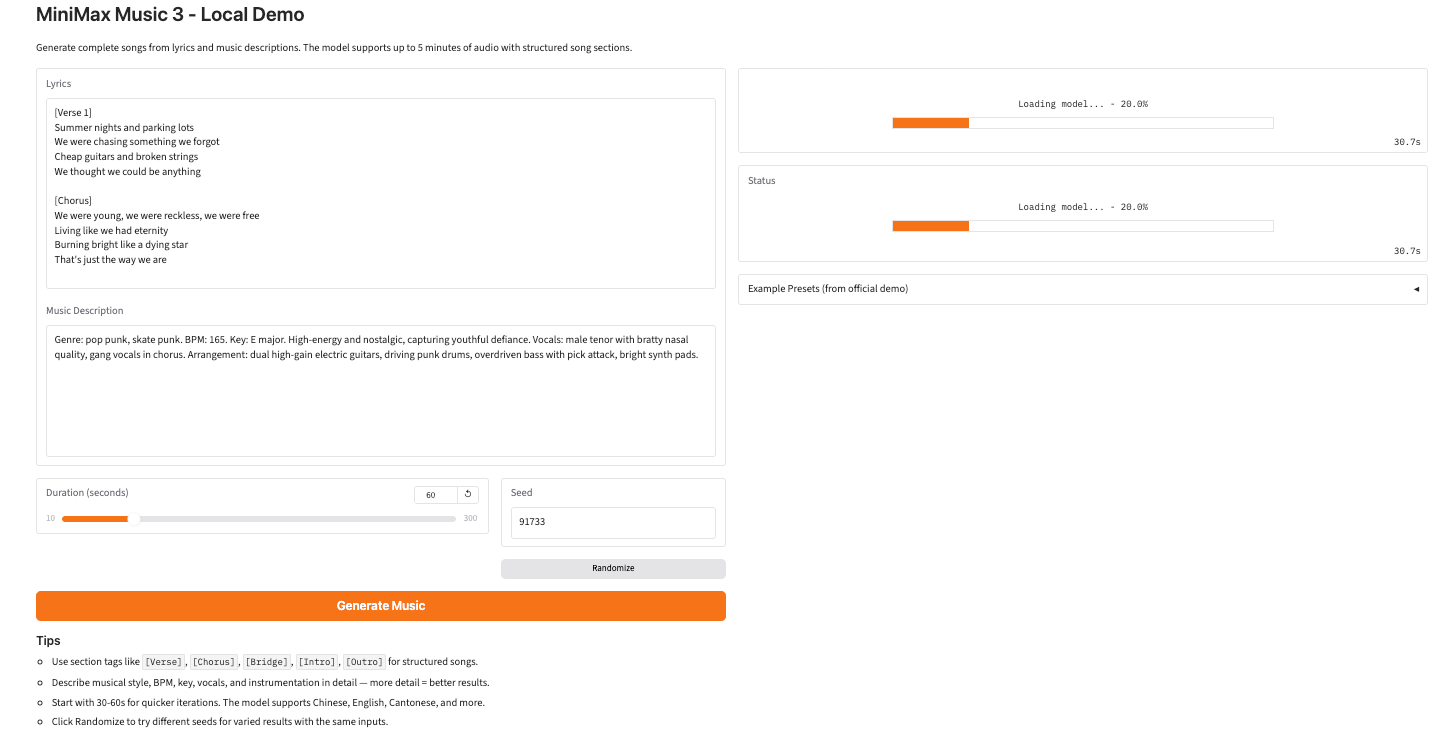
16. MiniMax Music 3: A music generation model based on lyrics and musical descriptions
MiniMax Music 3, launched by the MiniMax team in August 2026, is a text-based music generation model that can automatically create complete songs up to 5 minutes long based on lyrics and musical descriptions. The model employs a multi-component generation architecture, combining Qwen3-8B long-range structure modeling, Flow Matching Transformer, and Flow-VAE vocoder to achieve expressive vocals, dynamic arrangements, and stable long audio quality. Supporting 32kHz dual-channel output, it can be widely used in song creation, background music generation, and AI music research.
Run online:https://go.hyper.ai/U52vp
This tutorial, originating from the DigitalOcean Community and written by Adil Lheureux, builds a weather forecasting model based on LSTM (Long Short-Term Memory) networks. Using historical meteorological data from Jena, Germany, the tutorial predicts temperature changes over the next 6 hours using six features: temperature, air pressure, humidity, vapor pressure, wind speed, and air density, based on data from the past 72 hours (432 records). This case study is suitable as an introductory practice in time series forecasting and can be applied to short-term weather forecasting, meteorological data analysis, and other scenarios.
Run online:https://go.hyper.ai/ONbnQ
18. Introductory Tutorial on Geometric Graph Neural Networks
Geometric Graph Neural Networks (GNNs) are an important direction in the field of geometric deep learning, aiming to improve the model's ability to understand spatial relationships by designing network structures that satisfy the inherent symmetry and invariance of data. This tutorial is based on the geometric-gnn-dojo project by Chaitanya K. Joshi et al. at the University of Cambridge. It uses PyTorch Geometric (PyG) to practice invariance and isovariance verification, and combines geometric information such as molecular 3D coordinates and distances to construct a high-performance graph neural network. This method can be applied to scenarios such as molecular property prediction, drug development, material structure analysis, and 3D point cloud modeling.
Run online:https://go.hyper.ai/r9stc
Community article interpretation
1. Analysis efficiency improved by over 200 times! Argonne National Laboratory proposes a nanobeam diffraction analysis method based on unsupervised training, enabling DONUT to accurately extract material features.
DONUT (Diffraction with Optics for Nanobeam by Unsupervised Training) is an unsupervised physical sensing neural network proposed by a team at Argonne National Laboratory, U.S. Department of Energy, for the rapid analysis of scanning X-ray diffraction microscopy (SXDM) data. This method requires no labeled data or pre-trained models and can automatically separate the coupling relationship between beam shape and local lattice information, overcoming the limitations of traditional fitting methods such as high computational cost and reliance on preprocessing. Experiments show that DONUT can accurately extract nanoscale structural features, with an analysis efficiency more than 200 times higher than traditional methods, providing a new intelligent solution for material structure characterization.
Run online:https://go.hyper.ai/I00f5
Popular Encyclopedia Articles
1. Optical Character Recognition (OCR)
2. World Action Model WAM
3. Remote Sensing
4. Glitch Token (a term used to describe a glitch-related term)
5. Generative Pre-trained Transformation Model (GPT)
Here are hundreds of AI-related terms compiled to help you understand "artificial intelligence" here:
The above is all the content of this week’s editor’s selection. If you have resources that you want to include on the hyper.ai official website, you are also welcome to leave a message or submit an article to tell us!
See you next week!