Command Palette
Search for a command to run...
From Molecular Dynamics to Fluid Motion, MIT and Others Have Proposed WorldParticle, Modeling Six Types of Physical Processes With a Unified Framework
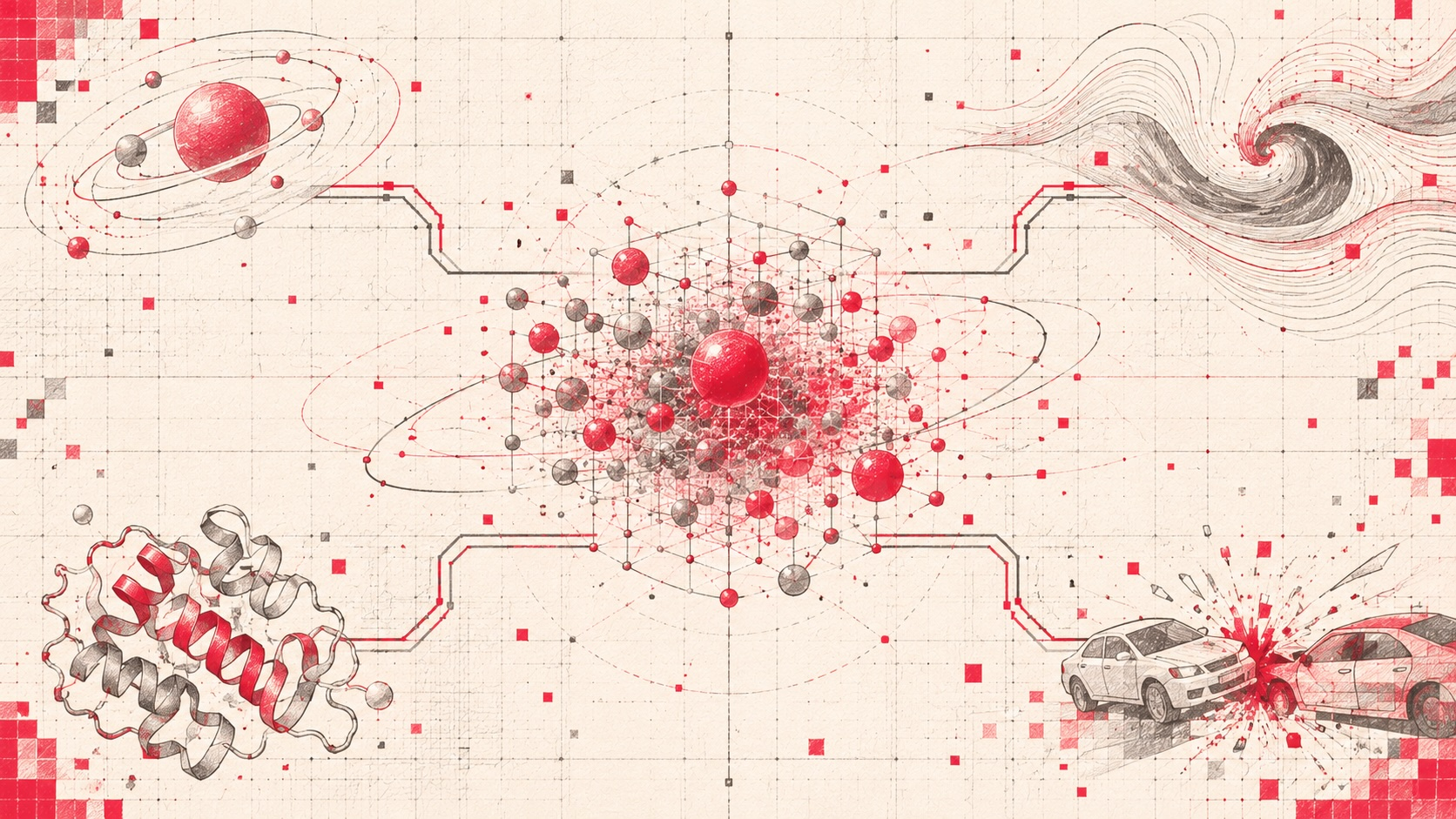
From the folding of small protein molecules to the collision-induced deformation of vehicles in motion; from dams resisting torrents and sand/gravel erosion to celestial motion in the vast universe... The motion of matter has never been merely visible phenomena such as displacement, flow, collision, and deformation; behind it lie deeper underlying physical laws that sustain the operation of life and materials. The advent of simulation technology has allowed scientists and engineers to break free from the limitations of physical experiments. By reproducing various physical processes in digital space, they can understand these complex physical processes spanning from the microscopic to the macroscopic. Many experiments that were originally difficult to conduct have thus become possible, the cost of scientific trial and error has greatly decreased, and research efficiency has greatly improved.
However, the field of simulation has long faced a barrier: different physical phenomena correspond to completely different modeling approaches. For example, fluid simulation usually uses Eulerian grids, while elastic solids rely on Lagrangian meshes and the finite element method (FEM); at the same time, the governing equations also form separate systems, covering the Navier-Stokes equations, nonlinear constitutive laws, granular rheology models, and so on. This "one type of physics, one solver" paradigm makes it difficult to directly handle scenarios in the real world where multiple physical processes are coupled together, and it also raises the threshold for research on cross-physics problems.
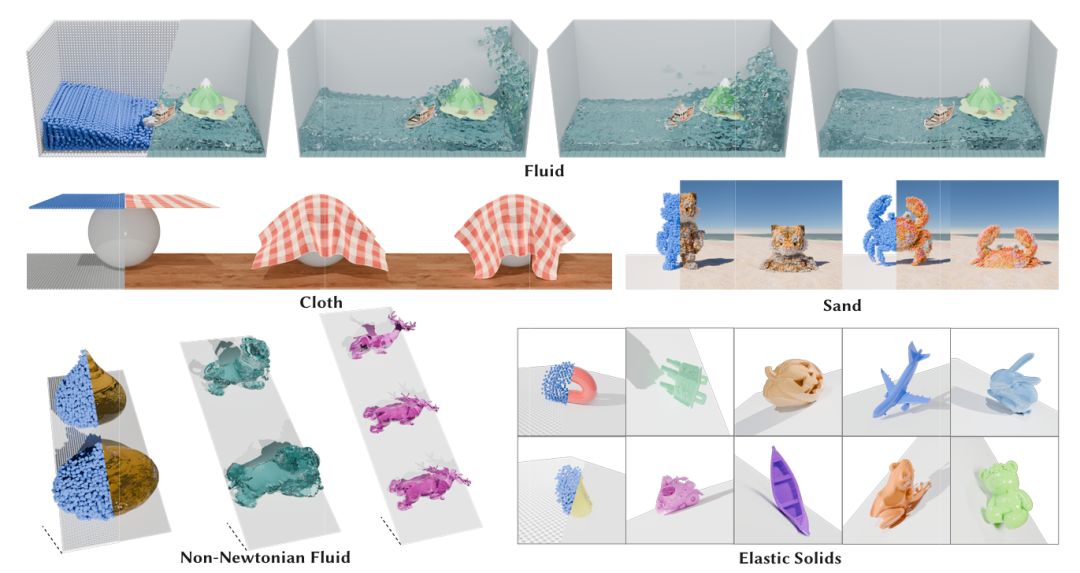
To build a unified simulation framework compatible with diverse physical processes, a research team from MIT, the University of British Columbia (UBC), and several other universities and research institutions proposed WorldParticle — a Transformer deep learning framework based on Lagrangian particle representation and using a prediction-correction process. It breaks away from the conventional "one physics, one solver" mindset. There is no need to redesign the network for different physical processes; by simply changing the training data and training independent weights according to the task, it can simulate six completely different physical processes under a unified architecture: cloth, elastic solids, granular materials, molecular dynamics, Newtonian fluids, and non-Newtonian fluids.
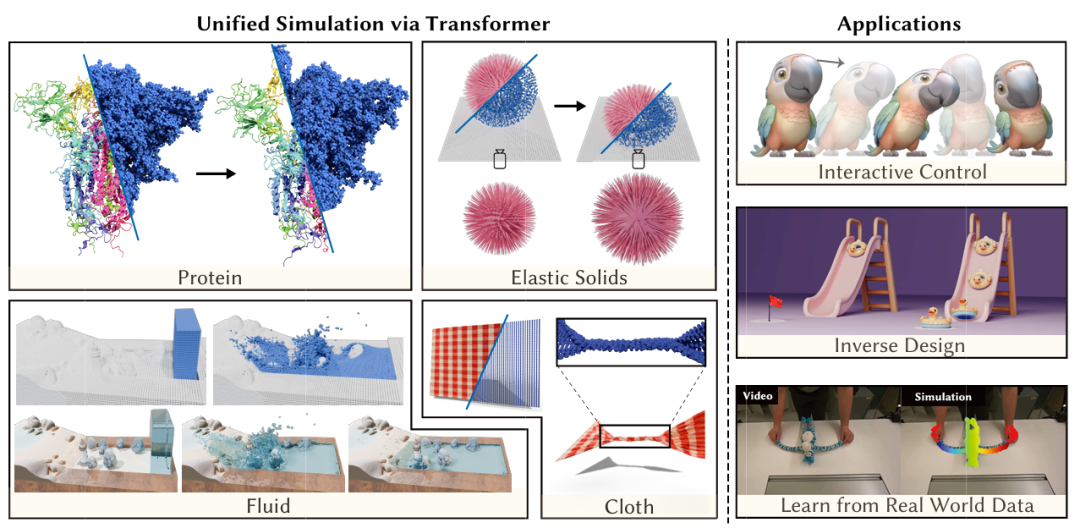
The related work, titled "WorldParticle: Unified World Simulation of Lagrangian Particle Dynamics via Transformer," was published on the arXiv preprint platform.
Research highlights:
-
A particle-based prediction-correction Transformer framework that can uniformly simulate six different types of physical processes, covering cloth, elastic solids, granular materials, molecular dynamics, Newtonian fluids, and non-Newtonian fluids
-
A particle tokenizer models local neighborhood interactions, paired with a super-token encoder-decoder, and relies on progressive token merging to achieve global information interaction while reducing computational overhead
-
On six types of physical tasks, compared with existing methods, WorldParticle has lower rollout error and more stable long-horizon prediction; it also supports three major applications: interactive control, inverse design, and real-world operation prediction

Paper URL:
https://hyper.ai/papers/2605.15305
Building independent datasets for six categories of particle dynamics
For the six categories of particle dynamics, the research team used traditional, mature simulation solvers to generate data for training separate models. Specifically:
Newtonian fluids:
Simulated using the DFSPH solver in SPliHSPlasH. Inside a container of size 4 × 2 × 2 (x∈[−2, 2], y, z∈[−1, 1]), dam-break dynamics were simulated—the fluid interacts with two fixed rigid bodies: a small boat and an island. The time step is △t = 0.01 s, and each sequence is simulated for 600 frames. The dataset contains 200 sequences in total, including 160 training sequences, and 20 validation and 20 test sequences, respectively.
Cloth:
Trajectories were generated using the stiff-GIPC solver. A triangular mesh cloth with 4900 vertices was released from a height of 0.62 and fell onto a fixed sphere (radius 0.3, center height 0.3) above the ground (height -0.01). There are 90 frames in total, with △t = 0.02 s. The dataset contains 200 sequences in total: 160 training sequences, and 20 validation and 20 test sequences, respectively.
Sand particles:
Simulated using the MPM method in NVIDIA Newton. Each sequence is initialized from one of 20 preset mesh geometries, and 10,000 particles are sampled from voxels inside the geometry. Each sequence runs for 400 steps, with △t = 0.005, and each step contains 2 substeps. The dataset contains 400 sequences in total: 360 training sequences, and 20 validation and 20 test sequences, respectively.
Non-Newtonian fluids:
Also simulated using the MPM method in NVIDIA Newton. Fluid particles are uniformly sampled within 10 preset meshes and released from a height of z = 0.2. Each sequence has 250 frames, with △t = 0.01 s. The dataset contains 400 sequences in total: 360 training sequences, and 20 validation and 20 test sequences, respectively.
Elastic solids:
Simulation using the VBD solver in NVIDIA Newton. For each sequence, one of 10 tetrahedral mesh models is selected, with a randomly rotated initial pose and an initial velocity of 0. Each trajectory has 160 frames, △t = 0.005s, 80 substeps per frame, and 150 VBD iterations per substep. The dataset contains 400 sequences in total: 360 for training, and 20 each for validation and test.
Protein:
For proteins 1a62_A (about 2,000 atoms) and 16pk_A (about 6,000 atoms) from the ATLAS dataset, trajectories were generated using OpenMM. It should also be noted that, as a large-step single-step predictor, WorldParticle uses a fixed, larger △t to rapidly explore conformational changes and avoid the extremely long computation time of traditional molecular simulations. For each protein, 1,000 independent trajectories (with different initial states) are generated: 800 for training, and 100 each for validation and test.
Building a Unified Simulation Framework for Multi-Physics Motion with a Prediction–Correction Process
The study reviews three current mainstream routes for neural physics simulation: learning-based particle/mesh physics simulation (Learning-based physics simulation), reduced-order modeling and neural operators (Reduced-order modeling and neural operators), and Transformers in graphics and simulation (Transformers in graphics and simulation). Through comparison, the research team identified the shortcomings in existing routes, thereby establishing the innovative approach of this study.
Specifically, WorldParticle models the single-step solution of Lagrangian particle dynamics as two major stages: “prediction” and “correction.”
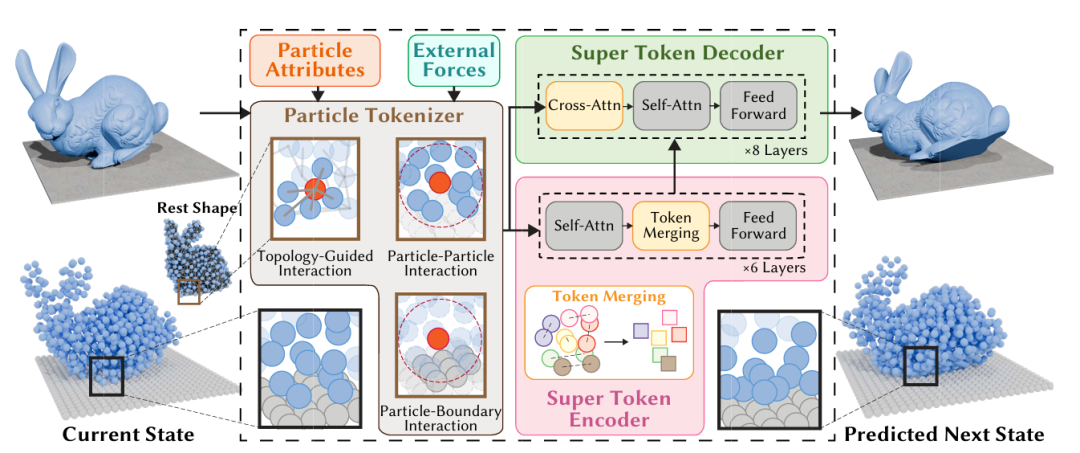
Prediction step: integrate the known external forces to obtain a rough intermediate state. This state is not an exact result, because the prediction step considers only the acceleration caused by external forces and does not include internal interactions such as tension, viscous forces, and elastic forces between particles; correction step: through the Transformer module, add correction terms for interactions between particles. The corrector consists of three components: particle tokenizer, super-token encoder, and super-token decoder.
The particle tokenizer is responsible for first encoding local interactions—encoding each particle and its surrounding neighbor information into tokens, capturing short-range local effects (inter-particle forces, boundary constraints when particles hit boundaries, and topological association information). It follows the locality principle of particle methods, i.e., interactions are computed only within a compact neighborhood, and distant particles do not directly affect each other. More importantly, the filter operator within the neighborhood is learned from data rather than predefined manually like an SPH kernel function, making it more flexible and better suited to different physical processes.
The super-token encoder is responsible for global information compression in subsequent global attention computation. Since the particle tokenizer only handles short-range local interactions, but many physical phenomena such as pressure waves, elastic stress, and molecular motion have long-range correlations, global information exchange is necessary; moreover, repeatedly performing self-attention directly on all particles incurs extremely high computational cost. Based on this, the research team draws on the idea of multi-grid hierarchical coarsening and uses the super-token encoder to alternately perform global self-attention at the current resolution and token merging, thereby efficiently modeling global long-range physical interactions with a decreasing set of tokens.
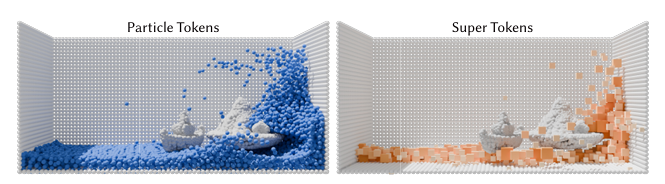
The super-token decoder is responsible for restoring the global information compressed by the encoder back to particle resolution through a cross-attention mechanism, predicting position and velocity corrections for each particle. During this process, particle tokens and position information from the tokenizer bypass the encoder and are fed directly into the decoder. In addition, all attention modules in the decoder are equipped with 3D RoPE positional encoding, residual connections, and feed-forward networks, thereby realizing a learnable coarse (super-token) to fine (particle) upsampling process—the weights computed by cross-attention act as dynamic interpolation coefficients, i.e., adaptively interpolating the global information in the coarse anchors (super-tokens) to each particle according to the current physical data.
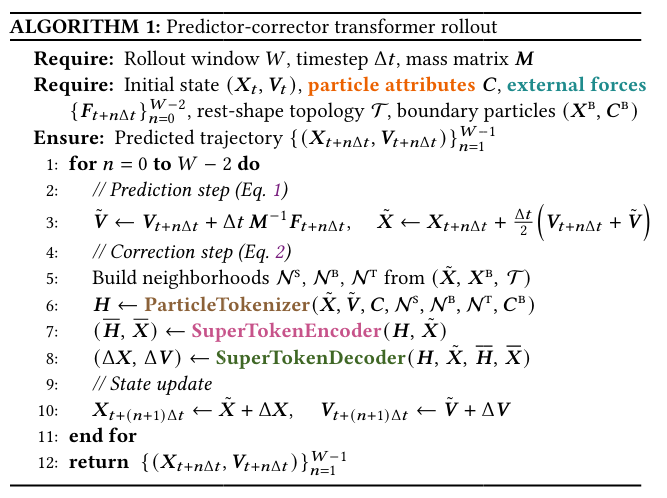
The research team adopts the same model architecture across all different categories of physical processes but trains a separate set of weights for each category, ensuring a fixed network structure and eliminating the need to redesign the network architecture for each specific task. Training was performed on 8 NVIDIA A100 GPUs, with 80 GB VRAM per GPU; the optimizer was AdamW. The final model has 156.73 million parameters.
“Coarse-to-Fine” Model Design Achieves Better Performance
The research team tested the model’s performance on 6 types of particle dynamics and set up multiple experiments:
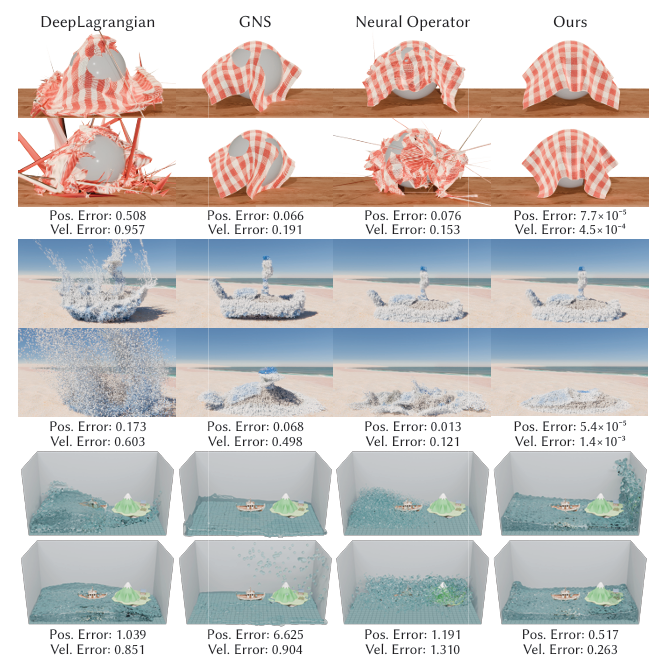
First, comparison with existing advanced neural simulators. On fluid, cloth, and sand tasks, the research team compared WorldParticle with GNS, DeepLagrangian, and Neural Operator. Results show that all baseline models produce artifacts during long-horizon rollout, such as floating sand particles, explosive distortion of cloth, and particles interpenetrating; WorldParticle maintains stable simulation, and the simulation results are highly consistent with the ground truth.
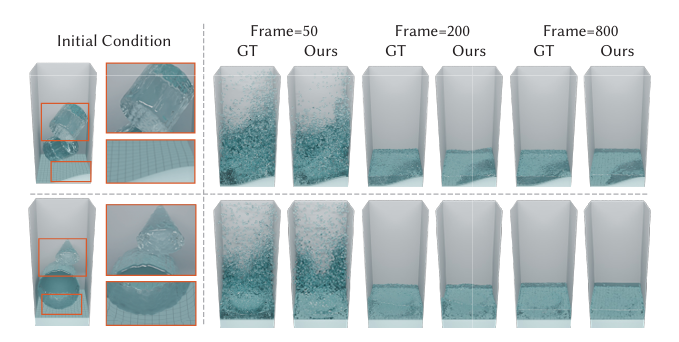
Then, generalization experiments verify whether the model can learn general physical laws. The research evaluated the model’s generalization ability from four dimensions: unseen initial and boundary conditions, long-horizon rollout beyond the training duration, unseen geometric shapes, and unseen particle sampling density.
Results under unseen initial and boundary conditions (figure below) show that the research team completed 800-frame rollout on test samples, remained stable throughout, and matched the ground truth well, capturing splash morphology, fluid-obstacle interaction, and long-term settling behavior, showing that WorldParticle can generalize to unseen initial and boundary conditions.
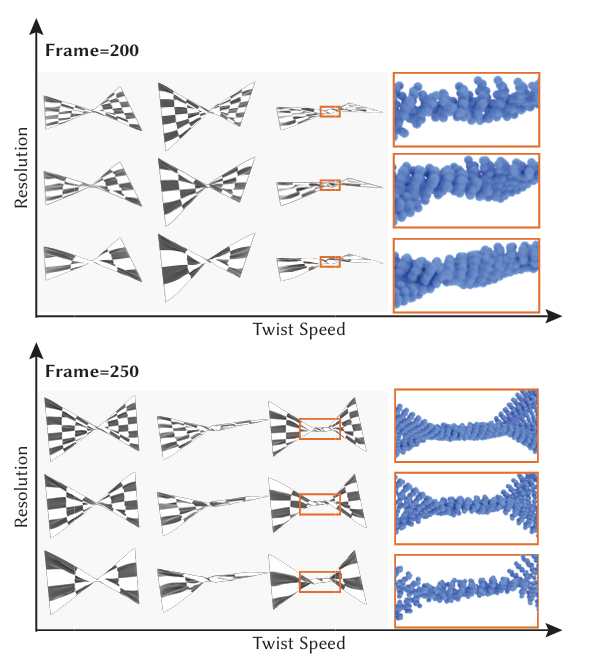
In the cloth twisting experiment (figure below), although the model was trained on 200-frame sequences, this experiment rolled out to 250 frames, meaning extrapolation beyond the training duration. Results show that the cloth can continuously accumulate torsional deformation without divergence, collapse, or particle penetration, producing coherent winding motion. This means the prediction-correction decomposition first outputs a reliable intermediate state from the prediction step, then hands it to the correction step for refinement, alleviating a recognized difficulty of autoregressive neural simulators—continuous error accumulation.
In unseen geometric shape validation (figure below), the model was trained only on simple geometries such as cylinders and cubes, but when a tiger-shaped sand pile appears, WorldParticle still stably predicts the beach collapse process and obtains physically plausible granular flow and spreading effects. This indicates that the model learns local interaction rules rather than memorizing trajectories of specific shapes. As long as the local neighborhood distribution of particles in the new geometry falls within the training distribution, the model can transfer. This conclusion is also verified in the cloth task.
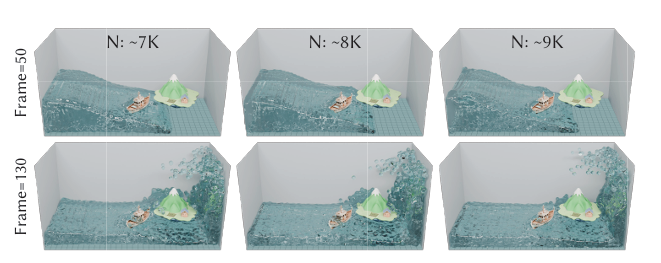
In unseen particle sampling density validation (figure below), tests were conducted on the fluid model; the model was trained with about 7000 particles, and testing changed the initial arrangement, increased the particle count, and used higher resolution. At all test densities, WorldParticle maintained stable rollout. The research infers that this robustness comes from the tokenizer using relative displacements, enabling the model to handle denser or sparser particle configurations than during training.
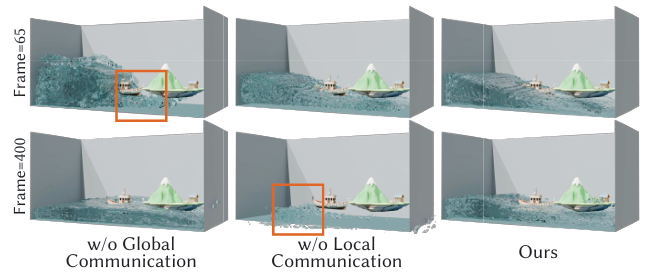
Next, ablation experiments verify the necessity of the core modules. The research team first examined the role of local and global information interaction on the fluid task (figure below), setting up local-only and global-only models. Results show that the local-only model cannot transmit long-range pressure information; the global-only model loses fine-grained local particle interactions, and error accumulates with rollout. The full model fusing both pathways generates the highest-accuracy rollout results.
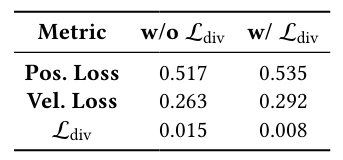
The research team then tested the effect of adding the divergence-free regularization term Ldiv to the physical loss Lphys on the fluid task (data in the table below). Results show that after adding Ldiv, divergence error decreases while trajectory accuracy remains basically at a similar level.
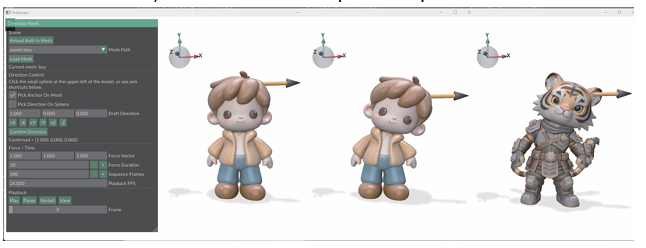
Finally, verify WorldParticle’s potential in downstream applications, including supporting interactive control, inverse design, and real-world operation prediction. The research team built a real-time interactive interface based on Polyscope, where users can apply external forces of arbitrary direction and magnitude at any position. Figure below:
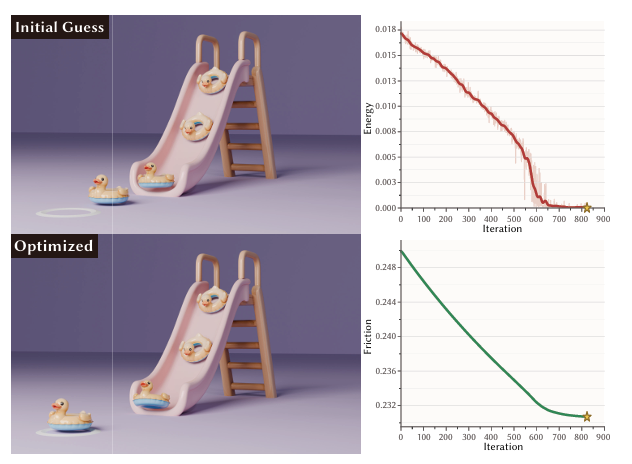
Gradients can be backpropagated along the neural rollout process, so WorldParticle can backpropagate gradients through the autoregressive rollout chain, thereby optimizing physical parameters. The experimental scenario is an inflatable mesh shaped like a duck sliding down a slope and gliding on the ground; the goal is to inversely solve for the friction coefficient μ so that the duck finally stops at a specified target. As shown below:
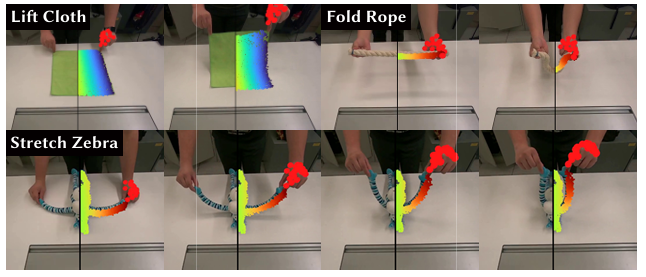
Because the model uses particle representations as input and output, it can be decoupled from traditional simulators and trained directly on real-world point cloud observations. The figure below shows three object manipulation sequences from the PhysTwin dataset, comparing real observations with model-predicted trajectories; the model rollout results are visually consistent with the real motion.
Final Thoughts
Overall, this single Transformer simulation framework based on particles and using prediction-correction handles both short-range interactions between particles and long-range global physical coupling with the same architecture. It is no longer constrained by fixed object shapes or preset boundaries, can adapt to various material forms such as cloth, fluids, and granular materials, and also supports real-time interactive manipulation, inverse design, and even learning object motion patterns directly from real-world point cloud observations, opening up richer application space for neural physical simulation.
Although this approach still has obvious bottlenecks, such as GPU memory overhead limiting the particle scale it can handle and the lack of additional physical information such as temperature and deformation history, it has undoubtedly planted the seeds of hope for physical simulation that is closer to the real world. With the continuous improvement of subsequent model design and hardware configurations, it may be expected to play a greater role in digital twin scenarios, such as simulating the impact of oil sloshing on elastic valves in storage tanks and studying the movement trajectories of soft robots when they contact granular materials, thereby truly enabling real industries to enjoy the value brought by digital twins.