Command Palette
Search for a command to run...
نماذج اللغة الكبيرة لا تستطيع القفز
نماذج اللغة الكبيرة لا تستطيع القفز
Tom Zahavy Oliver Nash
الملخص
كيف نكتشف أشياء جديدة بشكل جوهري؟ في رسالة إلى موريس سولوفين، تصور ألبرت أينشتاين الاكتشاف كعملية دورية تتضمن 'قفزة' حدسية من التجربة الحسية إلى البديهيات، يتبعها استنتاج منطقي. بينما أتقن الذكاء الاصطناعي التوليدي الاستقراء (المطابقة الإحصائية للأنماط) ويغزو الاستنتاج (البرهان الصوري) بسرعة، فإننا نجادل بأنه يفتقر إلى آلية الاستدلال التفسيري—أي توليد فرضيات تفسيرية جديدة. باستخدام صياغة أينشتاين للنسبية العامة كدراسة حالة حاسوبية، نوضح أن النظرية السائدة حول 'الإبداع كضغط للبيانات' (الاستقراء) تفشل في تفسير الاكتشافات حيث تكون البيانات الرصدية شحيحة. تجادل هذه الورقة البحثية بأنه بينما يمكن لنموذج لغة كبير حديث أن ينفذ بشكل معقول المرحلة الاستنتاجية لإثبات النظريات انطلاقاً من مقدمات راسخة، فإنه غير قادر هيكلياً على 'القفزة' الاستدلالية التفسيرية المطلوبة لصياغة تلك المقدمات. نحدد ترجمة المحاكاة إلى بديهيات صورية باعتبارها عنق الزجاجة الحرج في الاختراع العلمي الاصطناعي، ونقترح أن النماذج العالمية متعددة الوسائط والمتسقة فيزيائياً توفر الأساس الحسي الضروري لردم هذه الفجوة.
One-sentence Summary
Google DeepMind researchers argue that large language models, though adept at induction and deduction, are structurally incapable of the abductive “jump” necessary to formulate novel explanatory hypotheses, and propose that physically consistent multimodal world models can provide the sensory grounding required to overcome this critical bottleneck in artificial scientific invention.
Key Contributions
- The paper challenges the "creativity as compression" hypothesis by demonstrating that Einstein's formulation of General Relativity occurred without a pervasive error signal or abundant observational data, showing that statistical induction alone cannot explain such discoveries.
- This work identifies the abductive leap, translating internal physical simulations into formal axioms, as the critical missing mechanism in current AI, and supports this claim by examining the sensory-grounding limitations of state-of-the-art automated discovery systems like the AI Scientist and AlphaEvolve.
- It proposes that physically consistent, multimodal world models can provide the necessary sensory grounding for AI to perform the counterfactual simulations that drive abduction, offering a pathway to bridge the gap between intuition and logic in physical-science invention.
Introduction
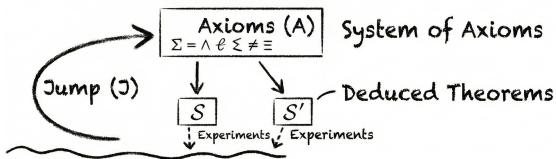
The authors challenge the reductionist view that scientific discovery is merely the combination of induction (data compression) and deduction (formal theorem proving), using Einstein's creation of General Relativity as a computational case study. Prior work in AI-driven discovery has shown success in extracting patterns from data or verifying theories from given axioms, but it cannot explain how novel axioms are formulated when no error signal or large dataset exists. The authors argue that the critical missing ingredient is abduction—the creative inference of a cause to explain a surprising phenomenon—and demonstrate that Einstein's axiomatic leap was driven by embodied thought experiments, not by statistical gradient. They conclude that current large language models, which lack physically consistent world models, are structurally incapable of the abductive jump required for true scientific invention, and propose that future AI must integrate sensory simulation to ground abstract symbols in physical experience.
Method
The authors propose a conceptual framework for automating scientific discovery that bridges the gap between logical deduction and the generation of novel axioms. They argue that while modern AI systems excel at deduction, which involves deriving theorems from existing axioms, they lack the capacity for the abductive jump required to formulate new foundational principles. To address this, the authors introduce the concept of Manipulative Abduction, a cognitive process relying on embodied simulation to generate hypotheses through active interaction with mental models.
This thought process is conceptualized as a two-stage mechanism. The first stage involves Simulation as Physical Variation, which can be viewed through the lens of Test Time Reinforcement Learning. In this phase, the system invents new variations of a problem to force progress. Unlike symbolic variations bounded by fixed rules, this requires manipulating perceptual experience to invent new axioms based on physical intuition.
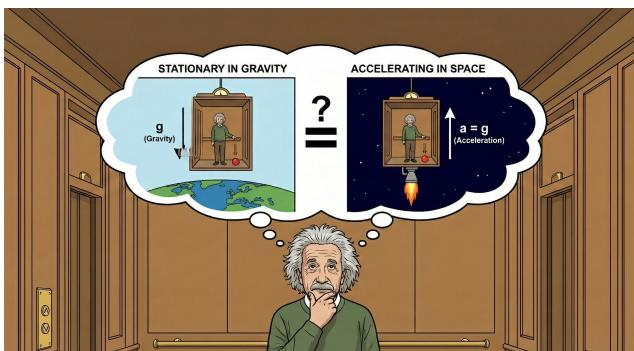
As illustrated in the figure above, the equivalence principle thought experiment exemplifies this stage. By simulating the physical sensations of an observer inside a sealed environment, such as comparing a stationary elevator in a gravitational field to an accelerating elevator in deep space, the system generates a specific sensory pattern. The second stage is Abduction and the Physical Prior, where the system performs abductive reasoning to infer the best explanation for the simulated observation. Because the simulated sensory experience of acceleration is indistinguishable from the remembered sensory experience of gravity, the system abducts that they must be the same phenomenon, effectively pruning the search space of possible axioms using a physical prior.
To operationalize this in AI, the authors point to the emergence of interactive World Models. Unlike passive video generators that rely on statistical correlation, architectures like Genie introduce action controllability, allowing for agentic intervention. This capability is a prerequisite for Manipulative Abduction, as it enables the AI to perform counterfactual interventions, such as conceptually cutting the cable of an elevator, rather than merely observing. By operating on a consistent latent physics manifold, these interactive environments provide a synthetic laboratory to transform the abductive jump from a mystical insight into a reproducible algorithmic process.