Command Palette
Search for a command to run...
مفارقة زينون للغات «منخفضة الموارد»
مفارقة زينون للغات «منخفضة الموارد»
Hellina Hailu Nigatu Atnafu Lambebo Tonja Benjamin Rosman Thamar Solorio Monojit Choudhury
الملخص
يُنظر عادةً إلى التفاوت بين اللغات الشائعة الدراسة في مجال معالجة اللغات الطبيعية (NLP) على أنه تمييز بين لغات عالية الموارد ولغات منخفضة الموارد. غير أنّ الإجماع يبقى محدودًا بشأن المعيار الدقيق الذي تجعل من اللغة «منخفضة الموارد». لفهم كيفية تعريف أوراق بحث NLP للغات «منخفضة الموارد» ودراستها، أجرينا تحليلًا كيفيًّا لـ 150 ورقة من مستودع ACL Anthology والمؤتمرات الشائعة في معالجة الكلام، والتي تُذكر فيها العبارة المفتاحية «low-resource». استنادًا إلى تحليلنا، نبين كيف تسهم عدة محاور متفاعلة في تحديد «انخفاض الموارد» للغة، ولماذا يجعل ذلك من الصعب تتبّع التقدّم المحرز لكل لغة على حدة. نأمل أن يحرّض عملنا (1) على تقديم تعريفات صريحة لهذا المصطلح عند استخدامه في الأوراق البحثية، وأن (2) يوفر أساسًا مرجعيًّا للمحاور المختلفة التي ينبغي أخذها بالاعتبار عند توصيف لغة بأنها منخفضة الموارد.
One-sentence Summary
UC Berkeley, MBZUAI, Lelapa AI, and colleagues qualitatively analyzed 150 papers from the ACL Anthology and speech-processing conferences, revealing that multiple interacting axes contribute to a language's 'low-resourcedness' and hinder per-language progress tracking, while advocating for explicit terminological definitions in future research.
Key Contributions
-
A qualitative analysis of 150 papers from the ACL Anthology and popular speech-processing conferences that mention low-resource languages documents how the term is defined and used in NLP research.
-
The analysis identifies four interacting aspects of resourcedness, including data, language vitality, and digital support, and explains why a single low-resource label can obscure progress for individual languages.
-
The work recommends explicit terminology and stakeholder actions for researchers, communities, conferences, institutions, industry, government, and funders to clarify resource categories and improve support for underrepresented languages.
Introduction
In NLP, language technologies are built primarily for high-resource languages, while many communities, especially in the Global South, lack accessible tools. This matters because missing or poor language support can accelerate language loss and cause downstream harms for speakers who rely on digital services. Prior work often labels a language as low-resource using vague or data-only criteria, which obscures social, human, technological, and community-level barriers and can lead to misaligned or exploitative research. The authors leverage a qualitative survey of 150 papers to show that low-resourcedness arises from four interacting aspects: sociopolitical constraints, available resources, technological artifacts, and community agency. They contribute a framework for more explicit terminology and stakeholder recommendations to guide targeted, community-centered interventions.
Dataset

-
Dataset composition and sources
- The authors use a corpus of published NLP and speech processing papers, not a language dataset for model training.
- They collect papers from *CL venues via the ACL Anthology and from INTER-SPEECH and ICASSP via the Semantic Scholar API.
- They filter papers by searching titles and abstracts for the terms “low-resource” or “under-resource.”
- The initial corpus contains 868 unique papers.
-
Qualitative subset and filtering rules
- The authors manually label 541 papers to identify those that explicitly study non-simulated low-resource languages.
- Papers that only simulate low-resource settings through under-sampling are excluded from the main qualitative analysis.
- Papers are retained if they study at least one actual low-resource language, even when they also include simulated low-resource experiments.
- From the screened set, the authors randomly sample 150 papers for detailed qualitative analysis.
- The sampled papers span publication years 2017 to 2023, and sampling is not constrained by publication year.
-
Processing and annotation schema
- For each sampled paper, the authors record how the term “low-resource” or “under-resource” is defined.
- They annotate which languages are studied in each paper.
- They also capture additional challenges mentioned by the paper that relate to those languages being low-resource.
- The annotations are analyzed using inductive thematic analysis to identify recurring themes.
- Themes discussed include linguistic features and descriptions, data availability or quality, and access to technology or computational tools.
-
Use of the data
- The corpus is used to qualitatively analyze how “low-resource language” is defined and applied in published research.
- The paper does not describe training splits, validation/test splits, mixture ratios, or model-training use for this corpus.
Method
The authors structure the study as a qualitative analysis pipeline rather than a computational training process. The pipeline is designed to move from a broad paper corpus to a tightly scoped analysis of how research papers construct the notion of a low-resource language. It can be understood as a modular workflow with four main stages: corpus construction, scope filtering, close-reading annotation, and thematic synthesis.
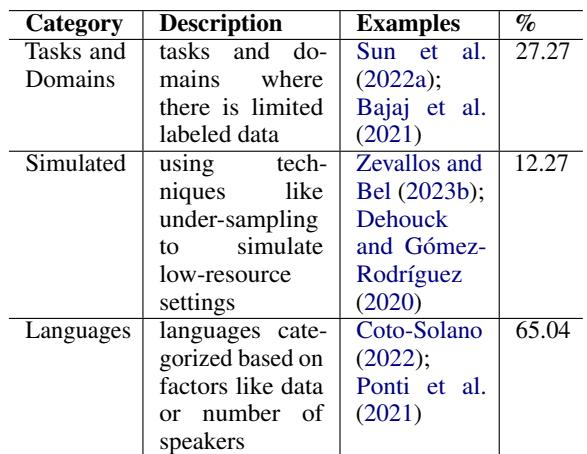
The first stage is corpus construction. The authors leverage bibliographic sources from natural language processing venues and speech processing venues, retrieving papers through ACL Anthology records and the Semantic Scholar API. A keyword matching rule is applied to titles and abstracts, selecting papers that mention “low-resource” or “under-resource.” This stage produces a broad candidate pool in which the target term is used across multiple research settings. The authors then perform a qualitative screening step and observe that the term appears in three broad categories: tasks or domains with limited labeled data, simulated low-resource settings created through methods such as undersampling, and claims about languages themselves.
The second stage is scope filtering. Since the study aims to understand how languages are labeled as low-resource, the authors restrict attention to papers involving actual languages rather than purely simulated settings. This involves manual inspection of the broader corpus to identify papers that explicitly study non-simulated low-resource languages. Papers that combine simulated low-resource experiments with studies of real low-resource languages are retained when the real languages are part of the research design. From the resulting filtered set, the authors randomly sample papers for detailed qualitative reading. This sampling is not conditioned on publication year, so the sampled corpus represents a time-spanning snapshot rather than a year-balanced design.
The third stage is close reading and annotation. For each selected paper, the authors read the full work and record three kinds of evidence: how the paper defines “low-resource” or “under-resource,” which languages are studied, and what additional challenges are associated with those languages. This annotation process operationalizes the research question by converting narrative definitions into analyzable categories. When a paper provides an explicit definition, the authors use that definition directly. When a definition depends on earlier work, they trace the cited source and treat that source as the operative definition. When no explicit definition is available, they infer the authors’ implicit criterion from the challenges described in the paper, such as limited data, limited linguistic description, or limited technological infrastructure.
The fourth stage is thematic synthesis. The authors use inductive coding, meaning that the categories emerge from repeated reading and discussion rather than from a predefined coding schema. Through iterative annotation and collaborative discussion, they consolidate recurring patterns into higher-level themes. This synthesis process turns individual paper definitions into a conceptual architecture that explains the recurring dimensions used to justify low-resource labeling.
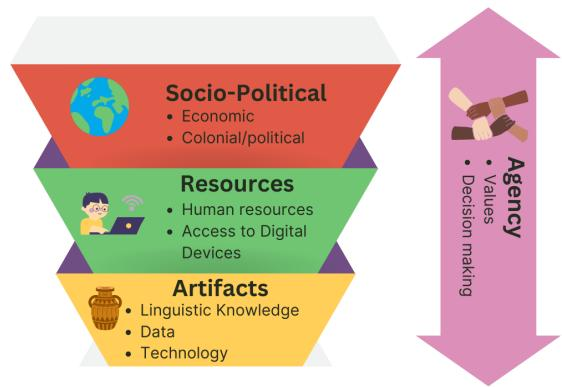
The authors organize these dimensions into a conceptual hierarchy. Refer to the framework diagram.
In this conceptual architecture, sociopolitical aspects form the top layer. They include economic constraints and colonial or political constraints that shape which languages receive institutional support, which writing systems or corpora are preserved, and which communities have access to language technology infrastructure. The diagram positions sociopolitical factors as upstream conditions because they influence both the availability of resources and the creation of linguistic artifacts.
Below the sociopolitical layer, the framework includes resources and artifacts. Resources cover human resources, such as expert annotation capacity, community language experts, and technical participants, as well as access to digital devices and connectivity needed to participate in digital language work. Artifacts include the tangible research inputs that are often treated as prerequisites for language technology development, such as linguistic knowledge, labeled or unlabeled data, and technological tools. In this framing, artifacts are not presented as neutral technical objects. They are shaped by prior sociopolitical conditions and by access to resources.
The framework also treats community agency as a cross-cutting dimension. Rather than placing agency as a separate terminal category, the authors represent it as spanning all other layers. This means that decisions about values, priorities, language planning, data collection, annotation practices, and technology design are influenced by whether and how language communities participate in research. In the resulting architecture, a language may be labeled as low-resource because of limited data or tools, but the proposed conceptual design argues that those observable shortages are connected to broader sociopolitical constraints and to the degree of decision-making power granted to community members.
Experiment
The experiments analyze papers that explicitly study languages as low-resource, comparing language coverage across multilingual and monolingual contexts and examining how languages are described, categorized, and justified. The findings show substantial variability in descriptive depth, with broader multilingual studies providing more generalized language information and focused studies offering richer linguistic and community context. Analysis of low-resource labeling reveals that data scarcity, especially lack of labeled data, is the dominant criterion, while limited computational tools, speaker population, and availability of digitized or online text are also used inconsistently. Overall, low-resource status is framed through heterogeneous and largely data-centric definitions rather than a single standardized criterion.
Papers using the term low-resource are grouped into tasks and domains with limited labeled data, simulated low-resource settings, and low-resource languages. Language-focused papers are the largest category, while simulated settings are the smallest, and some papers fall into multiple categories. The term low-resource spans data scarcity, simulated under-resourced settings, and language-level categorization. Papers studying low-resource languages dominate the search results. Simulated low-resource settings are less common than language-focused or task-domain uses. Data availability is the most common criterion for labeling a language as low-resource. Indo-European languages are most represented among studied low-resource languages, followed by Niger-Congo and Austronesian.
The analysis treats low-resource status as multidimensional and recommends terminology that specifies whether the issue is socio-political, resource-related, or artifact-related. Suggested terms cover language vitality, web presence, expert availability, orthography, and documentation quality. The context also indicates that data availability, especially labeled data, is the most common current basis for calling a language low-resource. Explicit terminology separates economic, political, speaker, online presence, expert, and artifact aspects of language resources. Data absence remains the dominant classification signal, with labeled data especially central, while other factors shape language selection and interventions.
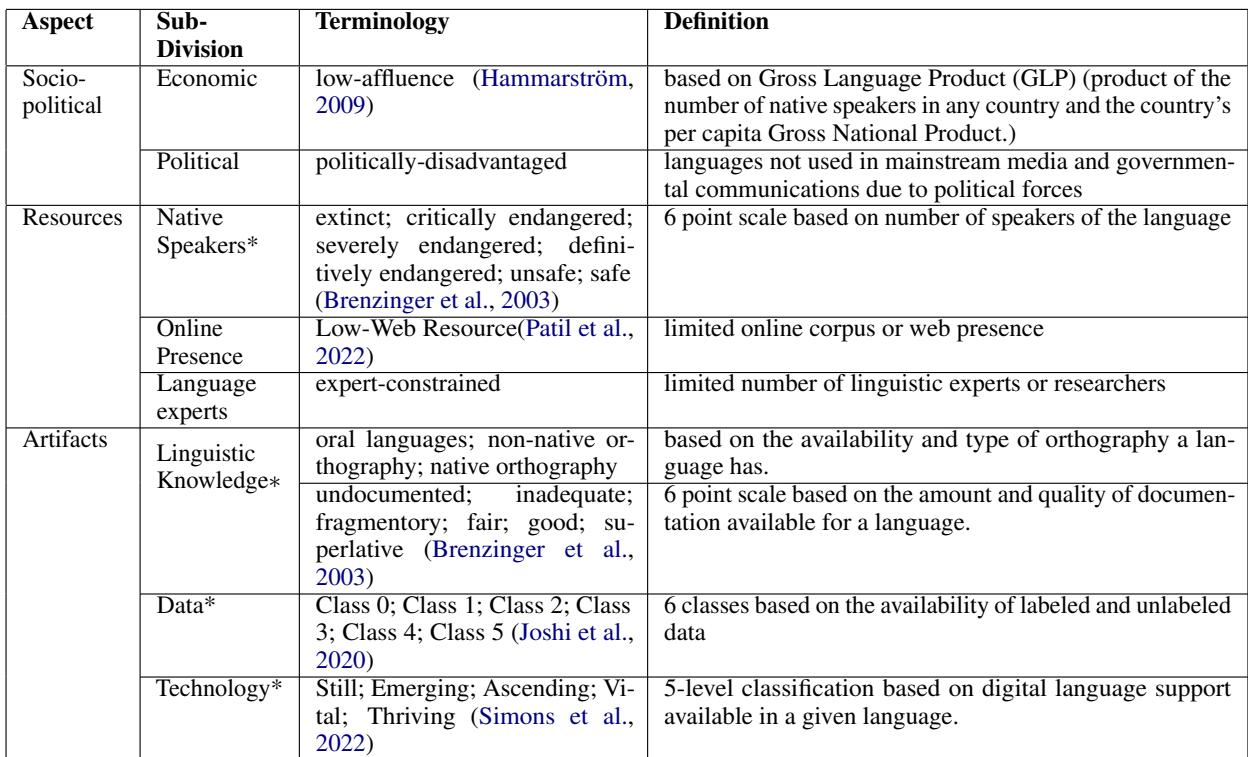
The analysis organizes papers that use the low-resource term into task-domain, simulated, and language-focused categories, with language-focused studies most common and simulated settings least frequent. It examines how low-resource labels are assigned, finding that data scarcity, especially lack of labeled data, dominates, while language families such as Indo-European are heavily represented. Based on this, it validates a multidimensional terminology framework that distinguishes socio-political, resource-related, and artifact-related factors such as vitality, web presence, expert availability, orthography, and documentation quality.