Command Palette
Search for a command to run...
التعمّق في الطبقات الالتفافية
التعمّق في الطبقات الالتفافية
Christian Szegedy Wei Liu Yangqing Jia Pierre Sermanet Scott Reed Dragomir Anguelov Dumitru Erhan Vincent Vanhoucke Andrew Rabinovich
الملخص
نقترح بنية شبكة عصبية التفافية عميقة تحمل الاسم الرمزي Inception، تحقق أحدث ما توصلت إليه التقنيات في مجالي التصنيف والكشف ضمن تحدّي إيمِج نت للتعرف البصري على نطاق واسع 2014 (ILSVRC14). السمة الجوهرية لهذه البنية هي الاستخدام المُحسَّن لموارد الحوسبة داخل الشبكة. فبتصميم مُحكم بعناية، زدنا من عمق الشبكة وعرضها مع الحفاظ على ميزانية حوسبية ثابتة. ولتحسين الجودة، استُند في القرارات المعمارية إلى مبدأ هبيان والبديهة المستمدة من المعالجة متعددة النطاقات. تجسيد معيّن من هذه البنية استُخدم في مشاركتنا في ILSVRC14 يُسمى GoogLeNet، وهو شبكة ذات 22 طبقة عميقة، وقد قُيّمت جودتها في سياق التصنيف والكشف.
One-sentence Summary
Google Inc., University of North Carolina, University of Michigan, and Magic Leap Inc. propose GoogLeNet (Inception), a 22-layer convolutional network that increases depth and width while keeping the computational budget constant by leveraging multi-scale processing guided by the Hebbian principle, achieving state-of-the-art results on ILSVRC14 classification and detection.
Key Contributions
-
The Inception architecture, implemented as the 22-layer GoogLeNet model, improves image classification and object detection by increasing network depth and width while keeping the computational budget nearly constant.
-
The paper presents a design principle for efficient convolutional neural networks, approximating useful sparse network structure with dense hardware-friendly building blocks guided by the Hebbian principle and multi-scale feature-processing intuition.
-
The Inception architecture achieves new state-of-the-art performance on the ILSVRC14 classification and detection benchmarks, and competitive object detection is obtained without contextual information or bounding box regression.
Introduction
In computer vision, deep convolutional networks rapidly improved object classification and detection, and their efficiency became especially important for mobile and embedded applications. Prior approaches often gained accuracy by making networks deeper, wider, or larger, which increased parameter counts, overfitting risk, and computational cost, while truly sparse designs were difficult to implement efficiently on dense hardware. The authors introduce the Inception architecture, implemented as GoogLeNet, which uses dense components, including 1x1 convolutions for dimensionality reduction, to approximate sparse network structures and increase depth and width under a fixed inference budget while achieving strong ImageNet classification and detection results.

Method
The authors build the model around the Inception module, whose purpose is to approximate an optimal local sparse convolutional structure with dense, efficiently implementable components. The starting assumption is translation invariance, which means the network is composed of repeated convolutional building blocks. The design begins by examining how correlated units tend to appear in a layer. In lower layers, highly correlated units are expected to concentrate in small local regions, which can be represented efficiently by 1×1 convolutions. At the same time, some correlations extend over larger spatial regions and require larger receptive fields, such as 3×3 and 5×5 convolutions. Pooling paths are also included because pooling operations are known to be valuable in convolutional vision networks. The outputs of these parallel branches are concatenated into a single vector that becomes the input to the next stage. Refer to the framework diagram.

The diagram also shows the practical modification that makes the module efficient. A naive version that directly applies 5×5 convolutions to a large number of input channels becomes computationally expensive, especially when pooling outputs are also concatenated. The authors therefore introduce dimensionality reduction with 1×1 convolutions before the more expensive 3×3 and 5×5 convolutions. These 1×1 layers serve two roles: they reduce the number of input channels to limit computation, and they include rectified linear activation, so they are also nonlinear transformations. This gives the Inception module a multi-scale structure while keeping the number of parameters and floating-point operations manageable. As modules are stacked, higher layers are expected to contain more abstract features whose spatial concentration decreases, so the relative use of larger convolutions can increase in deeper stages.
The full GoogLeNet architecture uses these modules repeatedly as its main building blocks. The network accepts a 224×224 RGB input, with zero mean normalization. Early layers use conventional convolution, pooling, and normalization, then the architecture transitions into stacked Inception modules. Between groups of modules, max-pooling layers reduce spatial resolution. The network contains 22 layers with trainable parameters, or 27 layers when pooling layers are counted separately, and approximately 100 independent building blocks in total depending on how the implementation groups operations. All convolutions, including those inside the Inception modules, use rectified linear activation. As shown in the network schematic below:

The schematic shows the complete classification pipeline: input processing at the bottom, multiple depth-concatenated Inception blocks, spatial reductions through max-pooling, and a final reduction before the classifier. Instead of relying on large fully connected layers, the network uses average pooling before classification, followed by a small linear layer. The linear layer helps adapt the network to different label sets, while average pooling replaces fully connected layers for better efficiency and improved top-1 accuracy. Dropout remains important after the move to average pooling.
To address the concern that gradients may become difficult to propagate through such a deep network, the authors attach auxiliary classifiers to intermediate Inception modules, specifically to the outputs of modules (4a) and (4d). These auxiliary branches encourage the intermediate features to be discriminative, reduce the risk of vanishing gradients, and provide additional regularization. Each auxiliary classifier consists of an average pooling layer with a 5×5 filter and stride 3, a 1×1 convolution with 128 filters and rectified linear activation, a fully connected layer with 1024 units and rectified linear activation, a dropout layer with a 70% drop rate, and a linear softmax classifier predicting the same target classes as the main output. During training, the auxiliary losses are added to the main loss with a discount weight, giving a total objective of the form
Ltotal=Lmain+0.3Laux0+0.3Laux1.At inference time, the auxiliary classifiers are discarded, and only the main network is used.
Training uses the DistBelief distributed machine learning system with a modest amount of model and data parallelism. The optimization is based on asynchronous stochastic gradient descent with momentum 0.9. The learning rate follows a schedule that decreases by 4% every 8 epochs. Polyak averaging is used to produce the final model for inference. The training procedure also emphasizes patch sampling and data augmentation to improve robustness. The authors describe sampling image patches whose area is distributed between 8% and 100% of the full image area, with aspect ratio constrained to the interval [3/4,4/3]. Photometric distortions are also applied to reduce overfitting to the specific imaging conditions of the training data.
Experiment
The experiments evaluate GoogLeNet on the ILSVRC 2014 ImageNet classification and detection challenges, testing both the core architecture and practical inference enhancements. Classification results validate that training multiple model variants, using extensive multi-scale and multi-crop testing, and averaging predictions improve top-level performance without external data, while additional models and crops show diminishing returns. Detection experiments validate an Inception-based R-CNN-style pipeline with improved region proposals and ensemble region classification, demonstrating substantial progress over earlier detection approaches and strong gains from ensembling.
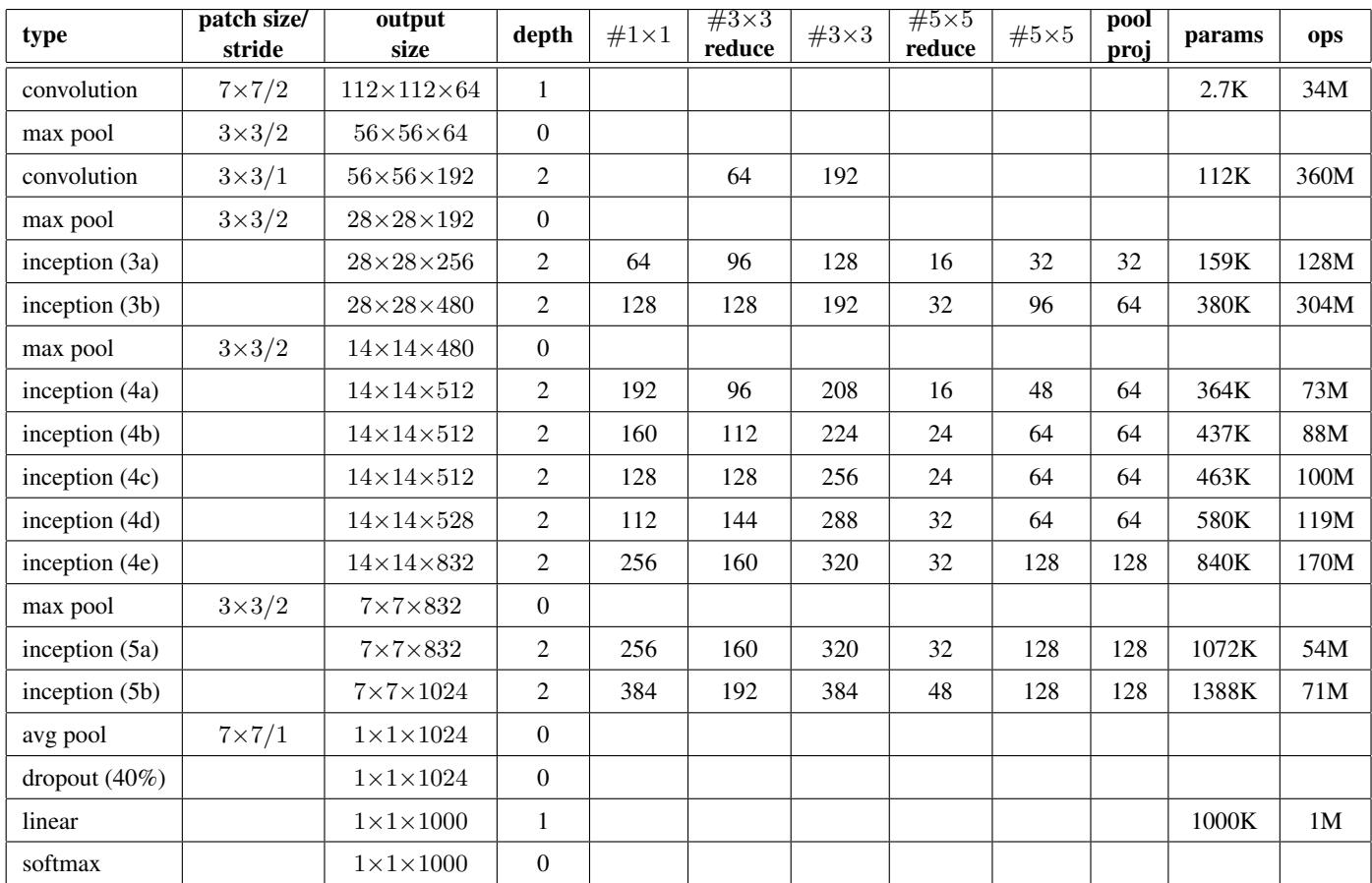
The described GoogLeNet incarnation of the Inception architecture uses repeated Inception modules with 1x1 reduction and projection layers to keep computation and memory requirements low. Its design emphasizes efficient inference and modest parameter counts, while replacing fully connected layers with average pooling improves accuracy, although dropout remains necessary. The same architecture also supports strong detection results when used in an ensemble of six models. 1x1 reduction layers before 3x3 and 5x5 convolutions and 1x1 pool projections are a key efficiency feature of the architecture. Average pooling before the classifier improves top-1 accuracy by about 0.6 percent, but dropout remains important even after removing fully connected layers. Using an ensemble of six GoogLeNet models for region classification raises detection accuracy from 40 percent to 43.9 percent.
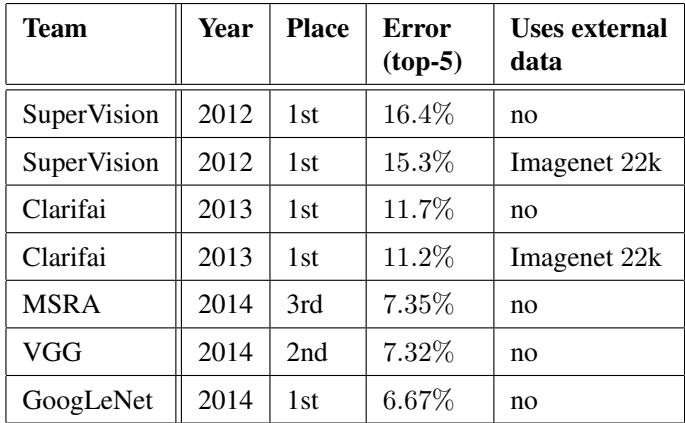
The classification results compare top ILSVRC entries across 2012 to 2014 using top-5 error. Error rates fall steadily over time, with the 2014 leading result outperforming earlier winners. The top 2014 entry achieved this without external data, while some earlier top entries used ImageNet 22k pretraining. Top-5 error decreased substantially from the earliest listed winners to the 2014 leaders. GoogLeNet placed first among the listed 2014 entries and had the lowest reported top-5 error. For the same team and year, the entry using external ImageNet 22k data had a lower top-5 error than the no-external entry.
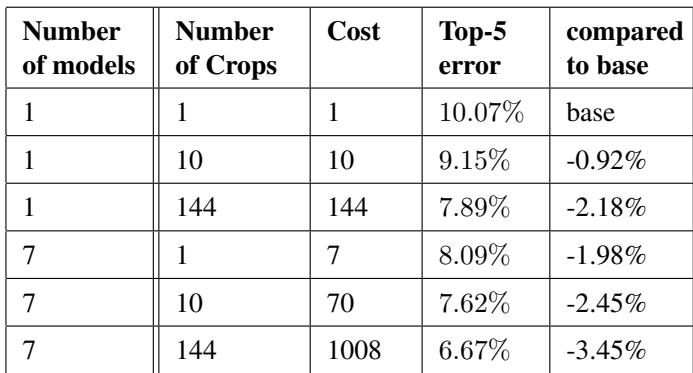
Increasing the number of ensemble models and test-time crops reduces top-5 error, with the strongest reduction when both are applied together. Aggressive cropping yields a larger single model improvement than increasing crops from one to ten, while model ensembling also helps. The validation results show that better accuracy is traded against higher testing cost. Using ten crops lowers top-5 error modestly compared with a single crop Seven models reduce error more than ten crops alone when tested on one crop Ensembling seven models with many crops gives the lowest top-5 error despite much higher cost
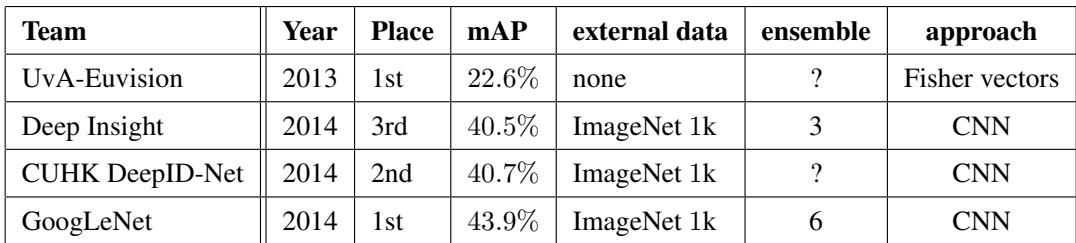
The reported detection results show a substantial improvement from 2013 to 2014, with the leading entries using convolutional networks rather than earlier Fisher vector approaches. The top entry combines external ImageNet pretraining with a large model ensemble, while the next CNN-based entries are close together and use fewer or unreported ensembles. Ensembling appears to be an important differentiator, as the top entry benefits strongly from it while another strong method gains only modestly. Convolutional networks dominate the leading 2014 detection results. External ImageNet pretraining is common among the top 2014 teams. The top result stands out for achieving the highest reported mean average precision. Ensemble size appears to be a major differentiator among the leading approaches.
The single-model detection results show that Deep Insight achieves the highest mAP among the reported teams, with GoogLeNet close behind. GoogLeNet remains competitive despite not using a contextual model or bounding box regression, while the leading Deep Insight model uses both strategies. Deep Insight leads in single-model detection performance. GoogLeNet reaches strong accuracy without contextual modeling or bounding box regression.
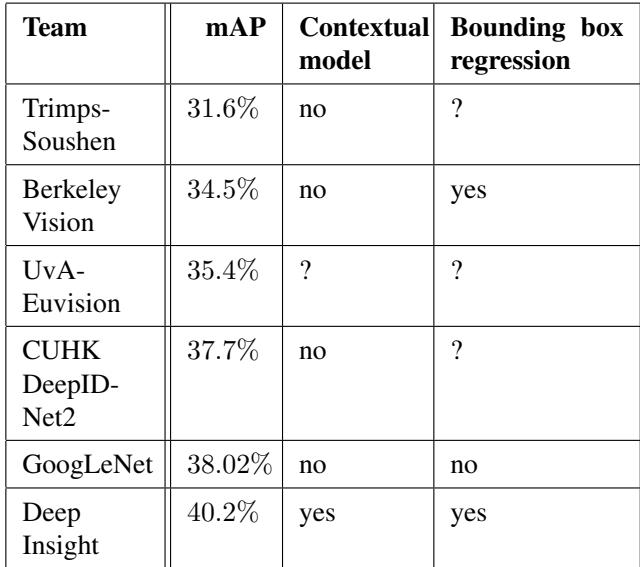
Experiments evaluate GoogLeNet’s architecture and performance on large-scale image classification and object detection tasks, comparing it with leading ILSVRC entries and single-model detection methods. The results show that efficient Inception design elements, average pooling, ensembling, and multiple test-time crops improve accuracy, while also increasing testing cost. Across classification and detection settings, GoogLeNet demonstrates strong competitiveness, with external pretraining, larger ensembles, and convolutional architectures playing major roles in the best-performing approaches.