Command Palette
Search for a command to run...
NounAtlas: سدّ الفجوة في وسم الأدوار الدلالية الاسمية
NounAtlas: سدّ الفجوة في وسم الأدوار الدلالية الاسمية
Roberto Navigli Dennis Rotondi Marco Lo Pinto Simone Ciciliano Pasquale Silvestri Alessandro Scirè
الملخص
على الرغم من التقدم الكبير المحقق في مجال وسم الأدوار الدلالية (SRL)، فقد نُفّذ الجزء الأكبر من العمل في هذا المجال بتركيز على المسندات الفعلية، في حين تأخر البحث في وسم الأدوار الدلالية الاسمية. ومع ذلك، غالبًا ما تكون المسندات الاسمية في سياقات كثيرة غنية بالمعلومات بالقدر نفسه الذي تتمتع به المسندات الفعلية، مما يستدعي معالجة مناسبة لها. في هذه الورقة، نهدف إلى سدّ هذه الفجوة وجعل وسم الأدوار الدلالية الاسمية عنصرًا أساسيًا في هذا المجال. نقدّم نهجًا جديدًا لإنشاء أول جرد واسع النطاق وعالي الجودة للمسندات الاسمية وتنظيمها في أطر ذات تماسك دلالي. وعلى الرغم من إنشائه تلقائيًا، يجري التحقق الكامل من NounAtlas، وهو جرد أطرنا الاسمية. ثم نقترح تقنية لتوليد بيانات تدريب فضية لوسم الأدوار الدلالية الاسمية ونُظهر أن نموذجًا متقدمًا لـSRL يمكنه تحقيق أداء جيد. وبفضل اختياراتنا التصميمية التي تتيح التكامل السلس بين جرد المسندات لدينا ونظيره الفعلي، أي VerbAtlas، نستطيع مزج البيانات الفعلية والاسمية وأداء وسم أدوار دلالية متين على كلا النوعين من المسندات.
One-sentence Summary
Sapienza University of Rome, University of Stuttgart, and Free University of Bozen introduce NounAtlas, the first large-scale, fully validated inventory of nominal predicates organized into semantically coherent frames, which integrates seamlessly with VerbAtlas to enable robust Semantic Role Labeling on both verbal and nominal predicates through silver training data generation.
Key Contributions
- NounAtlas is a validated, automatically created inventory of more than 10,000 nominal predicates organized into semantically coherent frames by linking WordNet nouns to VerbAtlas frames.
- A silver-data generation procedure uses NounAtlas and large language models to propagate predicate and semantic-role labels, creating a large wide-coverage nominal SRL dataset.
- A unified SRL model trained on both verbal and nominal data achieves state-of-the-art performance on both predicate types, showing that integration of nominal and verbal frame resources supports robust SRL across predicate classes.
Introduction
Semantic Role Labeling supports understanding of events by identifying predicates and their arguments, answering questions like who did what to whom and when. This matters for applications such as question answering, machine translation, textual inference, and summarization. However, most prior resources and models focus heavily on verbs, while many important predicates are nouns, especially in headlines and short texts. Existing nominal resources have limited coverage, inconsistent role inventories, or poor alignment with verbal predicate frames, making broad and unified SRL difficult. The authors address this gap by introducing NounAtlas, a large-scale inventory of nominal predicates linked to VerbAtlas frames, and by creating a large annotated dataset for nominal SRL. They also evaluate several modern SRL baselines and show that a unified approach trained on both nominal and verbal data can reach state of the art performance across both settings.
Dataset

-
The authors build two related text datasets:
- NounAtlas, a large nominal predicate inventory.
- A nominal Semantic Role Labeling dataset built from SemCor sentences and NounAtlas frames.
-
Sources:
- VerbAtlas is the starting frame resource, built from WordNet verbal synsets grouped into more than 400 semantic frames.
- NounAtlas is built from WordNet 3.0 nominal synsets.
- The SRL corpus is collected from SemCor, the largest manually annotated WordNet sense corpus.
-
NounAtlas composition and filtering:
- Nominal predicates are defined as WordNet nominal synsets that describe events, actions, or situations and allow identifiable semantic roles.
- Non-event nominal synsets, such as synsets for people or objects, are excluded.
- The authors rank WordNet nominal synsets by the number of hyponyms and select top general event synsets.
- After removing subsumed synsets, they keep four seed synsets: EVENT.N.01, EVENT.N.02, PROCESS.N.02, and PROCESS.N.06.
- They then include all descendant nominal synsets of these seeds.
- The final NounAtlas inventory contains 10,086 event-characterizing nominal synsets.
-
Mapping nominal synsets to VerbAtlas frames:
- Mapping is bootstrapped using WordNet derivationally related form links between nominal and verbal synsets.
- If a nominal synset has one verbal counterpart, or multiple verbal counterparts within the same VerbAtlas frame, it is assigned automatically as an Unambiguous link.
- If linked verbal synsets belong to different frames, annotators manually choose the most suitable frame.
- If no verbal link exists, an expert annotator maps the synset using a similarity ranking.
- DRF based Unambiguous links cover about 31% of the event-characterizing nominal synsets.
- For manually curated links, annotator agreement is moderate, with Cohen’s kappa of 0.57.
- Of 5,904 synsets without DRF links, 5,876 are manually linked, 88.2% choose from the top 5 frames, and 49.3% choose the top ranked frame.
- NounAtlas reuses VerbAtlas frame labels, so nominal and verbal predicates share one unified frame schema.
-
SRL dataset construction:
- The authors select SemCor sentences that contain at least one verb with a DRF link to a nominal synset and an Unambiguous link to a VerbAtlas frame.
- The initial filtered pool contains 36,295 verbal predicate occurrences.
- An LLM is prompted to rewrite each sentence by replacing the verb with a corresponding deverbal noun from the linked nominal synset.
- Output must follow a fixed format that marks the chosen nominal predicate.
- Generated sentences are automatically validated for noun POS, correct lexical form, and candidate membership.
- 29,221 generated nominal sentences pass validation.
-
Role annotation and final scale:
- Role labels are transferred from the original verbal predicate annotations.
- The authors align roles between the original verbal sentence and the nominalized sentence using span embeddings.
- The final SRL dataset contains 28,055 sentences.
- Sentences are discarded if any verbal role is not successfully propagated to the nominal sentence.
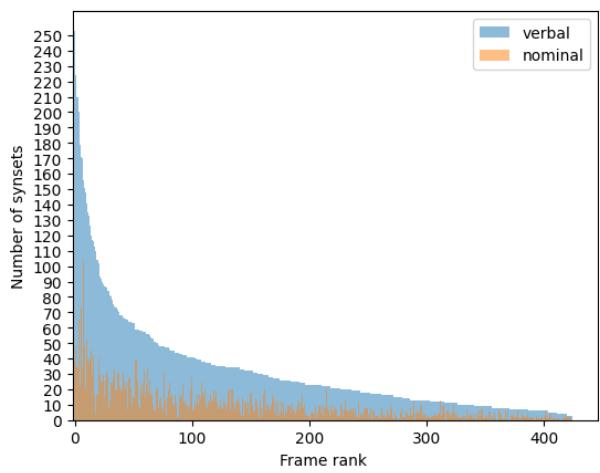
- Sentence counts across frames are skewed, with some frames having many sentences and others having very few; the median frame rank has 32 sentences.
-
Metadata and schema:
- Each SRL example contains a nominal predicate, an assigned NounAtlas frame label, argument spans, and semantic role labels.
- Roles follow VerbAtlas style semantic roles, such as Agent, Theme, and Topic.
- Frame labels are shared between VerbAtlas and NounAtlas, giving a unified nominal and verbal frame inventory.
-
Dataset quality assessment:
- The authors manually inspect 500 sentences.
- 92.11% of inspected sentences are judged grammatical.
- 95.56% of automatic frame assignments are unchanged after expert review.
- 77.11% of role spans are unchanged.
- 95.27% of role labels are unchanged.
-
Training split and usage:
- The provided text does not report a specific train, validation, or test split.
- It also does not report mixture ratios for using this data in model training.
- The data is described as an automatically annotated nominal SRL resource and an evaluation or construction artifact for frame based nominal predicate labeling.
-
Cropping and additional processing:
- No image cropping strategy is described because the dataset is text based.
- Main processing details are sense based filtering, nominalization, format validation, POS and lemma checks, and role span alignment.
Method
The authors leverage VerbAtlas as the structural foundation for constructing NounAtlas, a large-scale inventory of nominal predicates. VerbAtlas organizes WordNet verbal synsets into semantically coherent frames, each associated with a stable argument structure and semantic roles such as AGENT, PATIENT, and TOPIC. Because each verbal synset is assigned to exactly one frame, the associated frame semantics can be transferred to nominal predicates that express analogous event meanings. This transfer is central to both the construction of NounAtlas and the creation of a frame-annotated nominal semantic role labeling dataset.
The first stage identifies nominal synsets that behave like event predicates. A nominal predicate is treated as an event-characterizing concept if it can support clear argument roles. Non-event nouns, such as those denoting people, objects, or static entities, are excluded. The authors sort WordNet nominal synsets by the number of descendants in the WordNet nominal taxonomy and then reduce the selected general categories to four root event- or process-related synsets. All direct and indirect hyponyms of these root synsets are retained as the candidate set for nominal predicate mapping.
For mapping these nominal candidates to VerbAtlas frames, the authors exploit WordNet derivationally related form relations, abbreviated DRF. These relations connect nominal senses with corresponding verbal senses. If a nominal synset s is linked through a DRF relation to a verbal synset v, and v belongs to a VerbAtlas frame, then the nominal synset can inherit that frame. This produces three main mapping situations. If s is linked to a single verbal synset v, the mapping is unambiguous and follows frame(s)=frame(v). If s is linked to a set of verbal synsets V, the mapping remains unambiguous when all synsets in V belong to the same frame. Otherwise, a human annotator selects the most suitable frame among the linked candidates. Finally, some nominal synsets have no DRF connection to VerbAtlas verbal synsets and therefore require a separate ranking and annotation procedure.
The mapping categories are visualized below.
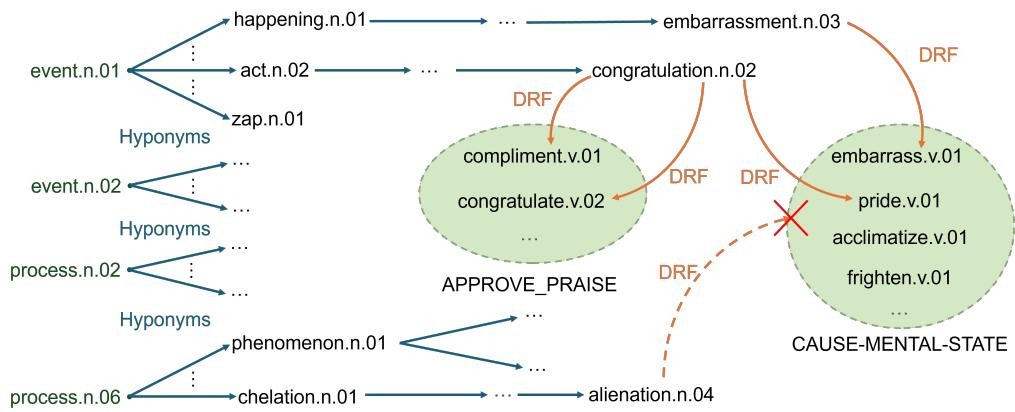
In this structure, nominal synsets connected to a single verbal frame can be assigned automatically. Nominal synsets connected to verbal synsets from different frames require manual curation because their meanings overlap multiple frame semantics. Nominal synsets without DRF links to any VerbAtlas verbal synset are not automatically mapped at this stage and are passed to a learned ranking component.
The resulting distribution of verbal and nominal synsets across frames is not uniform. Some frames contain many lexical entries, while others contain only a few. Frames with more verbal synsets also tend to acquire more nominal synsets, reflecting broader semantic productivity in the verbal inventory. This skewed distribution is shown below.
To increase coverage for nominal synsets with no DRF link, the authors build a supervised ranking module. They collect nominal synsets that have already been mapped to VerbAtlas frames through unambiguous or manually curated links. For each such nominal synset s mapped to frame f, they pair the definition of s with the definition of a verbal synset v∈f that is DRF-linked to s. This pair is labeled as a positive pair. The positive pool is expanded by pairing the definition of s with definitions of K additional verbal synsets randomly sampled from the same frame f. Negative pairs are created by pairing the same nominal synset definition with definitions of verbal synsets sampled from K+1 random frames different from f. Each definition is expanded by prepending the lemmas of the corresponding synset.
The ranking task is formulated as binary classification. A positive label means that the nominal and verbal synset definitions belong to the same VerbAtlas frame, while a negative label means that they belong to different frames. The authors use this construction to train a Cross-Encoder model. The architecture consists of a pre-trained encoder, specifically mpnet-v2, followed by a linear binary classification head. The training objective is binary cross entropy, and the optimizer is Adam with an initial learning rate of 3×10⁻⁵. Hyperparameters are selected using the validation split, with performance guided by the F1 score for the binary classification task.
At inference time, the trained model is used to rank VerbAtlas frames for an unlinked nominal synset. For each frame, up to ten verbal synset definitions are randomly selected and paired with the definition of the target nominal synset. Each pair is scored by the Cross-Encoder, and the final score of a frame is computed as the average score of its associated pairs. Frames are then ordered from highest to lowest score. This produces a similarity ranking in which the top-ranked frames represent the most plausible frame assignments for the nominal synset.
The top-ranked frames are then used in a semi-automatic annotation step. An expert annotator selects the most suitable frame from the top five candidates produced by the model. If none of the candidates is appropriate, the annotator may consult the full VerbAtlas inventory and choose a frame directly. This procedure allows the authors to map a large portion of unlinked nominal synsets while keeping manual effort focused on plausible model-proposed candidates rather than the entire frame space.
With the nominal predicate inventory constructed, the authors create a nominal semantic role labeling dataset by converting existing verbal predicate annotations into nominal annotations. The process begins with sentences from SemCor, selected when they contain a sense-annotated verbal predicate whose verbal synset has an unambiguous DRF link to a nominal synset. This choice preserves the frame consistency between the original verbal predicate and the target nominal predicate.
The next stage nominalizes the verbal predicate. The authors prompt a large language model to transform a sentence into a version where a designated verb is replaced by one of the deverbal nouns from the linked nominal synset. If the original sentence is w1,…,wn and the target verbal token is wi, the model is instructed to choose exactly one nominal alternative from the set {n1,…,nm} associated with the corresponding nominal synset. The chosen nominal is marked within the output sentence. To stabilize output formatting and nominalization behavior, the authors provide system-level instructions and manually crafted few-shot examples that expose the model to different nominalization patterns.
Each generated sentence is then validated with rule-based checks. The system verifies that a nominal item is explicitly marked according to the requested format, that part-of-speech tagging confirms the marked item is a noun, and that the lemmatized form of the chosen nominal belongs to the admissible nominal synset. If all checks pass, the sentence is accepted, and the nominal predicate is tagged with the inherited frame, where frame(nj)=frame(v) for the chosen nominal form nj and the original verbal synset v.
The final stage transfers semantic role annotations from the verbal sentence to the nominalized sentence. The original sentence σv is processed by InVeRo-XL, producing span-based argument roles for the verbal predicate. Both the original sentence σv and the nominalized sentence σn are encoded using a bi-encoder. For each verbal role span in σv, the authors compute a span embedding Er by mean pooling the token embeddings of the span and applying L2 normalization. They then slide a window of the same span length across σn, compute an embedding Esp for each candidate span, and select the nominal span that maximizes cosine similarity:
sp∗=argspmaxcos(Er,Esp)The role label from the verbal span is then assigned to the selected nominal span. This procedure yields sentences in which nominal predicates are tagged with VerbAtlas/NounAtlas frames and their argument spans are annotated with the corresponding semantic roles.
Experiment
The evaluations assess a Cross-Encoder ranking model for assigning VerbAtlas frames to unlinked nominal synsets, a human audit of an automatically generated nominal SRL corpus, and SRL baselines trained on verbal, nominal, and mixed data. The ranking results show that definition-pair scoring can identify plausible frames among the leading candidates, making manual annotation of missing links more efficient. The corpus audit indicates that most generated sentences are grammatical and retain correct frame and role labels, although argument spans are less reliable, while baseline results demonstrate that verbal-only models generalize poorly to nominal predicates and that nominal or combined training enables a competitive unified verbal and nominal SRL system.
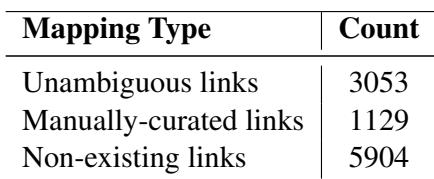
The WordNet-based mapping links nominal synsets to verb frames mainly through derivational relations, with unambiguous links forming the largest automatically mapped group. Manually curated links are needed for additional synsets whose related verbal senses point to different frames. The largest category consists of nominal synsets that do not receive a direct WordNet-based frame link. Unambiguous derivational links are more frequent than manually curated frame assignments. A substantial share of nominal synsets remains unmapped by direct WordNet verbal frame links.
The Cross-Encoder is used to rank candidate frames for unlinked nominal synsets by classifying whether nominal and verbal definitions belong to the same frame. Its binary classification accuracy and F1-score are both strong, and top-k accuracy improves steadily as more candidate frames are considered. The correct frame is most often recovered when the top five candidates are allowed, indicating useful ranking despite lower top-one accuracy. High binary classification accuracy and F1-score show that the model reliably distinguishes same-frame from different-frame definition pairs. Top-k accuracy increases monotonically as k grows, meaning more accurate ranking helps recover the correct verbal frame.

A model trained only on verbal semantic role labeling data transfers only modestly to the nominal test set, while training on nominal data gives a much stronger result. Combined verbal and nominal training performs best overall, with notably high predicate recall and slightly higher role-level scores than nominal training alone. These trends support using nominal data, especially when paired with verbal data, for better nominal semantic role labeling. Verbal-only training gives weak predicate identification on nominal data. Nominal training greatly improves overall performance over verbal-only training. Training on both verbal and nominal data yields the strongest nominal results.

Training on OntoNotes verbal SRL data and training on the union of verbal and nominal data produce broadly similar overall performance on OntoNotes. The combined model remains competitive on predicate and role detection, while the verbal-only baseline is slightly stronger on verbal predicate recall. These results support the combined baseline as a unified system for both verbal and nominal SRL. Adding nominal training data keeps verbal OntoNotes performance nearly unchanged. The combined verbal and nominal model remains competitive with the verbal-only baseline on OntoNotes.

The experiments examine how WordNet derivational relations can connect nominal synsets to verb frames, using a Cross-Encoder to rank candidates for unmapped cases and evaluating transfer of semantic role labeling across verbal and nominal predicates. WordNet provides a useful starting point but leaves many synsets unmapped and requires manual curation, while the ranking model reliably identifies same-frame pairs and recovers correct frames more often with a small candidate list. For semantic role labeling, nominal training substantially improves over verbal-only transfer, and joint verbal and nominal training yields the strongest nominal performance without sacrificing verbal OntoNotes results, supporting a unified modeling approach.