Command Palette
Search for a command to run...
EconAgent: وكلاء معزَّزون بالنماذج اللغوية الكبيرة لمحاكاة الأنشطة الاقتصادية الكلية
EconAgent: وكلاء معزَّزون بالنماذج اللغوية الكبيرة لمحاكاة الأنشطة الاقتصادية الكلية
Nian Li Chen Gao Mingyu Li Yong Li Qingmin Liao
الملخص
أدّى ظهور الذكاء الاصطناعي إلى تزايد التركيز على النمذجة الموجهة بالبيانات في الاقتصاد الكلي، حيث برزت النمذجة القائمة على الوكلاء (ABM) كنموذج محاكاة بارز يتبع نهج التكوين من الأسفل إلى الأعلى. في النمذجة القائمة على الوكلاء، يتفاعل الوكلاء (مثل الأسر والشركات) ضمن بيئة اقتصادية كلية، مولِّدين بشكل جماعي ديناميكيات السوق. عادةً ما تستخدم نمذجة الوكلاء القائمة حاليًا قواعد محددة مسبقًا أو شبكات عصبية قائمة على التعلم لاتخاذ القرارات. ومع ذلك، فإن تخصيص كل وكيل يمثل تحديات كبيرة، مما يُعقِّد نمذجة عدم تجانس الوكلاء. بالإضافة إلى ذلك، غالبًا ما يُتغاضى في عمليات اتخاذ القرار عن تأثير ديناميكيات السوق متعددة الفترات والعوامل الاقتصادية الكلية المتعددة الأوجه. في هذا العمل، نقدّم EconAgent، وهو وكيل معزَّز بالنموذج اللغوي الكبير يتميز بخصائص شبيهة بالبشر لمحاكاة الاقتصاد الكلي. نقوم أولًا ببناء بيئة محاكاة تتضمن ديناميكيات سوقية متنوعة مدفوعة بقرارات الوكلاء بشأن العمل والاستهلاك. من خلال وحدة الإدراك، ننشئ وكلاء غير متجانسين بآليات اتخاذ قرار متميزة. علاوة على ذلك، نُنمذج تأثير الاتجاهات الاقتصادية الكلية باستخدام وحدة الذاكرة، التي تتيح للوكلاء التأمل في تجاربهم الفردية السابقة وديناميكيات السوق. تُظهر تجارب المحاكاة أن EconAgent قادر على اتخاذ قرارات واقعية، مما يؤدي إلى ظواهر اقتصادية كلية أكثر معقولية مقارنةً بالوكلاء الموجودين حاليًا المعتمدين على القواعد أو التعلم. رمزنا البرمجي متاح على الرابط: https://github.com/tsinghua-fib-lab/ACL24-EconAgent.
One-sentence Summary
Tsinghua University introduces EconAgent, a large language model-empowered agent framework for macroeconomic simulation that leverages perception and memory modules to create heterogeneous agents with human-like decision-making, capturing multi-period market dynamics and yielding more realistic macroeconomic phenomena than existing rule-based or learning-based baselines.
Key Contributions
- EconAgent is introduced as a large language model-based framework for macroeconomic simulation, with a constructed labor and consumption market environment where agents' work and spending decisions interact with fiscal and monetary policies to generate market dynamics.
- A heterogeneous agent design is contributed through a perception module that assigns profile-based decision mechanisms and a memory module that incorporates past individual experiences and macroeconomic trends into decision-making, enabling multi-step human-like adaptation instead of predetermined rules.
- Experiments show that EconAgent reproduces classic phenomena such as inflation in the consumption market and unemployment in the labor market more reasonably than traditional rule-based or learning-based agents, while displaying human-like and environmentally responsive decision patterns.
Introduction
The authors study LLM-based agent simulation for macroeconomics, a setting that matters because digital trace data and AI tools now make it possible to model heterogeneous individual decisions rather than relying only on aggregate indicators. Early statistical and DSGE models struggled with large shocks or strong equilibrium assumptions, while agent-based models improved bottom-up simulation but still required handcrafted rules or large training data, making heterogeneous behavior and macro-dynamic memory difficult to represent. Their contribution is EconAgent, an LLM-empowered agent framework that uses perception to create diverse agent profiles and memory to incorporate past individual experiences and market dynamics within a simulated labor and consumption economy with fiscal and monetary policy, yielding more realistic reproduction of inflation, unemployment, and human-like adaptive decision-making.
Method
The authors leverage a closed-loop macroeconomic simulation in which an LLM-driven EconAgent interacts with a structured market environment. The overall system is organized into two coupled sides: the agent side, powered by large language models, and the macroeconomic side, which implements labor, consumption, financial, and government mechanisms. At each simulation step, interpreted as one month, agents make decisions about working and consumption, these decisions affect market outcomes, and the resulting macroeconomic feedback is then used to shape future agent decisions. Refer to the framework diagram below:
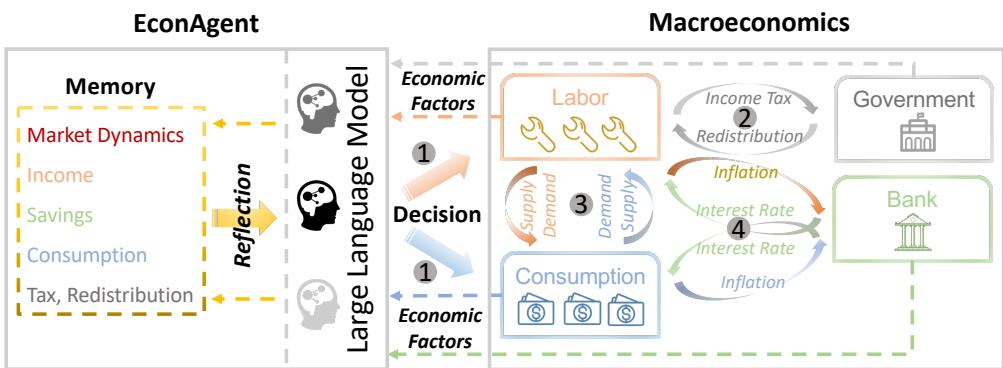
At the core of the agent side is the EconAgent design, which treats each household as a heterogeneous LLM agent. The simulation first initializes agents with realistic attributes such as age, job, and wage. The hourly wage is drawn from a Pareto distribution, and the monthly wage is computed as
vi=168wi,where wi is the hourly wage and 168 hours corresponds to the monthly working time. Each agent then makes two fundamental decisions in every monthly step. First, the agent decides whether to work:
li∼Bernoulli(piw),where piw is the work propensity. If li=1, the agent receives monthly wage income; otherwise, the agent earns zero income. Second, the agent chooses a consumption propensity pic, which represents the share of current wealth the agent wishes to allocate to essential goods. These decisions are not prescribed by fixed equations. Instead, they are produced by the LLM after processing economic signals, personal circumstances, and recent market history.
The government module implements taxation and redistribution. Taxes are collected from agents’ incomes using a progressive tax schedule. For income zi, the tax liability is computed as
T(zi)=k=1∑Bτk((bk+1−bk)1[zi>bk+1]+(zi−bk)1[bk<zi≤bk+1]),where bk denotes tax brackets, τk denotes the corresponding tax rate, and 1[⋅] is the indicator function. After tax collection, the revenue is redistributed evenly across all agents. The post-tax income becomes
z^i=zi−T(zi)+N1j=1∑NT(zj),and each agent’s savings are updated as
si←si+z^i.This mechanism links individual labor decisions to fiscal outcomes and then feeds those outcomes back to households through redistribution.
The labor and consumption modules connect personal decisions to market-level dynamics. Working agents generate productivity, which updates the inventory of essential goods according to
G←G+j=1∑Nlj×168×A,where A is the universal productivity parameter and G denotes total goods inventory. Meanwhile, total consumption demand is given by
D=j=1∑NPpjcsj,where P is the price of essential goods. The system then computes the supply-demand imbalance as
φˉ=max(D,G)D−G.This imbalance governs the adjustment of wages and prices. If demand exceeds supply, the model pushes wages and goods prices upward to reflect higher labor costs and tighter consumption conditions. Hourly wages are updated as
wi←wi(1+φi),φi∼sign(φˉ)U(0,αw∣φˉ∣),and the goods price is updated as
P←P(1+φP),φP∼sign(φˉ)U(0,αP∣φˉ∣),where αw and αP bound the maximum adjustment rate for wages and prices, respectively. Real consumption is then realized subject to inventory limits:
d^j=min(dj,G),c^j=d^j×P,followed by
G←G−d^j.Thus, the simulation explicitly ties aggregate market pressure to both production decisions and price signals.
The financial module completes the macroeconomic loop. Savings earn interest annually according to
si←si×(1+r).The interest rate is adjusted using a Taylor-style rule:
r=max(rn+πt+απ(π−πt)+αu(un−u),0),where rn is the natural interest rate, πt is the target inflation rate, un is the natural unemployment rate, and απ, αu are adjustment coefficients for inflation and unemployment gaps. Inflation and unemployment are defined as
π=Pˉn−1Pˉn−Pˉn−1,u=12N∑m=112∑j=1N(1−lj).This allows the banking sector to respond to annual price trends and labor-market slack.
To enable the LLM agents to interpret and act on these signals, the framework includes three dedicated modules: perception, memory, and action. The perception module equips each agent with a structured profile, including name, age, and occupation, while embedding current economic variables into the prompt. Job titles are generated according to wage deciles so that agents’ roles remain aligned with their income levels. Employment history is also reflected in the prompt, for example by informing an unemployed agent about a new job offer and salary. This lets the LLM reason about income risk, consumption pressure, and job stability in a way that mirrors household behavior in a real economy.
The memory module stores recent interaction history and periodically induces reflection. The system maintains a rolling context of recent market dynamics and agent decisions, and at the end of each quarter the agent is prompted to reflect on labor-market changes, consumption trends, and financial conditions. This reflection step condenses raw month-by-month observations into higher-level judgments about inflation, unemployment, income adequacy, and uncertainty. As a result, the agent can incorporate past macroeconomic patterns into its present decision-making rather than reacting only to the latest state.
The action module converts the perceived and remembered context into numerical economic decisions. The prompt explicitly highlights living costs, future aspirations, and current economic trends, and the LLM is instructed to output values indicating the propensity to work and to consume. In this way, the system replaces rigid behavioral equations with a language-model-based decision layer that can integrate heterogeneous factors such as income, savings, taxation, unemployment, goods shortages, and interest-rate changes.
Experiment
The experiments evaluate EconAgent against representative rule-based and learning-based agent baselines in a macroeconomic simulation, examining indicator stability, the effects of removing perception and reflection, the interpretability of decisions, and responses to external shocks. EconAgent produces more stable and plausible macroeconomic dynamics and reproduces key economic regularities, whereas the baselines show larger fluctuations or inconsistent relationships. Ablations and decision analyses further show that perception and reflection support adaptive behavior, while agent choices coherently reflect income, prices, savings, taxes, and broader economic trends, including a qualitatively realistic response to a COVID-19 prompt.
Regression analysis across agents shows that embedded economic variables are frequently statistically significant in shaping decisions. Work propensity is notably responsive to taxation, redistribution, and expected income, whereas interest rate effects are the least consistent. Consumption propensity is most strongly tied to current savings, with previous consumption also affecting most agents. Work decisions broadly reflect fiscal and income related variables. Consumption decisions show especially strong sensitivity to current savings. Interest rate significance is comparatively weaker for work propensity.
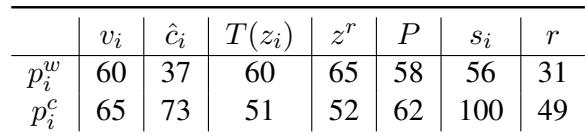
Regression analysis across agents shows that embedded economic variables play a meaningful role in shaping simulated decision-making. Work propensity is largely influenced by fiscal and income-related factors, especially taxation, redistribution, and expected income, while interest rates have weaker and less consistent effects. Consumption decisions are most strongly tied to current savings, with previous consumption also influencing many agents, indicating that household spending is primarily driven by financial constraints and past behavior rather than interest-rate conditions.