Command Palette
Search for a command to run...
تنبؤات دقيقة بالتفاعلات الجزيئية الحيوية الجديدة باستخدام IsoDDE
تنبؤات دقيقة بالتفاعلات الجزيئية الحيوية الجديدة باستخدام IsoDDE
Isomorphic Labs Team
الملخص
تعد عملية التنبؤ بالتفاعلات الجزيئية الحيوية ركيزة أساسية في التصميم العقلاني للأدوية (rational drug design)، ومع ذلك، لا يزال تحقيق الدقة التجريبية والقدرة على التعميم عبر الفضاء الكيميائي الجديد يمثل عقبة حرجة. ورغم أن نهج التعلم العميق، مثل AlphaFold 3، قد حققت تقدماً ملموساً في التنبؤ بالبنية، إلا أن الـ benchmarks تكشف عن استمرار وجود قيود في القدرة على التعميم في المناطق غير المستكشفة من الفضاء الجزيئي، وفي تقدير ألفة الارتباط (binding affinity)، وفي اكتشاف مواقع الارتباط الجزيئي على أسطح البروتينات التي لم يتم توصيفها مسبقاً.في هذا البحث، نقدم محرك تصميم الأدوية من Isomorphic Labs، والمعروف اختصاراً بـ (IsoDDE)، وهو نظام حوسبة موحد صُمم لمعالجة هذه القيود. وقد أثبتنا أن IsoDDE يضاعف دقة AlphaFold 3 بأكثر من مرتين في benchmark تحدي للتعميم بين البروتين واللجين (protein-ligand)، حيث نجح في نمذجة الأحداث المعقدة الخارجة عن التوزيع (out-of-distribution) مثل "الملاءمة المستحثة" (induced fits)، وتحديد جيوب الارتباط (binding pockets) الجديدة بدقة.أما في مجال المستحضرات الحيوية (biologics)، فقد تفوق IsoDDE بشكل كبير على النماذج الحالية، مما قدم معياراً جديداً (state of the art) للتنبؤ بواجهة الارتباط بين الأجسام المضادة والمستضدات (antibody-antigen interface) ونمذجة حلقة CDR-H3. وأخيراً، بالنسبة للروابط الجزيئية الصغيرة، تجاوزت تنبؤات ألفة الارتباط في IsoDDE الطرق الفيزيائية التي تُعد المعيار الذهبي، مما ساهم في سد الفجوة نحو الدقة بمستوى التجارب المخبرية دون العبء الحوسبي الذي تتطلبه سير العمل (workflows) التقليدية القائمة على الفيزياء.تُظهر نتائجنا أن IsoDDE يوفر أساساً قابلاً للتوسع لتصميم الأدوية المعتمد على الذكاء الاصطناعي، مما يوفر دقة تنبؤية عالية مطلوبة لاستكشاف الأنظمة البيولوجية الجديدة بدقة غير مسبوقة.
One-sentence Summary
The Isomorphic Labs Drug Design Engine (IsoDDE) is a unified computational system that outperforms AlphaFold 3 on protein-ligand generalization benchmarks by modeling complex out-of-distribution events like induced fits, achieving state-of-the-art accuracy in antibody-antigen interface and CDR-H3 loop modeling, and providing small molecule binding affinity predictions that exceed gold-standard physics-based methods.
Key Contributions
- The paper introduces the Isomorphic Labs Drug Design Engine (IsoDDE), a unified computational system that achieves a step change in unconditional accuracy for biomolecular interaction prediction. This architecture demonstrates the ability to more than double the accuracy of AlphaFold 3 on protein-ligand generalization benchmarks and successfully models complex out-of-distribution events like induced fits.
- This work presents a high-performance model for the biologics domain that establishes a new state of the art in antibody-antigen interface prediction and CDR-H3 loop modeling. The system also enables blind pocket identification, allowing for the discovery of novel binding sites on previously uncharacterized protein surfaces without requiring a specified ligand.
- The research provides a quantitative binding affinity estimation capability that outperforms gold-standard physics-based methods for small molecule binders. This approach bridges the gap toward experimental-grade precision while avoiding the high computational overhead associated with traditional free energy perturbation workflows.
Introduction
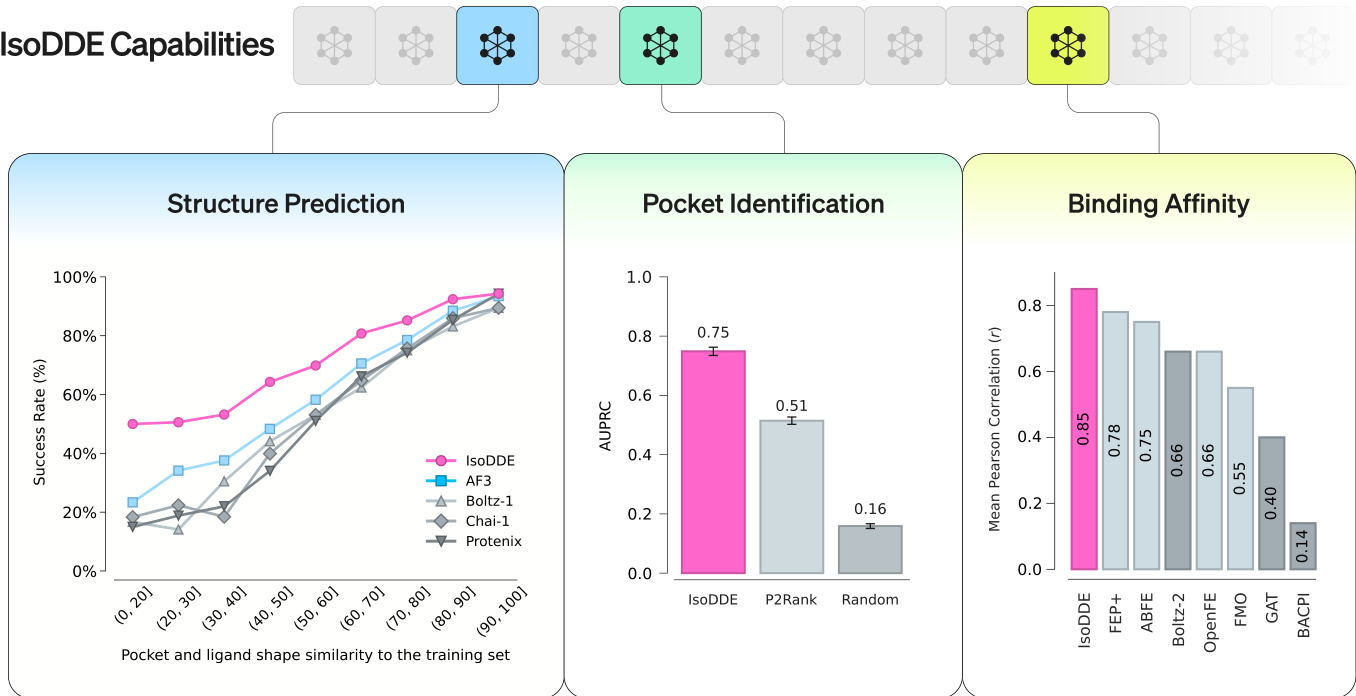
Accurate prediction of biomolecular interactions is essential for rational drug design and the discovery of new biological mechanisms. While deep learning models like AlphaFold 3 have advanced structure prediction, they often struggle to generalize to unexplored chemical spaces, fail to identify novel binding pockets, and lack the ability to provide precise quantitative binding affinity. Current methods for estimating affinity are either computationally expensive physics-based simulations or deep learning models that correlate poorly with experimental data. The authors introduce the Isomorphic Labs Drug Design Engine (IsoDDE), a unified computational system that achieves a step change in accuracy and generalization. IsoDDE more than doubles the accuracy of previous state-of-the-art models on protein-ligand benchmarks, provides superior antibody-antigen interface modeling, and delivers binding affinity predictions that exceed gold-standard physics-based methods.
Experiment
IsoDDE was evaluated across multiple benchmarks, including Runs N' Poses, FoldBench, and antibody-antigen datasets, to assess its structural modeling and generalization capabilities. The results demonstrate that the model significantly outperforms previous state-of-the-art methods like AlphaFold 3 and Boltz-2, particularly when predicting highly novel protein-ligand interfaces and complex antibody-antigen structures. Furthermore, IsoDDE shows exceptional performance in predicting binding affinities and identifying cryptic pockets, proving to be a robust tool for navigating diverse chemical and biological spaces in drug discovery.
The authors compare the performance of IsoDDE against AF3 across different subsets of the Runs N' Poses benchmark. Results show that IsoDDE achieves a higher success rate than AF3 in the full dataset, the filtered dataset, and the filtered plus clustered dataset. IsoDDE demonstrates a consistent performance advantage over AF3 across all evaluated data subsets The mean gain in success rate remains substantial whether using the full or filtered datasets IsoDDE maintains superior performance even when the data is filtered and clustered to reduce redundancy

The authors evaluate the performance of IsoDDE against Boltz-2 across different data subsets. Results show that IsoDDE maintains a higher success rate than Boltz-2 in the full, filtered, and clustered datasets. IsoDDE demonstrates a substantial mean gain in performance compared to Boltz-2 across all tested sets The model maintains consistent improvements even when data is filtered or clustered Performance advantages are observed in both the full dataset and more specialized subsets

The authors evaluate IsoDDE's structural modeling performance on the FoldBench dataset across three distinct interface types. Results show that IsoDDE achieves superior success rates compared to several external models in antibody-antigen, protein-ligand, and protein-protein benchmarks. IsoDDE demonstrates higher success rates in antibody-antigen interface prediction than all compared models The model shows improved performance in protein-ligand modeling relative to the other evaluated methods IsoDDE maintains a competitive advantage across protein-protein interaction benchmarks
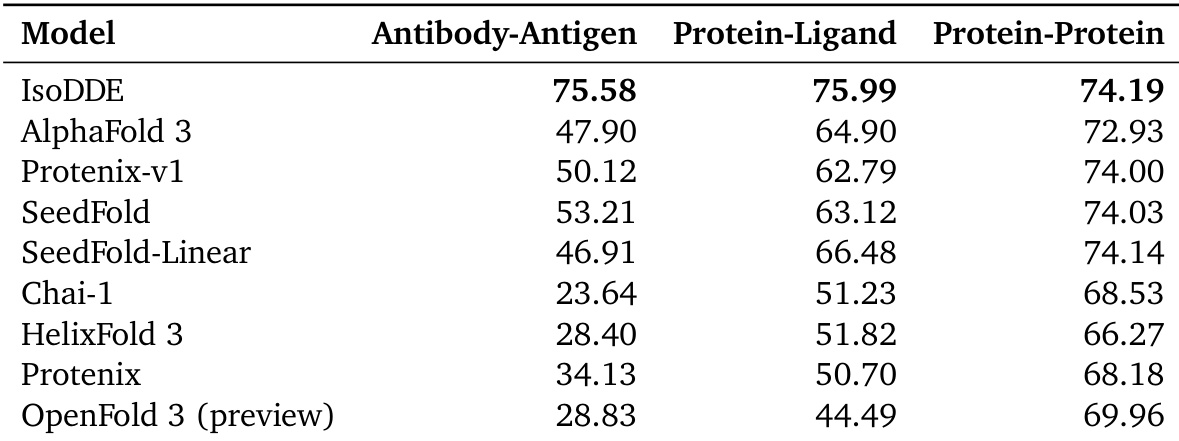
IsoDDE was evaluated against AF3, Boltz-2, and various external models using the Runs N' Poses and FoldBench benchmarks to assess its structural modeling capabilities. Across diverse datasets and interface types, including antibody-antigen, protein-ligand, and protein-protein interactions, IsoDDE consistently demonstrated superior success rates. The results indicate that the model maintains a robust performance advantage even when data is filtered or clustered to reduce redundancy.