Command Palette
Search for a command to run...
تكميم جبري للجاذبية انطلاقاً من المخروط الصفري
تكميم جبري للجاذبية انطلاقاً من المخروط الصفري
Venkatesa Chandrasekaran
الملخص
نقترح تكميماً مستقلاً عن الخلفية للنسبية العامة في الفراغ على زمكانات لورنتزية رباعية الأبعاد. انطلاقاً من الجاذبية من الرتبة الأولى، نحل قيود الجاذبية على مخاريط صفرية متقاطعة لمنطقة جزئية حجمية ونحصل على فضاء الطور المختزل عند قيمة منتهية لثابت نيوتن G_N. نرقّي أقواس بواسون القانونية لهذا الفضاء إلى علاقات تبادلية، ونستخدم تشوهات الفعل المختزل لتعريف جبر للمشاهدات. وبالاستناد إلى ذلك، نستخدم دوالاً موجية غاوسية للأزواج القانونية لبناء تمثيل غير اضطرابي لفضاء هيلبرت، يولد فيه هذا الجبر عاملاً من النمط I. وبتركيب السعات بين حالات محضّرة على مخاريط صفرية، نحصل على تكامل مسار لورنتزي يتقارب فيه كل مجموع على الحالات الوسيطة تقارباً مطلقاً. وللتحقق، نحسب سعة إنتاج وإفناء زوج من الغرافيتونات على مخروط صفري بشكل غير اضطرابي في G_N ونجد تعبيراً منتهياً بصيغة مغلقة، رغم أن المفكوك أولاً في G_N يعطي تباعداً لوغاريتمياً. ثم نستخدم تباين التكامل المساري تحت تعددات الشكل لنبين أن معيناً سببیاً ماكروسكوبياً بحجم أعظمي معطى يمتلك فضاء هيلبرت منتهي الأبعاد. ومن الأثر اللورنتزي نحصل على إنتروبيا بيكنشتاين-هوكينغ للسطوح المحاصرة هامشياً، ونحسب تصحيحها اللوغاريتمي لثقوب شفارتسشيلد السوداء الكبيرة، مستعيدين عند حلقة واحدة المعامل الذي حصل عليه سين بالطرق الإقليدية. ونختم باشتقاق معادلات أينشتاين شبه الكلاسيكية حتى حلقة واحدة بوصفها حد الطاقة المنخفضة لهذه النظرية.
One-sentence Summary
Researchers at the Leinweber Institute for Theoretical Physics, Stanford University, propose a background independent algebraic quantization of vacuum general relativity on four-dimensional Lorentzian spacetimes that, starting from first-order gravity, solves the gravitational constraints on intersecting null cones of a bulk subregion to obtain a reduced phase space at finite GN, promotes the resulting canonical Poisson brackets to commutation relations, and uses deformations of the reduced action to define an algebra of observables which generates a type I factor in a nonperturbative Hilbert space representation built from Gaussian wavefunctions of canonical pairs; by composing amplitudes between states prepared on null cones, they obtain a Lorentzian path integral in which each sum over intermediate states converges absolutely; as a check, they compute the graviton pair creation and annihilation amplitude on a null cone nonperturbatively in GN and find a finite closed form expression even though expanding first in GN yields a logarithmic divergence; using diffeomorphism invariance of the path integral, they show that a macroscopic causal diamond with a given maximum size has a finite dimensional Hilbert space, and from the Lorentzian trace they obtain the Bekenstein-Hawking entropy for marginally trapped surfaces and calculate its logarithmic correction for large Schwarzschild black holes, recovering at one loop the coefficient Sen obtained through Euclidean methods; they end by deriving the semiclassical Einstein equations to one loop as the low energy limit of this theory.
Key Contributions
- The paper develops a nonperturbative background-independent quantization of four-dimensional Lorentzian vacuum general relativity by solving constraints on intersecting null cones, obtaining a reduced phase space at finite Newton's constant and a Hilbert space representation whose observable algebra is a type I factor.
- It constructs a Lorentzian path integral by composing amplitudes between states prepared on null cones, with absolutely convergent intermediate-state sums, and obtains a finite closed-form graviton pair creation and annihilation amplitude nonperturbatively even though a perturbative expansion first in Newton's constant diverges logarithmically.
- The framework shows that macroscopic causal diamonds with bounded maximum size have finite-dimensional Hilbert spaces, derives the Bekenstein-Hawking entropy for marginally trapped surfaces plus the logarithmic correction for large Schwarzschild black holes matching Sen's one-loop coefficient, and recovers the one-loop semiclassical Einstein equations as its low-energy limit.
Introduction
Background-independent quantum gravity requires observables that remain meaningful when spacetime fluctuates, especially for finite bulk regions such as causal diamonds. Prior approaches face obstacles: perturbative pure general relativity is nonrenormalizable, string theory does not fix finite-subregion amplitudes nonperturbatively, loop quantum gravity has an open Hamiltonian constraint problem, and AdS/CFT gives only indirect bulk observables. The authors construct a nonperturbative algebra of observables for a causal diamond directly from its null boundary data. They leverage first-order gravity with the simplicity constraint, treat corner edge modes as a dynamical reference frame, solve the null constraints, and define amplitudes by gluing subregions and summing over boundary states; in four dimensions this leads to a finite-dimensional Hilbert space for macroscopic diamonds, a discrete area spectrum, Bekenstein-Hawking entropy, and recovery of one-loop semiclassical Einstein equations.
Method
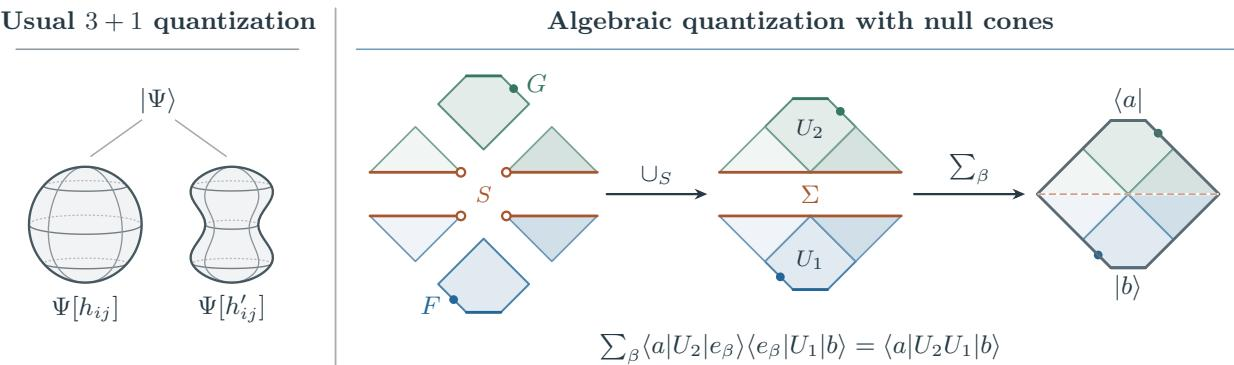
The authors propose an algebraic quantization framework that contrasts with the usual 3+1 quantization of general relativity. In the standard approach, a wavefunction is specified for the spatial metric on an entire Cauchy slice, which includes the metric outside a given causal diamond. To determine the independent states admitted by a causal diamond itself, the authors quantize characteristic data on the incoming null cone together with compatible data on a spacelike cap Σ0. This prepares a joint state of the gravitational clock and the matter field before adjoining an exterior.
To define a gravitational clock for a causal diamond, the authors follow an incoming null generator from the spacelike cap Σ0 to the corner S where it meets the outgoing null cone. Fixing the tangent vector in a local Lorentz frame on Σ0 sets the scale of the affine parameter, such that its value at the corner defines the clock reading.
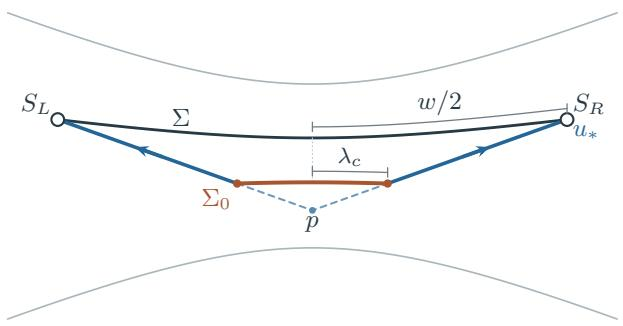
In JT gravity coupled to a massless scalar field, the proper width of a causal diamond can fluctuate even when the metric curvature is fixed. The authors demonstrate that the flux of matter across a null generator can be varied while holding the clock reading fixed.
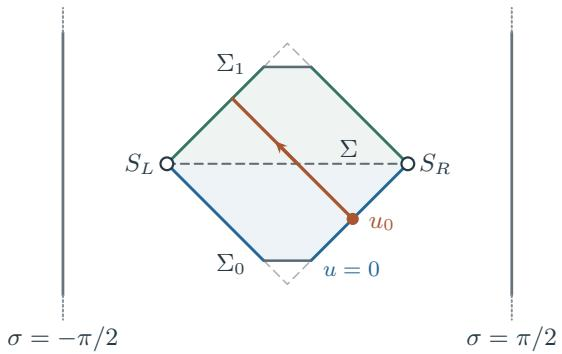
As shown in the Penrose diagram above, a matter shock can cross the incoming null generator at u0, lowering the dilaton at the corner SR without changing the affine parameter u∗ at that corner. This allows the preparation of distinct states with identical clock probabilities. To obtain the amplitude for a larger region, the authors glue neighboring null cone preparations by matching their fields at the shared corner S. They then compose the amplitudes to the past and future of the joined slice Σ by summing their product over a basis of states on that slice.
In four dimensions, the relationship between the clock reading and the state of the region is modified by gravitational radiation. Shear changes the affine parameter at which a null generator reaches a given area element at the corner. Consequently, an upper limit on the clock reading restricts the graviton states that can be prepared.
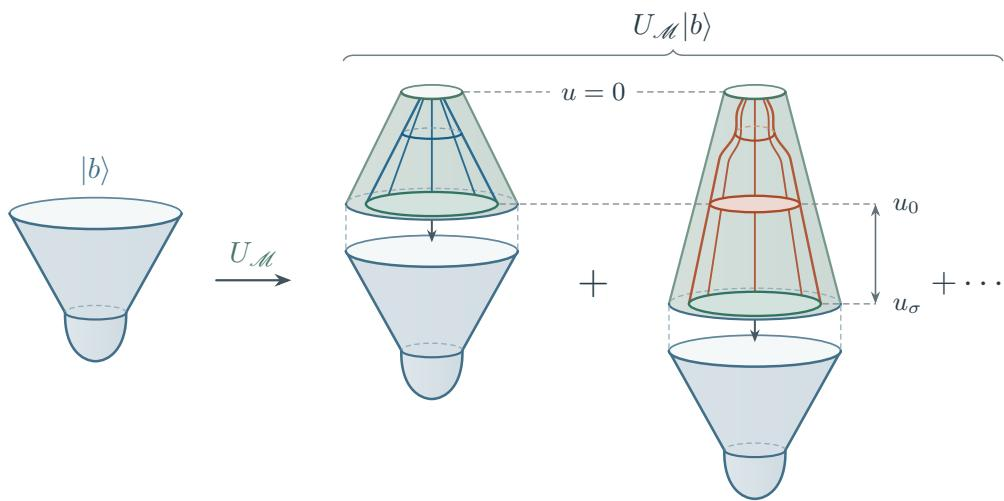
As illustrated above, after gluing a cobordism to an incoming state ∣b⟩, the outgoing state UM∣b⟩ can exist as a superposition of different gravitational clock readings. With the initial area element and expansion held fixed, a shear-free null generator reaches the corner S at u0, whereas a sheared null generator reaches the same corner area element at a later affine parameter uσ>u0.
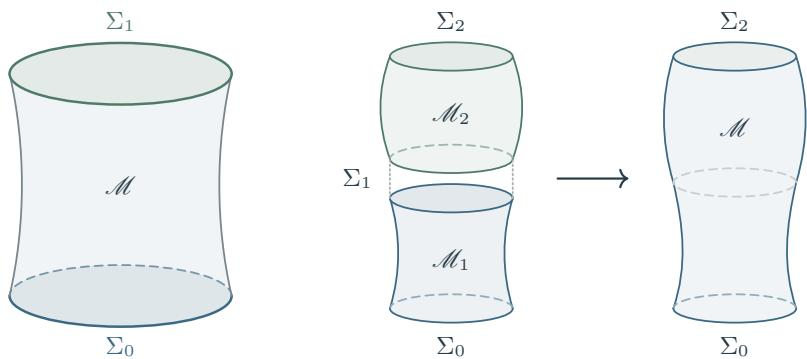
When joining neighboring subregions in space, the authors use an entangling product that matches the fields at the corner S and identifies states related by a simultaneous change of frame.
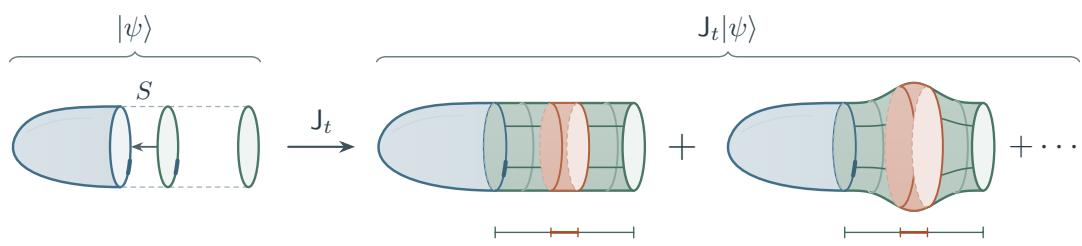
The map Jt joins superpositions of states that match the required fields and are invariant under simultaneous surface symmetries at S. At a fixed proper width and induced metrics on both faces, larger intermediate areas allow the second collar to enclose more volume. The quantization of these boundary observables and the subsequent restriction of the clock readings yield a finite-dimensional Hilbert space for the causal diamond, distinguishing the four-dimensional case from the infinite-dimensional algebra found in JT gravity.
Experiment
These analyses evaluate gravitational Hilbert spaces on causal diamonds by restricting clock readings and allowing corner area fluctuations, then compare cut and uncut amplitudes under relative boosts to test state counting. They establish that the causal diamond Hilbert space is finite dimensional, which implies a discrete area spectrum, finite thermal traces, and finite boundary energy spectra. For marginally trapped surfaces, the same construction yields a thermal density matrix whose entropy reproduces the Bekenstein-Hawking area term plus a logarithmic correction, and the one-loop coefficient for a large Schwarzschild black hole matches Sen’s result.