Command Palette
Search for a command to run...
Embo-Harness: نحو فهم حزام النماذج الحدودية كسياسات
Embo-Harness: نحو فهم حزام النماذج الحدودية كسياسات
الملخص
تُظهر النماذج متعددة الوسائط الحدودية قدرة استثنائية على التعميم في توليد أفعال الروبوت انطلاقًا من الملاحظات والتعليمات، مما يتيح نمطًا جديدًا تعمل فيه هذه النماذج مباشرة كسياسات داخل أحزمة روبوتية مغلقة الحلقة. غير أن مبادئ تصميم هذه الأحزمة، والقدرات الكامنة وراء أدائها القوي، ما تزال غير واضحة. نقدم Embo-Harness، وهو إطار عمل للدراسة المنهجية لأحزمة النماذج الحدودية كسياسات. ندرس أربعة مكونات للحلقة الوكيلة الروبوتية، وهي: التلقين، والتخطيط، وتنفيذ الأفعال، واستخدام الأدوات، ونستخلص ست نتائج تجريبية في وصفة عملية. تعطي هذه الوصفة الأولوية للواجهات التي تستثمر قدرات النموذج الأصلية في الاستدلال البصري واستخدام الأدوات بدلًا من الخطط أو المهارات أو الأوليات الحركية المصممة يدويًا، وتحدد خيارات فعالة لتمثيل الأفعال، والتقسيم إلى مقاطع، وجهد الاستدلال، والملاحظات البصرية، والمتواليات القصيرة متعددة الأفعال، وتنقيح السياسة. على RoboLab-120، يحقق Embo-Harness معدل نجاح قدره 83.3%، متجاوزًا أقوى خط أساس مُبلغ عنه بفارق 26.2 نقطة مئوية. كما ينجح في 15 من أصل 20 تجربة بدون أمثلة مسبقة عبر أربع مهام معالجة في العالم الحقيقي. وإلى جانب الأداء، تشير تدخلات مضبوطة إلى أن النموذج المدروس يعتمد بقوة أكبر على التقدير المكاني الدقيق للهدف مقارنة بالتوليد الصريح منخفض المستوى للمفاصل أو المسارات. تقدم هذه النتائج وصفة عملية لبناء أحزمة قوية من النماذج الحدودية كسياسات، وحسابًا أوضح للقدرات التي تحرك أداءها.
One-sentence Summary
Researchers from S-Lab, Nanyang Technological University and collaborating institutions propose Embo-Harness, a framework for systematically studying frontier-model-as-policy robotic harnesses across prompting, planning, action execution, and tool use, distilling six empirical findings into a recipe that favors native visual reasoning and tool use over handcrafted priors; the approach achieves an 83.3% success rate on RoboLab-120, outperforming the strongest reported baseline by 26.2 percentage points, and succeeds in 15 of 20 zero-shot real-world trials.
Key Contributions
- Embo-Harness is introduced as a framework for systematically studying frontier-model-as-policy robotic harnesses across prompting, planning, action execution, and tool use, distilling six empirical findings into a practical recipe that prioritizes native visual reasoning and tool-use capabilities over handcrafted plans, skills, or action priors.
- The recipe identifies effective choices for action representation, chunking, reasoning effort, visual observations, short multi-action sequences, and policy refinement, and Embo-Harness achieves an 83.3% success rate on RoboLab-120, outperforming the strongest reported baseline by 26.2 percentage points.
- In real-world manipulation, Embo-Harness succeeds in 15 of 20 zero-shot trials across four tasks, and controlled interventions indicate performance depends more strongly on accurate spatial target estimation than on explicit low-level joint or trajectory generation.
Introduction
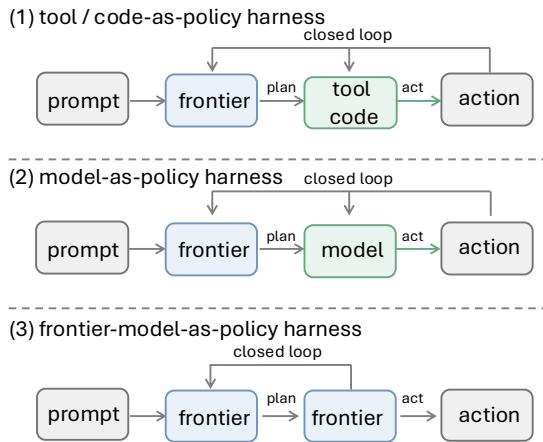
Recent frontier multimodal models such as GPT-6-Astra are reshaping robotic manipulation by handling complex instructions, diverse environments, long-horizon tasks, and failure recovery more effectively than specialized robot foundation models like VLAs and WAMs. Existing robotic harnesses range from tool/code-as-policy systems that use large models only for high-level planning, to model-as-policy systems that delegate action generation to learned policies, and more recently to frontier-model-as-policy closed loops. Prior work such as SenseNova-RoboRSI and GPT-as-Policy mainly demonstrates or tunes individual systems but does not isolate which harness components drive the gains or explain why general-purpose frontier models outperform specialized robot policies. The authors introduce Embo-Harness, a controlled study that systematically varies prompting, planning, action execution, and tool use from a common baseline. Their recipe achieves 83.3% success on RoboLab-120 and 15 of 20 zero-shot real-world trials, and they further show that frontier models’ manipulation strength depends more on accurate spatial perception than on low-level action generation.
Method
The authors begin by categorizing existing robotic harnesses into three distinct paradigms based on how robot actions are generated within a closed-loop framework.
In tool or code-as-policy harnesses, frontier models handle high-level planning while predefined tools or generated code execute actions. Model-as-policy harnesses delegate action generation to specialized learned policy models. In contrast, frontier-model-as-policy harnesses utilize the frontier model itself to both plan and generate robot actions directly. To systematically develop a practical recipe for this emerging paradigm, the authors introduce Embo-Harness, which explores four key dimensions of the robotic agentic loop: prompting, planning, action execution, and tool use.
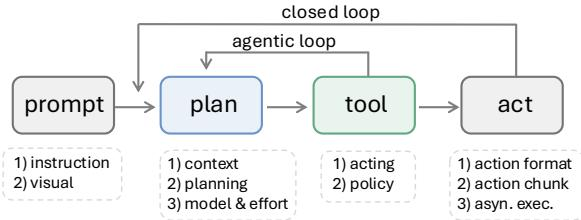
The prompting dimension covers text instructions and visual observations. Planning involves context management, planning strategies, and the selection of model variants and reasoning efforts. Action execution considers action representations, chunk sizes, and asynchronous inference. Finally, tool use extends the harness through combined action generation tools and the integration of external robot policies.
Through progressive exploration and evaluation on the RoboLab benchmark, the authors distill a unified and highly effective pipeline for frontier-model-as-policy harnesses.
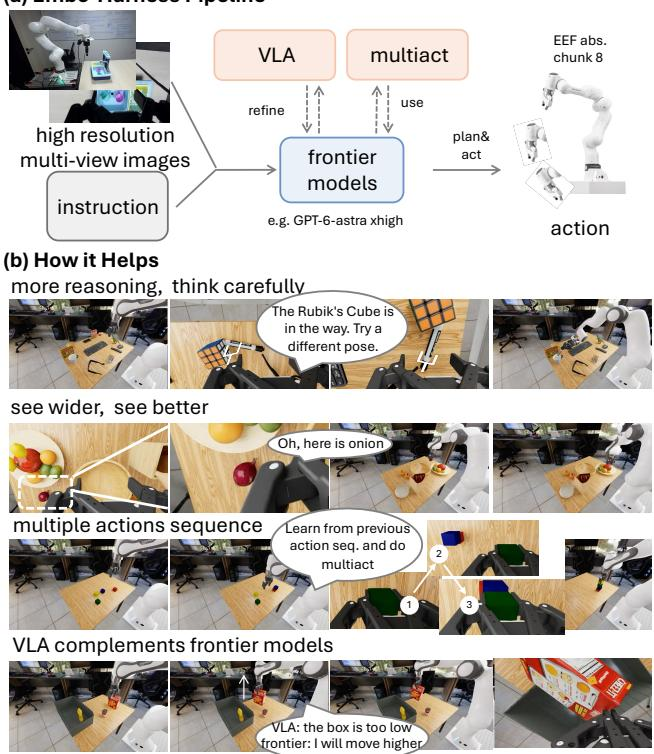
The final Embo-Harness pipeline takes task instructions and high-resolution multi-view images as inputs. These are fed into a frontier model, specifically GPT-6-Astra configured with high reasoning effort, to leverage its native visual reasoning capabilities. For action execution, the model generates short, fixed-length chunks of absolute end-effector actions, which proves more effective than joint-space actions or adaptive chunking. To further enhance manipulation performance, the authors integrate two specific tools into the agentic loop. First, short multi-action sequences allow the model to generate multiple consecutive actions in a single output without observing intermediate states, capturing common patterns like approach, grasp, and retreat. Second, Vision-Language-Action model refinement is employed, where a VLA proposes an initial action that the frontier model then refines and executes, effectively combining the complementary capabilities of both systems.
Experiment
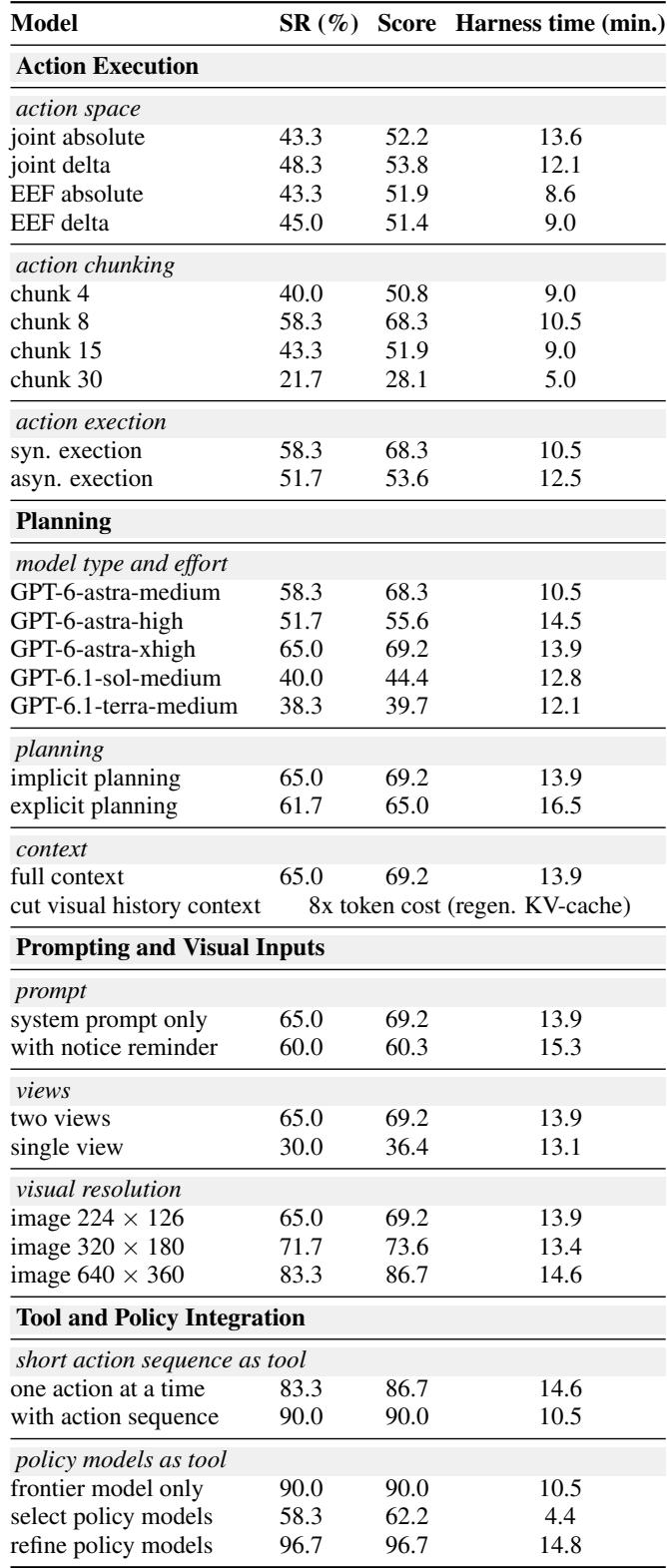
The experiments evaluate a frontier-model-as-policy harness across simulated RoboLab-120 benchmarks and real-world tabletop tasks, with ablations on action execution, planning, prompting, and visual inputs. Frontier models can handle multiple action formats but perform best when predicting spatial target poses while delegating low-level control to inverse kinematics or interpolation, and they benefit from stronger reasoning and higher visual resolution, whereas explicit planning, asynchronous inference, and failure-derived reminders do not help. The method achieves strong zero-shot benchmark and real-world results, with remaining failures concentrated in tasks requiring precise localization and alignment, indicating that spatial perception rather than explicit low-level action generation is the main driver of manipulation capability.
The ablation shows that frontier models can handle multiple action formats, while intermediate action chunking and higher visual resolution improve performance. Planning and prompting additions such as explicit plans and failure-derived reminders do not improve success and often increase execution time, while removing the wrist view or relying on asynchronous inference is ineffective. Tool-based short multi-action sequences improve both task success and execution speed, and reducing historical context maintains performance with lower execution time. All four action representations achieve comparable success rates, indicating frontier models can generate both end-effector and joint-space actions in absolute or delta form. An intermediate action chunk size performs best by balancing movement speed and execution horizon. Stronger model variants and higher reasoning efforts generally improve performance, but medium reasoning can outperform high reasoning. Explicit planning and task-agnostic text reminders add execution overhead without improving task performance. Removing the wrist view lowers performance, while higher visual resolution provides substantial gains. Asynchronous inference is not adopted because models focus on immediate movements rather than anticipating future robot states. Short multi-action sequences improve both task performance and execution speed. Trimming historical observations preserves performance and reduces execution time but increases uncached token consumption.
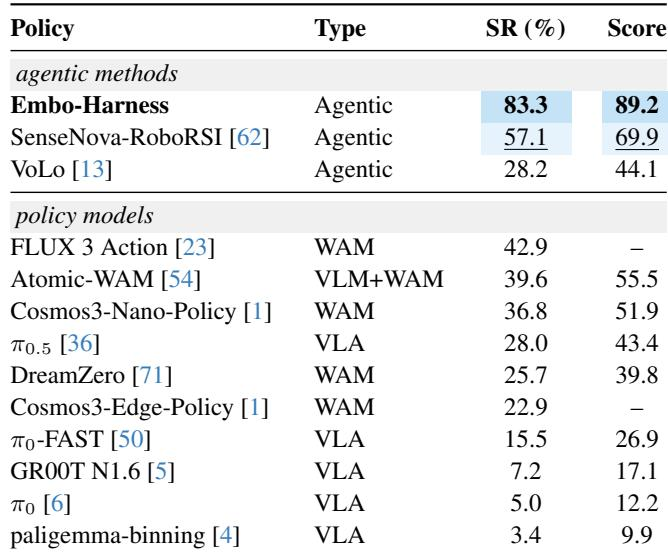
On the full RoboLab-120 benchmark, Embo-Harness achieves the highest reported success rate and score among all compared methods. It outperforms the strongest baseline, SenseNova-RoboRSI, by 26.2 percentage points in success rate and 19.3 points in score. The WAM and VLM+WAM policy models trail the leading agentic approaches. Embo-Harness is the top performer on both success rate and score among all reported methods. Its advantage over the strongest baseline, SenseNova-RoboRSI, is 26.2 percentage points in success rate and 19.3 points in score. Among the policy models compared, FLUX 3 Action and Atomic-WAM achieve moderate success rates but remain below the leading agentic methods.
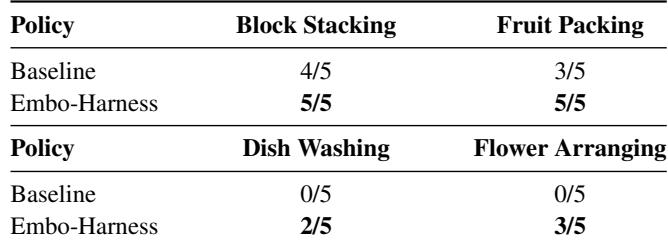
Embo-Harness consistently outperforms the baseline across four real-world manipulation tasks. It achieves perfect success in block stacking and fruit packing, while the baseline succeeds only partially or not at all. Remaining failures are attributed to fine-grained spatial perception challenges, especially precise faucet localization and vase opening alignment. Embo-Harness improves over the baseline on every task, with the largest relative gains in dish washing and flower arranging, where the baseline records no successes. Failures concentrate in tasks requiring precise spatial localization and alignment, such as locating a small faucet switch and aligning with a vase opening.
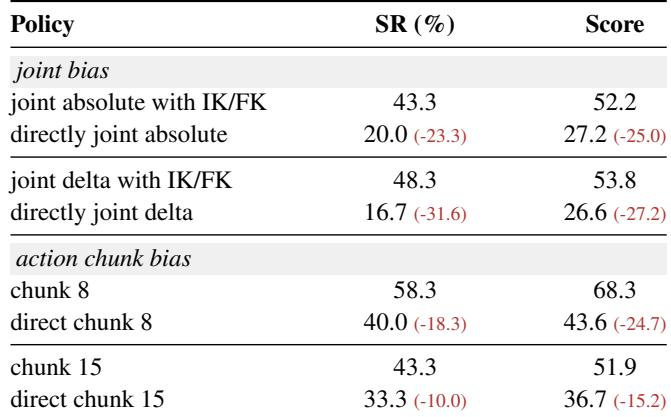
The results show that GPT-Astra can generate joint-level actions and multi-frame trajectories directly, but these modes consistently underperform control strategies that use IK/FK assistance or target pose interpolation. Direct joint-angle control reduces success rates substantially compared with IK/FK-assisted output, and direct chunk generation lags behind predicting a future target pose. The pattern suggests the model's manipulation strength is not primarily driven by learned low-level robot action priors. Direct joint-angle generation achieves lower success rates than IK/FK-assisted joint control, with drops of over 20 percentage points for both absolute and delta joint outputs. Explicit multi-frame action chunk generation underperforms target pose prediction followed by interpolation, indicating limited benefit from frame-level trajectory modeling.
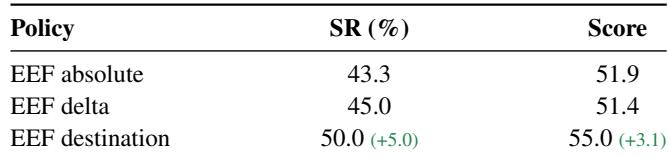
Directly predicting the end-effector destination yields the highest success rate and task completion score compared with short-range absolute and delta end-effector control. Absolute and delta control perform similarly, with delta slightly ahead of absolute. These results suggest spatial perception contributes more to manipulation capability than low-level action generation. Direct end-effector destination prediction outperforms both absolute and delta end-effector control on success rate and task completion score. Absolute and delta end-effector control show comparable lower performance, with delta only slightly ahead of absolute.
These experiments evaluate action representations, perception, prompting, context handling, and overall performance through ablations, a full benchmark comparison, real-world manipulation tasks, and action-output analyses. The ablations show frontier models are flexible across action formats and benefit from intermediate action chunking, higher visual resolution, tool-based short multi-action sequences, and trimmed history, while explicit plans, reminders, asynchronous inference, and removing the wrist view do not help. Benchmark and real-world results indicate the proposed Embo-Harness consistently outperforms strong baselines, with remaining failures tied mainly to fine-grained spatial localization. Additional studies reveal that direct end-effector destination prediction and IK/FK or target pose interpolation outperform direct joint-angle and multi-frame trajectory generation, suggesting spatial perception matters more than low-level action priors.