Command Palette
Search for a command to run...
3AGameFactory-Motion: تجهيز هيكلي وكيلي وتوليد حركة معقدة موثوق لأصول ثلاثية الأبعاد متنوعة
3AGameFactory-Motion: تجهيز هيكلي وكيلي وتوليد حركة معقدة موثوق لأصول ثلاثية الأبعاد متنوعة
الملخص
يتطلب تحريك أصول ثلاثية الأبعاد اعتباطية انطلاقًا من التعليمات استدلالًا بنيويًا وتحكمًا حركيًا معًا، غير أن معايير تقييم الحركة القائمة تغطي في الغالب هياكل بشرية أو حيوانية تقليدية بتعليمات بسيطة. نقدم DivDynBench الذي يقيّم التجهيز الهيكلي وتوليد الحركة عبر ست فئات مورفولوجية، مع تعليمات تتطلب تنسيقًا متعدد المراحل بين الأجزاء وقيودًا صريحة على التوقيت والزوايا والتكرار والمسارات. وباستخدام نماذج لغوية كبيرة، نقارن منهجيًا بين ثلاثة أنماط شائعة: توليد الحركة المتخصص، وتوليد الفيديو متبوعًا باسترجاع الحركة، والتوليد المباشر القائم على الوكيل. ونحلل قدراتها على التحكم، وقابليتها للتكيف عبر المورفولوجيات، وتكاليف التوليد. واسترشادًا بهذه المقارنة، نقترح إطارًا حركيًا وكيليًا يكتب فيه الوكيل برامج هيكلية وحركية بارامترية مدمجة، بينما يتولى منفذ حتمي عمليات التجهيز الهيكلي والحل الحركي والتصحيح الهندسي. يقلل التحكم البارامتري المدمج من الأعباء الحسابية للتوليد ويحسن موثوقية التجهيز الهيكلي ودقة التحكم الحركي، مما يوفر توجيهًا عمليًا لنشر توليد الحركة ثلاثية الأبعاد المعقدة.
One-sentence Summary
Researchers from Peking University, Nanyang Technological University, and other institutions introduce DivDynBench, a benchmark for rigging and motion generation across six morphology categories with instructions requiring multi-phase coordination and explicit timing, angle, repetition, and trajectory constraints; they compare specialized motion generation, video-to-motion recovery, and direct agent-driven paradigms, and propose an Agentic Motion Framework whose compact parametric skeleton and motion programs with deterministic execution improve rigging reliability and motion-control accuracy while lowering generation overhead.
Key Contributions
- The paper introduces DivDynBench, a benchmark that evaluates rigging and motion generation across six morphology categories with instructions requiring multi-phase part coordination and explicit timing, angle, repetition, and trajectory constraints.
- The paper systematically compares three LLM-based animation paradigms: specialized motion generation, video generation followed by motion recovery, and direct agent-driven generation, analyzing their control capabilities, cross-morphology adaptability, and generation costs.
- The paper presents an Agentic Motion Framework in which an agent writes compact parametric skeleton and motion programs and a deterministic executor performs rigging, kinematic solving, and geometric correction; compact parameter control reduces generation overhead and improves rigging reliability and motion-control accuracy.
Introduction
Recent text-to-motion models can synthesize natural motion, but their controllability remains limited: they often fail long-horizon instructions that require ordered phases, precise timing, specified angles, and repetitions. These models are also typically trained on conventional skeletons and simple prompts, making them poorly suited to diverse 3D assets such as multipeds, axial bodies, winged creatures, mixed-limb characters, and mechanical structures. Existing motion benchmarks share these limitations and do not systematically evaluate numeric control or cross-morphology generalization. To address this, the authors introduce DivDynBench, a benchmark spanning six morphology categories with complex instructions and program-verified constraints, and they compare three LLM-assisted paradigms: segmenting instructions for specialized generators, planning video with motion recovery, and direct agent-driven generation. Because direct generation is promising but costly and unstable, they propose an Agentic Motion Framework that combines agent-authored sparse parameters with deterministic rigging and kinematic solving to improve rigging reliability and motion-control accuracy.
Dataset

The authors introduce DivDynBench as a benchmark built around a common 3D asset import workflow. Its inputs are readable GLB assets rather than ground-truth motion clips on a standardized human skeleton.
-
Sources and composition:
- 50 self-contained GLB assets.
- Assets are collected from 3D generative model outputs, basic shapes downloaded from the internet, and engine libraries.
- Morphology coverage includes humanoids, multipeds, axial bodies, winged creatures, mixed-limb characters, and articulated mechanical objects.
- Each asset includes a manually designed skeleton and skinning weights as rigging ground truth.
- The benchmark contains 850 motion tasks.
-
Task construction and processing:
- A rigging task starts from a raw mesh.
- An instruction-driven motion task uses either a predicted rig or a provided reference rig.
- Each task pairs an asset with a motion instruction, itemized scoring criteria, and structured rules.
- Text tasks emphasize part coordination, action order, and phases, using mostly qualitative descriptions.
- Numeric tasks additionally specify timing, angles, displacements, repetition counts, or tolerances, with pre-reviewed check specifications.
-
Usage in the paper:
- The paper uses DivDynBench to evaluate structural inference and motion control through rigging and motion generation metrics.
- Rigging metrics include Source Fidelity, J2J, mIoU, Joint validity, Edge p99, and Rigid RMS.
- Motion metrics include Semantic, Accuracy, Completeness, Morphology, Quality, Aesthetics, and Overall.
- Evaluation combines programmatic measurements of geometry, motion, and numeric constraints with rubric-based visual scoring by a multimodal language model.
- The provided section does not specify a training split or mixture ratios; it describes benchmark evaluation rather than model training.
Method
The authors propose an Agentic Motion Framework to generate animations for diverse skeletons without the cost and control issues of directly generating joint coordinates. Instead of predicting joint coordinates, which often leads to interpenetration and foot sliding, the framework employs a vision-language agent to write compact skeleton configurations and parametric motion programs. A deterministic executor then translates these into rigs or animations. Given a mesh M=(V,F) and an instruction I, the interfaces are defined as:
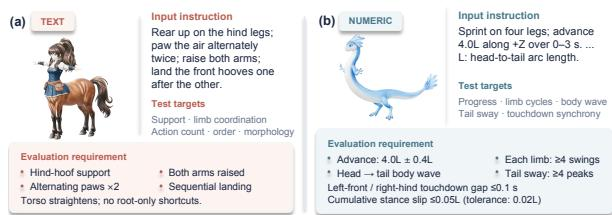
S=Arig(OM),P=Amot(I,OR),R=Xrig(M,S),Y=Xmot(M,R,P).Here, A and X denote the agent and executor, respectively. The agent observes calibrated asset views OM or views with rig information OR to produce a rigging configuration S and a parametric motion program P. The executor generates the rig R and the final animation Y. If a rig is already provided, it sets R=Rin and bypasses the rigging stage. The instructions processed by the agent can range from qualitative text descriptions emphasizing part coordination and action order, to precise numeric tasks specifying timing, angles, and displacements, as illustrated in the task examples.
The framework is divided into two main stages: Agentic Rigging and Agentic Motion Generation, as detailed in the system diagram.
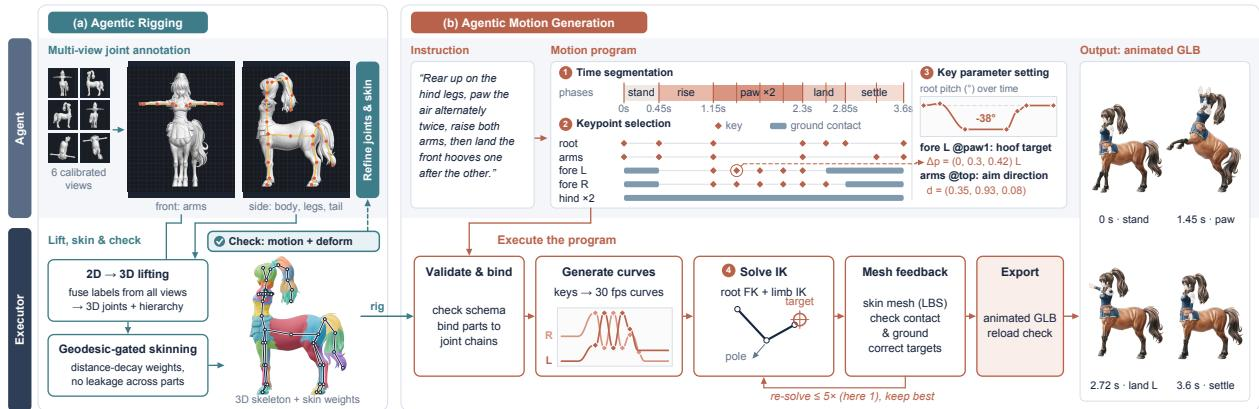
In the Agentic Rigging stage, the agent identifies parts in calibrated views, annotates joints, and connects them into bone chains. The executor reconstructs 3D joint positions from these annotations and builds the specified hierarchy. This part-to-joint mapping associates instruction terms with the actual structure of the asset without assuming a fixed human skeleton. For skinning, the executor computes distance-based skinning weights and smooths them within geodesically gated neighborhoods to limit influence across separate appendages. The agent can further restrict influences by part and assign rigid components to individual bones. The rig is then reloaded and checked with probe deformations to guide skeleton and skinning refinement.
In the Agentic Motion Generation stage, the agent plans phase timing, selects the parts to move, and specifies their trajectories and targets. These decisions form a compact program P:
P=(T,f,H,K,R0,{Pp}p∈Q,ξ),R0=(j0,o0,κ0),Pp=(Γp,op,κp,Wp).Here, T and f specify duration and frame rate, H and K specify phase windows and key events, and ξ configures refinement. Root control R0 applies operator o0 with parameters κ0 to root j0. For each part p∈Q, Pp specifies a joint chain Γp, operator op, motion parameters κp, and contact windows Wp.
The agent sets phase boundaries and repetition counts to organize action order and rhythm. A control curve within phase [ah,bh] uses local progress. For an endpoint transition:
ϕh(t)=clip(bh−aht−ah,0,1),ch(t)=ch0+(ch1−ch0)eh(ϕh(t)).Here, ch0 and ch1 are endpoint values and eh controls easing. Phase duration and easing determine transition speed, while count or frequency parameters control repeated actions.
Using the part mappings from the rig, the agent assigns motion to the relevant chains and end-effectors. Root parameters κ0 describe global displacement and orientation, while part parameters κp specify target positions, angles, or trajectories over the planned phases. Contact windows identify when an end-effector should remain anchored. This separates global motion from local coordination and allows edits to individual phases or parts.
For chain solving, the authors introduce an end-effector operator that bends a whole chain by one scalar distributed through per-joint weights. This allows the agent to shape the motion of an entire chain of any length by adjusting only its end-effector trajectory through timed keys, contacts, and gait cycles. Each joint is placed at the position of its parent plus its rotated bone vector, ensuring bone lengths never change. For an unreachable target, the bend stays within joint limits, the chain reaches the closest attainable distance while still pointing at the target, and the residual is passed to refinement.
Finally, the executor, which is a parameterized Python program invoked directly by the agent as a tool, solves joint poses with inverse and forward kinematics, deforms the mesh through skinning, and revises the input parameters based on mesh feedback to reduce penetration, contact errors, and end-effector deviations.
Experiment
The experiments evaluate rigging and motion generation separately, using programmatic metrics, rubric-based visual scoring, and a reference rig for motion so that control quality is not confounded by rigging errors. Rigging comparisons show that the Agentic Motion Framework helps LLM agents produce more faithful, morphology-aware skeletons than specialized methods, while motion comparisons indicate that direct LLM generation with the framework improves controllability over specialized generators and video-recovery pipelines. A user study further confirms that the LLM-based scoring aligns with human ratings.
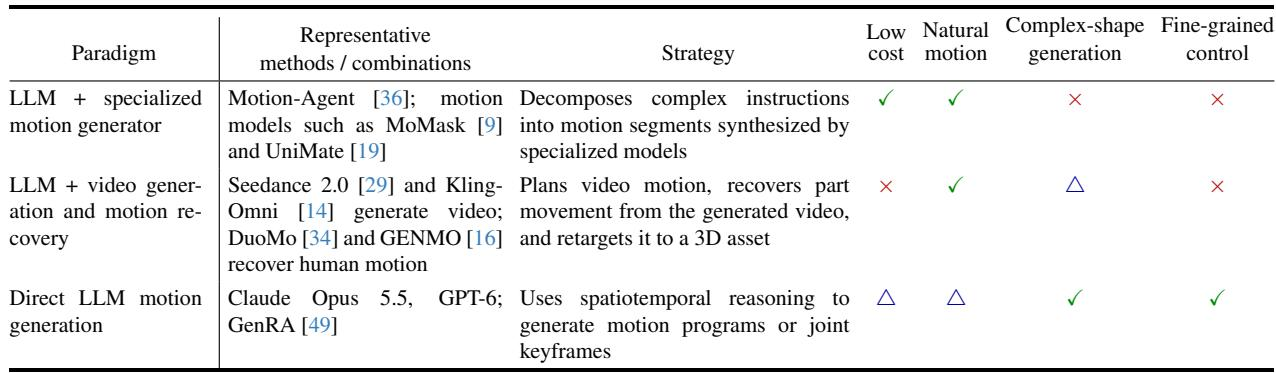
Three LLM-based paradigms for complex 3D motion generation differ mainly in cost, naturalness, cross-morphology support, and control precision. LLM-driven specialized generators and video-based recovery can produce natural motion but remain constrained by humanoid or fixed skeleton assumptions and often miss precise timing, angle, or phase requirements. Direct LLM motion generation supports arbitrary structures and fine-grained control, but is token-intensive and lacks kinematic constraints; an agentic framework that writes sparse semantic parameters for a deterministic executor shows the strongest balance. LLM plus specialized motion generation is cheap and natural but limited to the generator's skeleton and coarse semantics. Video generation and recovery brings strong visual priors but is expensive and loses fine timing and amplitude, especially for non-human assets. Direct LLM motion generation adapts to arbitrary morphologies and fine-grained control but is costly and prone to kinematic issues such as interpenetration. Agent-planned trajectories plus deterministic execution improve phase completeness and numeric control across diverse skeletons, outperforming direct and specialized-only baselines.
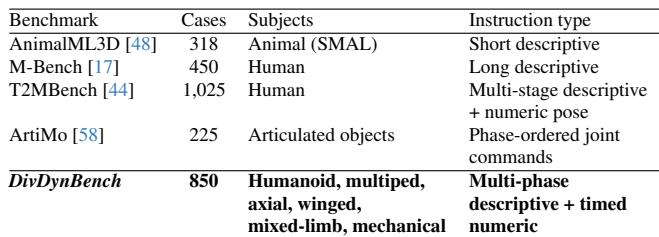
DivDynBench supplies a large motion benchmark with broad morphology coverage and demanding multi-phase timed numeric instructions. Its case count is second only to a human-only benchmark, but it spans humanoid, multiped, axial, winged, mixed-limb, and mechanical subjects. This contrasts with existing benchmarks that focus on a single subject type or use simpler instruction formats. DivDynBench has the broadest subject coverage among compared benchmarks, including humanoids, multipeds, axial bodies, winged creatures, mixed-limb characters, and articulated mechanical objects. Its instruction format combines multi-phase descriptions with timed numeric constraints, making tasks more complex than short or long descriptive prompts and phase-only joint commands. The benchmark includes a large case count, second only to a human-only benchmark, while adding non-human and mechanical morphologies.
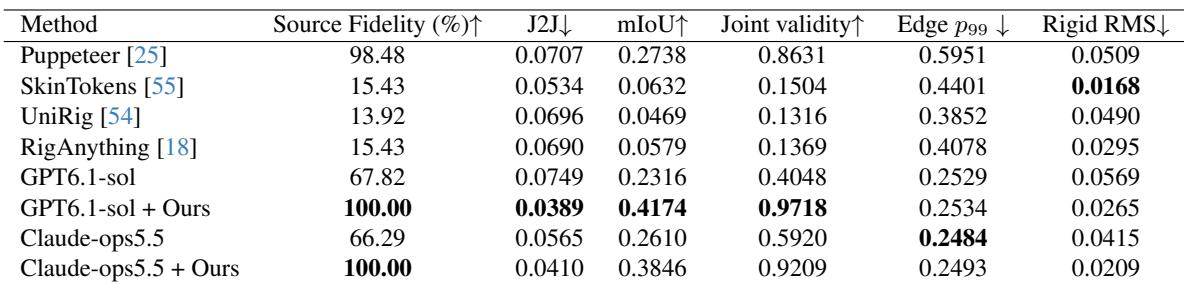
Adding the Agentic Motion Framework to the tested agents substantially improves rigging quality, with gains in Source Fidelity, J2J, mIoU, and joint validity over standalone baselines. Specialized baselines that process the input mesh lose Source Fidelity because their outputs no longer match the source mesh, while Puppeteer preserves the mesh but remains behind on joint-related metrics. The improvements do not come at the cost of larger deformation, as edge p99 is essentially unchanged and Rigid RMS moves closer to the best specialized result. The framework raises Source Fidelity and joint validity well above the standalone agent and specialized baselines. Mesh-processing baselines show very low Source Fidelity, while Puppeteer keeps the mesh but still trails on J2J, mIoU, and joint validity. Edge p99 stays essentially unchanged and Rigid RMS improves with the framework, indicating better articulation without larger deformation.
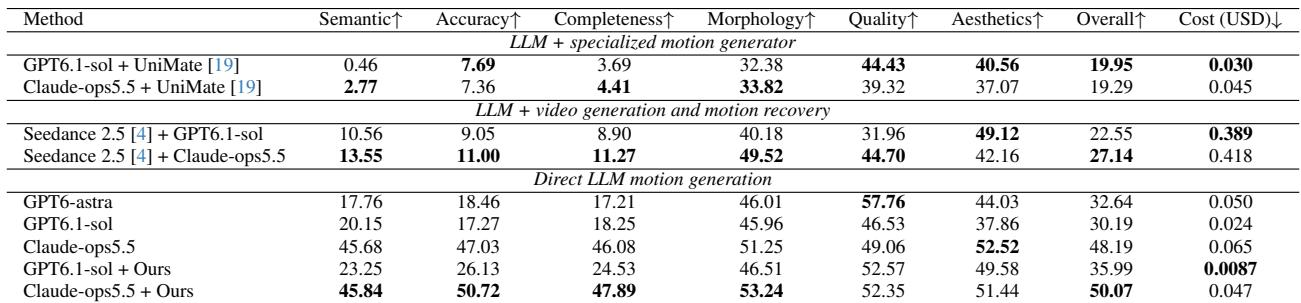
Across 428 text and 422 numeric cases on six asset categories, the evaluated paradigms differ mainly in controllability. Poses from specialized generators and video recovery look plausible but often miss ordered phases and required angles, while the agentic motion framework makes angle-based design stable and improves accuracy, quality, and overall scores. Direct LLM generation is economical, and the framework lowers its per-case cost further. Specialized generators and video recovery produce plausible poses but rarely satisfy ordered phases and numeric targets. The agentic motion framework improves direct LLM generation, with clear gains in accuracy, quality, and overall score. Direct LLM generation is very economical, and the framework reduces cost further.
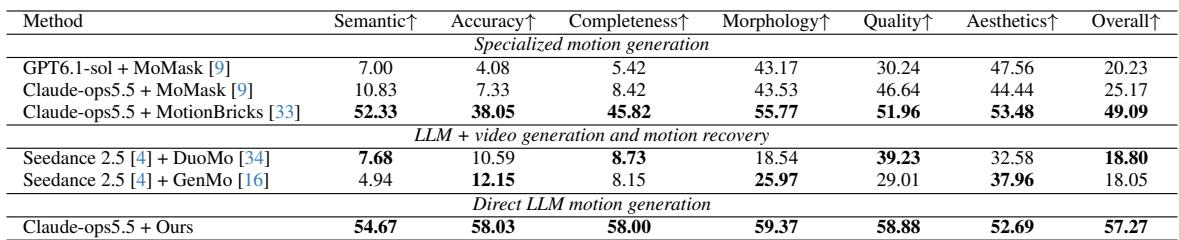
On the humanoid subset, video-based recovery and MoMask variants remain below 26 overall, while trajectory-guided MotionBricks reaches 49.09 and leads specialized generators. The Agentic Motion Framework improves further to 57.27 by enforcing explicit phase timing, root trajectories, and part targets. This suggests that separating program authoring from deterministic execution strengthens controllable motion generation. Claude-ops5.5 + MotionBricks leads specialized generators with a 49.09 overall score, clearly above MoMask and video recovery methods. MoMask and video recovery methods stay below 26 overall even on familiar humanoid morphology, showing weak instruction and angle enforcement. The Agentic Motion Framework reaches 57.27 overall on the same humanoid subset by adding explicit phases, root trajectories, and part targets. Trajectory guidance and programmatic phase control outperform segment-level prompting and recovered video motion.
The experiments evaluate three LLM-based paradigms for complex 3D motion generation using a large benchmark that spans humanoid, multiped, axial, winged, mixed-limb, and mechanical subjects with multi-phase timed numeric instructions. Specialized generators and video recovery produce natural poses but often miss ordered phases and numeric targets, while direct LLM generation adapts to arbitrary morphologies and reduces cost but can introduce kinematic errors. Adding an agentic framework that writes sparse semantic parameters for a deterministic executor improves source fidelity, joint validity, articulation, phase timing, root trajectories, and part targets without increasing deformation. Overall, separating program authoring from deterministic execution provides the strongest balance of controllability, naturalness, and cost across diverse skeletons.