Command Palette
Search for a command to run...
Tacinf: بنية تحتية لمسية موحدة لمعالجة الروبوت
Tacinf: بنية تحتية لمسية موحدة لمعالجة الروبوت
الملخص
تتطلب المعالجة المدركة للقوة أن يستنتج الروبوت قوى التفاعل المناسبة من سياق المهمة والتغذية الراجعة اللمسية. نقدم Tacinf، وهي بنية تحتية منخفضة التكلفة ومعيارية تمكّن السياسات من التنبؤ بأفعال الروبوت وقوى أطراف الأصابع انطلاقًا من لغة المهمة والرؤية واللمس. ويمكن لتعليمات المهمة أن تحدد اختياريًا مستوى القوة المطلوب. تدمج Tacinf توليف بيانات المحاكاة والمعايرة اللمسية (Tabero)، وتعلم سياسة الرؤية-اللمس-اللغة-الفعل (VTLA)، وجمع البيانات المحمولة باليد باستخدام القابض نفسه المستخدم في نشر الروبوت (Tacumi)، والتقييم المحاذي للمهمة من المحاكاة إلى الواقع (Taco). تشكل هذه المكونات معًا سير عمل متكاملًا يربط جمع البيانات من مصادر متعددة، وتدريب النماذج الأساسية، والنشر على العتاد. نتحقق من صحة كل مكون، بما في ذلك بيانات المحاكاة والمعيار والمتحكم وTacumi، ونصدر المجموعة الكاملة كبرمجيات مفتوحة المصدر. نموذج أساسي مضبوط بدقة على بيانات محاكاة لمسية فقط ينتقل دون أي تدريب إضافي إلى مهام روبوت حقيقية مختلفة. عبر ثمانية متغيرات للسياسات، يرتبط متوسط معدلات نجاح المهام ارتباطًا قويًا بين المحاكاة والروبوت الحقيقي (معامل بيرسون r=0.998، ومتوسط أقصى انتهاك للرتبة MMRV=0.010). بالنسبة للسياسات الأربع التي سُجلت لها قياسات قوة، يكون متوسط قوة القبضة أعلى تحت التعليمات الحازمة منه تحت التعليمات اللطيفة في جميع المهام الثلاثة وفي كلا المجالين. وعندما تُعشوائيا مواضع الأشياء ونماذجها، يرفع مزيج من بيانات التحكم عن بعد والمحاكاة وTacumi متوسط نجاح المهام على الروبوت الحقيقي من 20% باستخدام التحكم عن بعد وحده إلى 60%.
One-sentence Summary
Researchers from Nvidia, HKUST(GZ), and University of Cambridge introduce Tacinf, a low-cost modular tactile infrastructure that integrates simulation data synthesis, vision-tactile-language-action policy learning, handheld data collection, and task-aligned sim-to-real evaluation to predict robot actions and fingertip forces from language, vision, and touch, achieving zero-shot transfer and strong sim-to-real correlation.
Key Contributions
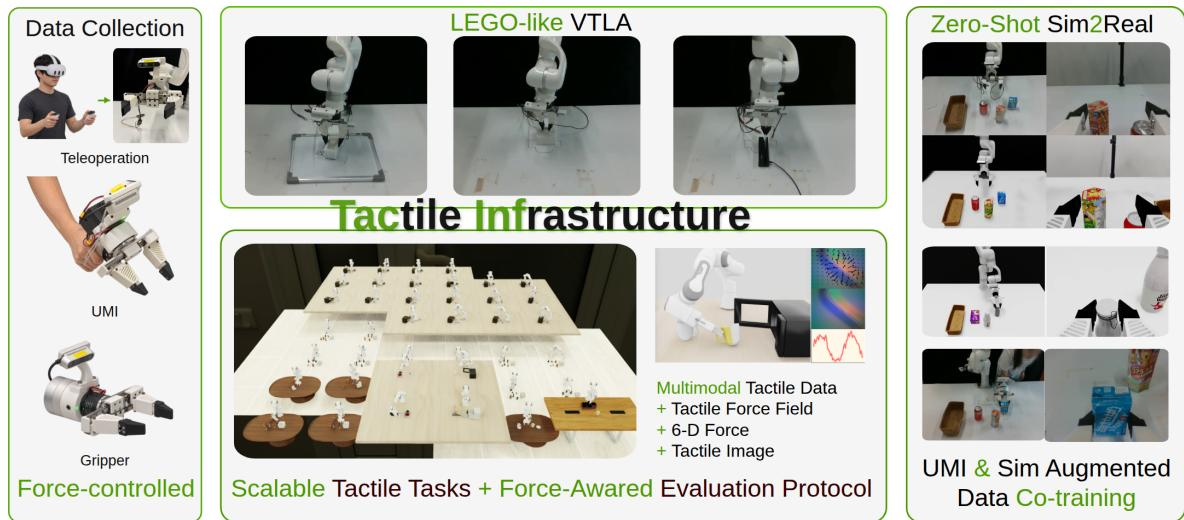
- Tacinf is an open-source modular infrastructure for force-aware manipulation that supports policies predicting robot actions and fingertip-force targets from task language, vision, and touch, with optional language-conditioned force levels. It integrates Tabero simulation data synthesis and tactile benchmarking, VTLA policy learning, Tacumi handheld data collection using the same gripper as robot deployment, and Taco task-aligned sim-to-real evaluation.
- A foundation model fine-tuned solely on tactile simulation data transfers zero-shot to different real-robot tasks. Across eight policy variants, simulation and real-robot mean success rates are strongly correlated (Pearson r=0.998, MMRV=0.010), and for the four policies with reported force measurements, mean grip force is higher under firm instructions than gentle instructions on all three tasks in both domains.
- Co-training on teleoperation, simulation, and Tacumi data raises mean real-robot success from 20% with teleoperation alone to 60% when object positions and instances are randomized. This gain cannot be attributed solely to increased data volume.
Introduction
Robot manipulation foundation models increasingly need to handle force-aware contact-rich tasks, where policies must infer interaction forces from instructions such as “gently” or “firmly,” scene context, and tactile feedback. However, tactile data collection is costly and fragmented by hardware and sensor design differences, while real-time force regulation is essential to avoid damaging objects or the robot, creating demand for low-cost evaluation and deployment platforms. The authors introduce Tacinf, a full-stack open-source infrastructure that combines simulated tactile data generation, a modular vision-tactile-language-action policy interface, low-cost hardware for teleoperation and handheld demonstrations, and task-aligned sim-to-real evaluation and training. Their contribution targets scalable force-aware manipulation by integrating multi-source data collection, force control and execution, and close sim-to-real consistency while keeping hardware and compute requirements low.
Dataset
Dataset sources and composition
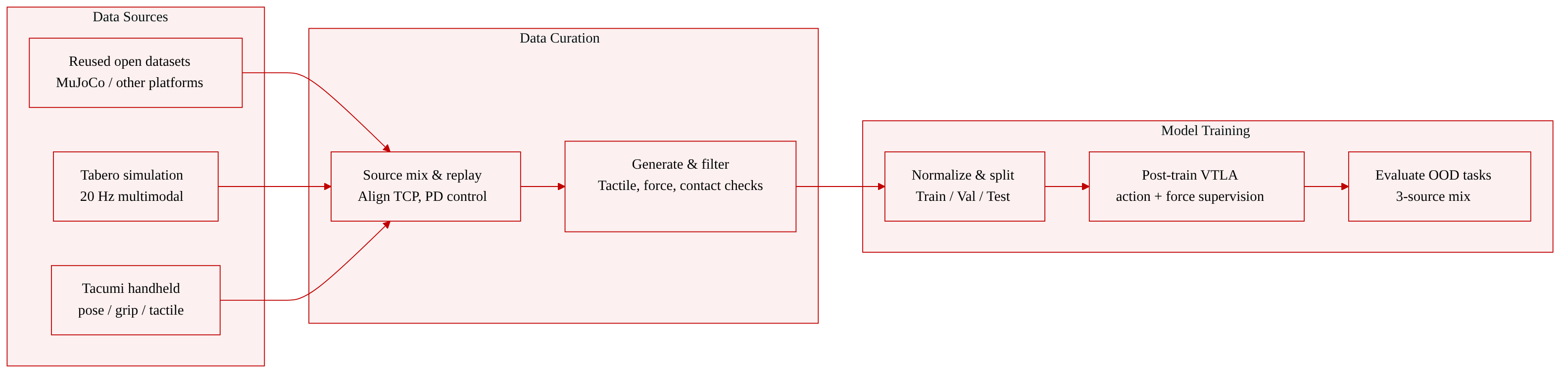
- Reused open-source manipulation data: The authors transfer existing manipulation datasets from MuJoCo and other platforms into the Isaac Sim-based Tacinf-Tabero benchmark. Task environments are reconstructed in Isaac Lab, and source trajectories are replayed with a tactile gripper.
- Tacinf-Tabero simulation data: This benchmark provides scalable multimodal data for language-conditioned tactile manipulation. It includes synchronized visual, tactile, force, language, and action streams sampled at 20 Hz.
- Tacinf-Tacumi handheld data: A handheld interface collects demonstrations with Xense tactile sensors, a motorized parallel gripper, a Meta Quest 3 tracking system, and a camera. It captures end-effector pose, gripper aperture, tactile observations, force estimates, and task instructions.
- Tacinf-Taco co-training data: Three sources are combined: real-robot teleoperation data, Tacumi handheld data, and simulation data.
Key details by subset
- Open-source replay: The authors align the tool center point by adjusting the robot base pose and use a high-gain PD joint controller during trajectory replay. The proportion of successful replayed episodes is reported as the data retention rate.
- Simulated sensors: Visual data comes from wrist-mounted and third-person RGB-D cameras. Tactile observations include 320×240 GelSight RGB images with an 11×9 marker grid, and Xense sensors with a 20×11 marker grid.
- Tacumi tracking: End-effector pose is acquired from Meta Quest 3 controller tracking and transformed into the gripper TCP frame through a fixed extrinsic calibration. Gripper aperture is computed from motor position feedback.
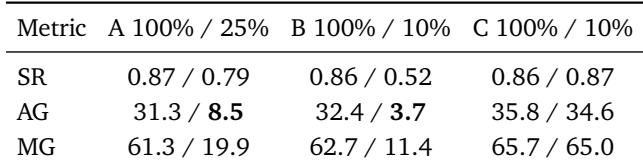
- Force-level data: Simulations use three ordered force levels, reported as 10%, 25%, and 100%. Low-force conditions are paired with language such as "gently" or "softly," while high-force conditions use "firmly" or "tightly." No adverb is added for tasks that naturally require high force, such as wiping a blackboard.
Processing and filtering
- Tactile generation: Tactile RGB images are generated with the Taxim framework, while marker displacement fields follow the FOTS approach.
- Scene reconstruction: Real workspaces are represented with 3D Gaussian Splatting, and interactive objects are imported as textured meshes generated by Seed3D. Objects receive rigid-body properties and collision meshes through a USD overlay.
- Simulated augmentation: The authors vary object appearance, object instances, and background visual elements, then replay tasks under controlled force regimes. A contact-signal check and task-completion check remove data with no contact or failed tasks.
- Spatial augmentation: Tacumi demonstrations vary object positions, orientations, and approach paths to add spatial diversity.
How the data is used
- Real, simulated, and Tacumi trajectories are synchronized, normalized, and sampled into mixed batches.
- These batches are used to jointly post-train a pretrained Tacinf-VTLA policy with action and fingertip-force supervision.
- The source sampling ratio and task/force-level coverage are explicit training settings.
- Simulation data mainly support visual and object generalization, Tacumi data support spatial and grasp-approach variation, and teleoperation data provide precise reference demonstrations. The three-source mixture outperforms teleoperation-only training on out-of-distribution tasks.
Method
The authors introduce Tacinf-VTLA, a framework providing shared interfaces for adapting tactile observations, supervising fingertip-force targets, and executing policies. A core component is the decomposition of fingertip forces. The planar contact at the fingertips is decomposed into a grip force, which squeezes along the closing axis, and an applied interaction wrench, represented as an estimated six-dimensional wrench at the Tool Center Point (TCP).
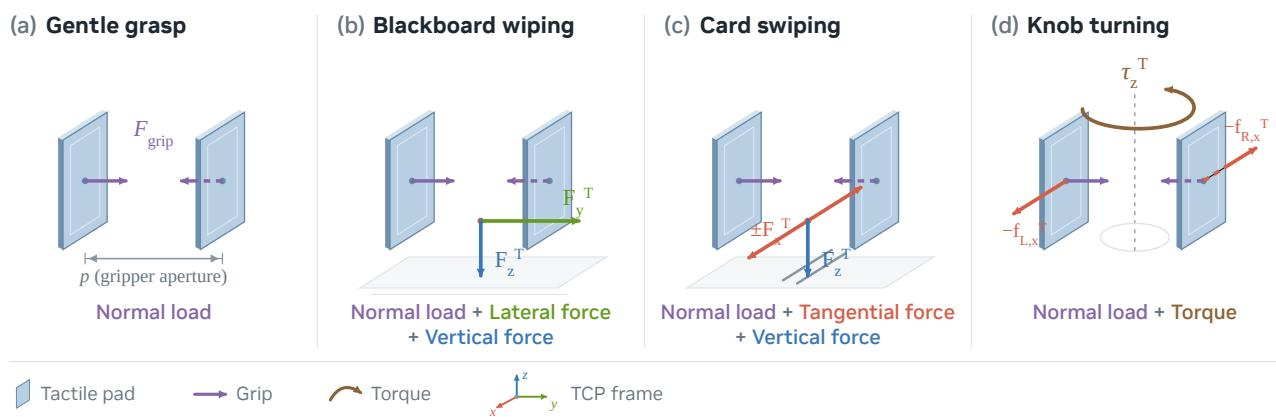
The system employs a hybrid controller that distinguishes a scalar squeeze channel from the applied wrench. The squeeze force is computed as a scalar proxy Fsqueeze=min(∥fLSL∥,∥fRSR∥). The applied wrench is derived from the sensor reactions transformed into the TCP frame, where the resultant force is FT=−(fLT+fRT) and the moment is approximated based on the gripper aperture p. To achieve compliant interaction, the authors implement a wrench-aware control loop and a separate grip force control loop. The policy predicts an end-effector pose and target sensor reactions. The controller computes force errors and applies pose corrections via an admittance-based mechanism, while the grip loop adjusts the aperture using feedforward and force feedback to track the predicted grip force.
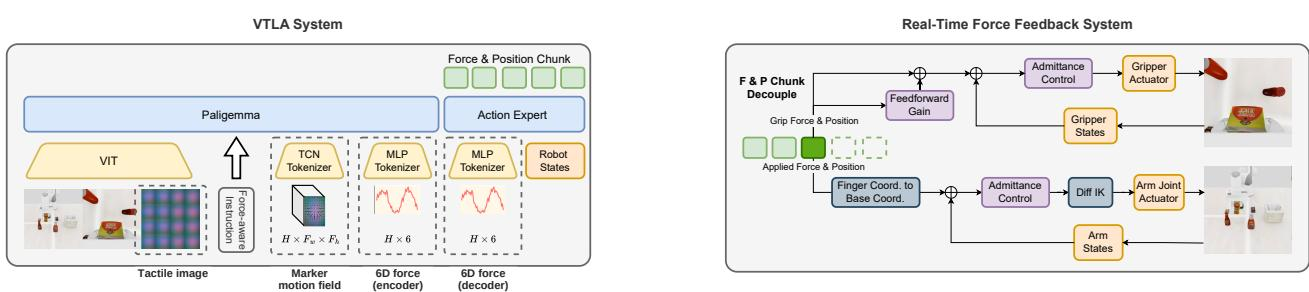
The high-level policy is trained on tactile representations and force-aware instructions. To integrate tactile signals into the Vision-Language-Action foundation model, the authors evaluate three tactile input adapters: a Marker-Field Adapter processing marker displacement via a temporal convolutional network, a Tactile-Image Adapter constructing a composite image processed by a visual encoder, and a Force Adapter using a multilayer perceptron on 3D sensor-frame reaction vectors. The policy uses flow matching to jointly predict continuous pose commands and six-dimensional fingertip-force setpoints. The loss function is defined as L=BKD1∑b=1B∑k=1K∑d=1Dwdeb,k,d2, weighting motion, force, and padding dimensions appropriately.
To collect real-world demonstrations of contact-rich manipulation, the authors develop Tacinf-Tacumi, a handheld multimodal interface.
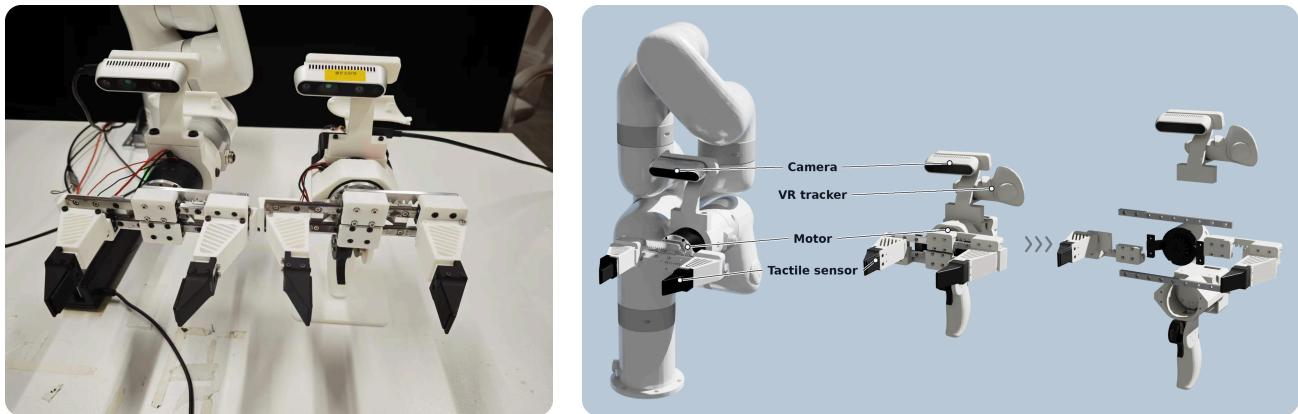
This device combines tactile sensing with real-time active force feedback. It features a motorized trigger operating under field-oriented control, which serves as both the command interface and the active feedback actuator. A parallel gripper driven by a motor provides position and load feedback, while fingertip-mounted vision-based tactile sensors capture contact observations. A VR controller supplies 6-DOF pose tracking. The system establishes a bidirectional interaction loop where trigger rotation maps to gripper aperture, and the estimated gripper motor torque τ^gripper is mapped back to the trigger as a reaction torque τtriggercmd=kfbτ^gripper, allowing operators to perceive and regulate grasping load.
Finally, the authors propose Tacinf-Taco to combine teleoperation, simulation, and Tacumi demonstrations for VTLA post-training.
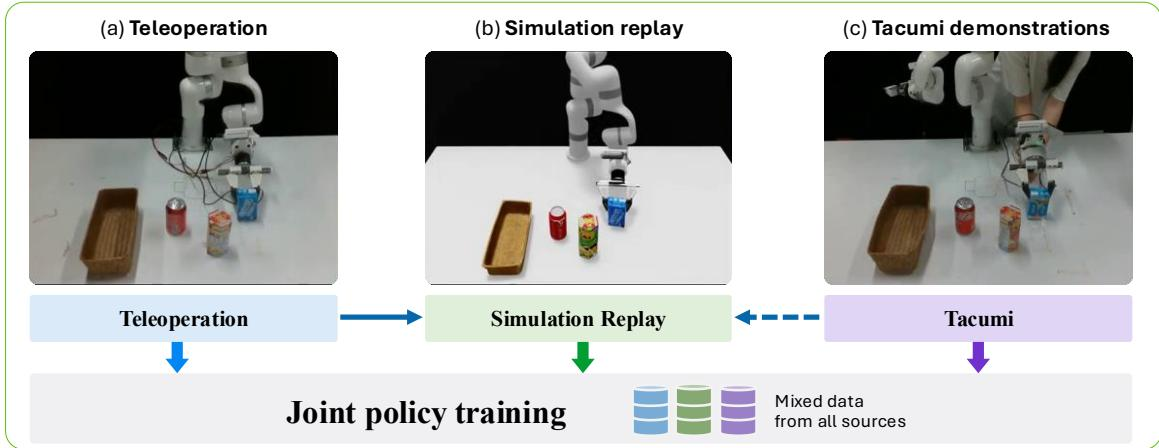
The pipeline consists of task-aligned scene reconstruction using 3D Gaussian Splatting for workspace appearance and textured meshes for objects, manipulator-system Real2Sim alignment to reproduce dynamics and tactile sensing, and data augmentation. Simulation data provides visual and force-level variation by replaying teleoperation trajectories under controlled regimes. Tacumi data provides spatial variation through human demonstrations with varied object poses and approach paths. These three sources are synchronized, normalized, and sampled into mixed batches to jointly post-train a single pretrained policy, leveraging the complementary strengths of each data source to improve generalization on real-robot tasks.
Experiment
The evaluation spans Tabero-based experiments on data reuse, continuous force-position control, and tactile VLA ablations; Taco-based experiments on zero-shot sim-to-real transfer and sim-to-real consistency; separate controller-execution tests; and data-mixture retraining experiments using simulation and a real XArm7 tactile gripper. The main findings are that force supervision and a continuous force-control interface are essential for language-conditioned force following, tactile observations such as marker fields add benefit, and accurate real-robot force tracking depends on closed-loop admittance and feedforward control. Simulated and real success rankings transfer strongly, supporting the simulation platform's reliability. Data synergy results show that teleoperation, UMI, and simulation sources are complementary: combining them improves generalization under position and object randomization, whereas UMI-only training fails in the low-data setting.
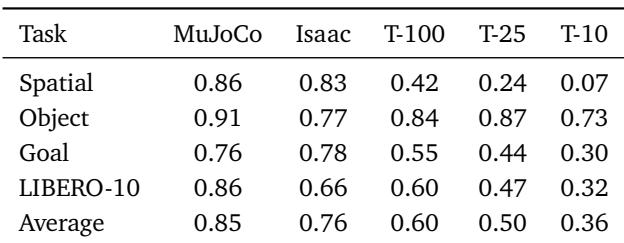
Replaying the MuJoCo benchmark in Isaac Lab with the same robot configuration leads to only a moderate overall success-rate decline, suggesting reasonably consistent transfer. Replacing the standard gripper with a tactile-sensor-integrated gripper reduces success, and lower force scaling deepens this drop, particularly for spatial and goal tasks. Object-focused manipulation remains comparatively stable across the modified tactile setups. The Isaac replay with identical robot kinematics tracks the original MuJoCo baseline closely, with only a slight average decline across the four subtasks. Tactile gripper configurations are sensitive to force scaling: spatial and goal tasks show steep success reductions at lower force levels, while object task performance stays relatively high.
Firm-condition success rates are high and similar across the three datasets, while gentle-condition outcomes depend strongly on the control mode. Reducing force to 25 percent lowers success only modestly, but reducing it to 10 percent under continuous control cuts success to about half of the firm baseline. Using binary gripper commands at the 10 percent gentle setting preserves near-firm success and force-related metrics. Firm success rates are comparable across all datasets, while gentle success drops sharply only in the continuous 10 percent force condition. At the extreme gentle setting, binary gripper commands retain success and force-related metrics close to firm levels, unlike continuous control at the same force.
The replay pipeline produces simulated data that closely matches real data on firm-force tasks across visual, tactile, and action channels. Visual similarity is strong for both camera views, tactile structure is well preserved, and action labels remain closely aligned across all three tasks. The metrics indicate consistent agreement on every evaluated task. Both wrist and third-person camera views show strong visual agreement, with CLIP similarity above 0.75 across all firm tasks. Tactile and action channels show only small deviations from real data, with tactile SSIM above 0.93 and action MAE below 0.074 across tasks.

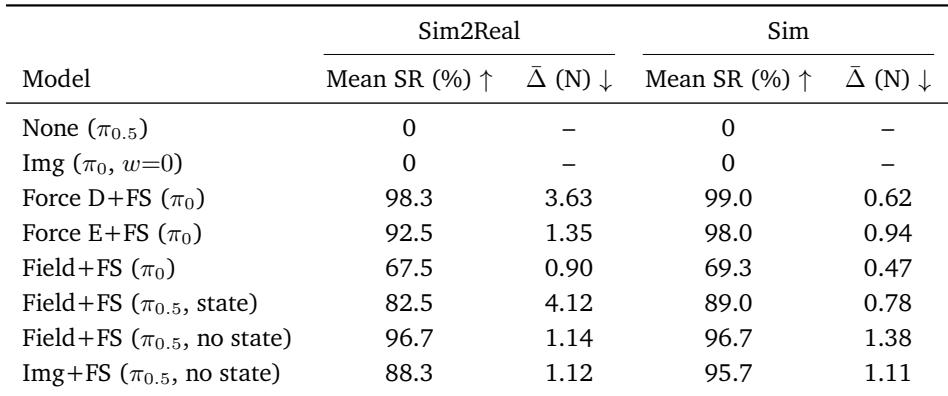
Policies without force observations fail all evaluated conditions. Adding force sensing yields high mean success in both aligned simulation and physical robot evaluation, though success on the physical robot is generally lower than in simulation. Predicted grip force also departs more from the human teleoperation label on the physical robot than in simulation. Policies without force observations fail in both simulation and real-robot evaluation, while force-enabled policies transfer successfully. Mean absolute force deviation is consistently larger on the physical robot than in aligned simulation, and higher success does not imply smaller force error.
Force-based policies with high simulated success rates also achieve high success rates on the real robot, especially under the gentle condition. The measured grip force gap shows a mixed pattern: simulated firm grasps are generally firmer than real-robot firm grasps, while gentle grasp gaps are smaller and can go in either direction. Task-specific variation is substantial, so the sim-to-real force offset is not uniform across objects or policies. The reported force-based policies transfer with high firm and gentle success rates, and real-robot gentle success equals or exceeds simulated gentle success in most reported cases. Firm grasp force gaps are predominantly positive, indicating that simulation often measures a firmer grasp than the robot, though some tasks show near-zero or small negative gaps. Gentle grasp force gaps are smaller in magnitude than firm grasp gaps and include both positive and negative values across tasks. The firm-force gap varies widely by task and policy, from small negative or near-zero values to substantial positive values.
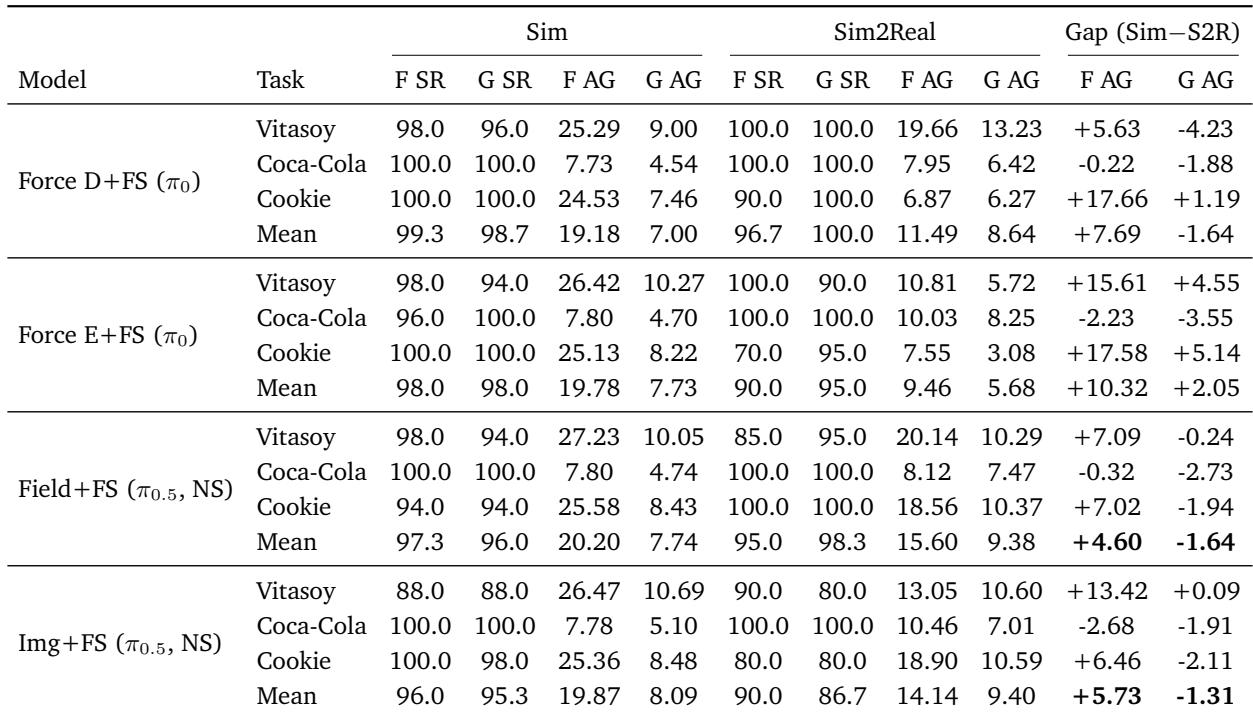
The experiments evaluate simulated replay and force-sensing manipulation across Isaac Lab and a physical robot. Replaying MuJoCo tasks in Isaac Lab transfers reasonably well, but tactile gripper modifications and lower force scaling mainly degrade spatial and goal tasks while object-focused manipulation remains stable. The replay pipeline closely matches real firm-force demonstrations in visual, tactile, and action channels, and under gentle force, binary gripper commands retain near-firm success whereas continuous low-force control drops sharply. Force observations are necessary for successful policies, and force-enabled policies transfer to the real robot with high success, though sim-to-real grip force gaps vary by task, with firm grasps often firmer in simulation and gentle grasp gaps smaller and mixed.