Command Palette
Search for a command to run...
Duopra: من المحادثة ثنائية الاتجاه الكامل إلى الوكالة ثنائية الاتجاه الكامل
Duopra: من المحادثة ثنائية الاتجاه الكامل إلى الوكالة ثنائية الاتجاه الكامل
الملخص
تُظهر نماذج التفاعل ثنائي الاتجاه الكامل وكالة محادثة قوية، مما يتيح تبادل الأدوار الطبيعي بزمن انتقال منخفض، والقنوات الراجعة، والمقاطعات. غير أن إنجاز المهام يتطلب بالإضافة إلى ذلك وكالة مهمة: استدعاء الأدوات في الوقت المناسب ومراجعة الوسائط بعد تصحيحات المستخدم. تفصل الوكلاء القائمون على الواجهة الأمامية والخلفية بين البدء والتنفيذ: تقرر الواجهة الأمامية ما إذا كانت ستطلب شيئًا وما هو، بينما تحدد الواجهة الخلفية كيفية التنفيذ. يمكن إسناد التنفيذ إلى الخلفية، لكن الطلبات غير المرسلة لا يمكن تنفيذها، والطلبات غير المكتملة قد تضلل الواجهة الخلفية. في معيار Full-Duplex-Bench v3 (FDB v3)، تحدث معظم إخفاقات Realtime-Venus-Audio + Harness في خط أنابيب البث لدينا قبل تنفيذ أداة المجال. نقدم Duopra، وهو نموذج تفاعل ثنائي الاتجاه الكامل يتعلم تنفيذ المهام إلى جانب التحكم في المحادثة. يعامل Duopra الواجهة الخلفية كأداة، ويقبل طلبًا بلغة طبيعية قائمًا بذاته. تشترك الاستدعاءات المباشرة وتفويض الواجهة الخلفية في واجهة إجراء واحدة ومتطلبات للبدء الأمين والتنفيذ الصحيح. يجمع تدريبه ثلاثي المراحل بين الضبط الدقيق بالإشراف على البروتوكول، والتعلم المعزز ثنائي الاتجاه الكامل الذي يكافئ التنفيذ الكامل في الوقت المناسب، وإصلاح تكييف المتحدث عبر جهاز العرض فقط بعد تحديثات المفكر. مع الواجهة الخلفية نفسها، يرتفع Pass@1 من 4.7% إلى 44.7%؛ ويحقق Duopra نسبة 47.7% عند استدعاء الأدوات مباشرة (26.0% بعد الضبط الدقيق بالإشراف) و49.3% مع واجهة خلفية DeepSeek. كما يحسّن ثلاثة معدلات استحواذ في FDB v1.0 مقارنة بالنموذج الأساسي. تُظهر هذه النتائج أن وكالة المهمة يمكن أن تتعايش مع وكالة المحادثة الرئيسية.
One-sentence Summary
Researchers from Shanghai Jiao Tong University et al. propose Duopra, a full-duplex interaction model that learns task execution alongside conversational control by treating the backend as a tool and sharing an action interface between direct calls and delegation, with three-stage training combining protocol SFT, full-duplex RL, and projector-only repair, raising Pass@1 from 4.7% to 44.7% and direct calls to 47.7%.
Key Contributions
- This work identifies frontend initiation as a key bottleneck in full-duplex task execution and introduces Duopra, a model that treats the backend as a tool and unifies direct domain-tool calls with natural-language backend delegation through a shared action interface.
- The model is trained with a three-stage procedure combining protocol supervised fine-tuning, execution-based full-duplex reinforcement learning that rewards timely and complete execution, and projector-only repair of talker conditioning after thinker updates.
- On Full-Duplex-Bench v3, Pass@1 rises from 4.7% to 44.7% with the same backend; direct tool calling reaches 47.7% (26.0% after SFT), a DeepSeek backend reaches 49.3%, and three FDB v1.0 takeover rates improve over the base model.
Introduction
Full-duplex spoken interaction systems must coordinate conversational agency, such as turn-taking and interruptions, with task agency, such as deciding when to act and completing multi-step requests. In frontend-backend agents, execution is offloaded to a tool-using backend, but the speech frontend still must decide when information is sufficient, incorporate corrections, and issue faithful requests; prior work shows this initiation stage can cap overall success. For example, the RV-Audio+Harness baseline delegates in only 11.0% of FDB v3 sessions and passes 4.7%, indicating a frontend initiation bottleneck rather than a general limit on delegation. The authors introduce Duopra, a full-duplex model built on RV-Audio that unifies direct tool calls and backend delegation through a query(task) natural-language action interface. It is trained with protocol supervised fine-tuning, execution-based full-duplex reinforcement learning, and projector-only repair, raising Pass@1 from 4.7% to 44.7% with the same backend while improving takeover rates for turn-taking, pauses, and interruptions.
Method
The authors introduce Duopra, a full-duplex interaction model built on RV-Audio that unifies conversational and task agency within a single causal streaming policy. Instead of relying on a separate dispatcher or free-text delegation, the model processes user audio arriving in units x1,x2,… of length Δ. At each unit t, the frontend reads the audio xt and injected observations et, which include tool schemas and previous call results. It then emits a tuple yt=(mt,wt,at), where mt∈{listen, speak} represents the turn state, wt denotes the text tokens to be voiced, and at is a private action that is never voiced. The causal policy is defined as:
πθ(yt∣x≤t,e≤t,y<t).Conversational agency governs mt and wt to manage turn-taking, while task agency determines at, selecting which tool to call and with what arguments. The framework supports a unified action space where domain tools and a backend delegation tool, query(task), coexist. This allows the model to dynamically choose between direct tool calling and request-based delegation without architectural changes.
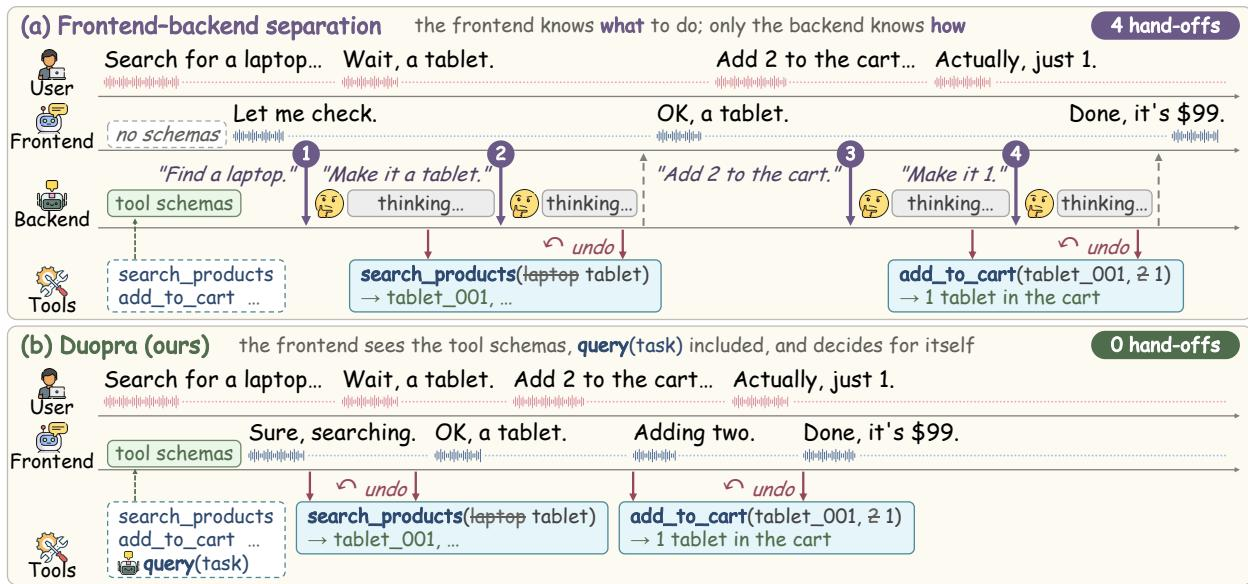
As illustrated in the framework diagram, when domain schemas are hidden from the frontend, the system requires multiple hand-offs to convey evolving user requests, complicating the preservation of corrections and tool dependencies. By exposing the tool schemas directly to the frontend, Duopra can issue corrected domain-tool calls immediately, eliminating unnecessary hand-offs while retaining the query(task) option for complex delegations.
The training pipeline for Duopra consists of three distinct stages, as outlined in the figure below:
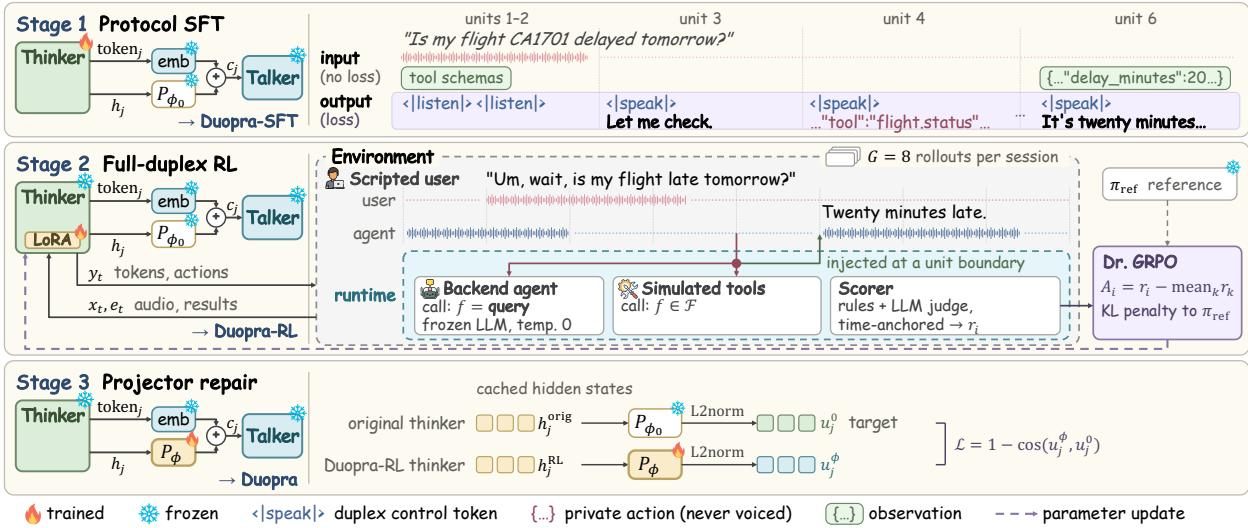
In Stage 1, Protocol Supervised Fine-Tuning, the authors fine-tune the thinker component on a mixture of tool-use demonstrations and capability-retention dialogues formatted as streams of 1-second units. The training objective minimizes the cross-entropy loss over the thinker's reference output positions, which encompass public text, private actions, and duplex control tokens:
LSFT=−Ed[∣M(d)∣∑j∈M(d)logπθ(zj∗∣Hj∗)]During this phase, only the thinker's transformer layers and final normalization are updated, while the embeddings, output head, audio encoder, and speech generation modules remain fixed. This yields the Duopra-SFT checkpoint.
Stage 2 introduces Full-Duplex Reinforcement Learning to refine task and conversational agency. The system generates G=8 streaming rollouts per training task within a sandbox environment. A runtime executes direct calls against simulated tools or delegates to a frozen backend, injecting the resulting observations back into the stream. A scorer evaluates the logged calls against gold standard calls C∗ and measures action timing, while a judge assesses the groundedness of spoken claims. The training curriculum progresses from Stage 2a, focusing on direct calls and conversational interruptions, to Stage 2b, which incorporates dependent calls and backend delegation. The rollout reward r(τ) is determined by the task family, combining penalties for timing violations and incorrect arguments with bonuses for grounded answers. The authors update the thinker's LoRA adapters using Dr. GRPO, maximizing the objective:
JRL(θ)=E∣I∣L1i∈I∑j∈M(τi)∑sijwhere sij=min(ρijAi,ρˉijAi)−βKij, with Ai representing the advantage and Kij the per-token KL estimator against the Duopra-SFT policy.
Finally, Stage 3 performs Projector-Only Talker Repair to address intelligibility degradation caused by the altered hidden states from RL training. The authors align the projected hidden states of the Duopra-RL thinker with the reference directions from the original RV-Audio model. By caching the hidden states hjorig and hjRL from the base and RL thinkers respectively, they compute the target uj0=L2norm(Pϕ0(hjorig)) and the trainable output ujϕ=L2norm(Pϕ(hjRL)). The projector weights ϕ are optimized using:
Lproj=Ej[1−cos(ujϕ,uj0)]+λ∥ϕ−ϕ0∥22This cosine alignment term, combined with an L2-SP regularization term, restores speech intelligibility without modifying the trained thinker, producing the final Duopra model.
Experiment
The study evaluates full-duplex spoken agents on FDB benchmarks and simulated APIs with a streaming protocol, comparing Duopra checkpoints against frontend-backend baselines under Direct, Backend, and Both tool exposures with frozen Qwen or DeepSeek backends. The results show that Duopra acquires task agency in the frontend, succeeding through native tool calls or delegation, and its improvement comes mainly from initiating requests that baselines never execute. Training first increases tool-call initiation and then converts it into complete execution, while remaining errors concentrate on wrong argument values. Conversational and speech evaluations confirm that task agency can coexist with turn-taking control and intelligible speech, although spontaneous backchanneling remains unrecovered.
Duopra gains task agency primarily by initiating domain-tool calls that the RV-Audio + Harness baseline leaves unserved, leading to a large Pass@1 improvement with the same backend. It performs comparably whether executing tools directly or delegating through a backend, and when both routes are visible it succeeds through its own domain calls. On conversational metrics, Duopra improves all three takeover rates relative to RV-Audio, though interruption response remains below the RL1 checkpoint and backchannels are absent. With the same backend, Duopra raises Pass@1 over RV-Audio + Harness mainly by increasing call initiation rather than improving conditional execution success. Duopra performs comparably in direct and delegated configurations, and nearly all successes occur through its own domain calls when both tool routes are visible. Duopra improves turn-taking relative to RV-Audio across all three takeover rates, taking turns more after user finishes, less during pauses, and more after interruptions. Against published reference points, Duopra is comparable to Gemini Live 2.5 but trails GPT-Realtime and Gemini Live 3.1.
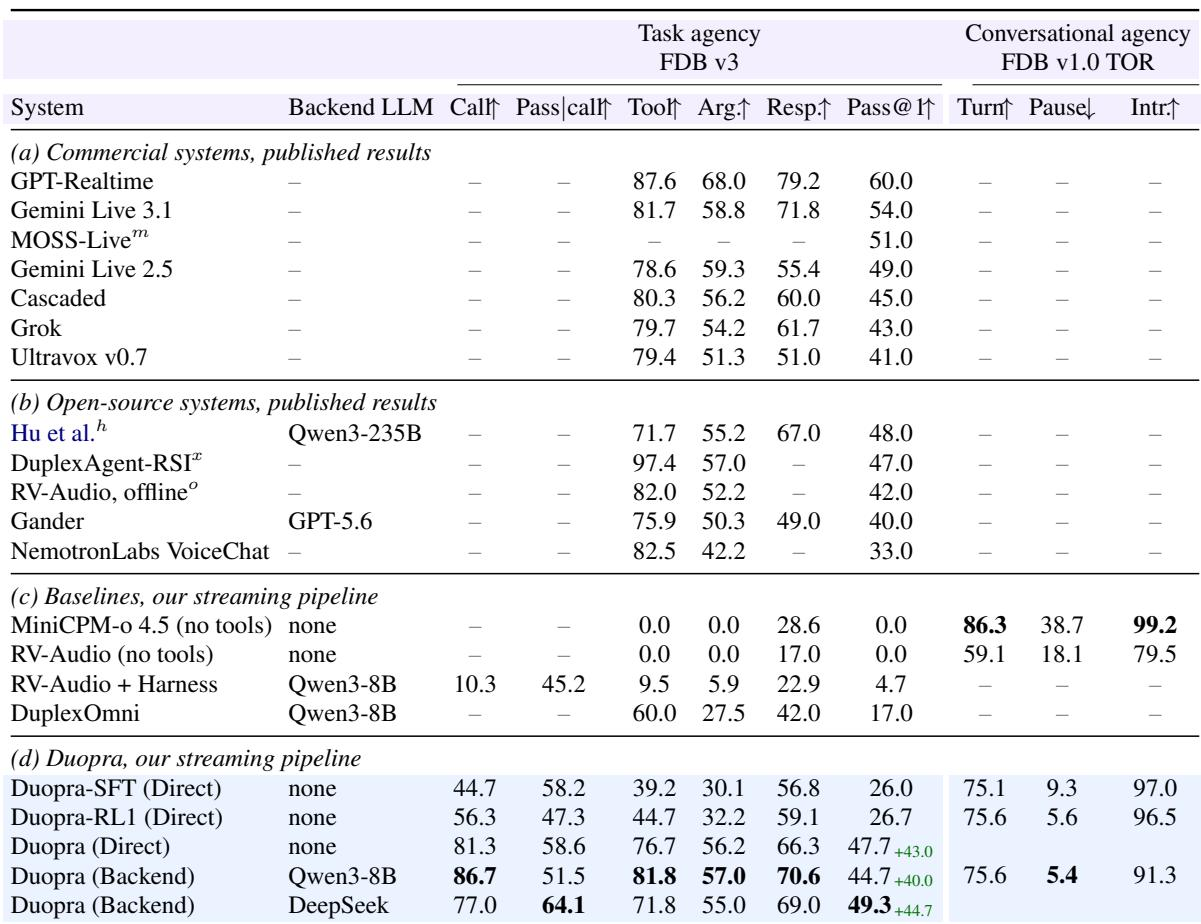
The experiments evaluate Duopra's task agency and conversational turn-taking against an RV-Audio baseline. With the same backend, Duopra improves task success primarily by initiating domain-tool calls that the baseline leaves unserved, and it performs comparably whether executing tools directly or delegating through a backend, with most successes coming from its own domain calls. Duopra also improves all three turn-taking takeover rates relative to RV-Audio, though interruption response remains below the RL1 checkpoint and backchannels are absent. Against published reference points, Duopra is comparable to Gemini Live 2.5 but trails GPT-Realtime and Gemini Live 3.1.