Command Palette
Search for a command to run...
GreenWAM: نموذج أساسي عالمي للروبوتات
GreenWAM: نموذج أساسي عالمي للروبوتات
Gennady Sidorov Valerii Kornilov Denis Grankin Polina Fedotova Aleksey Postnikov
الملخص
يحتاج الروبوت إلى نموذج عالمي يتنبأ كيف ستُغيّر أفعاله المشهد، وإلى سياسة تختار تلك الأفعال. عادةً ما تُبنى النماذج وتُقيَّم لأحد هذين الدورين فقط، كما يسجل كل روبوت أفعاله بتنسيقه الخاص. نتساءل عما إذا كان بإمكان نموذج عالمي واحد للروبوت أن يؤدي الدورين معًا عبر أجسام مختلفة، وما الذي يجعل ذلك ممكنًا. نقدم GreenWAM، وهو نموذج أساسي عالمي للروبوتات، إلى جانب الوصفة التي تنتجه: (1) فضاء أفعال تشريحي مشترك يصف 20 عائلة من الروبوتات، من الأذرع ثنائية اليدين إلى الروبوتات البشرية الماهرة، بإحداثيات مفصلية مشتركة؛ و(2) تدريب مشترك على هذه العائلات في الأنماط البصرية، والأنماط المشروطة بالأفعال، وأنماط العالم–الفعل؛ و(3) سياسات تفصل خبير أفعال من المولّد. بوصفه نموذجًا عالميًا، يحقق GreenWAM دقة من الطراز الأول في المسارات والعمق والأبعاد الثلاثية على WorldArena 1.0، متفوقًا على كل نموذج عالم–فعل وكل مولّد فيديو ضمن مقارنتنا. وبوصفه سياسةً، يحتل مرتبة بين أفضل المشاركات في لوحة صدارة RoboTwin 2.0، ويحقق أعلى نسبة نجاح بدون أمثلة (zero-shot) على LIBERO-plus بين الطرق المقارنة، ويكون منافسًا للسياسات المتخصصة من نوع الرؤية–اللغة–الفعل ونوع العالم–الفعل على CALVIN وLIBERO. كما نكيّف GreenWAM لروبوت بشري حقيقي، حيث ينجح في كثير من الأحيان أكثر من السياسات المكيَّفة من π0.5 ومن Cosmos 3 Edge، ونقطره إلى سياسة أحادية الخطوة من أجل التحكم في الوقت الفعلي. تسفر التجارب المضبوطة عن ثلاث نتائج: التخصص الروبوتي يحسّن التنبؤ بالعالم والتحكم معًا؛ ويساعد خبير الأفعال عند فصله في بداية التكييف؛ والإبقاء على أنماط نموذج العالم أثناء تكييف السياسة يحافظ على المتانة تجاه تغيرات المشهد.
One-sentence Summary
Brain Team and Sber Robotics Center present GreenWAM, a world foundation model for robotics built from a shared anatomical action space covering 20 robot families, joint visual, action-conditioned, and world-action training, and action-expert policies split from the generator; the model achieves top-tier trajectory, depth, and 3D accuracy on WorldArena 1.0, reaches the highest zero-shot LIBERO-plus success among compared methods, and outperforms policies adapted from π0.5 on a real humanoid.
Key Contributions
- GreenWAM, a world foundation model for robotics, adapts Cosmos 3 Edge to 20 robot families via a shared anatomical action space and joint training in visual, action-conditioned, and world-action modes, enabling one model to serve as both world model and policy.
- As a world model, GreenWAM attains top-tier trajectory, depth, and 3D accuracy on WorldArena 1.0 ahead of all compared world-action models and video generators; as a policy, it scores among the top RoboTwin 2.0 leaderboard entries, achieves the highest zero-shot LIBERO-plus success among compared methods, and is competitive on CALVIN and LIBERO.
- On a real humanoid, GreenWAM succeeds more often than policies adapted from π₀.₅ and Cosmos 3 Edge and distills into a single-step policy running at 28.3 Hz. Controlled experiments identify robot specialization, an action-expert split at the start of adaptation, and retained world-model modes as key design choices, with released weights and evaluation code for the RoboTwin 2.0, LIBERO, CALVIN, and WorldArena models.
Introduction
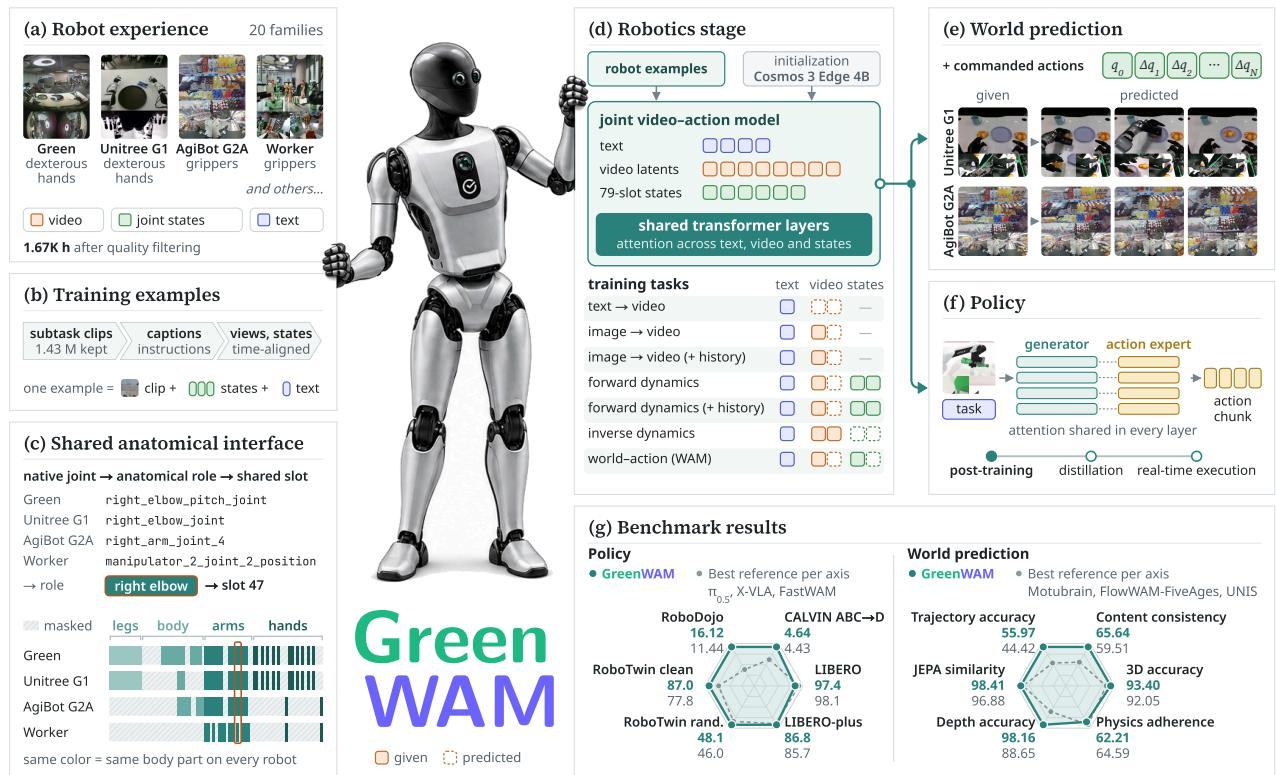
World foundation models learn how scenes evolve from large-scale video, and world-action models reuse this knowledge to jointly predict observations and actions. For robot control, this is especially demanding because the model must both predict how the scene changes when the robot moves and generate that motion itself, so the representation of the robot body is central. Prior work is limited because robot data are fragmented across embodiments, joint layouts, grippers, hands, cameras, frame rates, and task boundaries. Existing models typically describe each robot through per-embodiment action projections, end-effector poses, or padded joint vectors, leaving cross-body anatomical correspondences implicit or absent. The authors introduce GreenWAM, a world foundation model adapted from Cosmos 3 Edge through a shared anatomical action space: per-robot codecs map joints onto common slots for legs, torso, arms, and finger joints, and one model is trained jointly in visual, action-conditioned, and world-action modes. This produces a single model that serves as both a world model and a policy across different robot bodies through one action interface, including control of a held-out Franka arm and a real humanoid.
Dataset

Dataset description
The authors describe the robot experience dataset as a cross-embodiment corpus built from multiple robot sources and prepared as subtask-level training atoms.
Dataset composition and sources
- The corpus spans 20 main robot families, all two-armed:
- bimanual platforms with parallel grippers
- humanoids with grippers or dexterous hands
- real and simulated scenes
- It combines:
- public robot datasets in LeRobot format
- internal robot datasets
- the authors’ humanoid data
- The basic training unit is an atom: a subtask clip from one episode with synchronized views, measured states, text, and provenance.
- Section A of the paper gives the layout descriptions, admission rules, and stage counts.
Corpus size and filtering
- Registration first fixes camera roles, state layout, and robot properties for each source.
- Cutting episodes into atoms yields an admitted corpus of:
- 1.44 million whole-subtask atoms
- 1,688.5 hours
- A quality pass keeps:
- 1.43 million atoms
- 1,674.7 hours
- Captioning and command derivation leave:
- 1.19 million atoms with an accepted command
- Filtering rules include:
- Semantic subtask boundaries are taken from source annotations.
- An episode is used whole only when it has no finer temporal annotation.
- Ambiguous or incomplete boundaries are excluded.
- Overlong atoms are rejected rather than cut into arbitrary windows.
- Idle intervals, duplicated frame runs, temporal cuts, and unreadable clips are removed.
- For text-dependent training modes, an atom also needs an accepted caption or command.
Text and instruction construction
- A video captioner, Qwen3.8-27B, writes structured fields for each atom:
- subjects, background, lighting, aesthetics, context
- attempt record
- timed action phases
- temporal caption
- consistency check
- The source task label supplies the intended goal.
- Registry facts fix the embodiment, effector type, and real or simulated domain.
- The captioner records how far the attempt got by reading the final frame, not only the label.
- Captions whose motion does not match the object and action type from the label are rejected.
- A second text-only stage converts the action phases into a prospective command:
- It preserves observed motions, object references, and phase order.
- It includes partial or failed attempts.
- It does not complete an intended task that the clip does not demonstrate.
- It does not see native dataset instructions.
- The derived text is used differently by training mode:
- visual modes use the visual description
- forward dynamics and WAM use the derived command
- inverse dynamics uses a fixed trajectory-recovery instruction
Video, state alignment, and targets
- Camera selection and ordering are explicit for each source.
- Synchronized RGB views are assembled into one canvas while keeping original episode timestamps.
- Frame-rate reduction selects corresponding video and state times without rescaling physical joint positions or displacements.
- Autoregressive examples join complete adjacent atoms and stop at rejected gaps.
- WAM requires a positive success label:
- failed, unknown, and unlabeled outcomes are excluded from WAM
- they may still enter other eligible modes
- State-derived targets are constructed from measured states using a common trajectory codec:
- q_k = codec_l(s(t0 + Δ_k))
- the codec maps each layout to shared anatomical slots
- Inverse dynamics predicts absolute q_k.
- Forward dynamics and WAM use delta targets from the realized robot motion.
- Normalization statistics are computed on the training split only.
Training mixture
- Sampling chooses a mode, a robot cluster, a dataset, and a window.
- The Worker/ARX5 and Green humanoid clusters receive fixed shares.
- Other clusters and datasets are weighted by the square root of their admissible subtask counts.
- Each source is sampled only in the modes its data support.
Method
The authors present GreenWAM, a world foundation model for robotics that unifies video prediction and action generation across diverse robot embodiments. Initialized from the Cosmos 3 Edge 4B checkpoint, the model employs a mixture-of-transformers backbone that couples a frozen reasoner with a trained generator, alongside a causal video VAE and rectified-flow training. While prior approaches often rely on end-effector pose deltas with embodiment-specific projections, GreenWAM retrains action modes on measured joint and Cartesian states from 20 robot families, mapping them into a shared anatomical action space.
As shown in the framework diagram:
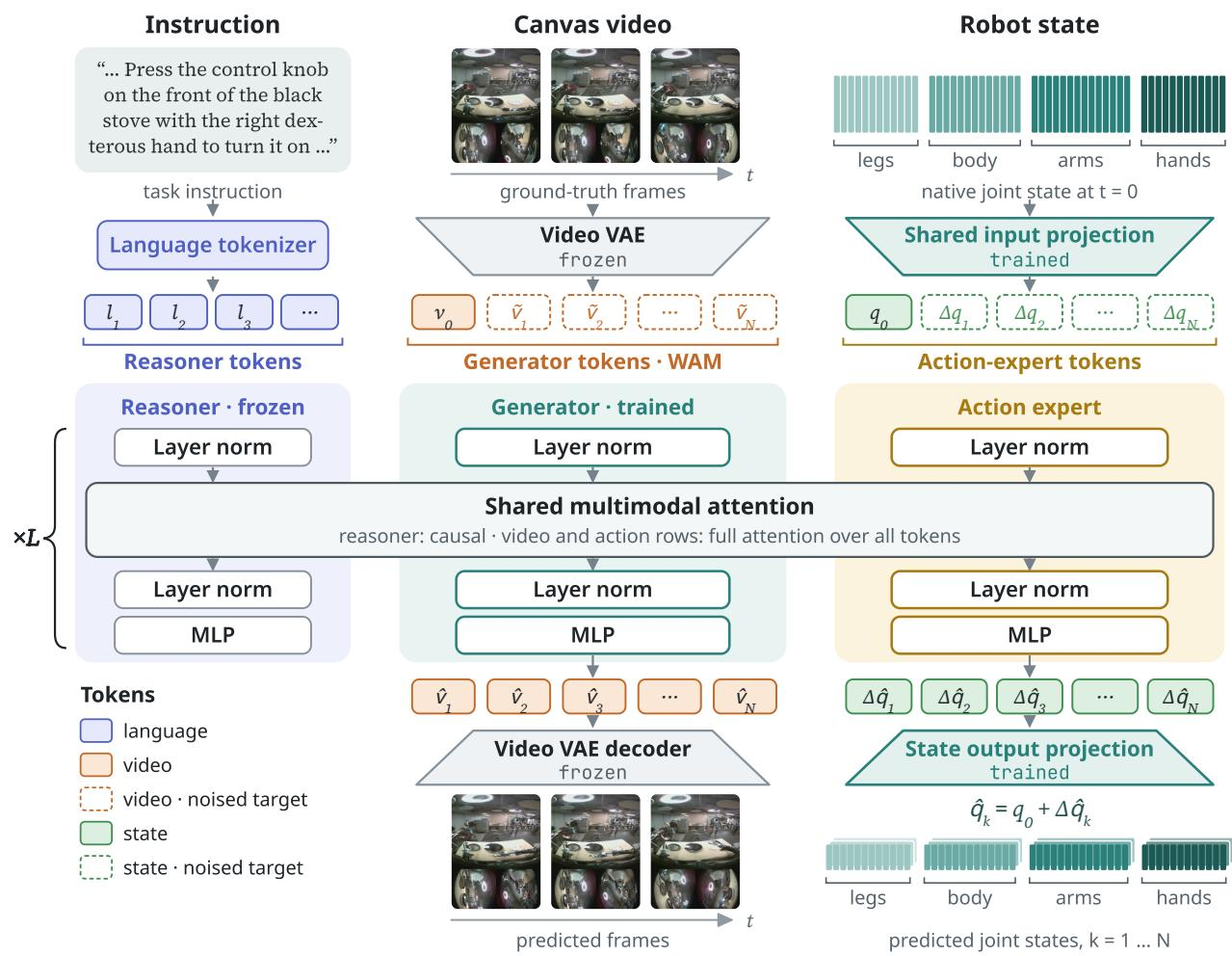
The architecture processes task instructions, multi-camera video canvases, and native joint states. The layout-specific codec maps native joints to shared anatomical slots before they pass through a shared input projection. In the standard GreenWAM configuration, state and action tokens pass through the main generator. For policy adaptation, an action expert is split from the generator to handle state and action tokens separately, while retaining joint attention with the video stream.
Refer to the comparison of action representations and data distribution:
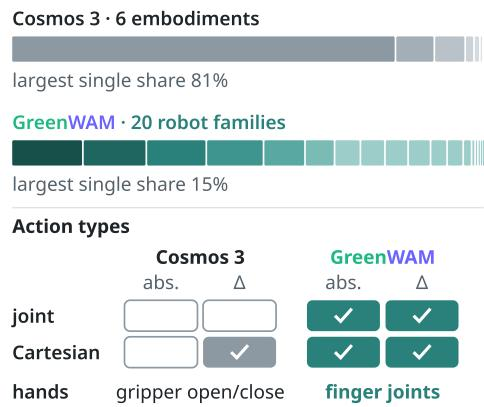
This comparison highlights how GreenWAM expands beyond the six embodiments and gripper open/close actions of its predecessor to support 20 robot families with joint and Cartesian representations, including finger joints for dexterous hands.
To accommodate the significant variation in state layouts, joint orders, and conventions across datasets, the authors establish a shared anatomical action space before projection. Layout-specific codecs map native channels to 79 anatomical coordinates, which are then processed by a single shared input and output projector. This ensures that a specific slot, such as the left elbow, corresponds to the same joint motion across all platforms. The vocabulary is divided into four blocks: legs, body, arms, and hands.
The shared anatomical action space is illustrated below:
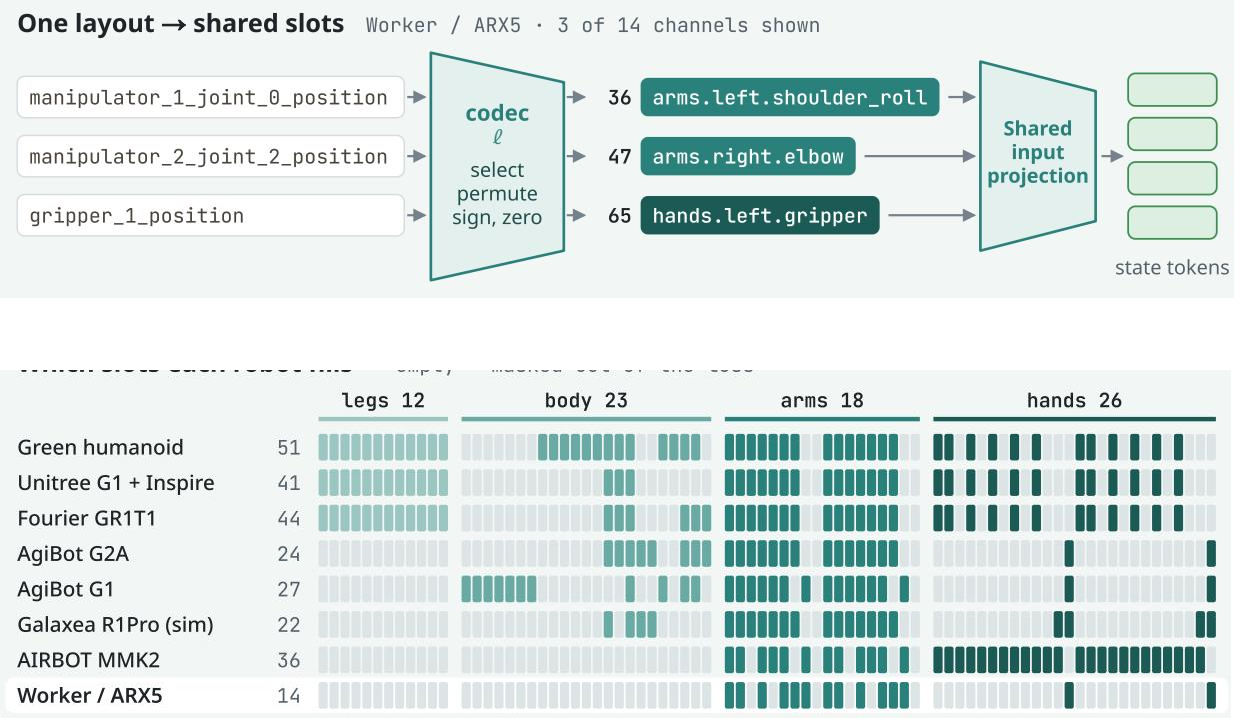
The codec selects, permutes, and adjusts the sign and zero offset of native channels to align with the shared slots. A shared input projection then maps the slot vector to state tokens. The bottom portion of the figure demonstrates how different robot layouts, such as the Green humanoid and Unitree G1, fill specific slots within the legs, body, arms, and hands blocks, while empty slots are masked during loss computation.
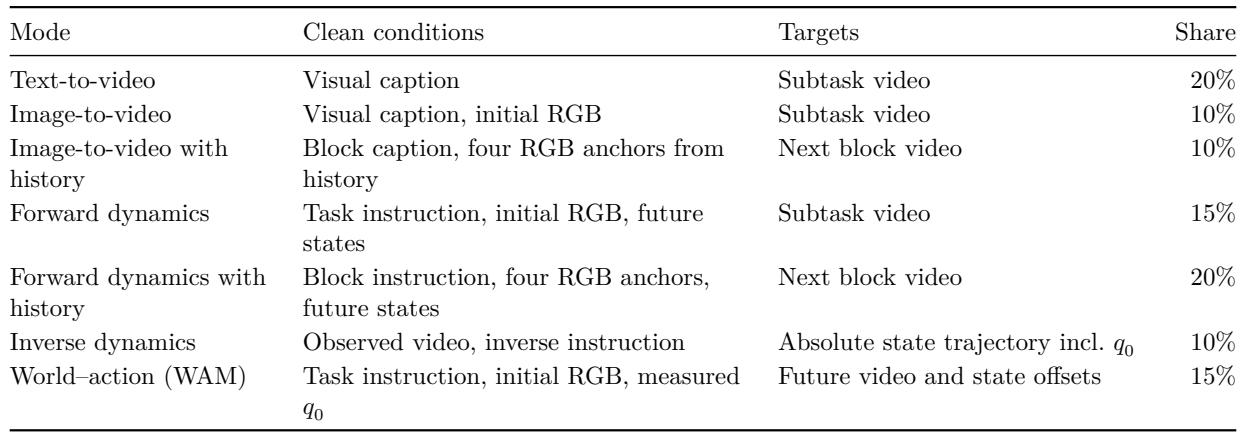
GreenWAM is trained jointly on seven modes, allowing a single set of generator weights to predict future video, robot trajectories, or both. A mode is defined by which streams serve as clean conditions and which are noised targets. For a mode m, let cm be the clean conditions and Sm the generated streams. All generated streams share a noise level σ, and a clean target x0 is noised along the rectified-flow path. The generator predicts the velocity v=ϵ−x0, minimizing the loss:
Lm=Eσ,ϵs∈Sm∑λs∥Ms∥1∥Ms⊙(v^θ(xσ,cm,σ)s−vs)∥2where Ms masks valid elements and λs weights the stream. The training mixture allocates three-quarters of examples to video prediction and one-quarter to state production through inverse dynamics and world-action modeling.
The data curation pipeline is depicted here:
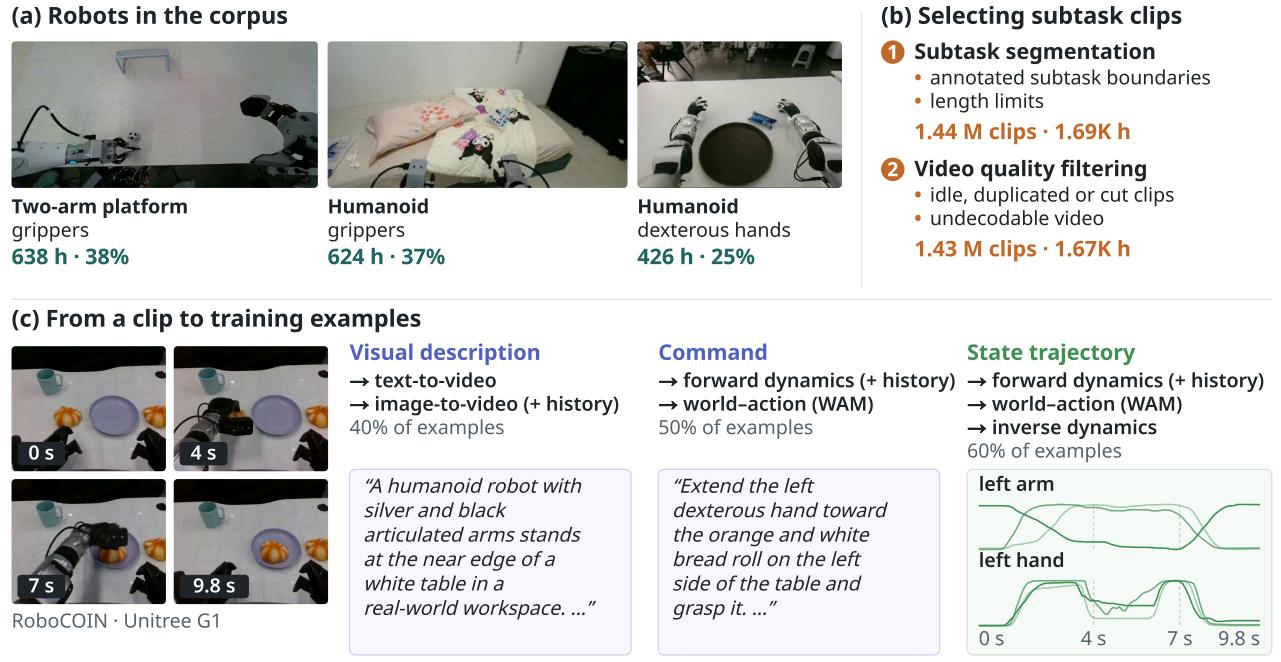
Public robot datasets are processed in stages. Episodes are cut into subtask clips at annotated boundaries, filtered for video quality to remove idle or undecodable segments, and then used to derive visual descriptions and commands. The state trajectory serves multiple action modes, acting as a condition for forward dynamics and a target for world-action prediction and inverse dynamics.
The captioning and command derivation process is shown in the figure:
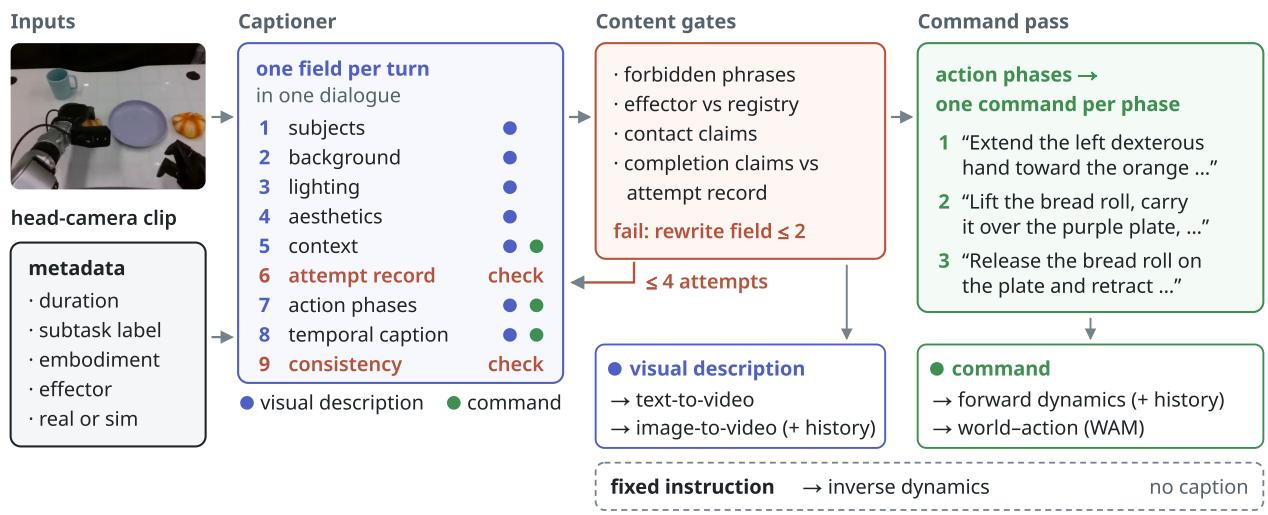
A captioner generates a structured record for each clip, including subjects, background, action phases, and a consistency check. Content gates verify forbidden phrases and completion claims against the attempt record. A subsequent command pass converts the action phases into prospective commands, preserving observed motions and phase order. These visual descriptions condition text-to-video modes, while the derived commands condition forward dynamics and world-action prediction.
For policy adaptation, the authors split the action tokens into a dedicated transformer while keeping video tokens in the generator. Joint attention connects the two streams at every layer, allowing action prediction to retain access to visual dynamics. The action expert is initialized by copying the generator tower, and the towers diverge during post-training. To enable real-time control, the adapted policy is distilled into a one-step student using modality-specific consistency objectives, significantly reducing inference latency while maintaining task success.
Experiment
The experiments evaluate GreenWAM in two roles. As a world model, it is tested on held-out robot recordings and on the WorldArena benchmark, where generated motion follows scaled action commands and it scores highest among compared world-action models on trajectory, depth, and 3D accuracy. As a policy, it is adapted to RoboTwin 2.0, CALVIN, RoboDojo, LIBERO, and a real humanoid packing task, achieving strong clean and randomized success, high zero-shot LIBERO-plus performance, and 95.6% in-distribution real-robot success. Controlled ablations show that robot-specialized initialization, a separate action expert, and retaining world-model prediction modes all improve policy success, with retained video prediction mainly improving robustness to randomized scenes because out-of-distribution success tracks the accuracy of the policy’s imagined video.
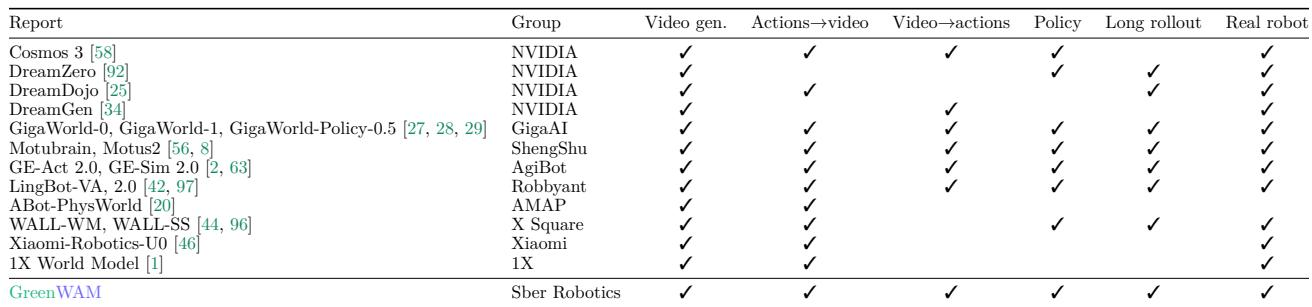
The comparison groups recent technical reports by whether they present video generation, forward and inverse dynamics, policy learning, long rollout, and real robot capabilities. GigaAI, ShengShu, and AgiBot entries are marked across all six listed capabilities, whereas NVIDIA entries cover video generation and dynamics but vary in policy, long rollout, and real robot support. The marks indicate capability coverage rather than quality. GigaWorld, Motubrain/Motus2, and GE-Act/GE-Sim are the only entries marked for every listed capability, including long rollout and real robot experiments. Cosmos 3 is marked for video generation, action-conditioned video, video-to-action, policy, and long rollout but not real robot; DreamZero and DreamDojo have fewer marks, and DreamGen has the fewest among the NVIDIA entries.
A single generator is trained across seven modes that mix video generation, forward dynamics, inverse dynamics, and world-action modeling. The largest sampling shares go to text-to-video and forward dynamics with history, while image-to-video and inverse dynamics modes are less frequent. The world-action mode conditions on the task instruction, initial RGB image, and measured initial state to predict future video and state offsets. Text-to-video and forward dynamics with history are the most heavily sampled modes, together accounting for 40% of example sampling probability. World-action and forward dynamics without history each account for 15%, while image-to-video, image-to-video with history, and inverse dynamics account for 10% each. History-conditioned video modes use four RGB anchors from prior frames as clean conditions. The world-action mode predicts future video and state offsets from the task instruction, initial RGB, and measured initial state.
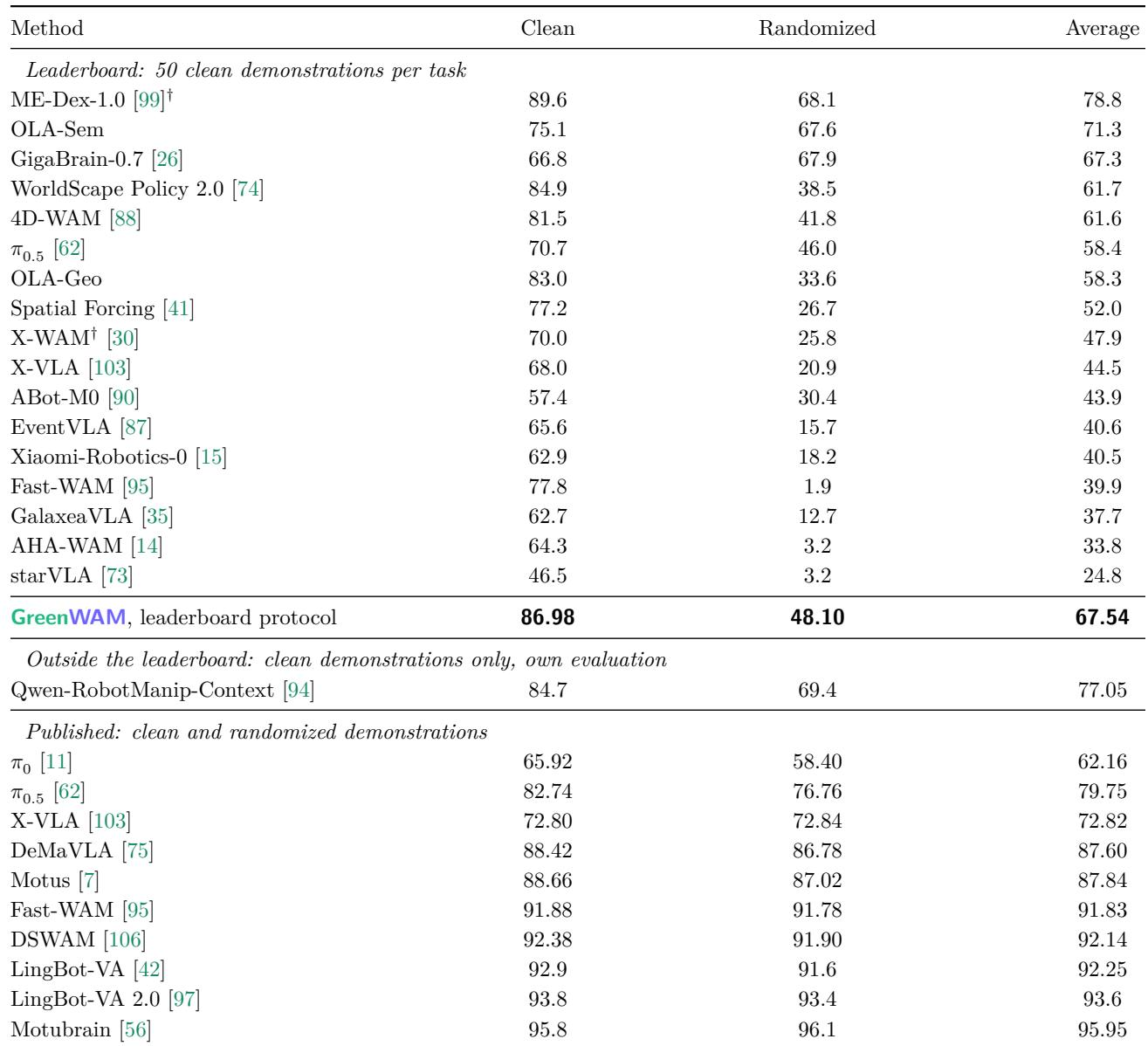
The benchmark shows that clean success is often high, but randomized success varies sharply across methods. ME-Dex-1.0 has the best average and randomized performance among the listed entries, while several models with high clean scores drop substantially under randomization. GreenWAM reaches competitive clean and average success but trails the most robust randomized performance. ME-Dex-1.0 leads the listed methods in both average and randomized success, showing less degradation under randomized scenes than high-clean alternatives. Models such as WorldScape Policy 2.0 and 4D-WAM score strongly on clean demonstrations but fall to much lower randomized success, while GreenWAM has strong clean and average results but only moderate randomized success.
A specialized start with 3,000 adaptation steps improves all three reported evaluation metrics relative to the comparison. Prediction quality sees roughly one-decibel gains on held-out RoboTwin forward frames and first-block WorldArena frames, while the WorldArena EWM score improves by a smaller positive margin. The pattern aligns with the broader finding that stronger forward prediction accompanies better policy success. Specialized adaptation from a world-model start yields positive gains across held-out forward prediction, first-block video prediction, and the WorldArena EWM score. The two frame-prediction metrics improve by roughly one decibel, while the EWM score increase is more modest but still positive.

The experiments compare technical reports across video generation, forward and inverse dynamics, policy learning, long rollout, and real robot capabilities; they also examine a seven-mode generator training distribution, clean versus randomized policy success, and adaptation from a world-model start. Qualitatively, only GigaWorld, Motubrain/Motus2, and GE-Act/GE-Sim cover every listed capability, while ME-Dex-1.0 remains the most robust under randomized scenes and several high-clean methods degrade sharply. A 3,000-step specialized adaptation improves forward prediction and WorldArena EWM, supporting the broader conclusion that better forward prediction accompanies better policy success.