Command Palette
Search for a command to run...
هل يُعمِّم تعلُّم طيِّ البروتين على استدلالٍ أوسع؟
هل يُعمِّم تعلُّم طيِّ البروتين على استدلالٍ أوسع؟
Yong Liu Zhanpeng Shi Yizhou Dang Zhongyue Zhang Xiaoliang Shi Zhijian Wei Shuangjia Zheng
الملخص
تعتمد نماذج اللغة الكبيرة اعتمادًا كبيرًا على النصوص البشرية التي تنقل غالبًا إجاباتٍ سطحية بدلًا من المنطق المكاني والبنيوي الكامن وراءها. يُمثل طي البروتين ميدان اختبار طبيعيًا؛ لأن البنية الواحدة المحلولة تُنتج آلاف العبارات المكانية والطوبولوجية القابلة للتحقق بدقة. نتساءل: هل يمكن لتعلُّم طي البروتينات أن يُكسب النماذج العامة قدرات استدلالية قابلة لإعادة الاستخدام؟ للإجابة عن هذا السؤال، نُنشئ FoldingCorpus، وهي مجموعة بيانات أسئلة وأجوبة مشتقة من البروتينات، وFold2Reason، وهي منهجية تدريب لاحق عليه عبر إشارتين متكاملتين: إجابات بنيوية متقطعة يُتنبأ بها عبر رأس اللغة الأصلي للنموذج، وهندسة ثلاثية الأبعاد مستمرة تُفك ترميزها من التمثيلات المشتركة ذاتها. يحقق Fold2Reason على FoldBench درجات تنبؤ بالبنية تبلغ من 2.7 إلى 3.5 ضعف درجات Qwen3.5-9B. وإلى جانب التنبؤ ببنية البروتين، يحسِّن الأداء في المعايير العشرة جميعها التي تشمل الاستدلال المكاني والبياني والعلمي والعام، رافعًا متوسط الدقة الكلي من 45.09% إلى 48.33% (+3.23 نقطة مئوية)، مع مكاسب إيجابية في المعايير العشرة كلها، في حين تحقق المجموعات الضابطة المطابقة المبنية على بنى عشوائية واصطناعية ومخلوطة مكاسب أصغر كثيرًا أو سلبية. يُظهر عملنا أن البيانات العلمية غير اللغوية عالية الكثافة البنيوية يمكن أن تحسِّن الاستدلال الواسع في نماذج اللغة بشكل منهجي، مما يجعل مسألة علمية محلولة مصدرًا عمليًا للإشراف في التدريب اللاحق.
One-sentence Summary
Researchers from Shanghai Jiao Tong University, Fudan University, Shanghai Innovation Institute, and Northeastern University propose Fold2Reason, a post-training recipe built on the FoldingCorpus protein question-answer dataset that combines discrete structural answers predicted via the model’s native language head with continuous 3D geometry decoded from shared representations, improving structure prediction scores 2.7 to 3.5 times those of Qwen3.5-9B and raising macro-average accuracy across 10 reasoning benchmarks by 3.23 percentage points.
Key Contributions
- FoldingCorpus is a question-answer dataset built from existing protein structures, containing 1,200 proteins and 14,400 records across 12 structural operators, with cluster-disjoint core partitions and independently recomputed answers for auditability.
- Fold2Reason is a post-training recipe that uses two complementary signals from shared representations: discrete structural answers supervise the model's native language head, while a frozen coordinate decoder constrains the same LoRA-adapted residue states; downstream evaluation uses the adapted base model alone.
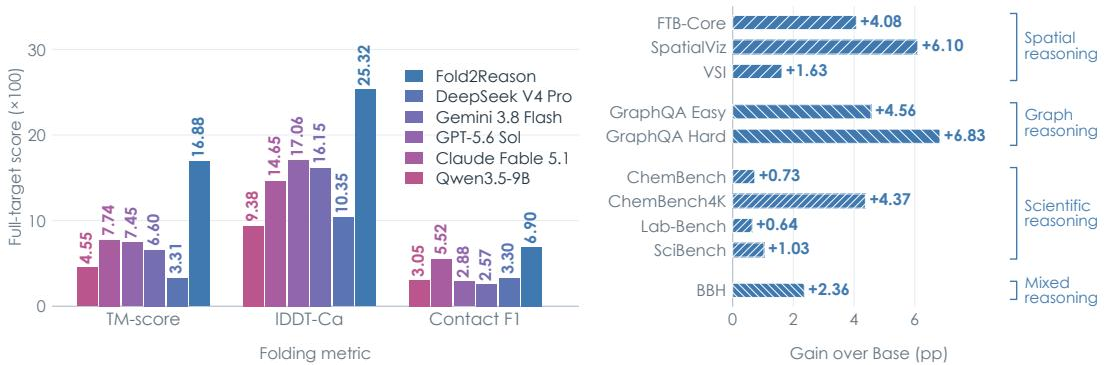
- On FoldBench, Fold2Reason achieves structure prediction scores 2.7 to 3.5 times those of Qwen3.5-9B. Across 10 general reasoning benchmarks, it raises macro-average accuracy from 45.09% to 48.33% with positive gains on all 10 benchmarks, while matched controls built from random, synthetic, and shuffled structure yield substantially smaller or negative gains.
Introduction
The authors tackle the open question of which supervision properties enable language model training to transfer beyond its source domain. Finite human-written text and code motivate alternative supervision, but specialized training often leaves broader behavior unchanged or worse. Protein folding provides a compelling testbed because solved Protein Data Bank coordinates yield deterministic, automatically verifiable contact, distance, orientation, and coordinate targets at scale without extra annotation. The authors build FoldingCorpus from 1,200 proteins and 12 structural operators, and propose FOLD2REASON, which post-trains Qwen3.5-9B with discrete structural answers plus continuous geometry supervision through a shared LoRA workspace, then removes all protein-specific components at evaluation. Across three seeds, this improves the General-10 macro-average from 45.09% to 48.33% (+3.23 pp), with positive mean changes on all ten general reasoning datasets, supporting behavioral transfer rather than uniform improvement.
Method
Training targets: known answers, hidden evidence
For a protein of length L, let x contain the amino-acid sequence and optional MSA or template evidence, let Y∈RL×4×3 contain the known backbone coordinates, and let m denote the residue-validity mask. Coordinates are used to generate targets and losses, but they are not part of the model input. The language model processes a prompt containing one marker per residue and produces residue states
H=fθ(x)res∈RL×4096,where the base weights are frozen and θ includes the trainable LoRA parameters.
Each protein yields one packed set of 12 questions. Programs computed over Y create labels for contact, distance comparison, segment orientation, center proximity, local direction, chirality, multi-constraint, and global-summary tasks. Nine answers are binary, two are three-way, and one is a 32-way textual summary match. Every option is represented by one vocabulary token. The authors construct these question packs once, independently recompute the answers, and retain the numerical evidence in an audit record rather than placing it in the prompt. Independent hash salts determine label sampling, option order, and question order, and the frozen packs are reused across epochs. The 32-way question selects among one target summary and 31 hard-negative summaries, but it remains ordinary answer-token supervision rather than a separate retrieval objective.
One workspace, two readouts
The workspace module Wϕ reduces the marker states to 256 dimensions, exchanges messages over sequence-local pairs and sampled long-range pairs, and returns two readouts:
(E,M)=Wϕ(H),E∈RL×4096,M∈R16×4096.Here E is residue aligned. Sixteen learned queries pool the residue set and project it back to the language model width, producing evidence tokens M. The workspace refers only to these training-time residue and pooled tensors.
Message-passing pairs connect sequence offsets 1 to 4 and evenly spaced longer-range indices, with at most 2,048 pairs per protein. Target contacts do not select the edges. Symmetric features combine absolute differences and elementwise products of the reduced states. Messages are averaged at incident residues followed by residual updates. Learned-query pooling forms the fixed-size prefix M, while E preserves residue-level correspondence.
The FoldingCorpus path prepends M to the packed question sequence q. Prefix and prompt positions are ignored, and only the 12 answer tokens and the end-of-sequence token are supervised. The answer loss is
Lqa=−∣S∣1t∈S∑logpθ,ϕ(yt∣M,q,y<t).The geometry path passes E to a frozen coordinate and distogram decoder gψ. Its loss combines coordinate, pair-distance, contact, distogram, local-frame, torsion, and radius-of-gyration terms:
Lgeo=Lcoord+Lpair+Lcontact+Ldist+Llocal+Ltorsion+LRg.Freezing ψ prevents a new coordinate head from absorbing the objective. Gradients must instead change the shared workspace and the LoRA parameters. The canonical objective is L=Lqa+Lgeo. Each training example uses two forward passes through the same LoRA-adapted model: the protein forward pass produces H, and the answer forward pass consumes the concatenation of M with the embedded question-answer sequence. The computation graph is retained between the two forward passes, so the answer loss updates both the answering parameters and the protein-to-workspace path. Freezing the decoder means excluding ψ from the optimizer, not detaching E. Geometry gradients therefore still reach ϕ and the shared LoRA parameters.
Only LoRA and the active workspace parameters are optimized. In the canonical run, four workers accumulate two one-protein microsteps, giving eight proteins per update. The authors average the answer cross-entropy over the 12 labels and the end-of-sequence token, combine it with the geometry loss, and clip the accumulated gradient norm to 1.0 before each AdamW update. At transfer evaluation, the workspace Wϕ and decoder gψ are discarded, and only the learned LoRA adapter is applied to the model's native benchmark interface. Thus, any measured transfer must reside in the adapted language model rather than in protein-specific modules.
Experiment
The study trains LoRA adapters on a protein FoldingCorpus that combines verified question-answer targets with geometry supervision through a frozen structural reader, then evaluates transfer on the General-10 reasoning suite and FoldBench structural metrics. Matched controls show that format copying and shuffled labels do not yield reliable gains, while hidden geometry targets transfer only partially, and scaling experiments indicate broad improvements across dataset families with diminishing returns at larger protein coverage. Ablations attribute most general reasoning transfer to FoldingCorpus answer supervision, with geometry contributing mainly to 3D-oriented tasks and local structural readouts, and cross-model tests find gains for several Qwen scales and InternVL but not Gemma.
FOLD2REASON lifts the General-10 macro from 45.09% to 48.33%, a gain of 3.23 percentage points, with positive mean changes on all ten datasets. Matched controls show a small aggregate gain from hidden geometry targets, while format copying and fixed shuffled labels stay near zero. The full recipe surpasses the strongest control by more than twofold, indicating the improvement is tied to protein-derived supervision rather than answer formatting or fixed label mismatches. FOLD2REASON improves the General-10 macro by 3.23 percentage points over the base model. Gains are broad, with positive mean changes across all ten General-10 datasets and the largest improvements concentrated in graph and spatial reasoning benchmarks. Among matched controls, only Hidden Geometry produces a modest aggregate gain; Format Copy and Fixed Shuffle remain near zero. The FOLD2REASON gain is more than twice the strongest control, so answer formatting or fixed shuffled supervision alone cannot explain the improvement.
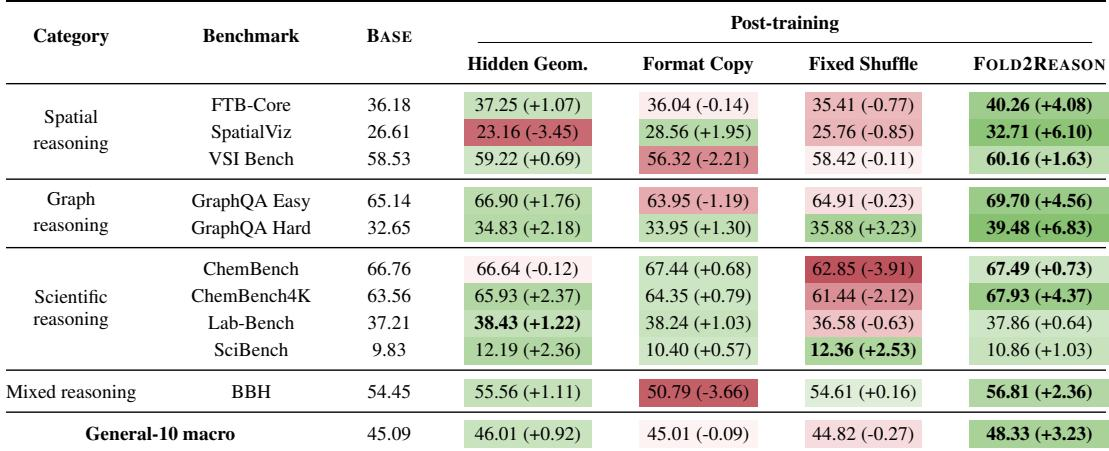
The full Fold2Reason configuration improves General-10 accuracy over the base model by just over three percentage points, with larger gains on the 3D macro than on the text-only aggregate. FoldingCorpus supervision accounts for most of the broad and text-heavy gains, while the added geometry signal provides a further modest boost concentrated in spatial tasks such as FTB-Core, SpatialViz, and VSI. Removing FoldingCorpus leaves only small overall improvement, confirming answer supervision as the main driver of behavioral transfer. The full configuration gains about 3.2 points on General-10 and about 3.9 points on the 3D macro relative to base. The w/o Geometry arm already supplies most of the overall General-10 and text aggregate gains, indicating FoldingCorpus supervision is the dominant contributor. Adding geometry on top of FoldingCorpus improves the 3D macro by about one point and each 3D-oriented dataset while leaving the text aggregate essentially unchanged. Without FoldingCorpus, gains are much smaller, especially for SpatialViz and VSI, while FTB-Core still shows a moderate improvement.

The evaluation measures transfer to the General-10 and 3D benchmarks. The full Fold2Reason method improves General-10 accuracy by about 3.2 points over the base model, with broad positive changes across all ten datasets and larger gains on spatial and 3D tasks. Control experiments show hidden geometry gives only a modest aggregate gain while format copying and fixed shuffled labels stay near zero, indicating the improvement is tied to protein-derived supervision rather than formatting or label mismatches. Ablations confirm that FoldingCorpus answer supervision is the main driver of broad and text-heavy gains, with the added geometry signal providing a further modest boost concentrated in 3D-oriented benchmarks such as FTB-Core, SpatialViz, and VSI.