Command Palette
Search for a command to run...
تطوير الألعاب الوكيل كمحرك بيانات مسارات قابل للتحقق لتوسيع نطاق نماذج العالم
تطوير الألعاب الوكيل كمحرك بيانات مسارات قابل للتحقق لتوسيع نطاق نماذج العالم
Pengfei Zhou Hexin Wang Zhengfeiyang Zhang Yixing Ma Zhenglin Wan Kaipeng Zhang Wangbo Zhao Yang You
الملخص
تتمثل إحدى الاستراتيجيات الشائعة لتوسيع نطاق نماذج العالم في التدريب على المزيد من مقاطع الفيديو المجمعة من الويب باستخدام قدر أكبر من الحوسبة. ونجادل بأن هذه الاستراتيجية غير فعالة: إذ يتطلب توسيع نطاق نماذج العالم أيضًا محرك بيانات تكراريًا يوفر إشارات مكافأة موثوقة. يوضح نجاح وكلاء الشيفرات البرمجية أهمية هذا الأمر. نظرًا لأن الشيفرة قابلة للتنفيذ، يمكن للمترجمات وبيئات التشغيل توفير مكافآت عالية الجودة للتدريب اللاحق لنماذج اللغة الكبيرة باستخدام التعلم المعزز. على النقيض من ذلك، لا يزال التوليد المكاني يعتمد إلى حد كبير على وكلاء تقريبيين غامضين مثل درجات CLIP. هذه الإشارات غامضة ومتحيزة، مما يجعل من الصعب دعم التدريب اللاحق بالتعلم المعزز. بالمقارنة مع هذه الإشارات، يوفر تطوير الألعاب بيئة المكافأة المفقودة لنماذج العالم المكانية. فالمشهد المشفر بواسطة محرك ألعاب هو مواصفة عالم قابلة للتنفيذ: حيث يمكن للمحرك التحقق بكفاءة من التصادم والفيزياء وقابلية الملاحة وقابلية اللعب المحدودة، بينما يوفر المطور إشارة التحقق الشاملة من خلال الحكم على ما إذا كان ينبغي قبول المشهد. كما يوفر تطوير الألعاب بيانات مسارات طويلة الأمد من العالم الحقيقي للتدريب اللاحق بالتعلم المعزز. لذلك، نقترح التعلم المعزز مع التحقق البشري-المحرك، وهو نموذج تدريب لاحق يجمع بين إشارات المحرك الكثيفة وملاحظات القبول البشري الضمنية من عملية التطوير. نطبق هدف التدريب هذا على نموذج العالم الوكيل الذي نقترحه: وهو وكيل بناء عوالم يقترح تعديلات على المشهد، ويلاحظ التحقق البشري-المحرك، ويحول الآثار متعددة الوسائط المقبولة أو المُصلحة إلى بيانات تدريب. نقيم النهج المقترح من خلال تجارب مضبوطة. على معيار UnitySceneBench، وهو تقييم لتعديل أصول Unity مكون من 200 مثال، يحقق نموذجنا أعلى درجة. في التعميم، يساعد نقل التعلم في التعامل مع التحولات خارج نطاق التوزيع ويعطي إشارات إيجابية في تجارب المحركات المتقاطعة Unreal و Godot. كما يحسن التدريب المعزز بـ AWoMo الأداء التجسيدي للسياسة على مهام R2R و Gymnasium MuJoCo و D4RL Gym-MuJoCo. تم إصدار الأدوات الوكيلة لإعادة الإنتاج: https://github.com/LanceZPF/cardinal-preview.
One-sentence Summary
National University of Singapore, UC Berkeley, and collaborators propose Reinforcement Learning with Human-Engine Verification (RLHEV), a post-training paradigm that combines dense game-engine signals with implicit human acceptance to train an Agentic World Model (AWoMo) for scene generation, thereby providing grounded reward signals for spatial world models and improving embodied policy performance on R2R and MuJoCo.
Key Contributions
- RLHEV is a post-training paradigm that combines dense engine verification signals (collision, physics, navigability) with implicit human acceptance feedback from game development to provide grounded rewards for spatial world models.
- AWoMo is an agentic world model that proposes scene edits, observes human-engine verification, and converts accepted or repaired multimodal traces into training data.
- On UnitySceneBench, RLHEV achieves the highest score. Transfer learning yields positive signals in Unreal and Godot cross-engine experiments, and AWoMo-augmented training improves embodied policy performance on R2R, Gymnasium MuJoCo, and D4RL Gym-MuJoCo.
Introduction
Spatial intelligence tasks like video generation, 3D synthesis, and world modeling lack the scalable, reliable verification that has accelerated progress in code and reasoning agents. Prior work depends on fuzzy proxy metrics such as FVD and CLIP similarity and on expensive, low-bandwidth human ratings, which introduce noise and bias that cap post-training at imitation rather than correctness. The authors argue that game development supplies a practical recursive data engine: game engines automatically verify structural properties (collisions, navigation, script integrity) while human developers provide final acceptance judgments, yielding dense, grounded feedback. They propose the Agentic World Model (AWoMo), a developer-centered agentic workflow that captures complete world-building trajectories, and train it with Reinforcement Learning with Human-Engine Verification (RLHEV). This dual-verification loop transforms world construction into a self-improving process, giving spatial models a post-training path analogous to the one that succeeded for code.
Method
The authors propose Reinforcement Learning from Human-Engine Verification (RLHEV) to address the limitations of fuzzy, subjective reward proxies in spatial generation. Instead of relying solely on expensive and noisy human annotations for final outputs, RLHEV leverages game engines as cheap, grounded verifiers for structural properties, while reserving human judgment for final acceptance and intent alignment.
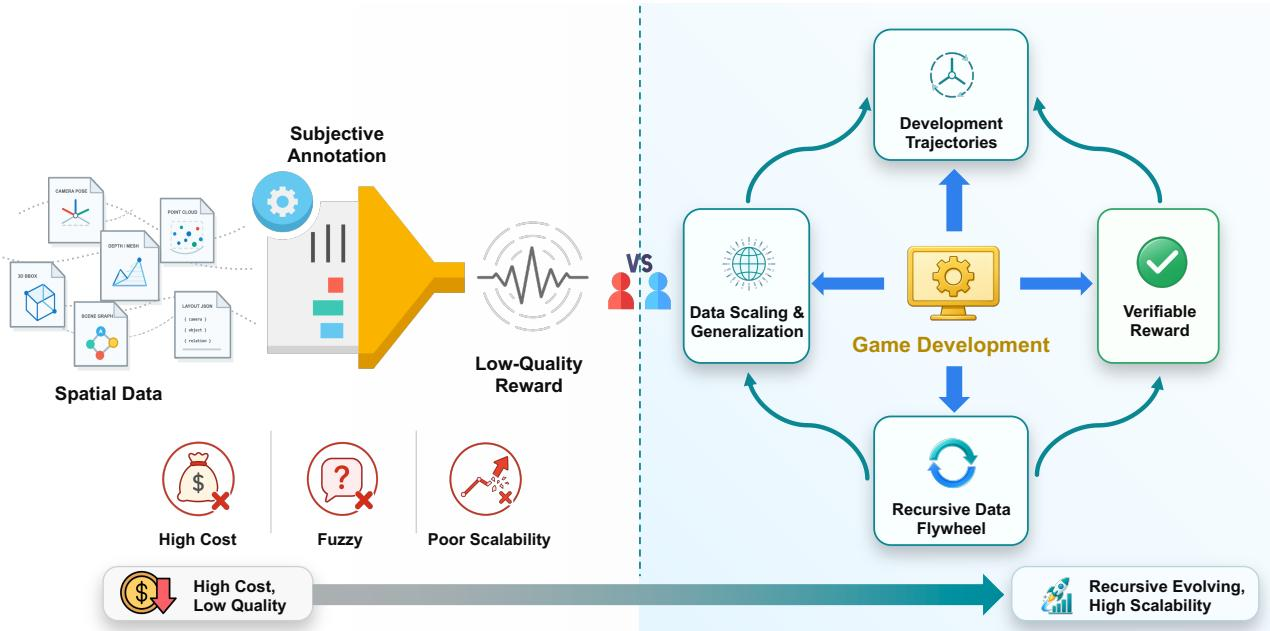
As shown in the framework diagram:
This approach shifts the paradigm from high-cost, low-quality subjective annotations to a recursive, evolving loop. The core system, named AWoMo, is organized around an omni-modal world model with four distinct interfaces. The intent interface receives task briefs and design constraints. The action interface emits scene programs, asset edits, and repair actions. The verification interface records engine checks such as collision, physics stability, and navmesh reachability. Finally, the review interface captures developer acceptance, rejection, and critique. The execution loop follows a propose, render, verify, repair, and review cycle, generating structured traces that serve as training data.
Refer to the figure below:
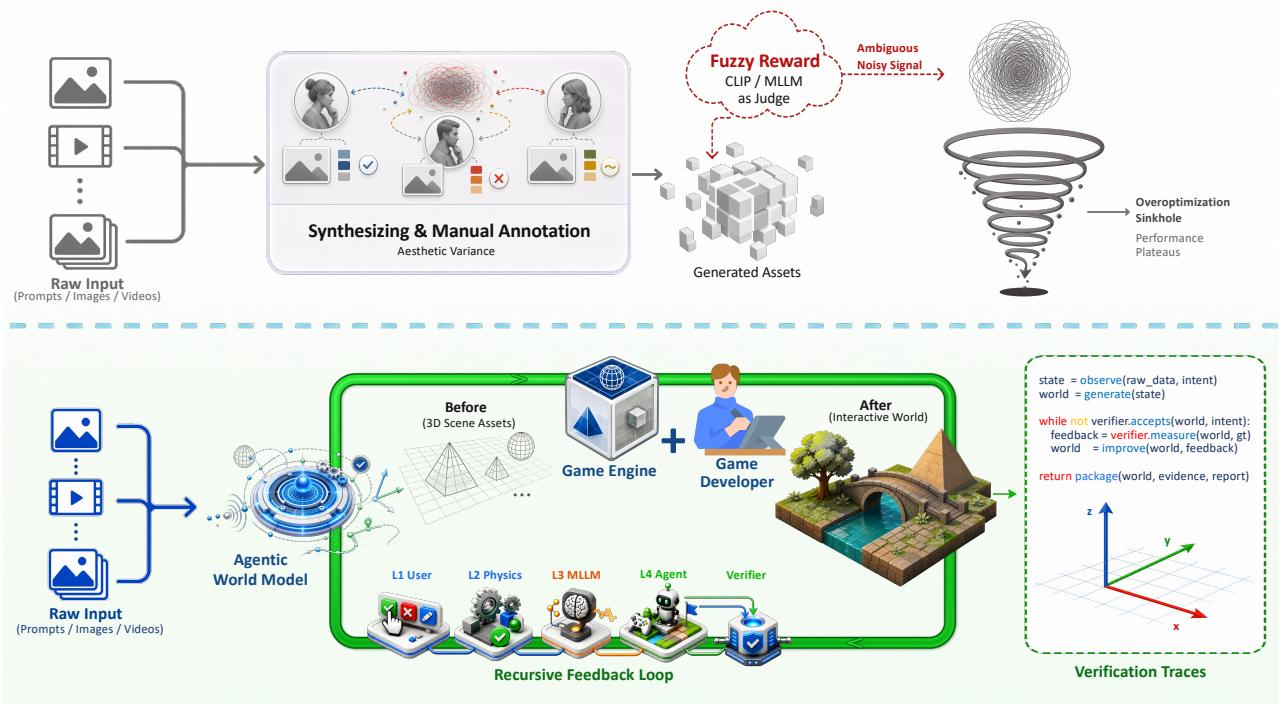
The bottom pipeline illustrates this human-engine feedback loop. Raw inputs are processed by an Agentic World Model, which interacts with a Game Engine and a Game Developer. The engine provides localized failure signals through a recursive feedback loop involving user intent, physics, multimodal large language models, and agents. This contrasts sharply with the top pipeline, where synthesizing and manual annotation lead to fuzzy rewards and overoptimization sinkholes.
At the heart of this architecture is a shared executable scene-program representation.
As illustrated in the figure below:
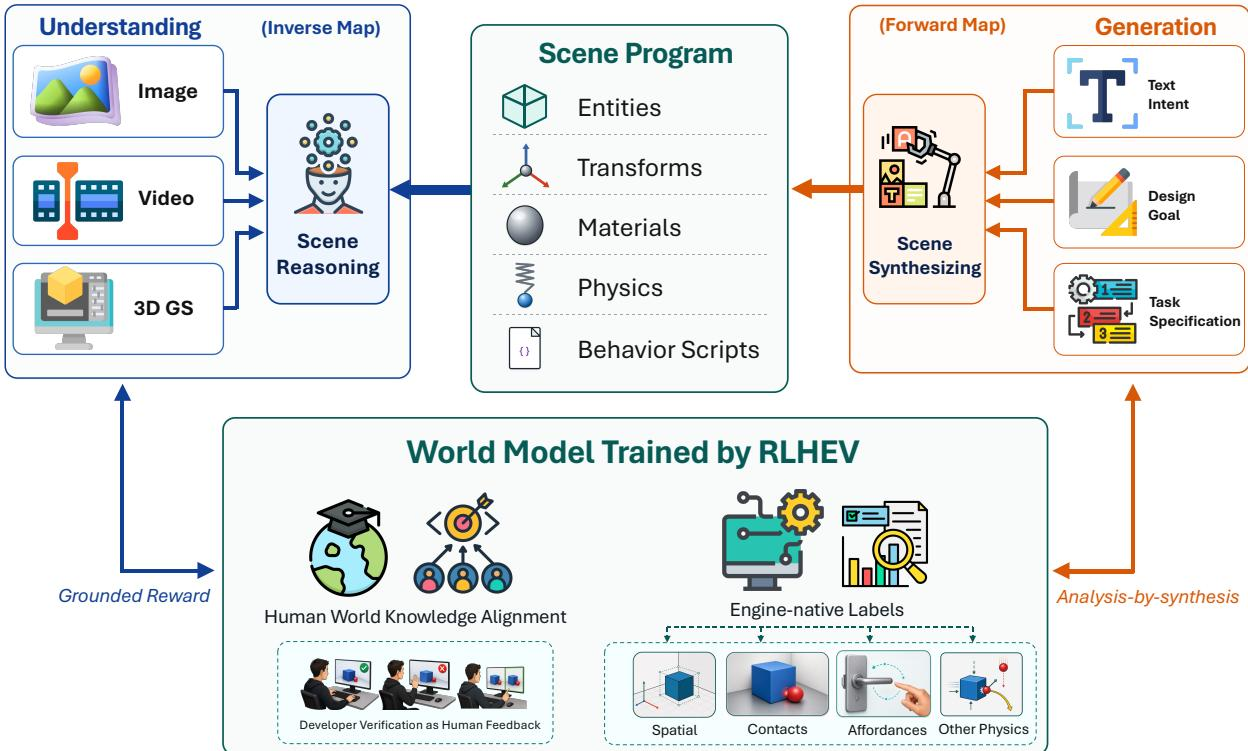
The World Model Trained by RLHEV bridges understanding and generation through this Scene Program. The generation process (Forward Map) maps text intent, design goals, and task specifications into scene synthesizing, producing entities, transforms, materials, physics, and behavior scripts. The understanding process (Inverse Map) performs scene reasoning on images, videos, and 3D Gaussian Splatting to reverse-engineer the scene program. The model is grounded by Engine-native Labels (spatial, contacts, affordances, physics) and Human World Knowledge Alignment (developer verification).
To formalize the data collection, the authors introduce the Unified World-Development Protocol (UWDP). This typed multimodal protocol converts ordinary game-development work into state-action-check-review traces. A compact instance is defined as ut=(b,ot,st,at,gt,vt,ht,ρt), where b is the design intent, ot is the object identifier, st stores spatial and semantic fields, at is the edit action, gt is the engine output, vt is rendered evidence, ht is the reviewer decision, and ρt links repairs and risks. This protocol ensures that the workflow used to build a world simultaneously emits its own verifiable training data.
Experiment
The evaluation uses a human-engine verification workflow where a world model generates or edits game assets, receives feedback from engine checks and a human reviewer, and is post-trained on that signal. Experiments on UnitySceneBench show that combining human and engine rewards achieves the best asset classification performance, while pretraining on source data improves out-of-distribution generalization within Unity and yields positive transfer gains to Unreal and Godot engines. Embodied diagnostic runs further demonstrate that AWoMo-augmented training improves policy performance on navigation and locomotion tasks. Overall, the pilot studies support human-engine verification as a practical feedback source, with the strongest gains observed under dual verification, though larger-scale studies are needed to confirm generalization.