Command Palette
Search for a command to run...
اقرأ أقل، وحُل أكثر: قراءة متفرقة موفرة للرموز للمحتوى الخارجي لوكلاء الذكاء الاصطناعي
اقرأ أقل، وحُل أكثر: قراءة متفرقة موفرة للرموز للمحتوى الخارجي لوكلاء الذكاء الاصطناعي
Zedong Liu Jiaan Wu Xinyang Ma Le Xu Kai Wang Yuanchao Hu Dingwen Tao Guangming Tan
الملخص
يصل وكلاء الذكاء الاصطناعي المتعاملون مع الويب بشكل متكرر إلى صفحات الويب والمستندات والمستودعات واستجابات الأدوات، ومع ذلك غالبًا ما تعرض واجهات القراءة الكائنات بأكملها بينما لا يلزم سوى أدلة متفرقة. تزيد هذه القراءة المفرطة من تكاليف الرموز وزمن الاستجابة ويمكن أن تضعف الأدلة ذات الصلة. نقدم SparseRead، وهي طبقة تحكم قراءة قابلة لإعادة الاستخدام تدير قبول المحتوى دون تعديل نموذج الوكيل. يتتبع بروتوكول نية القراءة الخاص بها الاحتياجات المتطورة وتغطية المصدر؛ وتختار خلفيات القارئ التكيفية كيفية تحديد موقع الأدلة وعرضها؛ وتحد بوابة القراءة المدرجة في الميزانية التعرض الخام التراكمي لكل حلقة مع تراجع أمين للعرض الكامل. تدعم واجهة قارئ موحدة اكتساب الأدلة القابل للتبادل عبر موارد غير متجانسة. عبر ستة نماذج، بما في ذلك Claude Opus 5، وخمسة سيناريوهات، يقلل SparseRead إجمالي الرموز بنسبة تصل إلى 92.9% وزمن التنفيذ بنسبة تصل إلى 89.0%، مع الحفاظ على جودة المهمة أو تحسينها في 97% من الإعدادات. في مهام البحث العميق على الويب، يقلل الرموز بنسبة 31.0–43.0% وزمن إنجاز المهمة بنسبة 23.0–37.0%. تثبت دراسات الاستئصال صحة التصاميم الثلاثة، بينما يُظهر التكامل مع ثلاثة أطر عمل للوكلاء قابلية النقل.
One-sentence Summary
Researchers from the University of Chinese Academy of Sciences, the Institute of Computing Technology, the Chinese Academy of Sciences, and the Songshan Lake Materials Laboratory propose SparseRead, a reusable reading control layer whose Read Intent Protocol, Adaptive Reader Backends, and Budgeted Read Gate govern content admission without modifying agents, reducing total tokens by up to 92.9% and wall time by up to 89.0% while preserving or improving task quality in 97% of settings.
Key Contributions
- SparseRead is a reusable reading control layer that governs content admission without modifying the agent model, combining a Read Intent Protocol for evolving needs and source coverage, Adaptive Reader Backends for evidence location and exposure, and a Budgeted Read Gate that bounds cumulative raw exposure per episode with faithful full-view fallback.
- A unified Reader interface supports interchangeable evidence acquisition across heterogeneous resources and lets retrieval or compression methods serve as replaceable backends.
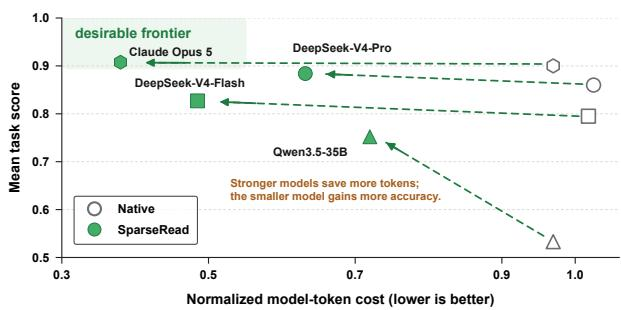
- Evaluations across six models, including Claude Opus 5, and five scenarios show total token reductions up to 92.9% and wall-time reductions up to 89.0%, with task quality preserved or improved in 97% of settings; Web deep-search tasks show token reductions of 31.0-43.0% and time reductions of 23.0-37.0%. Ablations validate the three designs, and integration with three agent frameworks demonstrates portability.
Introduction
Large language model agents increasingly operate over webpages, code repositories, and API responses across long-horizon tasks, but external observations often account for a large share of tokens and can persist across model calls. The authors characterize the resulting mismatch as over-reading: agents receive object-level content even when a decision requires only a small evidence slice, and broad context can dilute relevant evidence without improving quality. Existing approaches such as KV-cache compression, observation masking, and retrieval reduce representation overhead or fetch content on demand, but they do not jointly control what an artifact read should expose, track source coverage across evolving intents, bound cumulative exposure, and permit a faithful full-view fallback. SparseRead introduces a reading control layer in which an agent expresses a Read Intent and receives a bounded EvidencePack with explicit coverage, supported by adaptive reader backends and a budgeted gate that chooses between sparse access and a full view.
Method
The authors observe that useful evidence is often sparse within source documents. For long-document QA, annotated supporting evidence covers a median of only 3.17% of source tokens. This sparsity motivates evidence acquisition guided by current information needs rather than fixed summaries.
Refer to the reading-budget breakdown below:
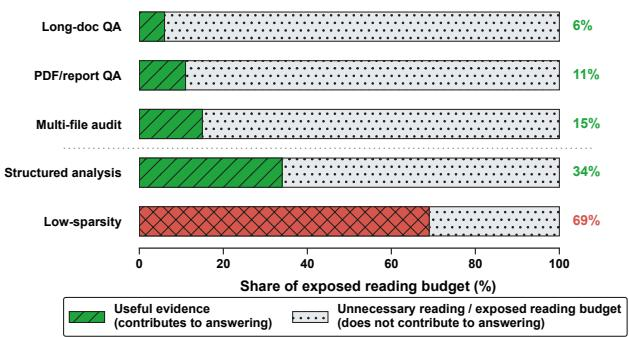
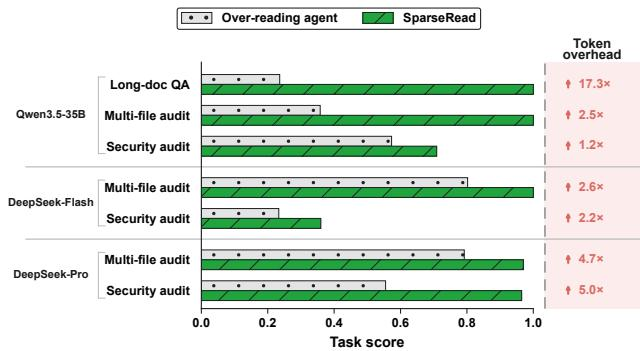
Furthermore, the cost of broad reading compounds across model calls. Content exposed at one step may remain in later calls, leading to significant replay-weighted exposure. If broad reading always improved quality, over-reading would be a cost-only problem, but selective reading often preserves or improves scores while reducing exposed context.
As shown in the figure below, full-read agents can spend up to 17.3 times more tokens than SparseRead while failing to improve task scores. This indicates that broad context is not a free substitute for reading control.
To address these issues, the authors identify that retrieval or compression alone is insufficient due to evolving evidence needs and uncertain regime boundaries. The optimal reading strategy depends on the artifact type and the specific task requirements.
Refer to the challenges of controlled reading below:
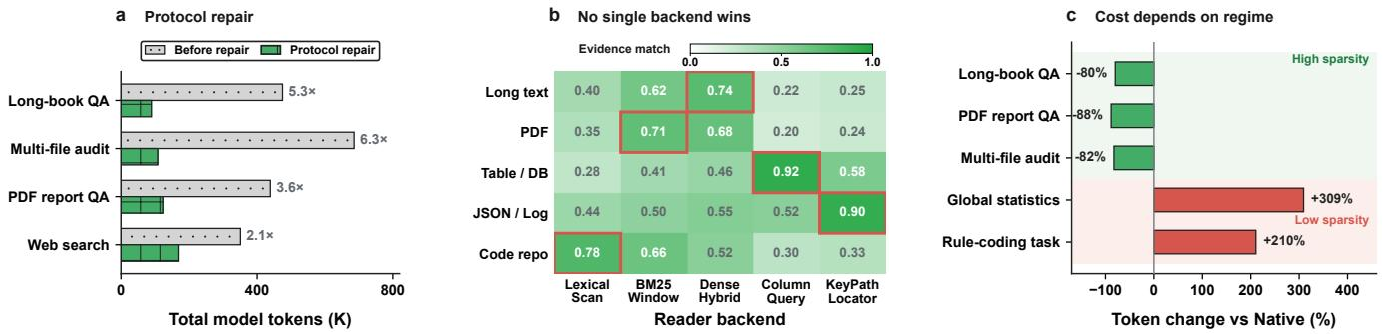
The figure above illustrates these challenges: protocol repair significantly reduces token usage, no single backend wins across artifact types (e.g., dense hybrid retrieval suits long text while key-path locators suit JSON), and the cost benefit depends heavily on the regime (sparse reading saves tokens on high-sparsity tasks but increases them on global statistics tasks).
Consequently, the authors propose SparseRead, which separates reading control from evidence acquisition. The architecture comprises a control plane and an evidence plane, connected by a common contract mapping Read Intent to an EvidencePack.
The architecture is illustrated in the framework diagram:
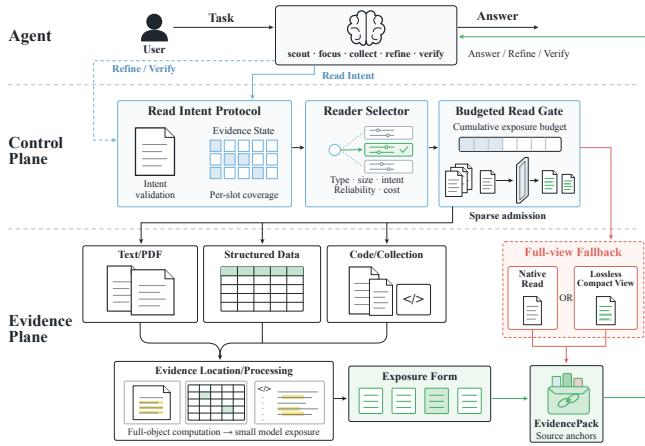
The control plane interprets the agent's reading intent, selects eligible Reader configurations, maintains the evidence record, and governs what enters the model context. The evidence plane contains Readers that declare their supported artifact types, actions, and execution costs. Readers acquire evidence but do not decide when they are invoked.
Read Intent Protocol The protocol treats reading as a sequence of evidence requests guided by the agent. At each access, the agent supplies a structured Read Intent describing what it needs for its next decision. This access intent takes precedence over a session intent derived from the user's opening request. The protocol maintains the validity and relevance of prior evidence using SHA-256 fingerprints to identify artifact versions. It tracks evidence coverage, identifying which slots have supporting evidence and which remain unresolved, without judging sufficiency. The agent interacts through five stable actions: scout, focus, collect, refine, and verify.
Adaptive Reader Backends A Reader is defined by the artifacts it handles. Within a Reader, evidence acquisition involves choosing how to locate or process evidence and what to expose to the agent. SparseRead adapts the choice of Reader configuration r∗ based on the artifact type, size range, and Read Intent h. The system selects the configuration that minimizes estimated cost C(r∣g) subject to a reliability threshold pvalid(r∣g)≥τ:
r∗=argr∈Ro,hminC(r∣g)s.t.pvalid(r∣g)≥τwhere Ro,h represents compatible configurations for artifact o and intent h. This allows the system to adapt to different artifact types, such as using column queries for tables or hybrid retrieval for text.
Budgeted Read Gate The Read Gate determines when selective access is worthwhile and when to fall back to a complete view. It enforces a budget where the cumulative sparse payload E does not exceed the length L of the least expensive faithful full view f(o). Before delivering a batch, the Gate compares its estimated size with the remaining budget. If the next batch cannot fit intact, it is withheld and the Gate delivers f(o) instead. This ensures that the total unweighted artifact exposure is bounded, preventing the downsides of uncontrolled selective reading while allowing savings when the agent can finish with minimal evidence.
Experiment
The evaluation tests SparseRead across six models, five scenarios including long-context comprehension, multi-file audit, structured analysis, web deep search, and scientific script generation, and against naive, retrieval, and context-reduction baselines. The main results show that SparseRead substantially lowers token use and wall time while preserving or improving task scores in nearly all settings, and it outperforms retrieval and compression baselines that often lose quality or increase cost. Cross-framework experiments with NanoBot, OpenCode, and OpenClaw confirm portability without retraining, with scores preserved or improved in most settings. Ablations attribute the gains to combined read intents, adaptive reader backends, and the budgeted read gate, which together reduce redundant reads, improve evidence coverage, and control resource exposure.
SparseRead reduced token use and wall time in every evaluated agent framework and model setting, while task scores were preserved or improved in most cases. Median savings varied across frameworks, with two showing larger reductions and one showing more moderate reductions. The method transferred across frameworks through thin adapters without requiring model retraining. Across all 18 settings, token use and wall time were lower, and scores were preserved or improved in 15 settings. Median token reductions were about 65% for two frameworks and about 31% for the third, with time savings following a similar pattern. For Opus 5, token savings ranged from roughly one-third to nearly three-fifths and time savings from under one-third to over half, with score gains across settings. Reusing the protocol, Readers, and Gate through thin adapters supported portability across agent frameworks without model retraining.
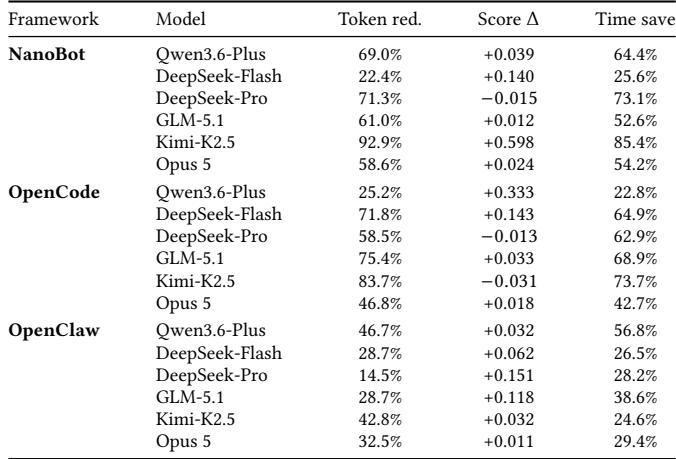
SparseRead was evaluated across multiple agent frameworks and model settings, where it consistently lowered token use and wall time while task scores remained stable or improved in most cases. Savings varied by framework, with two showing larger reductions and one showing more moderate reductions, and the approach transferred across frameworks through thin adapters without requiring model retraining. The results indicate that SparseRead provides portable efficiency gains across different agent environments.