Command Palette
Search for a command to run...
Alaya-EVOKE: من الإشراف ذي التدرج الخطي إلى عالم لا نهائي
Alaya-EVOKE: من الإشراف ذي التدرج الخطي إلى عالم لا نهائي
Yuanyang Yin Gongxuan Wang Yifan Zhan Chuanhao Li Kaipeng Zhang Feng Zhao
الملخص
يجب أن تدعم نماذج العالم التفاعلية في آنٍ واحد الذاكرة المستمرة، والاستجابة التفاعلية للمستخدم، والتوليد طويل الأفق، غير أن هذه المتطلبات تفرض قيودًا متعارضة على النموذج الأساسي. فالحفاظ على السجل في سياق مزيل الضوضاء أو في ذاكرة تخزين مؤقت للمفاتيح والقيم يُكلف تكلفة متزايدة مع مرور الوقت، مما يفرض مقايضة بين طول الجلسة والذاكرة المحتفظ بها، بينما يعتمد التفاعل منخفض الكمون عادةً على توليد بخطوات قليلة تظل قدراته في نهاية المطاف محدودة بقدرات معلمه. يعالج Evoke هذين القيدين من خلال إضفاء الطابع الخارجي على حالة العالم المستمرة وإعادة تصميم المعلم من أجل التوليد التفاعلي طويل الأفق. تُحفظ هندسة المشهد في بنك حالة عالم خارجي مفهرس بالكاميرا، ولا يُسترجَع منه إلا ما يتصل بالمنظور الحالي، مما يُبقي سياق مزيل الضوضاء محدودًا مع نمو الجلسة. وبدلًا من معاملة المعلم بوصفه مولدًا ثابتًا عالي الجودة، صُمم المعلم تصميمًا صريحًا للإشراف طويل الأفق. يجمع مخطط الانتباه المتناثر لديه بين التجميع في مقاطع، واسترجاع إطارات بعيدة مختارة، وحالة عامة بانتباه خطي، مما يحقق نموًا خطيًا في ذاكرة التنشيط والحساب مع تمكين الإشراف عبر آفاق زمنية طويلة. ويكشف هذا الإشراف انجراف المحتوى الذي يظل معقولًا محليًا داخل نوافذ قصيرة، بينما يتيح التكييف لكل مقطع إجراء تغييرات في المطالبات والتحكم في الأحداث على امتداد التسلسل. وينقل هدف مطابقة التوزيع طويل الأفق لمدة 30 ثانية، المطبق في إطار عمليات تنفيذ ذاتية الإجبار، كلتا القدرتين إلى طالب من ثلاث خطوات لا يستخدم التوجيه الخالي من المصنف (CFG)، مما يحسن مقاومة انجراف المحتوى طويل الأمد مع الحفاظ على التكييف الاستجابي. وبفضل السياق المحدود والذاكرة الخارجية المتكررة، يدعم Evoke التوليد المفتوح والمتطور باستمرار؛ فعلى معالج H200 واحد بدقة 384 × 640، يُولد كل مقطع مدته 1.5 ثانية في 2.11 ثانية. وبوصفه نموذج عالم من ثلاث خطوات، يحقق Evoke أداءً متقدمًا على WBench مع بقائه تنافسيًا في الجودة البصرية على VBench-Long وVBench-2.0.
One-sentence Summary
Researchers from MoE Key Lab of BIPC, USTC, Shanghai Innovation Institute, and Alaya Lab propose Alaya-EVOKE (Evoke), an interactive world model that externalizes persistent camera-indexed world state and uses a long-horizon teacher with sparse chunk-wise grouping, retrieval of selected distant frames, and linear-attention global state; the teacher is transferred via self-forced rollouts to a three-step CFG-free student, which generates 1.5 s chunks in 2.11 s on a single H200 at 384 × 640 and achieves state-of-the-art WBench performance while remaining competitive on VBench-Long and VBench-2.0.
Key Contributions
- Evoke is a three-step interactive video world model that externalizes persistent scene geometry in a camera-indexed world state bank with bounded read, write, and eviction, retrieving only view-relevant information to keep denoiser context bounded as sessions grow.
- Its long-horizon teacher uses a sparse attention scheme combining chunk-wise grouping, retrieval of selected distant frames, and a linear-attention global state, yielding linear growth in activation memory and computation while enabling long-horizon supervision and per-chunk prompt and event control.
- A 30-second long-horizon distribution-matching objective under self-forced rollouts transfers these capabilities to a three-step student without classifier-free guidance; Evoke achieves state-of-the-art WBench performance, remains competitive on VBench-Long and VBench-2.0, and generates each 1.5-second chunk at 384×640 in 2.11 seconds on one H200.
Introduction
Interactive world models must jointly support persistent memory, responsive interaction, and long-horizon generation, which matters for applications such as continuous camera-controlled exploration and evolving text-driven scenes. Prior systems often place both persistent state and fast inference on the denoiser, so retained history grows with session length or must be discarded through windowing and cache eviction. Distilled few-step models are further limited by the short supervision horizons and fixed prompts of their teachers, weakening long-term consistency and mid-session control. The authors introduce Evoke, which decouples persistent state from generation by storing camera-indexed geometric memory in an external, bounded world state bank, and redesigns the teacher with chunk-wise sparse attention and per-chunk conditioning for long-horizon interactive supervision. These capabilities are transferred to a three-step, CFG-free student via long-horizon distribution matching, enabling bounded-cost, hour-scale generation with responsive camera and text control.
Method
The authors leverage a bounded recurrent student with an externalized world state and a teacher designed for long-horizon interactive supervision to realize long-horizon interactive generation. At each recurrent step, the three-step student generates one video chunk from a short local history, view-aligned geometry retrieved from an external camera-indexed world state bank, and a per-chunk text condition. This design ensures that the context length or positional span of any individual generation step does not increase as the session grows.
As shown in the figure below:
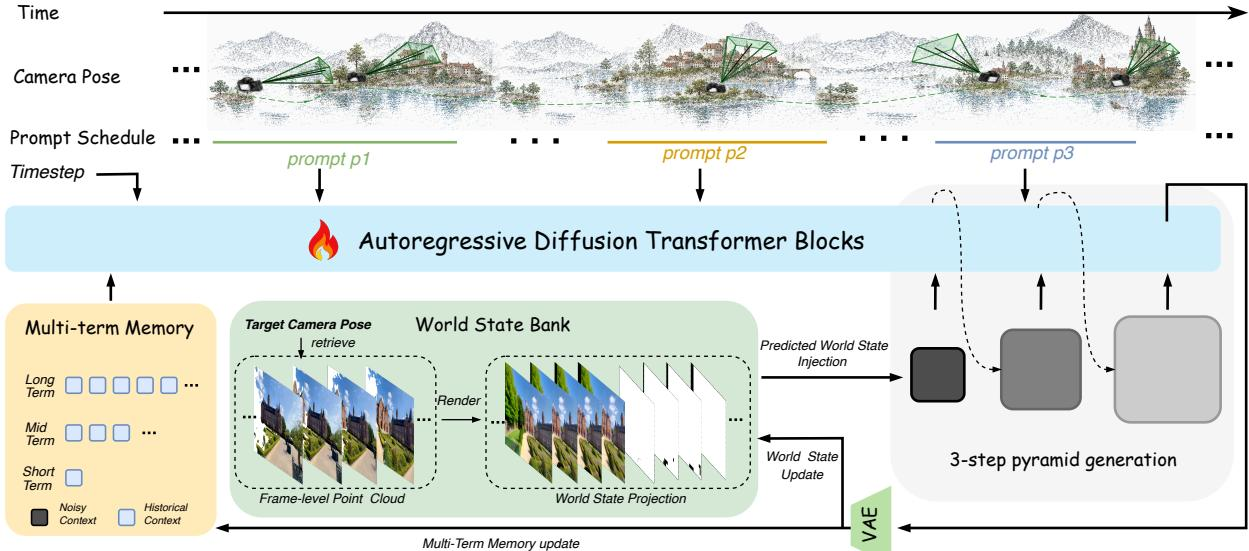
The recurrent interface separates transient denoiser context from persistent geometric world state. At recurrent step k, the student generates a chunk xk containing F=9 latent frames. Each step is conditioned on a camera trajectory Pk and a text condition ck that may vary across steps. Let hk denote a bounded local history and Mk the world state bank. At each step, geometry relevant to the current camera trajectory is first rendered from Mk, the next video chunk is then generated from the rendered geometry, local history, and text condition, and the resulting observation is written back to the store:
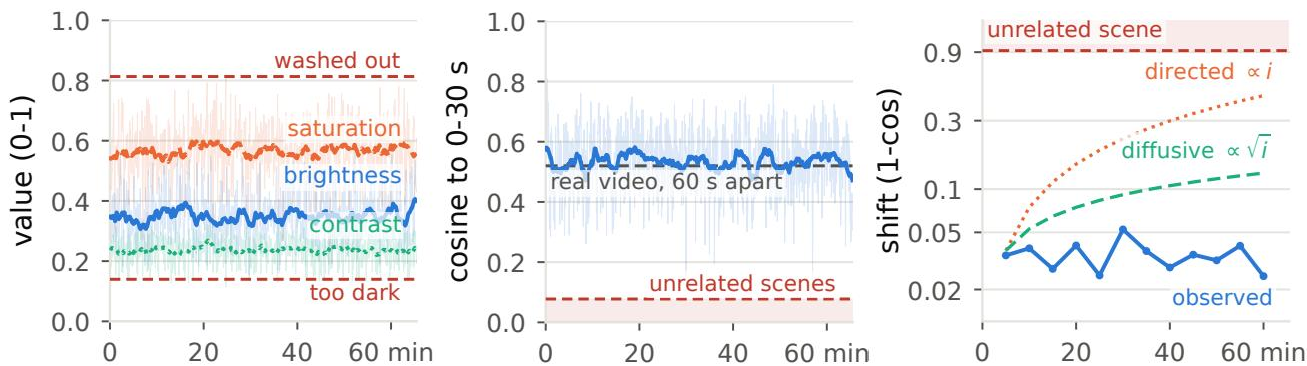
rk=Read(Mk,Pk),xk∼pθ(⋅∣rk,hk,ck),Mk+1=Write(Mk,xk,Pk).Both the local history and world state bank operate under fixed budgets. Consequently, extending a session increases only the number of recurrent calls, without increasing the context length, positional span, or computational footprint of an individual call. The authors demonstrate that an hour-long session stays bounded rather than degrading under this formulation.
As shown in the figure below:
The bounded recurrent formulation keeps each inference step independent of session duration, but it does not by itself prevent errors from accumulating across recurrent steps. To constrain long-range behavior, the authors employ self-forced distribution matching over windows of W consecutive chunks:
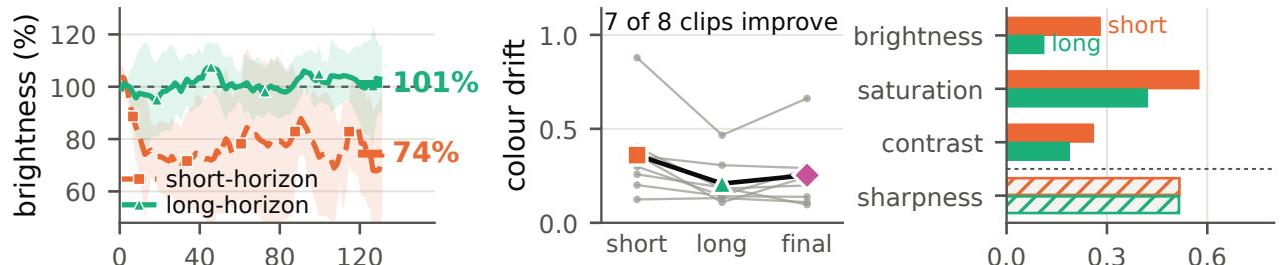
LW(θ)=Ek[D(qθ(k:k+W−1)∥p(k:k+W−1))],where D denotes the divergence whose gradient is estimated from the teacher and critic scores. Long-horizon supervision serves two complementary roles: it enlarges the range of rollout perturbations under which the recurrent generator learns to remain stable, and it exposes long-range inconsistencies that cannot be identified from local trajectory statistics alone. The authors show that a student inherits photometric stability from a long-horizon teacher, exhibiting substantially greater stability over extended rollouts compared to a short-horizon counterpart.
As shown in the figure below:
The Evoke Teacher is built on the 14B Wan2.2 A14B diffusion transformer. To make long-window supervision computationally practical, the teacher partitions a sequence into chunks of nine latent frames and applies chunk-wise sparse attention. Each query chunk accesses a bounded set of sources: a first-frame global sink, local context with a one-frame overlap, spatially compressed nearby frames, a small set of selected distant frames, and a global state accumulated through linear attention. Because the amount of information accessed by each chunk remains bounded, the resulting attention computation grows approximately linearly rather than quadratically with sequence length. The same chunk partition provides an independent text-conditioning context for every chunk, allowing prompt changes to be represented within a single long sequence.
As shown in the figure below:
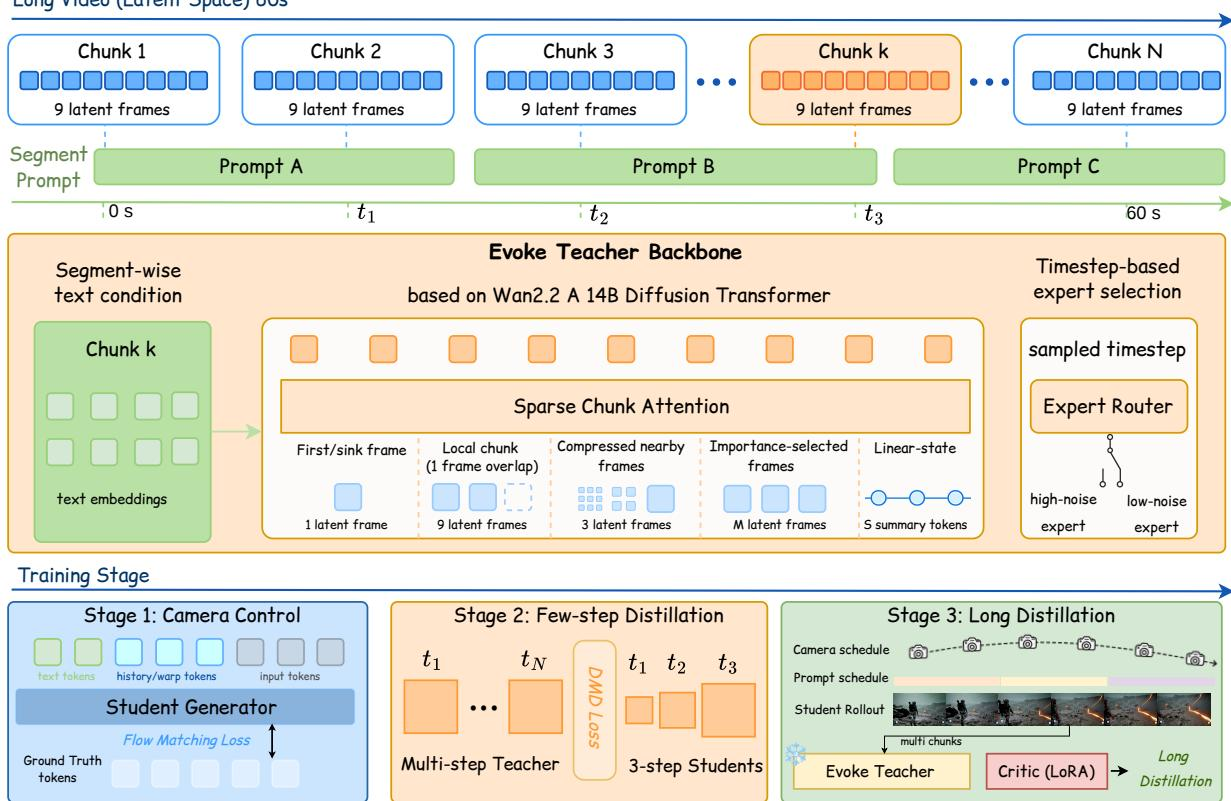
The authors transfer this long-horizon supervision to the few-step student through full-window distribution matching distillation (DMD). Training starts from one ground-truth prefix chunk followed by a self-forced rollout of 20 generated chunks, yielding 189 latent frames. The teacher and critic jointly score all 189 latent frames, so the supervision horizon spans the complete self-forced rollout. The score difference Δs=sfake−sreal is normalized by ν over the region Ω that receives the distribution-matching gradient:
Lgen=21x^0−(x^0−νΔs)detach22.History is detached between consecutive rollout chunks, restricting each backward graph to a single chunk and allowing chunk-level gradients to be computed independently. This shortens the gradient horizon without shortening the supervision horizon.
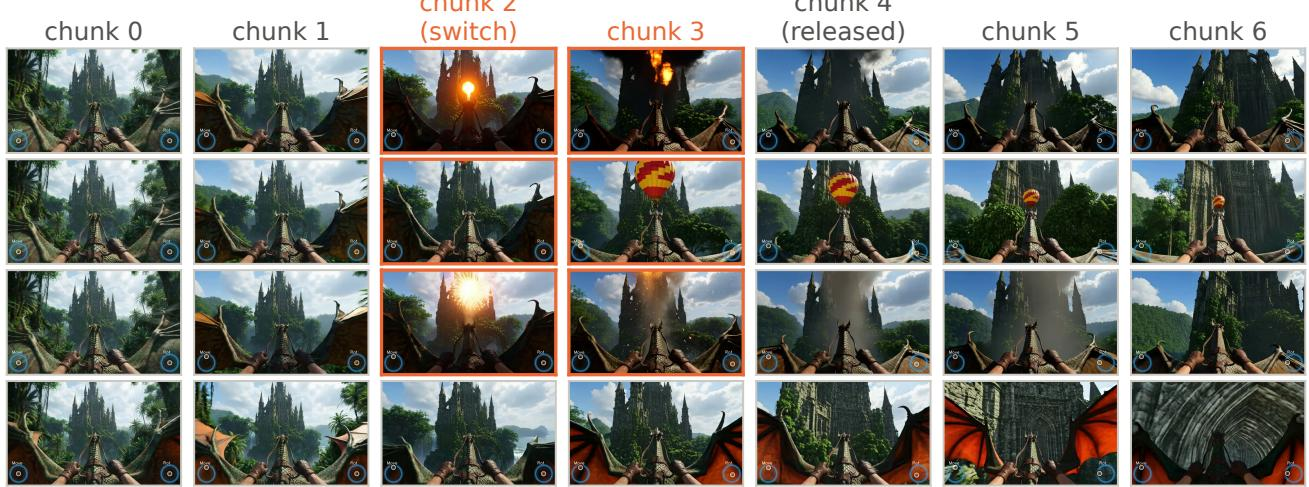
The teacher must also express the time-varying conditioning encountered at deployment. The authors assign text conditions at the chunk level and include prompt transitions within the training sequence. This allows text-driven elements to be introduced or withdrawn during an ongoing session, a capability referred to as evocation. Timed prompt switching can modify elements like the sky while preserving anchored scene structure.
As shown in the figure below:
To externalize persistent world state that cannot remain within the bounded denoiser context, the authors maintain an external world state bank Mk, using camera pose both as a control signal for generation and as an address for retrieving previously observed scene content. At each recurrent step, newly generated observations are written into Mk as world-space geometry. A monocular depth model estimates depth for 12 frames of the generated chunk under the known camera trajectory. The resulting depth maps are unprojected with the corresponding camera intrinsics and extrinsics and appended to the world state bank. To read the store, the current camera pose directly determines which stored observations are geometrically relevant. Stored source views are ranked by co-visibility with the target view, and up to eight sufficiently distinct sources are selected and rendered through batched projection with z-buffering.
The visibility mask controls how the rendered state enters the denoiser. Regions supported by stored geometry retain informative warp conditioning, whereas unsupported regions are suppressed by increasing the warp noise level. The same visibility signal is pooled at the patch resolution of each history tier and used to remove unsupported history tokens from the denoiser sequence.
For inference, the authors generate each chunk with three CFG-free denoising evaluations over a coarse-to-fine latent pyramid at resolutions 12×20, 24×40, and 48×80. Geometric conditioning is injected only at the coarsest stage, where it establishes large-scale spatial structure before the higher-resolution stages refine appearance and detail. Visibility-based pruning further removes unsupported geometric tokens, so the additional conditioning cost depends on the coverage of the world state bank rather than on session duration. Together with bounded local history, bounded geometric retrieval, and local positional indices, each recurrent call operates within a session-independent context and positional range.
Experiment
Evoke is evaluated across general world-model and video quality, long-session stability and runtime, the effect of long-horizon teacher supervision, and the interaction between timed text control and persistent geometric memory. The few-step student remains competitive with many-step systems while hour-scale rollouts stay computationally bounded and show no progressive visual degradation, and long-horizon teacher distillation improves photometric stability. Pose-addressed recall restores previously observed views to recognizable fidelity when the retention window covers the revisit, while timed text successfully controls unanchored content but is resisted by already anchored geometry.
On the WBench navigation split, Evoke achieves the highest scores for aesthetic quality, imaging quality, and dynamic behavior, and the second-highest HPSv3-Norm score. LingBot-World v2 fast leads HPSv3-Norm and is also near the top on aesthetic and imaging quality, while other systems lead only in isolated metrics such as flickering and smoothness. Overall, Evoke shows broad strength across visual and motion quality rather than dominating every single metric. Evoke records the best scores for Aesthetic, Imaging, and Dynamic among all compared systems. LingBot-World v2 fast leads HPSv3-Norm and is the closest rival on Aesthetic and Imaging, but Evoke remains ahead on both visual quality metrics and Dynamic. Genie 3 leads Flickering and Matrix-Game 2.0 leads Smoothness; Evoke stays near the top on these metrics but does not rank first.
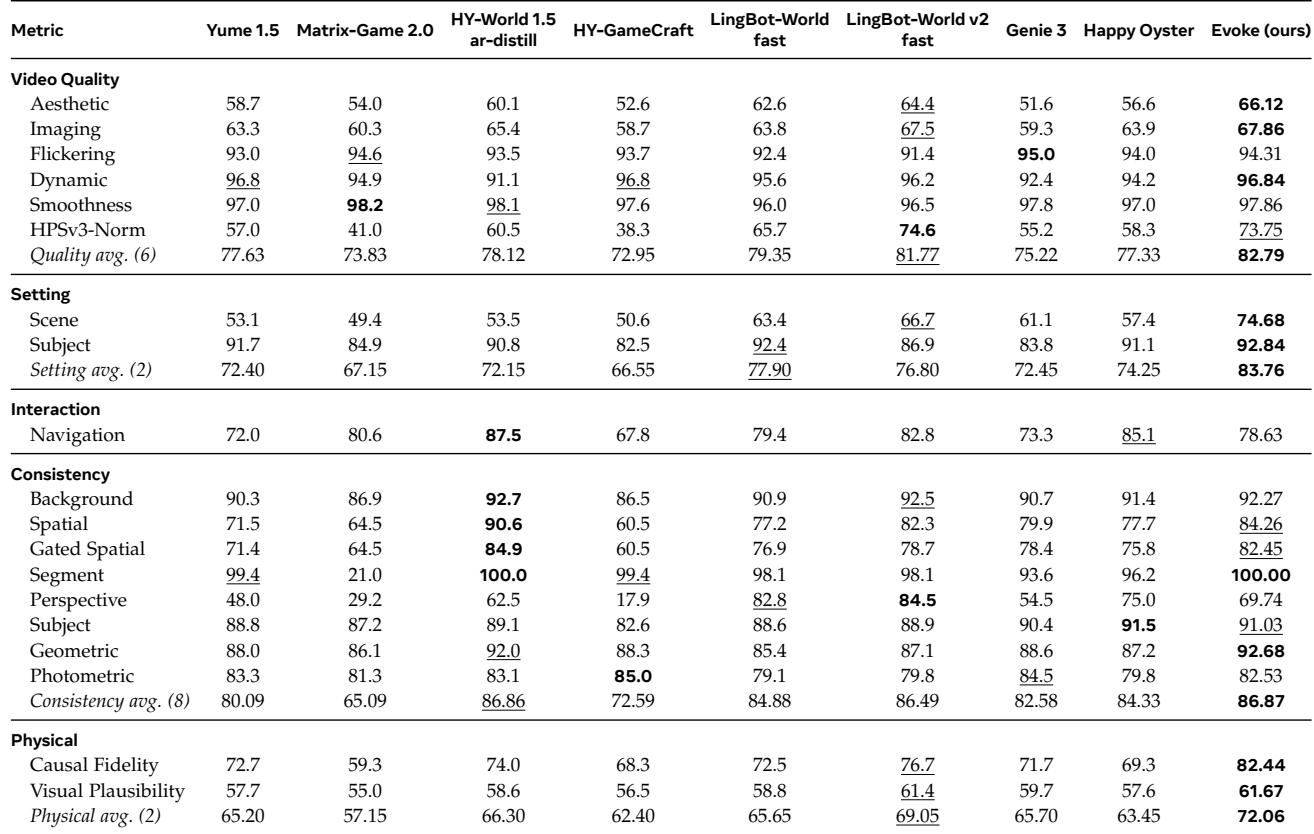
Evoke leads the VBench-2.0 leaderboard among top-10 peers, narrowly ahead of the nearest competitor, while on VBench-Long it ranks seventh of ten and trails the leader but remains slightly above the nearest peer. These leaderboard positions are not step-matched: Evoke is sampled in three steps without classifier-free guidance, whereas peers use their own many-step default samplers. Evoke ranks first among top-10 peers on VBench-2.0, with a narrow edge over the closest peer. On VBench-Long, Evoke ranks seventh of ten, behind the leader but slightly ahead of the nearest peer. The comparisons are not step-matched; Evoke uses three sampling steps and no classifier-free guidance, while peers run many-step default samplers.

On the WBench navigation split, Evoke demonstrates broad strength in visual and motion quality, ranking highest on aesthetic quality, imaging quality, and dynamic behavior, while other systems lead only isolated metrics such as flickering and smoothness. On the VBench benchmarks, Evoke ranks first among top-10 peers on VBench-2.0 but seventh on VBench-Long, where it remains slightly above the nearest peer. These results are obtained with Evoke using only three sampling steps and no classifier-free guidance, whereas competing systems use many-step default samplers, indicating efficient sampling under a substantially lower compute budget.