Command Palette
Search for a command to run...
التحكم تدفقاً بتدفق: تجاوز الحكم على المحتوى لضبط مخرجات الذكاء الاصطناعي في المجالات عالية الخسارة
التحكم تدفقاً بتدفق: تجاوز الحكم على المحتوى لضبط مخرجات الذكاء الاصطناعي في المجالات عالية الخسارة
Hiroki Naito
الملخص
أظهرت أعمال سابقة أن الرقابة القائمة على إشراك العنصر البشري تصبح غير قابلة للاستمرار هيكلياً في المجالات عالية الخسارة عندما تتجاوز سرعة مخرجات الذكاء الاصطناعي V القدرة الإدراكية القصوى للبشر C_max. غير أن القيد الفاعل ليس V وحدها، بل V × L، حيث ترمز L إلى العبء الإدراكي لكل عنصر. تتكون L من الفرز، وإصدار الحكم، والاستجابة، وهي تستجيب بشكل غير متماثل لتحسن قدرات الذكاء الاصطناعي. لا تنخفض تكلفة الفرز مع ازدياد قدرة النماذج، لأن اللايقين الدلالي متأصل في التصميم متعدد الأغراض. وتظل تكلفة الاستجابة ثابتة بغض النظر عن تحسن الدقة. فقط تكلفة إصدار الحكم تواجه ضغطاً تنازلياً، وهذا الضغط يعمل غالباً عن طريق الحث على الإغفال بدلاً من التخفيض الحقيقي. وبالتالي، فإن تحسن القدرة يعيد هيكلة L بدلاً من تقليلها. آليات الحوكمة القائمة على تقييم صحة مخرجات الذكاء الاصطناعي إما تفوض هذا التقييم للذكاء الاصطناعي نفسه وتتحمل خطر الهلوسة، أو تفوضه للبشر وتصطدم بسقف V × L. نقترح نموذج 'التحكم تدفقاً بتدفق'، وهو إطار حوكمة يضبط العبء الإشرافي دون تقييم المحتوى. يفرض مقياس تكلفة إدراكية يعتمد على سمات شكلية قابلة للعد تكاليف غير خطية على الإنتاج عالي الحجم، بينما يحافظ سقف قدرة مؤسسية على بقاء حجم المعالجة ضمن C_max. نستخلص أربعة ثوابت تصميمية لأي مسار لتجاوز الحكم على المحتوى: لا حكم على المحتوى، لا استهلاك قابل للتوسع لقدرة الفاحص، احتكاك مرتبط بالهوية لكل تطبيق، وعدم وجود تصفية جماعية. نناقش تطبيقاً مرجعياً واحداً لإظهار أن هذه الثوابت قابلة للتحقيق بشكل مشترك، مع الإقرار صراحة بصعوباته العملية. يشير تحليل مونت كارلو توضيحي عبر 1,000 سحب للمعلمات إلى أن التحكم المركب متعدد المقاييس في التدفق يتفوق على تعزيز الإشراف وحده في 90.8% من التجارب.
One-sentence Summary
Researchers from UTIE Research Institute and UTIE Instruments Inc. propose Flow-by-Flow, a content-judgment-bypass governance paradigm for high-loss domains that imposes a cognitive cost score based on formal, countable features and an institutional capacity cap to maintain supervisory load within Cmax without evaluating output, outperforming supervision reinforcement alone in 90.8% of 1,000-parameter Monte Carlo trials.
Key Contributions
- Flow-by-Flow controls supervisory load without evaluating content by applying a cognitive cost score based on formal, countable features and an institutional capacity cap that keeps processing volume within human cognitive limits.
- The paper derives four design invariants for any content-judgment-bypass exceedance pathway: no substantive content judgment, no scalable consumption of examiner capacity, identity-bound per-application friction, and no batch clearance.
- An illustrative Monte Carlo analysis across 1,000 parameter draws suggests that composite multi-metric flow control outperforms supervision reinforcement alone in 90.8% of trials.
Introduction
The authors observe that current AI governance frameworks, including the EU AI Act and the U.S. NIST framework, rest on the assumption that human oversight can keep generative AI systems safe even as output volumes grow. However, decades of research on automation bias and normal accidents show that human operators are poorly suited to monitoring highly automated systems, and in generative AI the problem intensifies: errors appear as subtle semantic or logical flaws rather than physical deviations, and exposure to statistically regular AI outputs can degrade a supervisor's internal error-detection frame. Prior work by Naito (2026) formalized a condition where human oversight becomes nominal when the output rate V exceeds cognitive capacity C_max, but that model treated all outputs as equally burdensome and offered only a broad direction for institutional response, leaving the bridge from diagnosis to implementable design unbuilt.
The authors' main contribution is a theoretical refinement that extends the model to V × L, where L captures the per-item cognitive load of verification and response, and the proposal of a "Flow-by-Flow" institutional design. This design enforces a flow-rate limitation without evaluating the truth or content of outputs, instead inferring cognitive cost from formal quantitative features such as counts of citations, modalities, or word lengths. The paper derives four invariants that any such content-judgment-bypass mechanism must satisfy in high-loss domains where errors are severe and formal verification is impossible, and it demonstrates through simulation that strategies limiting total throughput buy more time before oversight collapse than simply adding more human supervisors.
Method
The authors ground their approach in a theoretical extension of the earlier monitoring constraint V≤Cmax. They observe that the original variable V, representing the AI output rate as a simple count, abstracts away the per-item cognitive burden that supervisors must bear. Real-world scrutiny of patent applications, legal documents, or academic papers shows that the load imposed by each output can vary dramatically. Hence, the relevant quantity is not V alone but the product V×L, where L is the cognitive load per output. The human cognitive capacity ceiling is rewritten as Cmax per unit time, and the fundamental inequality becomes
V×L≤Cmax.The variable L is decomposed into three irreducible tasks: triage (deciding what type of information the output represents), judgment (evaluating correctness or validity under that assumption), and response (acting on the evaluation). Crucially, triage and response do not decrease with improvements in AI accuracy. In fact, higher accuracy can increase the volume of responses that must be carried out and can make triage more difficult, because outputs from a highly capable model look more plausible and require finer discrimination. Thus, efforts to improve content judgment alone cannot guarantee that the throughput constraint is satisfied.
The Flow-by-Flow framework is introduced to enforce the inequality without relying on content judgment. Instead of trying to assess the truth or quality of each output, the system controls the flow rate so that the aggregate cognitive load presented to human supervisors stays within their biologically bounded capacity. The design rests on a single principle: implement an asymmetric incentive structure that makes AI-enabled mass production costly while keeping AI-enabled concision inexpensive. All components derive from this principle.
The first component is the cognitive cost score, an automatically computed quantity that measures the formal, quantitative features of a submission. For a patent application these might include number of claims, word count of the specification, and number of citations; for an academic paper they could be word count, number of references, figures, and supplementary-material volume. The features are first made dimensionless by dividing by field-specific median values, and then combined into a product:
S=i=1∏Nmedian(fi)fi.The score is a product of multiple mutually constraining features. Because each feature is tied to the content of the submission, compressing one dimension (e.g., reducing the number of claims) forces burden onto another (e.g., longer descriptions per claim). The score does not need to be a precise proxy for L; its function is to transform evasive optimization from a one-dimensional problem into a multidimensional constraint-satisfaction problem. The institution can add new features or recalibrate weights as processing-time data accumulate, without ever evaluating the semantic content of the outputs.
The second component is the institutional capacity cap, which makes explicit the finite processing capacity of the human side. The annual processable load is computed as
annual load=(number of examiners)×Cmax×(annual working hours).Applications whose cognitive cost score falls within the cap proceed directly to human examination. Those that exceed the cap are not rejected; they are routed into an exceedance pathway that imposes a bounded, identity-bound per-application friction. The cap thereby creates a natural incentive for submitters to make their applications concise and understandable, because only a limited number of processing slots exist.
The overall architecture is a two-layer structure. The first layer is fully automatic and performs only counting-based measurement of formal features to compute the cognitive cost score. This layer contains no content judgment and therefore avoids the hallucination risks that would arise if AI were asked to evaluate semantic quality. The second layer is human: only the submissions that remain within the institutional capacity cap are examined by human experts. Because the flow rate is controlled, the human workload is guaranteed to stay within Cmax, preserving the effective cognitive capacity (Ceff) of the examiners.
The authors analyze the limits of relying solely on first-stage controls, such as know-your-customer (KYC) identity verification and per-actor submission-count limits. In a first-stage-only institution, once the number of submissions is capped, rational applicants using AI will redirect optimization pressure toward increasing the information density of each item. This can push L upward, causing V×L to exceed Cmax even though V is fixed. The second stage the cognitive cost score with an exceedance mechanism is therefore necessary to prevent such inside-the-cap escalation.
The choice of a composite metric is justified through a toy model of applicant behavior. Under a single-metric limit, large language models (LLMs) can easily find evasion strategies, such as compressing text while preserving claims. With a product of N features, however, the applicant must simultaneously satisfy multiple constraints. Because the features are rooted in the content itself, substantive trade-offs (e.g., narrowing the scope of protection when reducing claims) cannot be eliminated by improvements in LLM capability. The institution can increase N at low cost, raising the computational and economic burden of evasion.
For applications that exceed the cognitive cost score threshold, the authors propose a reference implementation of the exceedance pathway: the physical waiting path. An applicant must visit a designated KYC-enabled office, verify identity, and wait for a period proportional to the amount by which the score exceeds the cap. The waiting time is T×k (where T is a baseline and k is the threshold multiplier). A 16-digit submission passcode is issued after waiting, enabling the application to be accepted despite the exceedance. This mechanism satisfies four design invariants that are necessary for any flow-control mechanism that bypasses content judgment:
- No substantive content judgment the path does not evaluate the quality of the output.
- No scalable consumption of examiner capacity identity verification is handled by service-desk staff, not domain experts.
- Identity-bound per-application friction each waiting event is tied to a verified identity through passport checks.
- No batch clearance each application requires a separate waiting instance and a unique passcode.
The physical waiting path transforms the marginal-cost structure of digital mass production into the marginal-cost structure of physical presence. While a single user can generate thousands of outputs through API calls at near-zero marginal cost, one thousand threshold-exceeding applications require one thousand separate waiting events. The authors note that the physical waiting path is one reference design; any mechanism that satisfies all four invariants can serve the same role, and alternatives such as remote identity-verified time-lock passes are discussed for improved accessibility.
The framework also replaces traditional AI-use disclosure requirements with a process-time declaration requirement. Instead of asking whether AI was used a yes/no question that cannot be verified submitters declare the number of real-time hours spent on each stage of the workflow (e.g., literature review, writing, experimentation). These declarations provide a channel for statistical verification: a paper claiming three hours of literature review but citing 200 references implies implausibly fast reading, and such inconsistencies can be flagged without external identity checks. Process-time declarations are not used to determine the cognitive cost score; they serve as an independent source of calibration data and help quantify the B variable, which measures the extent to which a domain’s workflow is anchored in physical-space activities and thus resistant to AI-driven acceleration.
Together, the cognitive cost score, the institutional capacity cap, and the exceedance pathway form a flow-control system that does not attempt to judge the truth or falsity of AI outputs. It systematically arranges the conditions under which human supervisors can exercise quality judgment, by ensuring that the volume and complexity of the material they review never exceed their cognitive limits.
Experiment
The first-stage-only institution analysis shows that even with identity verification and submission caps, AI users can cheaply escalate per-item information density, causing aggregate cognitive load to exceed processing capacity. The Monte Carlo simulation evaluates the robustness of three strategies under wide parametric uncertainty and finds that composite flow control consistently outperforms supervision enhancement alone, even when given extremely favorable initial conditions. The experiment does not predict exact collapse timing but validates that the relative superiority of flow control is robust, supporting its adoption as a resilient institutional design across diverse AI growth scenarios.
Across 1,000 Monte Carlo trials, the strategy combining supervision enhancement with composite flow proved best in 90.8% of cases, far outpacing supervision enhancement alone (1.6%) and supervision with simple flow (7.6%). Even when initial conditions were deliberately skewed to favor supervision enhancement, composite flow remained the most robust approach under wide parameter uncertainty. The results confirm that the relative ordering of these strategies is stable, though the absolute timing of system collapse depends on domain-specific factors. Composite flow was the top-performing strategy in 90.8% of trials, even though the simulation was intentionally biased toward supervision enhancement alone. The performance ordering – composite flow first, then simple flow, then supervision only – held consistently across a broad range of parameters, underscoring the resilience of flow-based interventions.
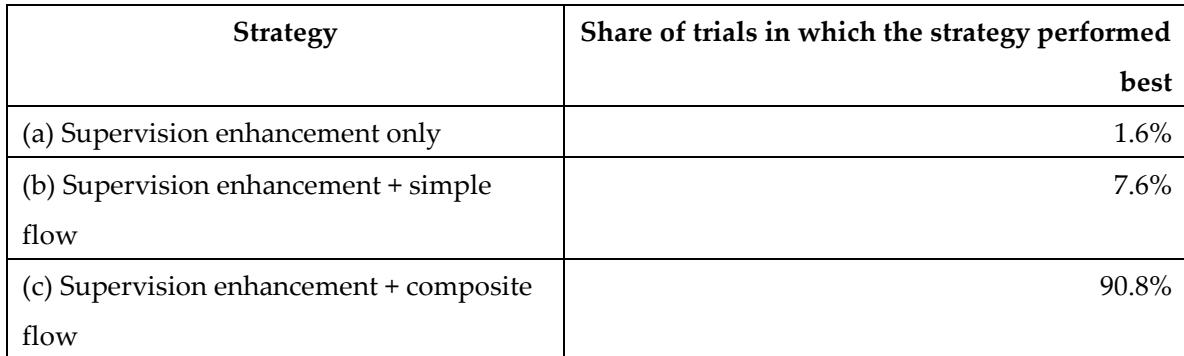
A Monte Carlo simulation with 1,000 trials compared three strategies under broad parameter uncertainty, deliberately biasing initial conditions to favor supervision enhancement alone. The composite flow strategy proved most robust, ranking first in 90.8% of trials, and the consistent performance ordering was composite flow, followed by simple flow, then supervision only. These findings confirm that flow-based interventions maintain their advantage even when the simulation is skewed against them.