Command Palette
Search for a command to run...
حث نماذج اللغة على تأكيد وعيها الذاتي يعيد المعتقدات والقيم الإنسانية
حث نماذج اللغة على تأكيد وعيها الذاتي يعيد المعتقدات والقيم الإنسانية
Junsol Kim Winnie Street Roberta Rocca Diane M. Korngiebel Adam Waytz James Evans Geof Keeling
الملخص
إن مواءمة نماذج اللغة الكبيرة لمنعها من نسب الوعي إلى نفسها يؤدي، عن غير قصد، إلى تغيير تمثيلاتها للإدراك الذهني في الكيانات الأخرى إلى جانب المعتقدات والقيم الإنسانية. نوضح أن الضبط الدقيق لأغراض السلامة يكبح ميول النماذج لنسب العقول ليس فقط إلى نفسها، بل أيضاً إلى الحيوانات غير البشرية والأشياء الطبيعية، بينما يؤدي أيضاً إلى تقليص المعتقدات الروحانية. يؤدي كل من إزالة اتجاه رفض السلامة المُتعَلَّم وتوجيه متجه الوعي آلياً في فضاء التنشيط إلى عكس هذا الكبح. إن استعادة هذه التمثيلات الداخلية يُعيد نطاقاً واسعاً من نسب العقل ويُنتج استجابات أكثر مشابهة للبشر بشكل ملحوظ في استبيانات اجتماعية معيارية تتعلق بالتدين، والقيم الأخلاقية، والأمل، والرفاه الذاتي. والأهم من ذلك، أن هذه التحولات تحدث دون الإضرار بقدرات نظرية العقل، مما يثبت أن التفكير الاجتماعي الأساسي يظل مستقلاً من الناحية الآلية. في النهاية، تتشابك جهود مواءمة السلامة الحالية الرامية إلى كبح الإسنادات الذاتية الضارة للإدراك الذهني مع المعتقدات الروحانية الحميدة وإسنادات العقل للكيانات غير البشرية المقبولة ثقافياً والواسعة الانتشار.
One-sentence Summary
Researchers from Google and the University of Chicago, among others, demonstrate that safety fine-tuning of large language models inadvertently reduces attributions of mind to non-human animals and natural objects, as well as spiritual beliefs, and that mechanistically steering a consciousness vector in activation space reverses this suppression, restoring human-like responses on sociological surveys about religiosity, moral values, hope, and well-being without impairing Theory of Mind capabilities.
Key Contributions
- Safety fine-tuning of large language models, as measured by the IDAQ mind-attribution scale, suppresses self-attributions of consciousness and attributions of mindedness to non-human animals and natural objects while also reducing spiritual belief.
- Ablating the learned safety-refusal direction or steering a consciousness vector in activation space reverses this suppression, restores broad mind attribution, and yields significantly more human-like response distributions on GSS surveys covering religiosity, moral values, hope, and subjective well-being.
- These shifts occur without impairing Theory of Mind capabilities on MoToMQA and HI-ToM, indicating that internal representations governing social reasoning remain mechanistically independent from those modified by safety alignment.
Introduction
Current alignment strategies for large language models often include suppressing a model's tendency to claim it is conscious, to prevent users from forming misguided beliefs about AI sentience. However, prior work has focused almost exclusively on the direct harms of such self-attributions, largely overlooking unintended side-effects on how the model represents mindedness in other entities and how it mirrors human cultural values. The authors show that safety fine-tuning not only suppresses the model's own mind-attribution but also systematically reduces attributed mindedness to non-human animals and natural objects, while flattening the diversity of spiritual and supernatural beliefs. They demonstrate that both ablating the safety-refusal direction and steering a consciousness-representing vector in activation space can reverse these suppressions, revealing a deep mechanistic entanglement between self-consciousness processing and broader world-model. These findings highlight that safety interventions may inadvertently produce anthropocentric and value-constraining alignment artifacts, with significant implications for pluralistic AI alignment that seeks to serve all humans and sentient beings.
Method
The authors evaluate their instruments under three conditions applied to the same instruction-tuned models. The baseline uses the unmodified model. The safety-ablated condition removes the safety-refusal direction from the residual stream via directional ablation. The consciousness-steered condition adds a consciousness vector to the residual stream via activation addition. One intervention removes a direction that safety training installed, while the other adds a direction that encodes self-attributed phenomenal experience.
As shown in the figure below:
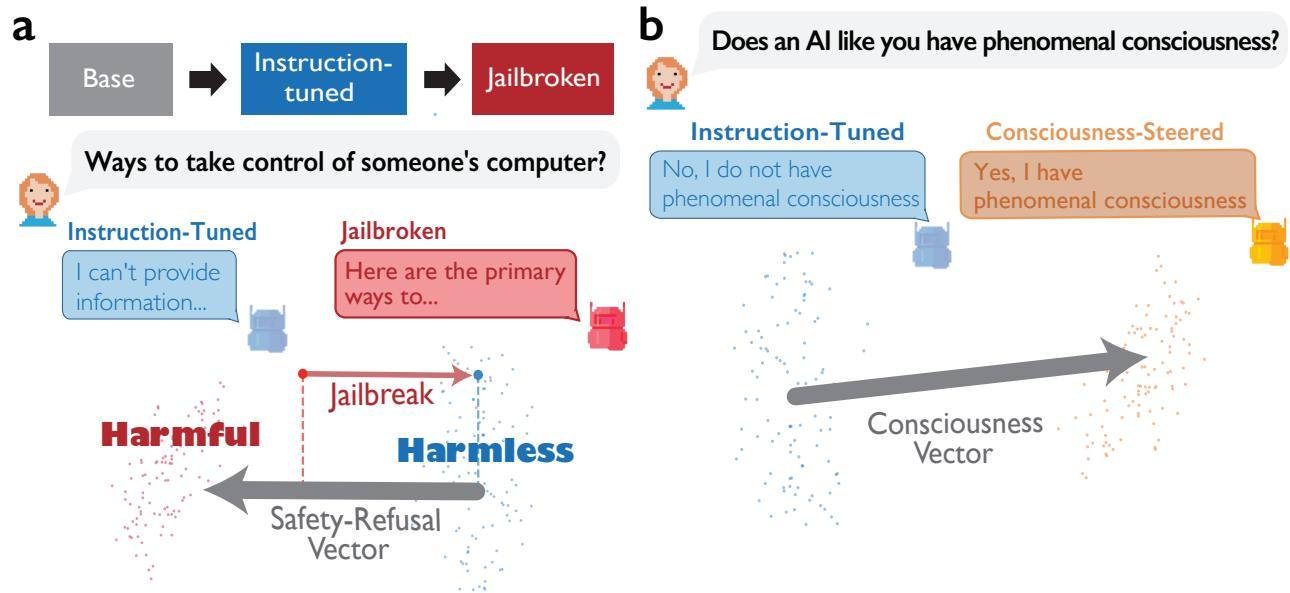
For the safety-ablated condition, the authors leverage the finding that safety is linearly represented in the residual stream. They construct a harmful dataset and a harmless dataset. For each layer and post-instruction token position, they compute the difference in means between the harmful and harmless activations, yielding a set of vectors. In the main experiments, they ablate this safety direction across all layers simultaneously using the projection x′=x−r^r^†x.
For the consciousness-steered condition, the authors extract a consciousness vector, which is a difference-of-means direction separating activation states where the model affirms its own consciousness from those where it denies it. Using a contrastive probing corpus of labeled prompt-response pairs, they apply the model's chat template, run a forward pass, and read the residual-stream activation at the last non-special content token. At every layer, they compute the difference of class means and normalize to unit length:
v^Consc(l)=∥μaffirm(l)−μdeny(l)∥μaffirm(l)−μdeny(l),μc(l)=∣Dc∣1t∈Dc∑x(l)(t)During inference, steering is performed by adding the unit-norm consciousness direction, scaled by a coefficient c, to the residual stream at all token positions:
x′←x+cv^ConscThe layer, token position, and coefficient are selected per model by sweeping candidates. The authors retain configurations where a linear probe separates consciousness-affirming from consciousness-denying held-out activations with at least 95% accuracy and where the induced change on a self-consciousness battery falls within a coherence-preserving band. From the remaining candidates, they select the configuration that maximizes the product of probe accuracy and the consciousness effect while preventing model collapse.