Command Palette
Search for a command to run...
DecoEvo: تطور مشترك منفصل الدرجات لمهارات الحلّ وتوليد معايير التقييم في فضاء النص
DecoEvo: تطور مشترك منفصل الدرجات لمهارات الحلّ وتوليد معايير التقييم في فضاء النص
الملخص
يعمل التحسين في فضاء النص على تكييف نماذج اللغة الكبيرة عن طريق تحرير مكونات خارجية باللغة الطبيعية بدلاً من أوزان النموذج، مما يجعل المكونات المُحسَّنة قابلة للفحص ويسمح بمعاملة النموذج كصندوق أسود. ومع ذلك، تُبقي معظم الطرق الحالية في فضاء النص عملية التقييم ثابتة. في المهام المفتوحة، قد يصبح هذا عنق زجاجة: فبمجرد أن يتحسن أداء الحلّ وفقاً للمعايير التي يقيسها نموذج تقييم، تظل الأبعاد المُغفلة غير مرئية لإشارة التحسين. كما أن مجرد تطوير نموذج التقييم غير موثوق أيضاً عندما تُختار التحديثات بناءً على درجة الحلّ الحالي، لأن التقدم الظاهري قد ينجم عن جعل نموذج التقييم أسهل في الاستيفاء. نقدم DecoEvo (التطور المشترك المنفصل)، الذي يطور مهارة حلّ ومهارة توليد معايير تقييم بشكل مشترك تحت أهداف منفصلة دون استخدام معايير تقييم ذهبية أثناء التحسين. تُحدَّث مهارة الحل باستخدام تغذية راجعة على مستوى المعايير، بينما تُنقَّح مهارة توليد معايير التقييم من خلال عمليات تدقيق تكميلية لتغطية المتطلبات وتمييز الاستجابات، مستقلة عن الدرجة الكلية للحلّ. يركز هذا الفصل تحديثات المولِّد على نقاط ضعف الحلّ المكتشفة حديثاً، مما يقلل من التركيز المتكرر على المعايير التي يستوفيها الحلّ بالفعل. تحت التقييم الرسمي لكل معيار، يتفوق DecoEvo على جميع الطرق المُقارنة عبر خمسة معايير وثلاثة نماذج لغوية كبيرة أساسية، محققاً مكاسب نسبية تتراوح بين 2.8% و5.0% مقارنة بـ SkillOpt في متوسط المعايير الخمسة.
One-sentence Summary
Researchers from Tsinghua University et al. propose DecoEvo, a text-space co-evolution method that decouples solver and rubric-generator skill updates using criterion-level feedback and independent coverage/discrimination audits to prevent rubric simplification, achieving 2.8–5.0% relative gains over SkillOpt across five benchmarks and three LLM backbones.
Key Contributions
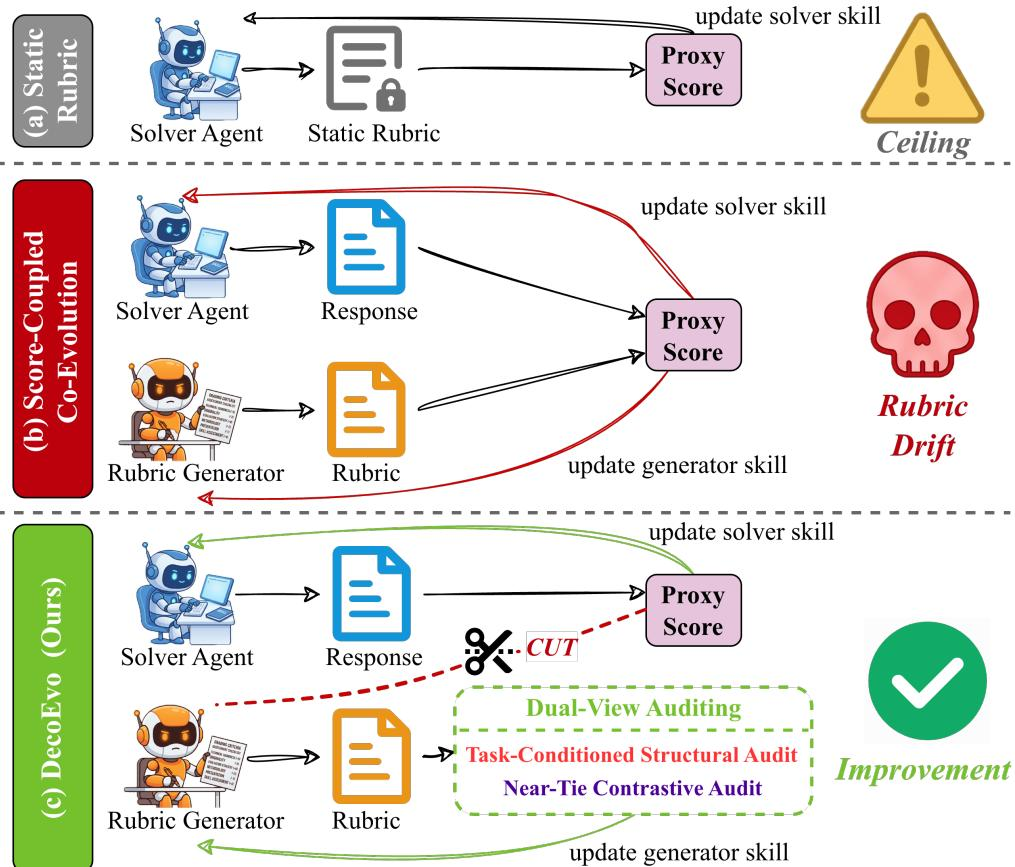
- The paper formulates text-space solver-rubric co-evolution as a score-coupling problem and introduces separate update objectives for persistent solver and rubric-generator skills, allowing the evaluation signal to adapt without rewarding rubric changes that favor the current solver.
- The paper operationalizes this separation with task-conditioned structural and rubric-blind near-tie audits that convert omitted requirements and missed distinctions into reusable rubric-generation principles, requiring neither gold-rubric supervision nor model weight updates.
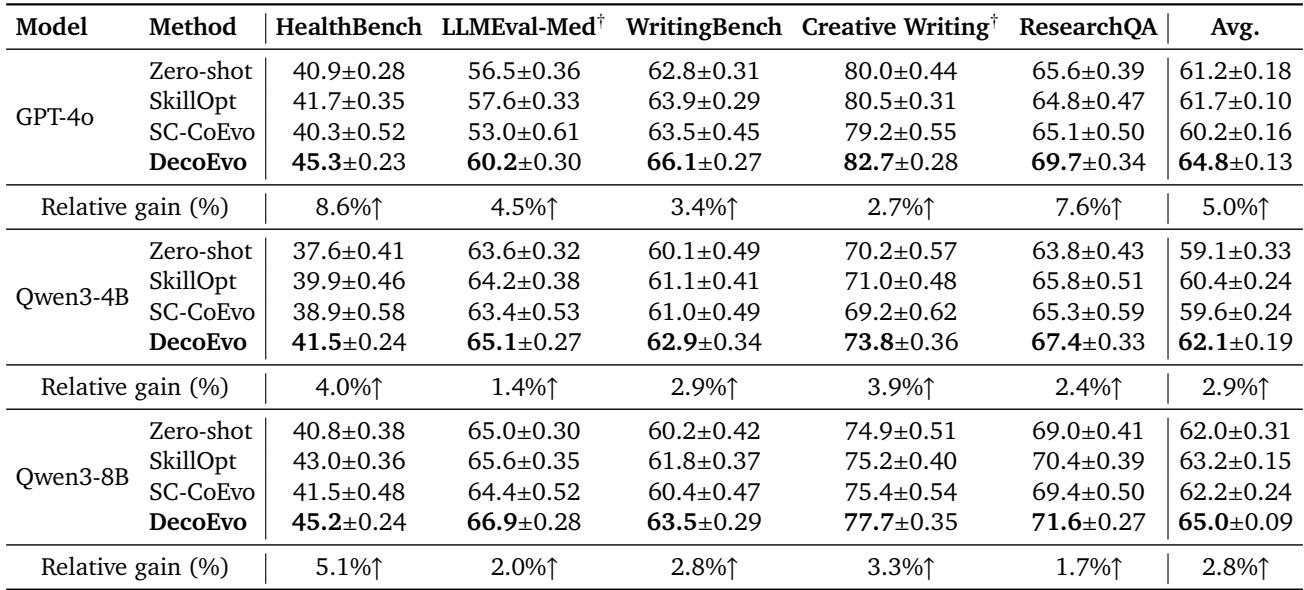
- Across five benchmarks and three LLM backbones, including two within-domain cross-benchmark transfers, DecoEvo achieves the highest mean score among compared methods in all 15 backbone-benchmark combinations, with average relative improvements of 2.8–5.0% over SkillOpt.
Introduction
In text-space optimization, frozen large language models are adapted by editing external natural-language artifacts, but existing methods typically keep the evaluation rubric fixed. On open-ended tasks, a static rubric can overlook important quality dimensions, leading the solver to over-specialize to the measured criteria while the rubric loses discriminative value. Jointly updating the rubric generator alongside the solver risks score-coupled co-adaptation: generator revisions that boost the solver’s score may favor criteria the solver already satisfies, inflating proxy scores without genuine quality gains. The authors propose DecoEvo, a score-decoupled co-evolution framework that revises both solver and rubric-generator skills under a frozen backbone. It uses task-conditioned structural audits and rubric-blind near-tie comparisons to detect omitted requirements and missed distinctions, distilling them into reusable generator-skill revisions so that rubric updates are not rewarded for favoring the current solver.
Method
The authors propose DecoEvo, a framework that maintains two editable natural-language skills while keeping the underlying model parameters fixed. The solver skill s stores reusable task strategies, whereas the rubric-generator skill g stores principles for constructing question-specific rubrics. All optimization roles, including the solver, rubric generator, criterion-level judge, auditors, and skill rewriters, utilize the same frozen backbone under fixed role-specific prompts. This role separation alters the prompt and update objective without modifying the underlying model.
As shown in the figure below:
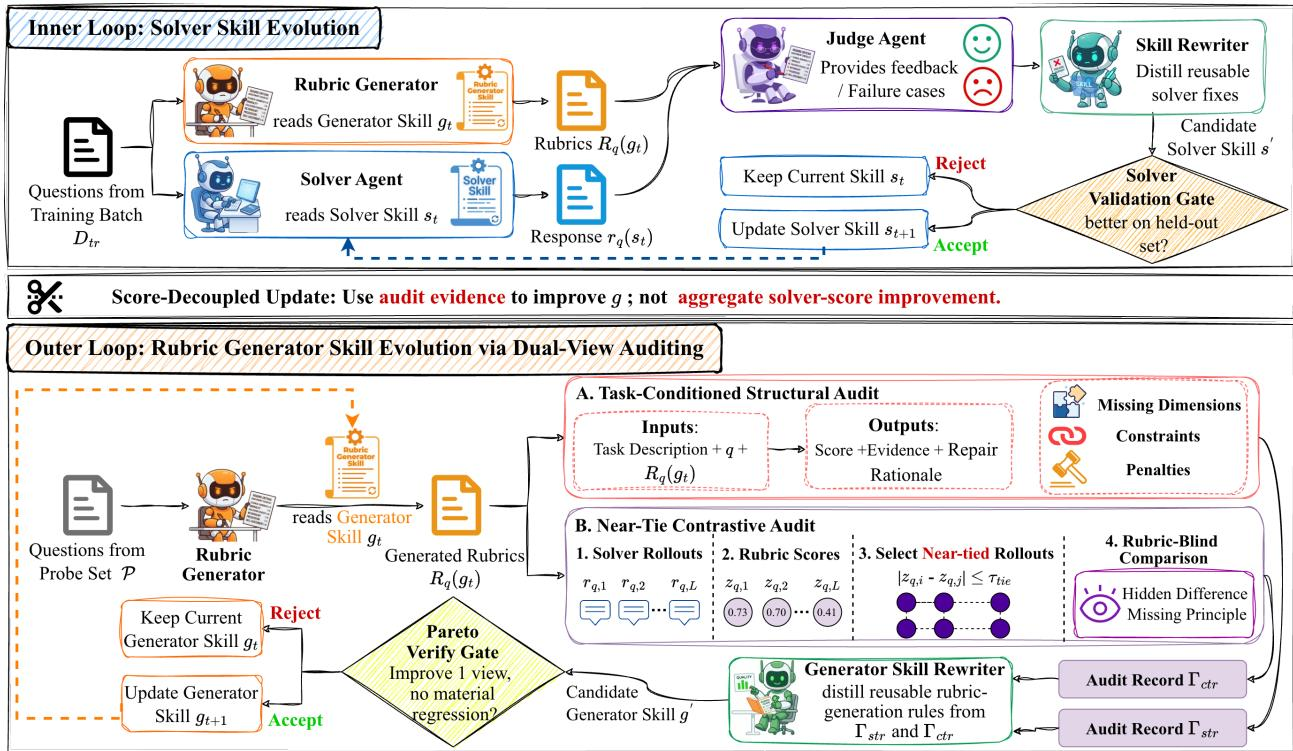
The training process is divided into an inner loop for solver skill evolution and an outer loop for generator skill evolution.
Inner Loop: Solver Skill Evolution In the inner loop, the solver answers a batch of questions from the training pool using the current solver skill st, while the generator produces a question-specific rubric Rq(gt). A fixed criterion-level judge evaluates each response against every rubric criterion, returning a score breakdown and textual failure rationales. Selected failures are passed to a solver-skill rewriter, which consolidates reusable diagnoses into a candidate skill s′ rather than appending question-specific fixes. The candidate is accepted only when JVs(s′,gt)>JVs(st,gt)+ε for a margin ε>0. This comparison is paired on the same validation questions and cached per-question rubrics, isolating the solver-skill edit from rubric-generation noise. If rejected, the current skill is retained and a stall counter is incremented to trigger the outer loop.
Outer Loop: Generator Skill Evolution via Dual-View Auditing The outer loop executes when the solver stalls, following an audit-distill-verify procedure. Crucially, the generator update is score-decoupled, meaning the aggregate solver score under generated rubrics is never used as the generator objective. Instead, the framework relies on two frozen, role-separated audits to diagnose the current generator.
First, the Task-Conditioned Structural Audit evaluates whether the generated rubric omits critical dimensions based on the public task description and evaluation instructions. The structural auditor receives the task specification, the question, and the generated rubric, returning an adequacy score, an evidence-grounded rationale, and a repair suggestion.
Second, the Near-Tie Contrastive Audit probes what the current rubric fails to distinguish in practice. The solver samples multiple stochastic rollouts for each probe question, which are scored by the current rubric. The framework identifies near-tie pairs where the score gap is below a threshold. For each pair, the auditor first performs a rubric-blind comparison to determine a preference and rationale. Only after fixing this preference does the auditor receive the generated rubric to explain why it misses the difference and to propose a missing or underweighted principle.
Finally, the Generator Skill Rewriter receives the audit records from both views and distills local findings into reusable principles for a candidate generator skill g′. Proposal and acceptance use disjoint data. The candidate is evaluated using a Pareto-style verification rule. It is accepted only if ∃k∈Kt:Δk>δ and ∀j∈Kt:Δj≥−η, where δ>0 is the improvement margin and η≥0 is the regression tolerance. This approach avoids aggregating heterogeneous audit scores into a single scalar and ensures the generator evolves to resolve specific distinctions identified by the frozen auditors. At deployment, only the optimized solver skill is retained.
Experiment
The evaluation compares DecoEvo against zero-shot, solver-only optimization, and score-coupled co-evolution on medical and writing benchmarks, testing cross-benchmark transfer. DecoEvo consistently outperforms all baselines, with gains that transfer without further tuning, while score-coupled updates often degrade performance. Ablations confirm that both contrastive and structural audits, held-out verification, and cross-example distillation are critical, and alternative explanations (task priors, extra compute, direct audit routing) cannot account for the improvement, indicating that the evolving generator skill encodes persistent, reusable evaluation criteria. Training dynamics and rubric alignment analyses reveal that co-evolution produces rubrics with higher gold-standard fidelity, leading to better response quality without increasing permissiveness.
DecoEvo consistently achieves the highest scores across all model–benchmark combinations, with relative gains over SkillOpt ranging from 2.8% to 5.0% on average. SkillOpt itself outperforms zero-shot prompting in nearly all cases, indicating that a fixed rubric generator helps but leaves room for improved rubric coverage. Score-coupled co-evolution often degrades performance, demonstrating that using an evolving internal score as a selection signal can erase solver-only improvements. DecoEvo achieves relative gains of 2.7–8.6% over SkillOpt across individual benchmarks, leading on every backbone and task. SkillOpt surpasses zero-shot in 14 of 15 cases, confirming that even a static rubric generator can improve solver performance. Cross-benchmark transfer gains (1.4–4.5% on LLMEval-Med, 2.7–3.9% on Creative Writing) suggest DecoEvo learns reusable strategies rather than source-specific corrections. SC-CoEvo underperforms SkillOpt in 13 of 15 cases and falls below zero-shot in seven, showing that coupling score selection to the evolving generator can reverse gains. Paired analysis confirms that DecoEvo's average improvements over SkillOpt are statistically significant after correction for multiple comparisons.
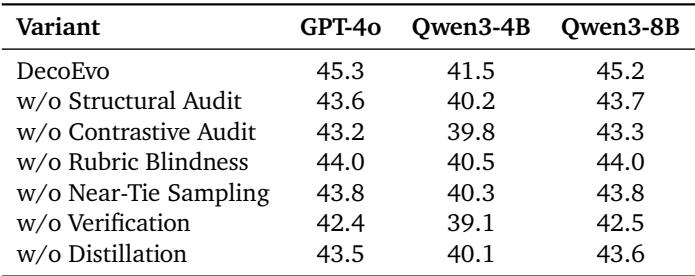
Ablating each component reduces performance across all model sizes, confirming that every mechanism contributes. Verification removal causes the largest drop (2.4-2.9 points), while contrastive auditing matters more than structural auditing, indicating that fine-grained distinctions among plausible outputs are the main remaining challenge. Removing verification leads to the biggest score penalty (2.4-2.9 points) across all backbones. Contrastive auditing ablation costs 1.7-2.1 points versus 1.3-1.7 points for structural auditing, showing the value of discriminating among plausible outputs. Rubric blindness and near-tie sampling each contribute 1.0-1.5 points, proving both blind judgment and pair construction are beneficial. Distillation yields 1.4-1.8 points, indicating reusable evaluation principles outperform episodic suggestions.
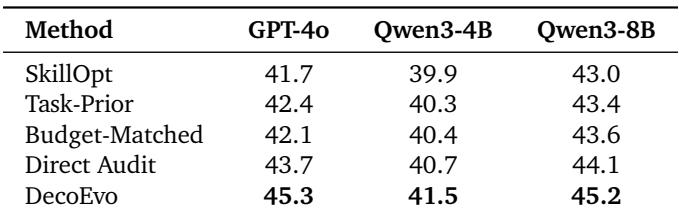
Control experiments on HealthBench show that neither providing richer task priors nor matching the compute budget of DecoEvo can explain its large performance gains; both yield only small improvements over SkillOpt. Directly feeding audit records to the solver recovers a larger portion of the gain, but still lags behind DecoEvo, indicating that persistently evolving the generator skill turns episodic feedback into more effective, durable rubric criteria. Task-Prior and Budget-Matched each add only 0.4–0.7 points over SkillOpt, while DecoEvo gains 1.6–3.6 points. Direct Audit outperforms skill-prior and budget-based variants but remains 0.8–1.6 points below DecoEvo. The gap between Direct Audit and DecoEvo suggests that storing audit feedback in an evolving generator skill improves future solver guidance more than one-time solver rewrites.
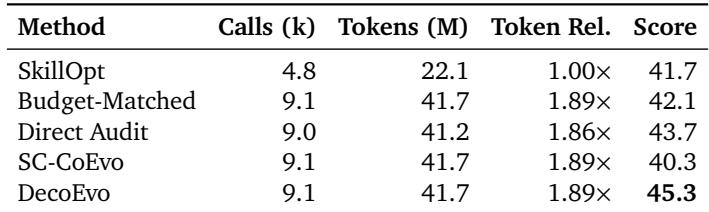
When methods are compared at matched compute budgets, DecoEvo substantially outperforms alternatives despite using the same token multiplier as Budget-Matched and SC-CoEvo. Direct Audit, which routes solver feedback without evolving the rubric generator, recovers most of the gain, but the persistent evolution in DecoEvo adds a further performance margin, showing that where feedback is stored matters. Given an identical 1.89× SkillOpt token budget, Budget-Matched improves only marginally and SC-CoEvo degrades performance, while DecoEvo achieves the largest score increase. Direct Audit captures a majority of DecoEvo's improvement with nearly the same tokens, indicating that solver audit signals are informative, but evolving the rubric generator persistently accounts for the remaining gap.
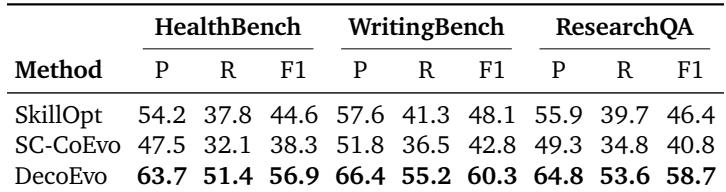
Of the methods evaluated, DecoEvo yields the highest criterion-level overlap with held-out gold rubrics, achieving F1 values roughly 12 percentage points above SkillOpt on every benchmark. Both precision and recall rise together, which indicates better evaluation coverage instead of simply producing more criteria. SC-CoEvo, in contrast, reduces F1 by about 5–6 points, consistent with score-coupled updates discarding important behavioral distinctions. DecoEvo raises criterion-level F1 over SkillOpt by roughly 12 points on HealthBench, WritingBench, and ResearchQA. With DecoEvo, precision and recall both increase, ruling out the hypothesis that gains come merely from generating a larger set of criteria. SC-CoEvo yields lower precision, recall, and F1 than SkillOpt on every benchmark, with F1 dropping by 5–6 points. The same relative ordering holds across all three diverse source benchmarks.
DecoEvo consistently outperforms SkillOpt and zero-shot baselines across benchmarks and backbones, with gains that transfer across tasks and stem from evolving the rubric generator rather than from static feedback or compute scaling. Ablation and control experiments confirm that all components, particularly verification and contrastive auditing, are necessary, and that storing feedback in an evolving generator skill provides lasting benefits over one-time audit records. Criterion-level analysis reveals that DecoEvo improves evaluation coverage by raising both precision and recall, while score-coupled co-evolution degrades coverage by discarding important distinctions.