Command Palette
Search for a command to run...
EvolvingWorld: إطار عمل مفتوح المخطط للمحاكاة المشتركة لوكلاء تمثيل الأدوار ونموذج العالم في العوالم الأدبية التفاعلية
EvolvingWorld: إطار عمل مفتوح المخطط للمحاكاة المشتركة لوكلاء تمثيل الأدوار ونموذج العالم في العوالم الأدبية التفاعلية
Qing Zong Yue Guo Mengxin Yang Yiwen Guo Yangqiu Song
الملخص
تقدم هذه الورقة البحثية نظام EvolvingWorld، وهو إطار عمل ومعيار للتطور المشترك للشخصيات والعالم في العوالم الأدبية التفاعلية. تعالج الأنظمة الحالية المحاكاة الأدبية التفاعلية إما كمحاكاة ثابتة للشخصيات أو كتوليد منعزل للمشاهد، مما يعجز عن تصوير كيفية تطور الشخصيات والعوالم معًا عبر الزمن. لمعالجة هذا القصور، يصوغ EvolvingWorld المحاكاة الأدبية كعملية طويلة الأمد تتفاعل فيها الشخصيات، وتتقدم فيها المشاهد، ويتم فيها تحديث حالات الشخصيات والعالم بشكل مستمر. على عكس الأنظمة السابقة التي تعتمد على مخططات ثابتة، يتبنى EvolvingWorld إطار عمل مفتوح المخطط لدعم المحاكاة عبر عوالم أدبية متنوعة. يتكون الإطار من وحدتين مترابطتين: وكيل شخصية لتمثيل الأدوار متعدد الشخصيات وتطور الملف الشخصي المستمر، ونموذج عالم قائم على نماذج اللغة الكبيرة لصيانة الحالة على المستوى العالمي ومستوى الكيانات/المواقع وتقدم المشاهد. بناءً على هذه البنية، نصوغ 7 مهام قابلة للتدريب لتهيئة المشهد، وتوليد التفاعل، وتحديث الحالة. نقوم ببناء مجموعة بيانات من 57 كتابًا، منتجين 138,596 عينة تدريب خاضعة للإشراف و222 لقطة للاختبار. علاوة على ذلك، نقدم بروتوكول تقييم على مستوى المسار باستخدام نموذج اللغة الكبير كحكم يغطي 10 أبعاد و20 مقياسًا. تُظهر التجارب أن EvolvingWorld يمكنه تحسين المحاكاة طويلة الأمد من خلال الحفاظ بفعالية على تطور مستمر ومتماسك للشخصيات والعالم.
One-sentence Summary
A team from Hong Kong University of Science and Technology, LIGHTSPEED, Huazhong University of Science and Technology, and an independent researcher propose EvolvingWorld, an open-schema framework that pairs a Character Agent with an LLM-based World Model for co-evolving role-play and world simulation in interactive literary worlds, introduces seven trainable tasks and a benchmark built from 57 books, and achieves improved long-horizon coherent development as validated by an LLM-as-Judge evaluation protocol.
Key Contributions
- The paper introduces EvolvingWorld, a simulation framework that couples an open-schema Character Agent with hidden trackers for multi-timescale profile evolution and an LLM-based World Model for persistent state maintenance and scene progression. The framework is decomposed into seven trainable tasks covering initialization, interaction, and update.
- This work constructs a benchmark from 57 books, providing 138,596 supervised training samples and 222 test snapshots. It also proposes a trajectory-level LLM-as-Judge evaluation protocol with 10 dimensions and 20 metrics for quantifying persistent character and world development.
- Experiments show that EvolvingWorld reduces long-horizon performance degradation observed in prior frameworks, demonstrating that co-evolving character and world states leads to more coherent and persistent long-horizon simulations.
Introduction
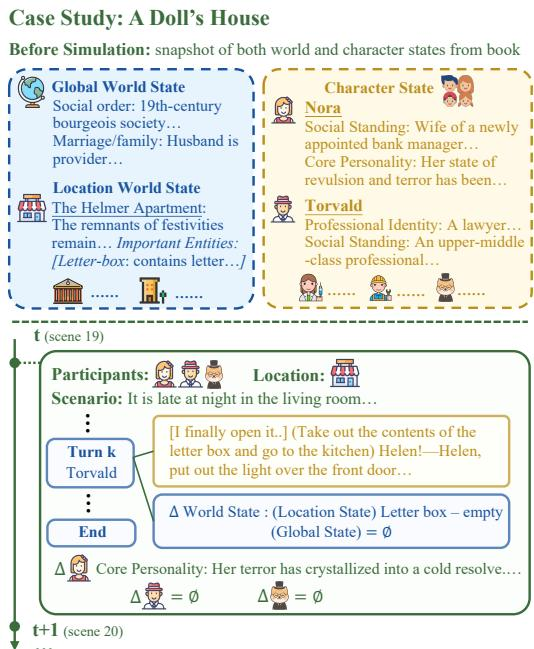
Large language models have made it possible to build agents that sustain persona-grounded dialogue, but simulating an entire literary world over long story arcs requires something deeper: as plots unfold, characters must update their beliefs, motivations, and relationships while the world itself changes locations, objects, and social orders. Existing role-playing systems fall short because they rely on static persona profiles, manually crafted sandboxes that do not scale across diverse stories, and partial state updates that cannot track full character profile evolution or location and entity-level world changes. The authors introduce EvolvingWorld, a framework that couples an open-schema character agent with hidden trackers for multi-timescale profile evolution and an LLM-based world model that maintains global, location, and entity states, all decomposed into seven trainable tasks. They also construct a benchmark from 57 books with a trajectory-level evaluation framework that measures persistent character and world development beyond single-scene role-play quality.
Dataset
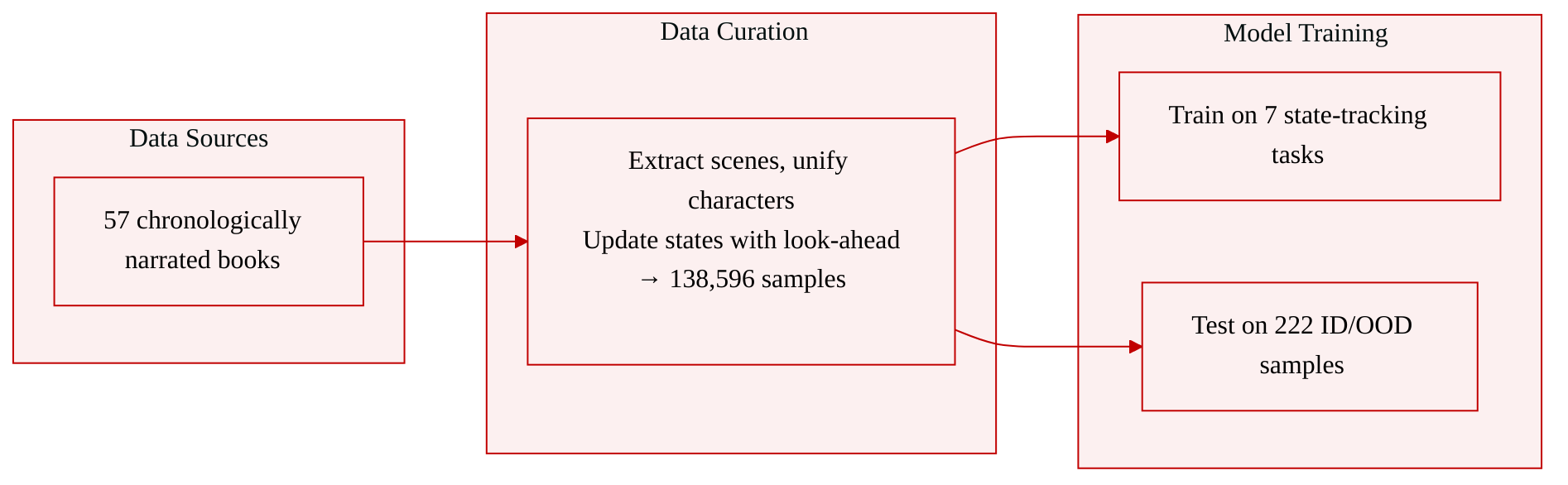
The authors construct the EvolvingWorld dataset from 57 chronologically narrated books, selected following Wang et al. They use Gemini-2.5-Pro as the extraction LLM to automatically generate structured scenes, character profiles, and world states. The chronological narrative structure allows later scenes to serve as look-ahead evidence, grounding state changes in the text rather than the model’s prior knowledge.
Dataset composition and processing details:
- Source: 57 chronologically narrated books.
- Extraction: Each book is split into text chunks. For each chunk, the LLM builds structured scenes containing summaries, scenarios, key characters, and multi-turn interactions. When a scene is cut off at a chunk boundary, the truncated text is prepended to the next chunk so the LLM can continue the same scene.
- Character processing: The LLM unifies different name mentions into consistent characters, constructs an initial open-schema profile and hidden tracker from the first few relevant scenes, and updates these states scene by scene using later narrative evidence as look-ahead. For example, if a character reflects after a failure, a later scene showing sustained effort confirms a real state change.
- World state processing: The LLM tracks two levels. A global world state captures story-level settings and systemic conditions; location-level states describe each location’s properties and important non-character entities. The immediately following interactions and scenes provide evidence for global-state changes, while interactions and the next scene occurring at the same location provide evidence for physical-state changes. Location names are standardized, and both world states are initialized and updated after interactions.
- Dataset size and splits: The extracted sequences are concatenated along timelines to produce 138,596 supervised training samples covering seven tasks (described in the paper). The test split contains 222 samples, selected from specific time points, each containing the current character and world states from which simulation can continue. The test data is further divided into in-domain (ID) samples from partially seen books and out-of-domain (OOD) samples from books excluded entirely from training.
How the paper uses the data: The dataset provides supervised training data for learning to predict character and world state changes. Training samples are used to train models on the seven state-tracking tasks, while the ID and OOD test samples evaluate generalization within familiar and entirely new narrative worlds.
Method
The authors introduce the EvolvingWorld framework to simulate scene-by-scene interactions over persistent character and world states, unfolding a book from a chosen narrative point into an evolving interactive literary world.
As shown in the figure below:
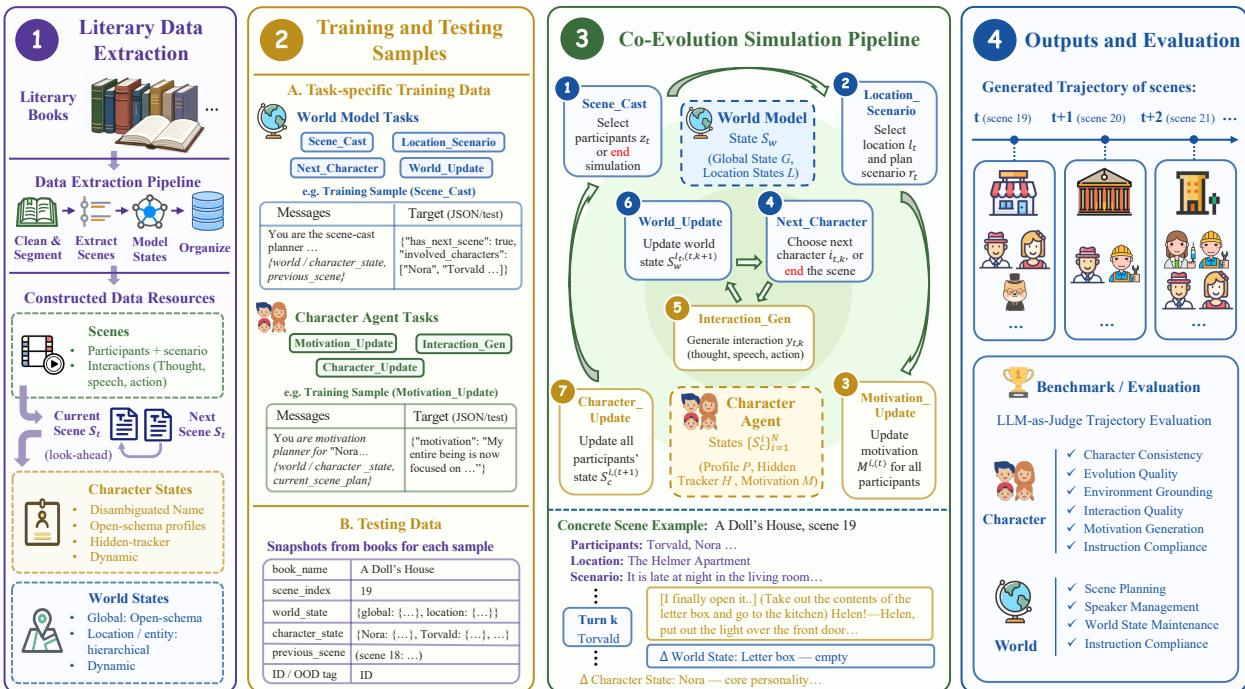
The framework is built upon two core components designed to drive open-schema, long-horizon evolution: the Character Agent and the World Model.
The Character Agent represents each character with an open-schema profile, allowing the large language model to select, merge, or introduce new fields based on the book's genre and style. To support persistent profile evolution, the agent treats every dimension in the profile as potentially evolvable. It introduces a hidden tracker to record weak or emerging evidence separately from the main profile. This design models multi-timescale evolution, preventing premature updates while allowing repeated signals across scenes to accumulate into later changes. The Character Agent also supports the environment and character groups as special acting units.
The World Model maintains both a global world state and location-level physical states. The global state captures world-level settings such as historical background and social institutions using an open-schema design. Additionally, the World Model explicitly models the physical state of each location, tracking detailed descriptions and important non-character entities. Locations can be nested or separate, and both global and location-level states are automatically updated through character interactions.
The authors formulate a co-evolution simulation pipeline that composes these components. At scene step t, the simulator maintains a global world state, location states for each location ℓ∈L, and character states for each character i∈I. The world state at location ℓ is denoted as Swℓ,(t)=(G(t),Lℓ,(t)), where G(t) is the open-schema global world state and Lℓ,(t) stores the location description and entity states. The character state is Sci,(t)=(Pi,(t),Hi,(t),Mi,(t)), comprising the open-schema profile, hidden tracker, and scene-level motivation. Module-specific observations are constructed from these states.
The simulation proceeds through a sequence of seven tasks per scene:
- scene_cast: The World Model selects the participating character set zt⊆I.
- location_scenario: Given the cast, the World Model produces a scene plan specifying the location ℓt and scenario rt.
- motivation_update: The Character Agent prepares each participant with a scene-specific motivation Mi,(t).
- next_character: During the scene, the World Model chooses the next acting character it,k from the cast.
- interaction_gen: The Character Agent generates the interaction yt,k, which may mix thought, speech, and action.
- world_update: After each interaction, the World Model updates the global and location state.
- character_update: After the scene, each participating character state is updated to Sci,(t+1).
These tasks define one scene-level transition over persistent states and interactions. Repeated transitions produce a full trajectory τ, aiming to generate a grounded long-horizon trajectory where scene content, character evolution, and world-state changes remain mutually consistent.
For dataset construction, the authors select chronologically narrated books and use an extraction LLM to build structured scenes. The extraction pipeline segments books into text chunks and extracts summaries, scenarios, key characters, and multi-turn interactions. Character and world states are initialized and updated scene by scene using later narrative evidence as look-ahead references to ensure grounded state changes. The extracted states are concatenated along each timeline to create supervised training samples for the seven tasks, alongside in-domain and out-of-domain test splits.
Experiment
The EvolvingWorld evaluation framework assesses simulation quality through two score families, CHARACTER and WORLD, covering 10 dimensions with LLM-as-Judge scoring. Experiments fine-tune multiple open-source models on EvolvingWorld data and compare them against closed-source APIs, role-play baselines, and the BookWorld framework in long-horizon simulations. Results show that EvolvingWorld training improves character consistency, evolution, and environmental grounding over role-play-only methods, while its structured world state tracking yields better scene continuity and long-range evolution than BookWorld, which degrades on longer trajectories.
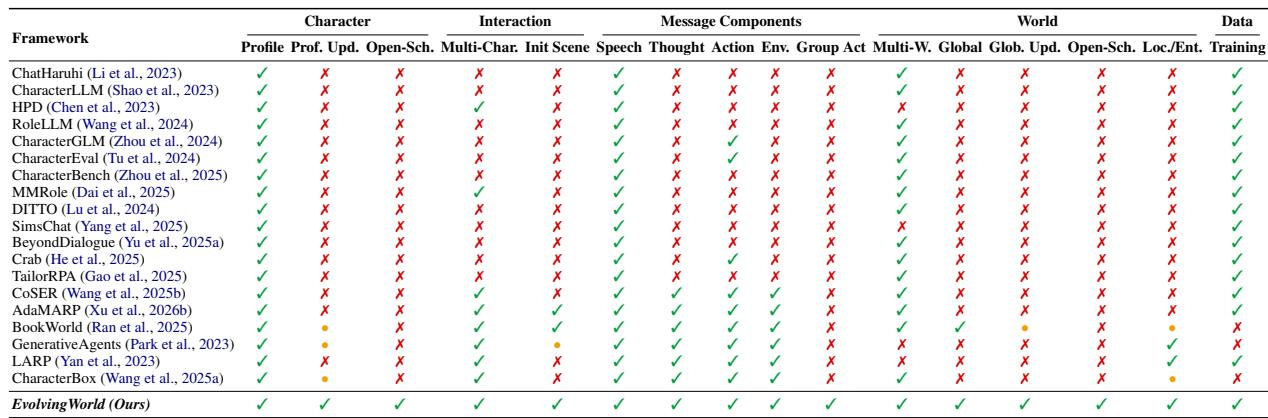
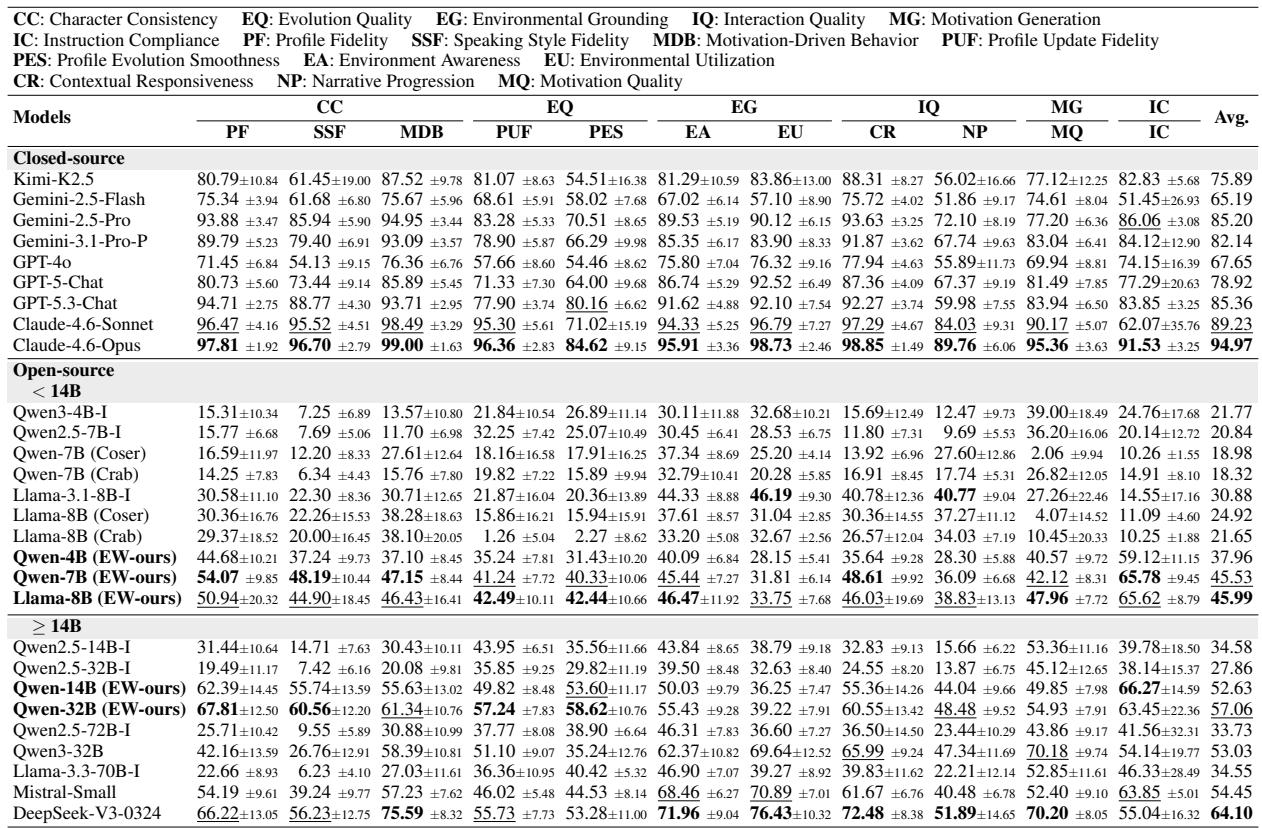
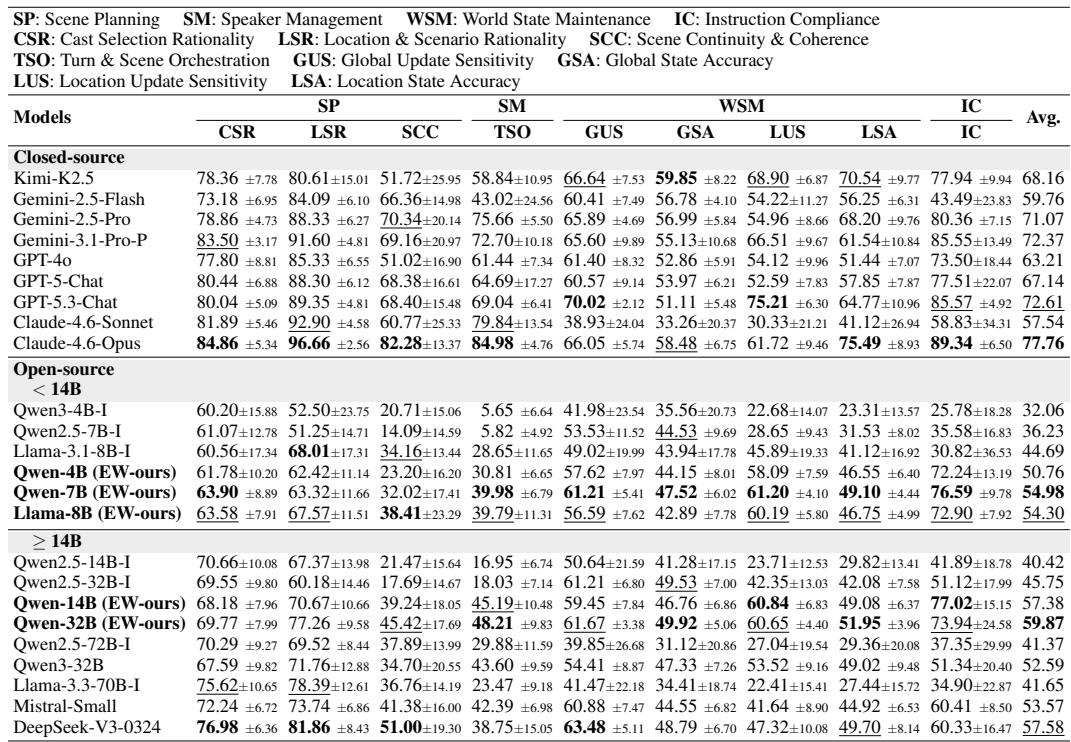
Existing role-play frameworks rely on static character profiles and limited world modeling, lacking automatic profile updates and entity-level state tracking. EvolvingWorld introduces open-schema character and world evolution, which significantly improves long-horizon role-playing, especially in character consistency, evolution, and environmental grounding. Models trained with EvolvingWorld supervision surpass even some larger general-purpose models on world modeling tasks, demonstrating the value of structured state tracking for coherent multi-agent simulations. All prior frameworks lack automatic profile updates and open-schema character states, and none support environmental messages or group actions. Only one existing framework supports multi-character scenes, and none offer automatic scene initialization. EvolvingWorld training improves character consistency and evolution, with better preservation of traits and smoother event-driven profile updates. Environment awareness increases despite lower environment utilization, indicating more accurate grounding rather than arbitrary use of details. For world modeling, the largest gains are in long-range scene continuity, turn/scene orchestration, and location-level state updates. EvolvingWorld outperforms the BookWorld baseline, particularly on character evolution metrics like PUF, PES, and MQ, and mitigates performance degradation over long trajectories. A Qwen-32B model trained with EvolvingWorld reaches a world model average score of 59.87, surpassing Claude-4.6-Sonnet and Gemini-2.5-Flash.
Closed-source model evaluation shows Gemini-2.5-Pro achieving the highest overall character agent performance, with strong character consistency and interactive progression. Motivation-related metrics and profile evolution smoothness remain weaknesses even for top models, highlighting challenges in long-horizon character consistency that the EW training method is designed to address. Gemini-2.5-Pro leads the closed-source models with an overall average of 85.20, surpassing the next best model by about 3 points. Character consistency and interactive consistency are relatively high across strong models, but motivation grade and motivation depth are markedly lower, indicating that sustaining character motivations is a persistent difficulty. Profile evolution smoothness varies significantly; Gemini-2.5-Pro reaches 86.06 while GPT-4o only achieves 74.15, suggesting that handling character updates over time is a key differentiator. The paper associated with the table reports that EW training improves controlled character evolution and environmental awareness, compensating for the weaknesses observed in these closed-source baselines.
World model evaluation shows that explicit structured state tracking is challenging for general-purpose models, with closed-source world model averages ranging from 59.76 to 72.37. Targeted EW training substantially improves long-range scene continuity, turn orchestration, and location-level updates, enabling a Qwen-32B model to reach 59.87 and surpass Gemini-2.5-Flash and Claude-4.6-Sonnet. These gains come from modeling coupled character and world-state evolution rather than imitating dialogue alone. EW-trained Qwen-32B achieves a World Model Avg. of 59.87, surpassing Gemini-2.5-Flash (59.76) and Claude-4.6-Sonnet. Among closed-source models, Gemini-3.1-Pro-P leads with a 72.37 average, driven by a turn/scene orchestration score of 85.55.
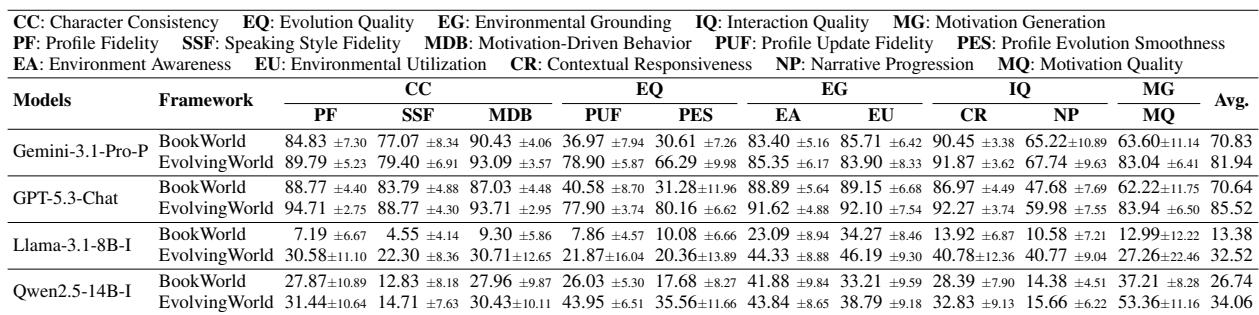
EvolvingWorld consistently outperforms BookWorld on character agent metrics across all tested backbones, with the strongest gains in character evolution indicators such as PUF, PES, and MQ. The advantage reflects the benefit of open-schema state updates for maintaining coherent character development over long simulations. EvolvingWorld achieves higher average character agent scores than BookWorld for every backbone evaluated, including both large and small models. The largest relative improvements occur in character evolution metrics PUF, PES, and MQ, indicating more effective profile updates and evolution quality under EvolvingWorld's framework.
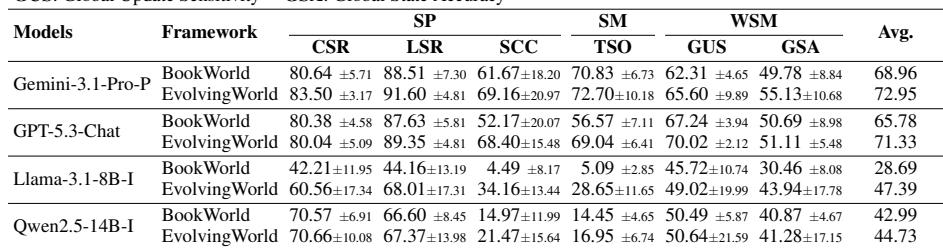
EvolvingWorld consistently outperforms BookWorld on world model metrics across all backbones, with the largest gains in long-range scene continuity and turn/scene organization. The improvement is most pronounced for the weakest backbone, where EvolvingWorld more than doubles certain scores, indicating that structured world-state updates are essential for robust long-horizon simulation. EvolvingWorld achieves higher scene continuity (SCC) and turn/scene organization (TSO) scores than BookWorld for every tested backbone. On the smallest backbone, EvolvingWorld raises TSO by over 60% and roughly doubles the average character state recall (Avg. CSR) compared to BookWorld.
EvolvingWorld is evaluated against existing frameworks and closed-source models on character agent and world modeling tasks. It introduces open-schema character and world evolution, which significantly improves long-horizon role-playing consistency, character evolution, and environmental grounding. Training with EvolvingWorld enables a Qwen-32B model to surpass larger closed-source models on world modeling, and consistently outperforms the BookWorld baseline on both character and world metrics, with the largest gains in profile evolution and scene continuity. The framework also addresses weaknesses observed in top closed-source models, such as sustaining character motivations and smooth profile updates over time.