Command Palette
Search for a command to run...
PROTECT-90: مجموعة بيانات للأعطال في أنظمة حماية القوى الكهربائية
PROTECT-90: مجموعة بيانات للأعطال في أنظمة حماية القوى الكهربائية
Julian Oelhaf Georg Kordowich Christian Bergler Andreas Maier Johann Jäger Siming Bayer
الملخص
يواكب الاهتمام المتزايد بالطرق المعتمدة على البيانات في حماية أنظمة القوى الكهربائية نقصٌ في مجموعات بيانات موحدة ومتاحة للعموم لشكل موجات الجهد العالي، مما يتيح تقييماً شفافاً وقابلاً للتكرار. ولمعالجة هذه الفجوة، تقدم هذه الورقة مجموعة بيانات PROTECT-90، وهي معيار مرجعي مفتوح ومُحاكى بالطرق الكهرمغناطيسية العابرة (EMT) لدراسات أعطال الجهد العالي، مع قياسات متسقة تشبه مسجلات الأعطال الرقمية، وتم إصدارها للعموم مع هذا العمل. تضم مجموعة البيانات 9,022 حلقة محاكاة قصر دائرة متسقة فيزيائياً، تم توليدها على طوبولوجيا خط مزدوج قياسي بجهد 90 كيلوفولت، مع توثيق منهجي لعشوائية النطاق في نقاط تشغيل الشبكة، ومعاملات الخط، وظروف العطل. لكل حلقة، تُسجل شكل موجة الجهد والتيار ثلاثي الطور المتزامن في ثمانية مواقع قياس، وتُصدر مع بيانات وصفية منظمة قابلة للقراءة آلياً تصف نوع العطل، وموقعه، وزمن بدايته، وظروف التشغيل. يتم توثيق جميع افتراضات النمذجة، ونطاقات المعاملات، وإجراءات توليد البيانات بشكل صريح لضمان الشفافية وقابلية المقارنة بين الدراسات. من خلال الجمع بين محاكاة EMT ذات الأساس الفيزيائي، والتغطية المتوازنة للسيناريوهات، والإتاحة المفتوحة، تؤسس PROTECT-90 أساساً موحداً للمقارنة المرجعية القابلة للتكرار لطرق معالجة الإشارات والتعلم الموجهة نحو الحماية.
One-sentence Summary
Researchers from Friedrich-Alexander-Universität Erlangen-Nürnberg and Ostbayerische Technische Hochschule Amberg-Weiden introduce PROTECT-90, an open electromagnetic transient-simulated benchmark comprising 9,022 physically consistent short-circuit episodes on a standardized 90kV double-line topology that provides synchronized three-phase voltage and current waveforms with structured metadata to enable transparent, reproducible evaluation of data-driven power system protection methods.
Key Contributions
- The PROTECT-90 dataset is released as an openly accessible high-voltage electromagnetic transient benchmark comprising 9,022 labeled fault scenarios with synchronized three-phase voltage and current measurements and structured, machine-readable metadata.
- A physically constrained domain-randomization framework systematically varies grid operating points, line parameters, and fault conditions within explicitly documented and physically plausible bounds.
- Full documentation of all modeling assumptions, parameter ranges, and data-generation procedures is provided under an open license to support transparent and reproducible evaluation of protection-oriented signal processing and learning-based methods.
Introduction
Electromagnetic transient (EMT) simulation is essential for analyzing fault behavior in high-voltage protection, yet openly accessible waveform datasets with fully documented topologies, parameter ranges, and labeling conventions remain scarce. Existing public resources either rely on proprietary grid models without releasing complete waveform corpora and metadata, or offer real-world recordings that lack structured simulation assumptions, limiting reproducibility and cross-study comparability. The authors address this gap by introducing PROTECT-90, a publicly released 90 kV EMT dataset containing 9,022 physically consistent fault scenarios. It provides raw three-phase voltage and current measurements together with machine-readable metadata and explicitly bounded domain-randomized parameters, establishing a transparent and reproducible benchmark for protection-oriented waveform analysis.
Dataset
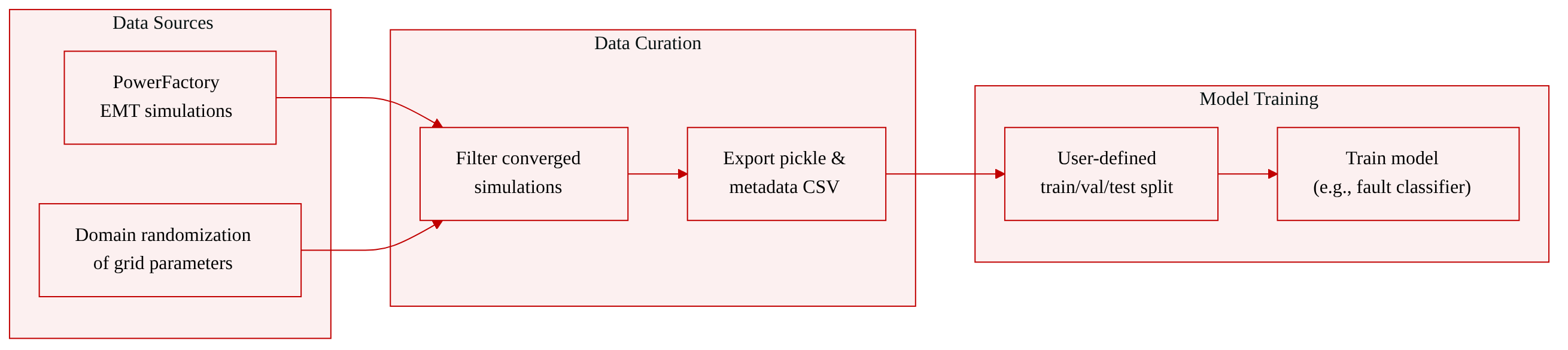
The authors introduce PROTECT-90, a synthetic benchmark dataset for high-voltage fault studies, generated through automated electromagnetic transient simulations in PowerFactory. The dataset is publicly available on Zenodo under a CC BY 4.0 license, with a compressed size of 12.5 GB and an uncompressed size of approximately 31 GB.
Dataset composition and sources
- The dataset contains 9,022 fault scenarios, all representing short-circuit events with no separate non-fault class.
- Each scenario is stored as an individual Python pickle file containing a time-series dataframe, accompanied by a structured CSV metadata file (7.3 MB).
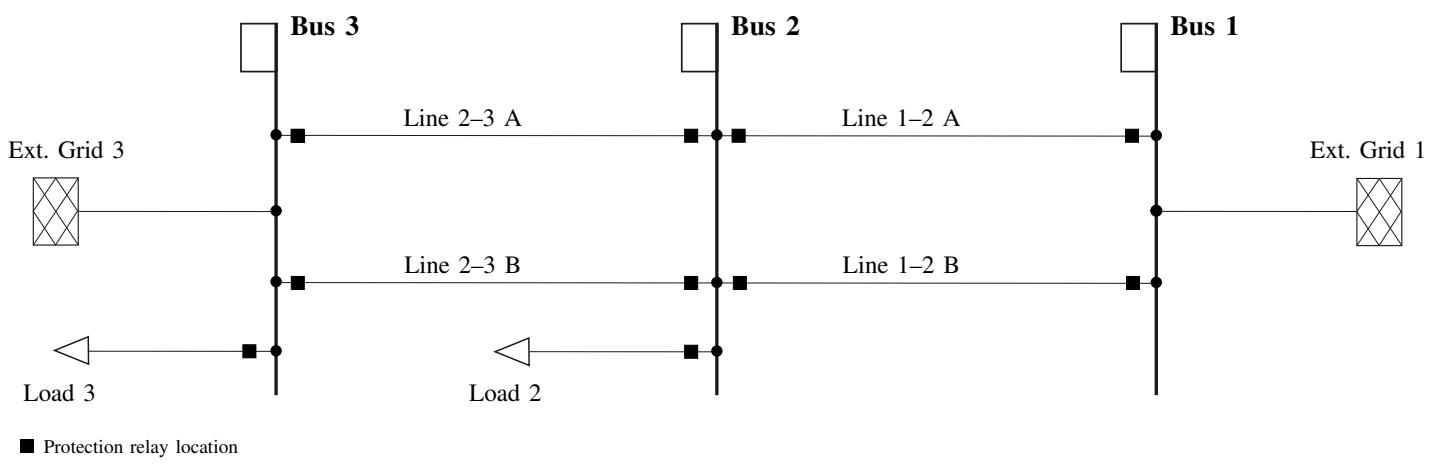
- Waveforms are simulated on a standardized 90 kV high-voltage double-line network with three buses, two parallel corridors between adjacent bus pairs, external grid equivalents at Bus 1 and Bus 3, and aggregated loads at Bus 2 and Bus 3.
Key details for each subset
- Fault types (single-line-to-ground, line-to-line, line-to-line-to-ground, three-phase) are approximately uniformly distributed within each line section.
- Primary corridor sections (Line 1-2A and Line 2-3A) each account for roughly 35% of the dataset, while secondary corridor sections (Line 1-2B and Line 2-3B) contribute about 15% each, reflecting a topology switching strategy where secondary corridors are switched out in a subset of scenarios.
- Topology switching for Line 1-2B, Line 2-3B, and the external grid at Bus 3 is balanced at approximately 50/50, ensuring representation of both single- and double-circuit configurations and reduced infeed conditions.
- Fault locations are uniformly distributed along the normalized line length, and fault resistance and inception time are sampled within predefined ranges.
How the paper uses the data
- No predefined train/test split is provided; dataset partitioning is left to the user to enable application-specific evaluation protocols.
- The authors do not include derived or preprocessed features, allowing users to define task formulations explicitly.
Processing details
- Each episode contains a single short-circuit event. Grid parameters (line length, series resistance, series reactance, shunt capacitance, load active and reactive power, external grid short-circuit power, voltage magnitude, and voltage angle) are independently sampled within physically constrained bounds using domain randomization.
- The R/X ratio of all lines is constrained to the interval [0.05, 0.5] to reflect typical high-voltage line characteristics, and all parameter combinations must satisfy load-flow convergence and electromagnetic transient numerical stability.
- Simulations that fail load-flow convergence are discarded, and exported episodes are verified to contain no missing values.
- Each pickle file holds a dataframe with 49 columns: one time vector and 48 columns representing synchronized three-phase voltage and current measurements from eight relay locations (six channels per relay), sampled at 6,400 Hz. Signal naming follows a consistent convention encoding bus, line section, quantity, phase, and unit.
- The structured metadata CSV includes fault type, affected phases, faulted line section, normalized fault location, fault resistance, inception time, randomized grid parameters with physical units, and topology switching states as boolean flags.
Method
The authors leverage an electromagnetic transient simulation framework to generate the dataset, ensuring that each recorded scenario captures physically realistic fault waveforms under varied operating conditions. All simulations are executed in EMT mode using a fixed-step solver with a step size of 10μs. Each scenario begins with a short warm-up period of 0.1s to allow the differential equation system to settle into steady state. The subsequent 1s analysis window is recorded and exported at a sampling rate of 6,400Hz, yielding 6,400 time steps per episode. This rate corresponds to 128 samples per 50Hz fundamental cycle, striking a balance between high-resolution transient analysis and manageable data volume. Three-phase voltages and currents are measured at both terminals of every line segment, producing six measurement channels per relay location and a total of 48 synchronized waveform channels. The signals are extracted directly at the bus terminals without secondary instrument transformer models, so all exported quantities represent ideal primary voltage and current signals.
To populate the dataset with diverse and physically plausible fault scenarios, the authors employ a domain randomization strategy built on an automated generation pipeline. Each episode contains a single short-circuit event, characterized by the affected line segment, fault type, and involved phases. Fault resistance Rf and inception time tf are drawn from predefined ranges, while fault locations are uniformly distributed along the normalized line length to guarantee full spatial coverage. Prior to each simulation, key electrical parameters are independently sampled within specified bounds: per-kilometer line length, series resistance R′, series reactance X′, and shunt capacitance C′, as well as load active and reactive power (P,Q). External grid parameters, including short-circuit power Sk′′, voltage magnitude V, and voltage angle ϕ, are likewise randomized. The short-circuit power range is intentionally biased toward lower values to reflect future grid conditions with increased penetration of inverter-based resources and reduced fault levels, and the voltage angle is randomized to prevent systematic phase alignment across scenarios. In a subset of cases, the external grid at Bus 3 is deactivated to emulate reduced infeed or topology reconfiguration. All parameter combinations must satisfy load-flow convergence and EMT numerical stability before, during, and after the fault, and the R/X ratio of every line is constrained to the interval [0.05,0.5] to preserve the characteristics of typical high-voltage lines. This physically constrained randomization maintains electrical plausibility while producing a wide variability spectrum representative of real-world high-voltage system operation.
Experiment
The benchmark topology models a realistic 90 kV double-line network with parallel corridors and variable configurations, designed to introduce complex current distributions and impedance measurement errors relevant to distance protection studies. The PROTECT-90 dataset supports multiple protection tasks, including fault classification, line identification, and fault localization, while randomized grid parameters enable robustness analysis under diverse operating conditions. For benchmarking, episode-wise data partitioning is recommended to prevent temporal leakage, and the dataset remains task-agnostic, allowing flexible evaluation designs without prescribed window lengths or model architectures.
The PROTECT-90 dataset provides electromagnetic transient simulations of fault scenarios on a 90 kV double-line network, sampled at 6.4 kHz over one-second episodes. It includes structural variability through switched secondary corridors and randomized grid, line, and fault parameters. The dataset supports fault classification, line identification, and localization tasks while requiring careful episode-wise partitioning to avoid temporal leakage. The topology is a 90 kV double-line system with parallel corridors between three buses, introducing non-trivial current distribution relevant for distance protection. Each episode captures one second of simulation at 6.4 kHz, yielding 6,400 samples per scenario across 9,022 fault episodes. Structural variability is introduced by switching out secondary corridor segments in a subset of scenarios, altering network configuration. Randomized grid, line, load, and fault parameters enable robustness analysis under varying operating conditions and domain shift effects. Fault classification uses phase and short-circuit type labels, while fault localization relies on regression-based estimation of the normalized fault position. Episode-wise data partitioning is recommended to prevent temporal leakage when applying sliding windows for model training and evaluation.
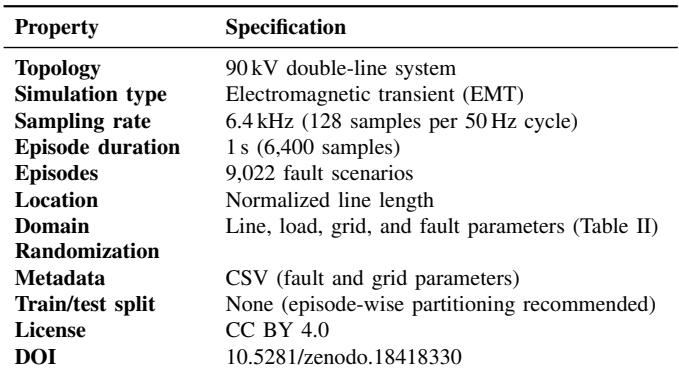
The evaluation uses the PROTECT-90 dataset, which contains electromagnetic transient simulations of fault scenarios on a 90 kV double-line network, to assess fault classification, line identification, and localization. Structural variability is introduced through switched secondary corridors and randomized parameters, enabling robustness analysis under domain shift. The experiments validate that models can accurately classify fault types and estimate fault position, provided that episode-wise data partitioning is applied to prevent temporal leakage.