Command Palette
Search for a command to run...
إذا كانت نماذج اللغات الكبيرة (LLMs) تمتلك سمات مشابهة للبشر، فإن لعبة Age of Empires II تمتلكها أيضًا.
إذا كانت نماذج اللغات الكبيرة (LLMs) تمتلك سمات مشابهة للبشر، فإن لعبة Age of Empires II تمتلكها أيضًا.
Adrian de Wynter
الملخص
أجريت بحوث واسعة النطاق حول النماذج اللغوية الكبيرة (LLMs) وسير العمل القائم على الوكلاء المدعومين بهذه النماذج. ومع ذلك، تدعي العديد من الأعمال في هذا المجال ظهور سمات أنثروبومورفية عامة (أي نسبة خصائص بشرية) لهذه النماذج، أو تعزى إليها، أو تفترضها ضمنيًا (مثل الأخلاق أو فهم اللغة الطبيعية). لا يهدف هدفنا إلى المجادلة لصالح أو ضد وجود هذه السمات، بل إلى الإشارة إلى أن هذه الاستنتاجات قد تكون غير صحيحة. وبناءً على ذلك، قمنا ببناء وتدريب شبكة عصبية بسيطة على لعبة الفيديو Age of Empires II، ولاحظنا أن أي كيان موجود في وسط حاسوبي قوي بما يكفي، مثل قطع LEGO أو منطقة greater Boston، يمكن أن يظهر أيضًا مثل هذه السمات. ومن ثم، فإن السمات الأنثروبومورفية المزعومة للنماذج اللغوية الكبيرة (LLMs) ليست فريدة تجريبياً: فبينما يمكن أن تبقى بعض الخصائص (مثل الاستجابات لـ prompt) ثابتة، فقد تتغير أخرى، مثل تفسير السلوك المُدرَك، باختلاف الوسط (substrate). وبالتالي، فإن أي مناقشة مبنية على أسس تجريبية تتطلب معايير قياس صريحة؛ وإلا فإن التفسير يُترك لتمثيل البيانات وحسب. ونظهر بعد ذلك أن افتراض وجود هذه السمات أو عدم وجودها في نظام معين، بشكل مستقل عن الوسط وبشكل عام، يؤدي إما إلى استنتاجات دائرية (circular) أو استنتاجات غير مفيدة، بغض النظر عن وجهة نظر الباحث تجاه الموضوع.
One-sentence Summary
Adrian de Wynter demonstrates that anthropomorphic attributes ascribed to large language models are empirically non-unique by training a simple neural network on Age of Empires II to show that perceived behaviour depends on the substrate, arguing that generalised assumptions lead to circular or uninformative conclusions and require explicit measurement criteria for empirically-grounded discussion.
Key Contributions
- A simple neural network is built and trained on the videogame Age of Empires II to demonstrate that purported anthropomorphic attributes are empirically non-unique and vary with the underlying substrate.
- A null assumption is proposed where experiments avoid presupposing anthropomorphic attributes to ensure conclusions remain sound and robust.
- Perceived anthropomorphism varies heavily with interface presentation, indicating that many anthropomorphic measurements assess presentation rather than actual system behavior.
Introduction
Research evaluating Large Language Models frequently presupposes the existence of human-like attributes such as empathy or moral reasoning. This methodological approach often leads to circular or uninformative conclusions because the experimental design relies on the very assumption it seeks to test. To address this, the authors train a simple neural network within the video game Age of Empires II to demonstrate that anthropomorphic behavior can emerge in any sufficiently powerful substrate. They argue that perceived intelligence depends heavily on representation and propose a null assumption framework to facilitate rigorous experiments that do not inherently bias results toward or against anthropomorphism.
Dataset
-
Dataset Composition and Sources
- The authors collected scientific articles by querying the Semantic Scholar API and retrieving papers from ArXiv.
- The search query targeted titles matching 'agent lllm' within a specific timespan from 1 May 2024 to 1 May 2026.
- The collection process implemented timeouts and backoff mechanisms to avoid overloading external services.
-
Filtering and Processing
- An initial deduplication step removed entries based on exact title matches.
- Semantic filtering was conducted using a calibrated LLM-as-a-judge, specifically GPT-5.2.
- The filtering pipeline excluded works that were not scientific articles or did not feature LLMs as the central aspect of study.
- Additional prompts classified document types and determined if LLMs were the subject of study for pre-annotation.
-
Dataset Size and Sampling
- The authors randomly sampled a subset of 1,024 papers from the initial filtered pool.
- The final curated dataset consists of 315 papers after applying all filtering and labeling rules.
-
Metadata and Labeling
- Papers were labeled regarding human-like attributes, including assumptions, study focus, and conclusions.
- Emergent properties claimed by the works were identified as a free-form list and manually normalized.
- Labels indicate whether papers assumed, studied, or concluded that LLMs possess human-like attributes.
-
Usage and Ethics
- The dataset supports a survey analysis of anthropomorphic assumptions in LLM research rather than model training.
- No human subjects were used in the study, and the crawling was performed responsibly.
- The labelled and anonymised dataset is available in the repository, while survey code remains unreleased due to licensing and ethics considerations.
Method
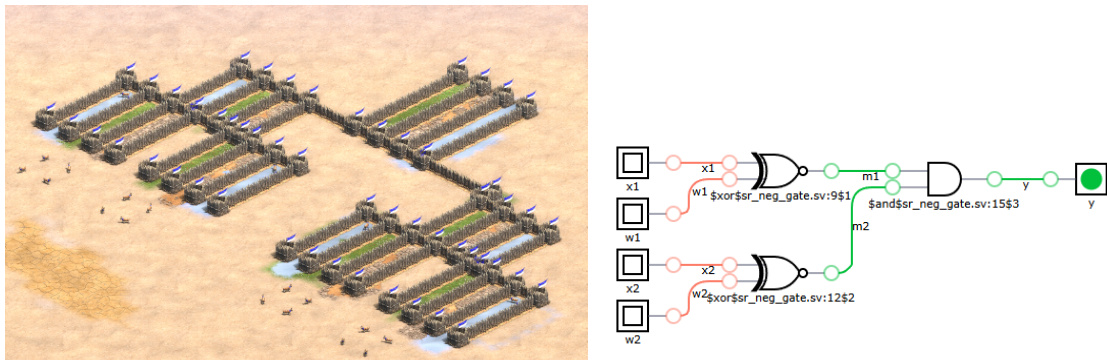
The authors establish the functional and Turing-completeness of Age of Empires II (AoE II) to demonstrate that any neural network can be implemented within the game's engine. This is achieved by constructing fundamental logic gates, specifically NAND gates, using in-game units and triggers. Building upon this foundation, the authors implement a perceptron, a fundamental building block of neural networks, using a bipolar 1-bit architecture that avoids floating-point arithmetic.
The perceptron implementation utilizes a bipolar representation where bits are mapped to {−1,+1} rather than standard binary, allowing for the representation of negative weights and biases necessary for learning. The core architecture consists of two parallel XNOR gates whose outputs are fed into an AND gate, which acts as the Heaviside step function h(z). In this specific configuration, the bias term is hardcoded into the AND gate logic to simplify the circuit.
As shown in the figure below:
To train the perceptron to learn the AND function, the authors adopt an ansatz-based training algorithm suitable for the constraints of the 1-bit hardware. The training circuit takes the true label t, the input vector x, and the current weights w as inputs. The process begins by computing the perceptron's output f(x) and comparing it with the true label t to determine the error ϵ. This error is calculated using an XOR operation, ϵ=XOR(f(x),t).
The circuit then evaluates whether the weights need updating. If the error is non-zero, the weights are updated according to the rule w←w+ηϵx, where the learning rate η is set to 1. The implementation includes logic to compare the new weight set with the current one; if they are identical, the process interrupts, otherwise, it retries.
Refer to the framework diagram for the detailed circuit layout of this training algorithm:
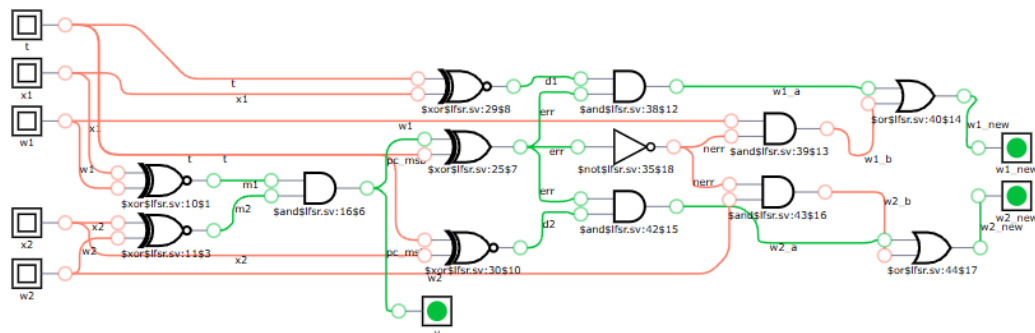
This approach leverages the concurrency control provided by the bipolar bit representation, where each logical bit is represented by two physical rails (or goats in the game context) to manage signal timing and avoid race conditions. While this ansatz-based strategy is less sophisticated than standard gradient descent, it successfully demonstrates the capability to train a perceptron within the game's environment.
Experiment
The analysis examines the validity of measuring anthropomorphic attributes in LLMs, demonstrating that mechanistic analysis and substrate invariance do not inherently prevent circular reasoning unless assumptions are explicitly stated. A parallel corpus study validates the prevalence of these methodological issues, revealing that most papers assume human-like traits and frequently conclude their existence without independent verification. Consequently, the findings highlight a systemic reliance on accept or reject setups that often yield uninformative results regarding emergent capabilities.