Command Palette
Search for a command to run...
Please provide the title you would like me to translate.
Please provide the title you would like me to translate.
الشبكات التوليدية
الملخص
Please provide the title and abstract you would like me to translate.
One-sentence Summary
Established in 2022 by the ILC International Development Team to advance engineering studies for the International Linear Collider, the ILC Technology Network coordinates laboratories in Asia and Europe to execute work packages that support ILC development while addressing broader accelerator applications, as summarized in this midterm status report.
Key Contributions
- The ILC Technology Network coordinates engineering design studies across multiple work packages to advance International Linear Collider development while extending technical relevance to broader accelerator projects.
- The study outlines beam tuning methodologies for the ATF, specifically implementing wakefield and multipole error mitigation to sustain a 37 nm ultra-small beam.
- The report evaluates vertical vibration thresholds for the final doublet cryostat, establishing a 50 nm stability requirement to guide accelerator and detector interface designs prior to the ILC Pre-Lab phase.
Introduction
The International Linear Collider requires advanced engineering solutions for superconducting radio-frequency cavities, high-brightness particle sources, and nanometer-scale beam focusing to enable precision measurements in particle physics. While earlier design reports established technical baselines, unresolved engineering hurdles and a delayed transition to a preparatory facility highlighted the need for targeted research on beam stabilization, wakefield mitigation, and high-performance photocathode development. The authors outline the establishment of the ILC Technology Network, a global collaboration that consolidates laboratory resources to execute fifteen priority engineering work packages. They report on the current progress of these initiatives, demonstrating how coordinated international efforts are addressing critical design challenges and preparing the accelerator community for future construction phases.
Dataset

- Dataset composition and sources: The authors compile a technical status report for the ILC Technology Network, drawing from institutional contributions by CERN, KEK, CEA-Saclay, INFN-LASA, and other partner organizations. The material consists of work package documentation, procurement records, quality control results, and project timelines.
- Key details for each subset:
- Single-cell cavity data includes two manufactured units using different niobium grades, material procurement records, and baseline surface treatment specifications.
- Nine-cell cavity data covers four bare cavities under fabrication, jacketing procedures, and High Pressure Gas Safety compliance testing protocols.
- Pulser prototype records outline design simulations, supplier contracts, and testing schedules for damping-ring kicker modules.
- Institutional lists document member affiliations and technical responsibilities across participating labs.
- Data usage: The authors utilize the compiled information to track manufacturing progress, validate surface preparation recipes, coordinate cross-laboratory cold testing at 2 K, and harmonize pressure vessel codes for large-scale production. The documentation serves as a progress tracking and quality assurance resource rather than a machine learning training set.
- Processing and technical handling: No cropping or machine learning metadata construction is applied. Instead, the authors structure the data through strict acceptance criteria including material purity thresholds, surface roughness limits, and scratch depth measurements. All technical specifications are formalized through standardized vertical cold testing and aligned with Japanese regulatory frameworks for pressure vessel qualification.
Method
The International Linear Collider (ILC) project employs a modular and distributed design approach, with distinct work packages addressing key subsystems. The core of the accelerator consists of superconducting radiofrequency (SRF) cavities, which are manufactured under WPP-1 to strict specifications compliant with international safety standards. These cavities undergo vertical testing for performance evaluation before being integrated into cryomodules. The cryomodule design, detailed in WPP-2, is a critical component that integrates multiple SRF cavities into a single cryogenic unit. These modules are designed for high-pressure gas compatibility and feature a compact, string-like configuration without intermediate warm sections, similar to the European XFEL. The cryomodule architecture incorporates a large-diameter helium-gas return pipe (GRP) as a structural backbone and thermal shield, which supports the cryogenic piping and maintains temperature stability along the kilometer-long cryo-units. 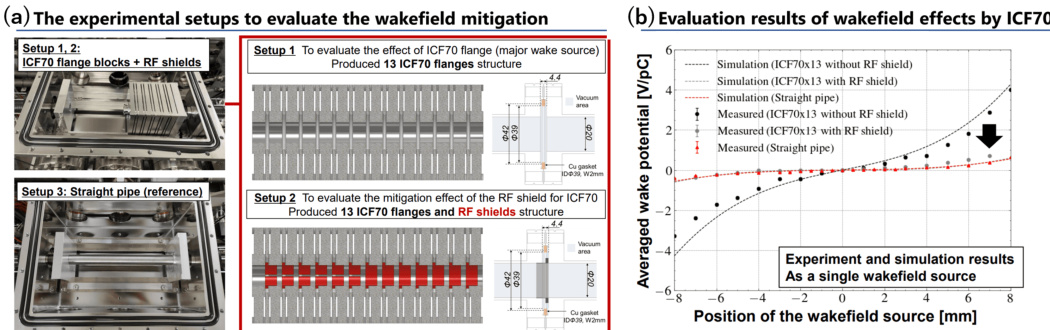
The cryomodule design is further optimized to accommodate various components, including superconducting quadrupole packages and dipole correctors, which are integrated at the center of the module. This configuration allows for a standard interconnection interface across all main-linac cryomodules. The design also includes fundamental-mode power couplers to deliver RF power and RF cables to connect field pickups and HOM antennas to the LLRF control system. The overall cryomodule design is an evolution of the TESLA Test Facility (TTF) module, further refined by Fermilab for the ILC-TDR.
The ILC requires a sophisticated crab cavity system to counteract the 14 mrad crossing angle at the interaction point, ensuring optimal luminosity. Five distinct crab cavity designs have been developed under the ILC International Development Team (IDT), which are evaluated for compliance with stringent RF and mechanical specifications. These include a 3.9 GHz Racetrack Cavity, a 1.3 GHz RF Dipole (RFD), a 1.3 GHz Double Quarter Wave (DQW) cavity, a 1.3 GHz Wide Open Waveguide (WOW) cavity, and a 2.6 GHz Quasi-Waveguide Multicell Resonator (QMiR). The down-selection process identified the 1.3 GHz RF Dipole and the 2.6 GHz QMiR as the most promising technologies for prototyping. These designs must fit within a compact cryomodule space of 3.85 m longitudinally and 0.198 m transversely.
The polarized electron source, a critical component of the ILC, is based on a high-voltage DC photo-gun with a GaAs/GaAsP photocathode to provide polarization greater than 85%. The gun design, developed by Jefferson Lab, includes an inverted insulator geometry to improve high-voltage operation and suppress asymmetric fields, while also incorporating improvements in vacuum design to extend photocathode lifetime. The proposed work includes beam dynamics simulations for shorter laser pulses, electrostatic design to maximize gradient while limiting field emission, and the development of a triple point junction shield and a tilted biased anode to correct electrostatic field asymmetries.
The positron source is based on an undulator scheme, which provides a mature and reliable source with a large margin to the damping ring acceptance. The baseline scheme uses an undulator with a 231 m active length and a 126.5 GeV electron drive beam. This scheme allows for the generation of polarized positrons, which is crucial for physics impact. The main work packages, WPP-6 and WPP-7, focus on the rotating target and magnetic focusing systems. The target wheel, with a 1 m diameter, rotates at 2000 rpm and is cooled via radiation into a stationary water-cooled cooler. The magnetic focusing system uses a pulsed solenoid to match the flat-top pulse width of the beam, generating a half-sine current pulse of about 4 ms and a peak field of 3-5 T.
The damping ring design, detailed in WPP-12, uses normal-conducting magnets and is designed to achieve a very large dynamic aperture to maximize positron capture yield. The baseline design includes a hard-edge magnet model with zero spacing between magnets. The design specifications for the damping ring are listed in Table 9, and the goal is to achieve a low emittance of 4 μm horizontally and 20 nm vertically, including intra-beam scattering, while maintaining a wide dynamic aperture of 0.07 mrad.
The fast injection and extraction system for the damping rings, WPP-14, involves the use of semiconductor pulsed power supplies with nano-second pulse lengths. The stripline kickers for the ILC damping ring share similarities with the storage ring injection striplines for the UK Diamond-II upgrade project, and a prototype pulser suitable for ILC has been discussed with the same company.
The main beam dump, designed to absorb the electron or positron beam after collision, is a pressurized water dump capable of handling 17 MW, including a 20% safety margin. The design includes a vortex water flow system to prevent local heat accumulation and a remote-exchange system for the beam window. The beam dump vessel is designed with a circular cross-section of 1.8 m in diameter to create a vortex flow, and the beam window is mounted off-center to receive an effective vortex flow performance.
Experiment
The experimental program utilizes an international manufacturing and testing framework to evaluate superconducting cavities, cryomodules, and critical ancillary components. Prototype testing and surface treatment trials validate that newly developed niobium materials and standardized heat processes reliably meet design specifications, while high-power and cryogenic assessments confirm the mechanical integration and operational readiness of input couplers, frequency tuners, and magnetic shields. Concurrent cleanroom automation trials further validate the scalability and precision of robotic assembly workflows. Collectively, these evaluations demonstrate the technical viability of component standardization and establish a robust foundation for full-scale integration and performance testing.
The authors present performance targets for superconducting radio-frequency cavities, with vertical tests requiring a gradient of 35.0 MV/m and a Q-value of at least 0.8 times 10 to the power of 10, while cryomodule tests require a slightly lower gradient of 31.5 MV/m but a higher Q-value of at least 1.0 times 10 to the power of 10. Results show that the design specifications for the vertical test are more stringent in terms of gradient but less demanding in Q-value compared to the cryomodule test. Vertical test requirements are more stringent in gradient but less demanding in Q-value compared to cryomodule test. Cryomodule test requirements are less stringent in gradient but more demanding in Q-value compared to vertical test. The design specifications for both tests emphasize high Q-values, indicating a focus on minimizing energy loss.

The authors evaluate wakefield effects in experimental setups involving ICF70 flange blocks and RF shields to assess mitigation strategies. Results show that the presence of RF shields significantly reduces wakefield potential compared to configurations without shields, with measured data aligning closely with simulation trends. RF shields effectively reduce wakefield potential in ICF70 flange configurations. Experimental results align with simulation trends for wakefield mitigation. Setup variations demonstrate the impact of shield placement on wakefield effects.
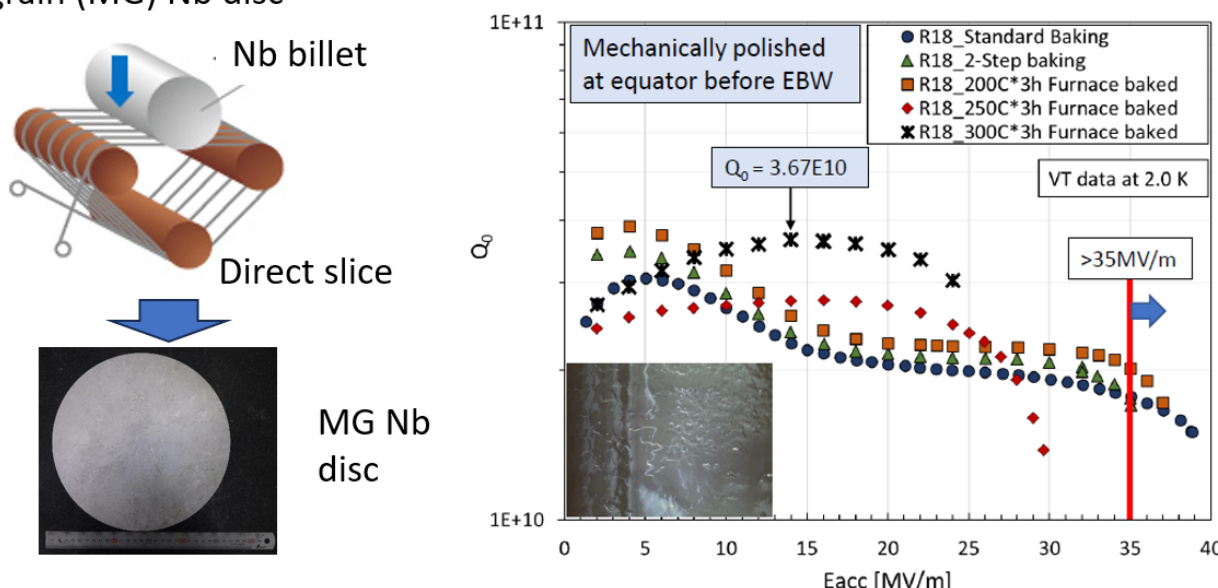
The authors investigate the performance of niobium cavities using different surface treatment methods, focusing on the impact of baking processes on quality factors and accelerating gradients. Results show that a two-step baking method achieves high quality factors and meets the target accelerating gradient, with performance consistent across various treatments. The authors use a combination of mechanical polishing and furnace baking to optimize cavity performance. Different surface treatment methods, including two-step baking, are evaluated for their impact on cavity performance. The two-step baking process achieves high quality factors and meets the target accelerating gradient. Mechanically polished cavities show consistent performance across various baking treatments.
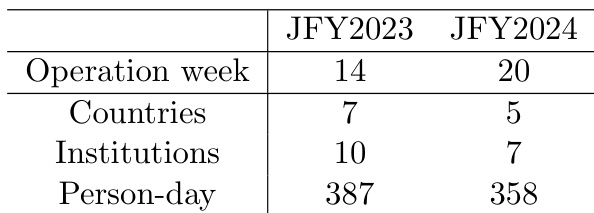
The authors present a comparison of operational metrics between two fiscal years, showing a reduction in the number of participating countries and institutions, as well as a decrease in person-days, indicating a shift in collaboration scale or activity intensity over time. The number of participating countries decreased from seven in JFY2023 to five in JFY2024. The number of institutions involved reduced from ten in JFY2023 to seven in JFY2024. Total person-days of operation decreased from 387 in JFY2023 to 358 in JFY2024.
The authors describe the progress of superconducting radio-frequency cavity manufacturing and testing, focusing on the successful completion of single-cell cavities that meet performance specifications. Results show that the 2-step baking surface treatment enables high Q-values, and the target performance for 9-cell cavities has been updated based on these results. The vertical test target gradient is higher than that for the cryomodule test, indicating a more stringent requirement for individual cavity evaluation. The 2-step baking surface treatment process enables high Q-values and is being applied to nine-cell cavities. Vertical test targets are more stringent than cryomodule test targets, with higher gradient and Q-value requirements. Completed single-cell cavities have met the ILC specification, validating the surface treatment method.

The experimental program evaluates superconducting radio-frequency cavity performance through vertical and cryomodule testing, wakefield mitigation assessments, and surface treatment optimization. Vertical testing validates stricter accelerating gradient requirements, while cryomodule configurations prioritize superior quality factors to minimize energy loss, and RF shield installations on flange assemblies effectively suppress wakefield potentials with outcomes closely matching simulations. Additionally, niobium cavities subjected to mechanical polishing and a two-step baking process consistently deliver high quality factors and meet target gradients, successfully validating the manufacturing protocol for both single-cell and multi-cell units despite a concurrent contraction in international collaboration scale.