Command Palette
Search for a command to run...
إزالة الضبابية للصورة المفردة ذات المقياس المزدوج عبر التعزيز العصبي
إزالة الضبابية للصورة المفردة ذات المقياس المزدوج عبر التعزيز العصبي
Z. G. Li C. B. Zheng H. Y. Shu S. Q. Wu
إزالة الضباب من الصور باستخدام MATLAB
الملخص
تُعيد خوارزميات إزالة الضباب من الصور الفردية القائمة على النماذج استعادة صور خالية من الضباب ذات حواف حادة وتفاصيل غنية للصور الضبابية في العالم الحقيقي، وذلك على حساب قيم منخفضة لمقياس نسبة الإشارة إلى الضوضاء (PSNR) ومقياس تشابه الهيكل (SSIM) للصور الضبابية الاصطناعية. بينما تعيد الخوارزميات القائمة على البيانات استعادة صور خالية من الضباب ذات قيم عالية لـ PSNR و SSIM للصور الضبابية الاصطناعية، لكنها تعاني من تباين منخفض، بل وقد تترك بعض الضباب المتبقي في الصور الضبابية في العالم الحقيقي. في هذه الورقة البحثية، تُقدّم خوارزمية جديدة لإزالة الضباب من الصور الفردية من خلال دمج النهج القائمة على النماذج مع النهج القائمة على البيانات. أولاً، يتم تقدير خريطة النقل والضوء الجوي باستخدام الطرق القائمة على النماذج، ثم يتم تحسينها باستخدام نهج تعتمد على الشبكات التوليدية التنافسية ثنائية المقياس (GANs). وتشكّل الخوارزمية الناتجة تعزيزاً عصبيًا يتقارب بسرعة كبيرة، بينما قد لا تتقارب الخوارزمية المقابلة القائمة على البيانات. يتم استعادة الصور الخالية من الضباب باستخدام خريطة النقل والضوء الجوي المقدرين، بالإضافة إلى قانون كوشميدر. وتشير النتائج التجريبية إلى أن الخوارزمية المقترحة يمكنها إزالة الضباب بشكل فعال من الصور الضبابية في العالم الحقيقي والصور الضبابية الاصطناعية.
One-sentence Summary
The authors propose Dual-Scale Single Image Dehazing Via Neural Augmentation, a method that combines model-based estimation of transmission maps and atmospheric light with fast-converging dual-scale generative adversarial networks to refine these parameters, ultimately leveraging Koschmieder's law to effectively restore haze-free images across both synthetic and real-world datasets.
Key Contributions
- A neural augmentation framework for single image dehazing is introduced, which estimates the transmission map and atmospheric light using model-based methods and refines both components through dual-scale generative adversarial networks.
- The architecture reduces the training dataset requirement to 500 images and accelerates convergence compared to purely data-driven approaches, while a novel theoretical analysis establishes that high accuracy in the initial model-based estimation is essential for framework stability.
- Experimental evaluations on synthetic and real-world hazy images demonstrate that the algorithm effectively removes haze while preserving sharp edges and rich details, mitigating the low contrast and residual artifacts common in standard data-driven methods.
Introduction
Single image dehazing serves as a critical preprocessing step for computer vision pipelines, as atmospheric haze severely degrades contrast, color fidelity, and dynamic range, ultimately compromising downstream tasks like object detection. Traditional model-based methods handle real-world haze effectively but produce low fidelity metrics on synthetic data and introduce morphological artifacts, while purely data-driven deep learning approaches excel on synthetic benchmarks but fail to generalize to real-world conditions due to domain gaps and heavy paired-data requirements. To bridge this divide, the authors leverage a neural augmentation framework that initializes the transmission map and atmospheric light using established physical priors before refining them with a dual-scale generative adversarial network. This hybrid strategy significantly reduces training data needs, accelerates convergence, preserves high-frequency image details, and delivers consistent dehazing performance across both synthetic and real-world scenarios.
Method
The proposed method integrates model-based estimation with data-driven refinement in a neural augmentation framework to achieve effective single image dehazing. The overall architecture, as illustrated in the framework diagram, begins with a hazy input image that is processed through two parallel streams. The first stream estimates the atmospheric light A using a hierarchical search method, while the second stream computes an initial transmission map t0 via the dark channel prior. These initial estimates are then refined through a dual-scale generative adversarial network (GAN) that leverages both spatial and channel attention mechanisms to enhance feature representation and suppress noise.
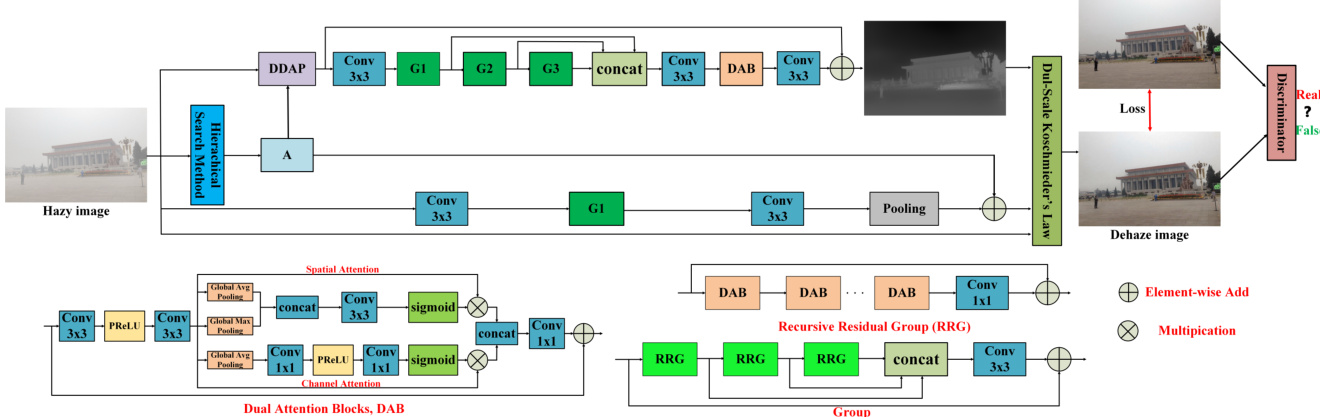
The generator within the GAN is constructed based on the Recursive Residual Group (RRG) module, which is composed of multiple Dual Attention Blocks (DABs). Each DAB incorporates both spatial and channel attention mechanisms to selectively emphasize informative features and suppress less relevant ones, thereby improving the model's ability to handle uneven haze distribution. The RRGs are organized into groups, and shortcut connections are employed at both the RRG and group levels to preserve high-frequency information by propagating shallow-layer features into deeper layers, mitigating the tendency of deep networks to bias toward low-frequency functions. The discriminator is implemented using PatchGAN, operating at two scales to evaluate the realism of the dehazed output and its coarse-scale approximation.
The data-driven refinement process operates on a dual-scale representation derived from Laplacian pyramids. The transmission map is decomposed into Gaussian pyramid levels, and the haze-free image is reconstructed using a two-scale dehazing algorithm that ensures noise amplification in sky regions is avoided and high-frequency details are preserved. The loss function for the GAN combines multiple components to guide the refinement: an extreme channel loss ensures the removal of haze by matching the extreme channel characteristics of the restored and ground-truth images; a gradient loss preserves morphological details and sharpness by aligning the gradients of the restored and clean images; a dual-scale reconstruction loss enforces consistency between the restored image and its coarse-scale approximation; and an adversarial loss, applied at both scales, ensures that the textures and reflections of the restored image are perceptually similar to the ground truth. The overall training objective minimizes the sum of these losses, enabling the model to produce high-quality dehazed images with enhanced contrast and detail.
Experiment
The proposed hybrid dehazing framework is evaluated on synthetic and real-world datasets against eight state-of-the-art algorithms to demonstrate how physical priors and data-driven learning compensate for each other. Qualitative comparisons indicate that while purely data-driven methods often yield blurry outputs and traditional model-based approaches introduce color distortion and noise, the proposed method successfully produces sharper, photo-realistic results with superior color fidelity across varying haze densities. Ablation studies further validate that initializing the network with model-based atmospheric estimates ensures stable convergence, while refining both transmission and light parameters alongside a dual-scale architecture effectively mitigates visual artifacts. Ultimately, the experiments confirm that synergistically integrating model-based constraints with deep learning yields a robust framework that overcomes the limitations of existing single-paradigm approaches.
The authors compare their proposed dehazing algorithm with several state-of-the-art methods using both synthetic and real-world hazy images, evaluating performance through quantitative metrics and visual analysis. Results show that the proposed method achieves superior or competitive performance in terms of image quality and realism, particularly excelling in real-world scenarios while maintaining stability and avoiding common artifacts. The proposed algorithm outperforms most compared methods in real-world image quality metrics, achieving top rankings in both DHQI and FADE evaluations. The proposed method demonstrates improved stability and convergence compared to a purely data-driven approach, benefiting from integration with model-based components. Ablation studies confirm that key design choices, such as dual-scale processing and refinement of atmospheric light, contribute to enhanced performance and reduced color distortion.

The authors compare their proposed dehazing algorithm with several state-of-the-art methods using synthetic and real-world hazy images. Results show that the proposed method achieves competitive performance in terms of quantitative metrics and superior visual quality, particularly in handling heavy haze and avoiding color distortions. The ablation study further demonstrates the effectiveness of incorporating model-based components and specific training strategies. The proposed algorithm outperforms several model-based and data-driven methods in both quantitative and qualitative evaluations. The integration of model-based components enhances the stability and convergence of the neural augmentation framework. The proposed method achieves better visual results by refining both atmospheric light and transmission map, leading to reduced artifacts and improved color fidelity.

The authors conduct an ablation study to evaluate the impact of different components in their proposed neural augmentation framework for dehazing. The results show that combining model-based and data-driven approaches, using dual-scale processing, refining atmospheric light, and employing the proposed training method leads to improved performance across multiple metrics. The framework demonstrates faster convergence and better stability compared to a data-driven approach alone. The proposed framework converges faster and more stably than a data-driven approach that does not use model-based components. Using dual-scale processing and refining atmospheric light improves the performance of the dehazing algorithm. The proposed training method reduces color distortion compared to using adversarial loss alone.

The authors evaluate their proposed dehazing algorithm against state-of-the-art methods using both synthetic and real-world hazy images, assessing performance through comprehensive visual analysis and standard quality metrics. The comparative experiments demonstrate that the hybrid approach consistently delivers superior visual fidelity, effectively handling heavy haze while minimizing common artifacts and color distortions in practical scenarios. Ablation studies further validate the individual contributions of key architectural choices, confirming that dual-scale processing, atmospheric light refinement, and the integration of model-based components significantly enhance convergence stability and overall image realism. Collectively, these findings establish the framework as a robust and visually compelling solution for real-world dehazing applications.