Command Palette
Search for a command to run...
تحليل الاستجابة الديناميكية غير الخطية لسد كونا مع الأخذ في الاعتبار الضغط الهيدروديناميكي
الملخص
Please provide the title and abstract you would like me to translate.
One-sentence Summary
This study investigates the propagation dynamics of circular Airy Gaussian vortex beams in a (2+1)-dimensional optical system governed by the fractional nonlinear Schrödinger equation, demonstrating how the fractional diffraction Lévy index α, distribution factor, input power, and topological charge modulate autofocusing characteristics, induce outward acceleration and autodefocusing, and dictate the propagation behavior of off-axis beams containing positive vortex pairs.
Key Contributions
- The propagation of circular Airy Gaussian vortex beams in a fractional nonlinear Schrödinger equation system is analyzed, demonstrating that increasing the fractional diffraction Lévy index weakens the abruptly autofocusing effect, expands the beam radius, and shortens the autofocusing length.
- The roles of the input power and topological charge in determining autofocusing properties are examined, while the influence of the distribution factor on autofocusing length is characterized alongside observed autodefocusing and outward acceleration dynamics.
- The propagation features of off-axis circular Airy Gaussian vortex beams containing positive vortex pairs are investigated, revealing distinct behavioral characteristics within the fractional nonlinear optical system.
Introduction
Fractional quantum mechanics and the fractional nonlinear Schrödinger equation (FNSE) provide a robust framework for modeling anomalous wave propagation in optical systems, which is critical for advancing nonlinear photonics and precision beam control. Despite extensive prior work on fractional Schrödinger equations, standard Airy beams, and vortex solitons, the propagation dynamics of autofocusing circular Airy Gaussian vortex beams (CAGVBs) within an FNSE framework remain completely unexplored. Existing studies have not yet clarified how the fractional Lévy index influences CAGVB stability or governs their autodefocusing behavior. To bridge this gap, the authors develop a theoretical model to simulate both on-axis and off-axis CAGVB propagation. They demonstrate that adjusting the Lévy index provides precise control over autofocusing and autodefocusing dynamics, enabling new methods for engineered light manipulation.
Dataset
- Dataset composition and sources: The authors do not provide any dataset composition or sources in the supplied text, which only lists author names and institutional affiliations.
- Key details for each subset: No subset sizes, origins, or filtering rules are outlined.
- Data usage and processing: The authors do not describe how the data is split for training, what mixture ratios are used, or how it is processed.
- Cropping strategy and metadata: The text contains no information about cropping methods, metadata construction, or additional preprocessing steps.
Method
The authors investigate the propagation dynamics of circular Airy Gaussian vortex beams (CAGVBs) in a (2+1)-dimensional optical system governed by the fractional nonlinear Schrödinger equation (FNSE). The theoretical framework is based on a model that incorporates both fractional diffraction and nonlinear effects, enabling the analysis of beam behavior under varying conditions. The FNSE is formulated as:
i∂z∂u−2kw02−α1(−∂x2∂2−∂y2∂2)α/2u+n0n2k∣u∣2u=0,where u represents the complex amplitude of the optical wave, z is the longitudinal propagation distance, k=2π/λ is the wave number, λ is the wavelength, and α is the Lévy index, constrained to the range 1<α≤2. The transverse coordinates x and y are scaled, and n0 and n2 denote the refractive index of free space and the nonlinear coefficient of the Kerr medium, respectively. The fractional-diffraction operator is defined via an integral expression in Fourier space, and the Hamiltonian operator Hα is given by:
Hα=2w02−α1(−∂x2∂2−∂y2∂2)α/2+n0n2k∣u∣2.The initial field is prescribed as a CAGVB in polar coordinates (r,ϕ), expressed as:
ν(r,ϕ,z=0)=A0Ai(±bwr0−r)exp(±dbwr0−r)exp[−w2(r0−r)2](wmrmeimϕ),where A0 is the amplitude, Ai(⋅) is the Airy function, r0 is the radius of the primary Airy ring, w is a scaling factor, b is the distribution factor, 0≤d<1 is the exponential truncation factor, ϕ is the azimuthal angle, and m is the topological charge. The ± signs correspond to inward and outward acceleration, with the study focusing primarily on inward acceleration cases. Due to the non-analytic nature of the FNSE, numerical methods are employed to solve the equation. The fast Fourier transform (FFT) method is used to compute the propagation of the electric field u(r,ϕ,z).
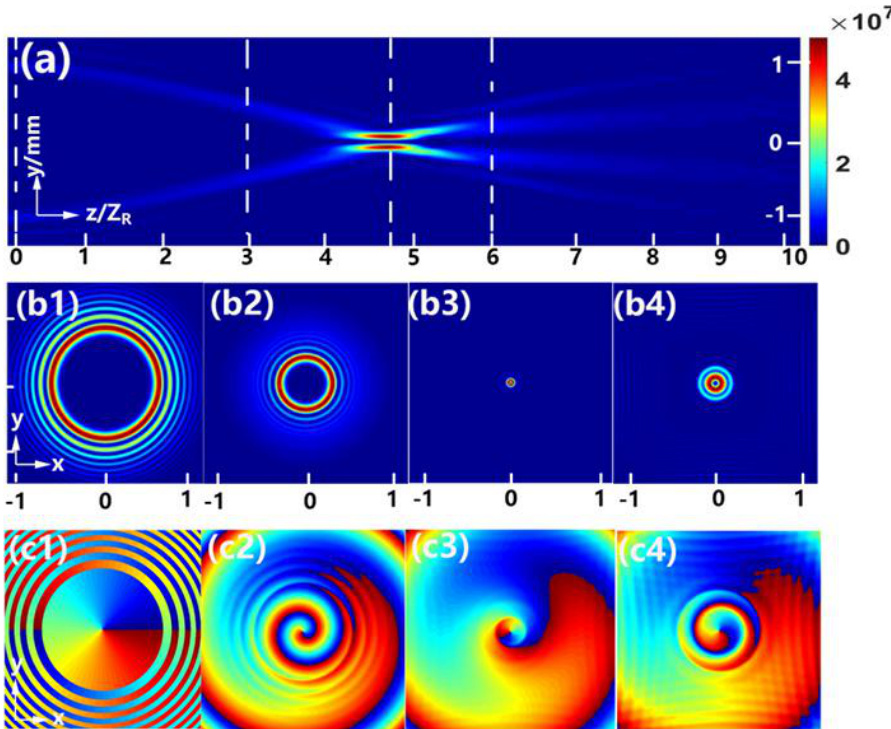
As shown in the figure below, the propagation dynamics of the CAGVBs are visualized through intensity distributions at various axial positions, revealing the abrupt autofocusing behavior. The beam initially spreads and then converges to a focal region, with the focusing characteristics influenced by the Lévy index α and the distribution factor b. The intensity profile evolves from a ring-shaped structure to a tight focus, demonstrating the interplay between fractional diffraction and nonlinearity.
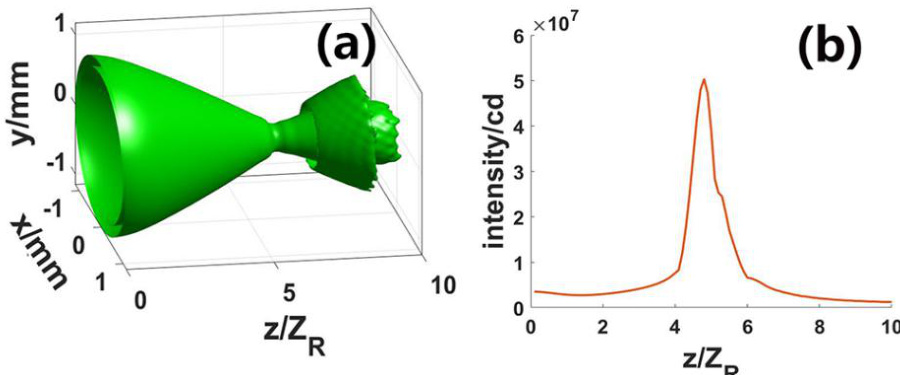
The authors further analyze the evolution of the beam's intensity profile and its corresponding 3D representation. The intensity peak along the propagation direction is observed to shift and sharpen, indicating the autofocusing effect. The 3D rendering highlights the conical shape of the beam as it propagates, with the intensity concentrating at a specific axial location. The intensity profile as a function of z/ZR shows a sharp peak, confirming the abrupt autofocusing phenomenon. The simulation parameters are set to α=1.5, m=1, n0=1.45, b=0.1, λ=532×10−6 mm, d=0.1, r0=1 mm, w=1 mm, and n2=2.6×10⁻¹⁶ cm² W⁻¹, which yield a critical power for self-focusing Pcr that allows for observable autofocusing.
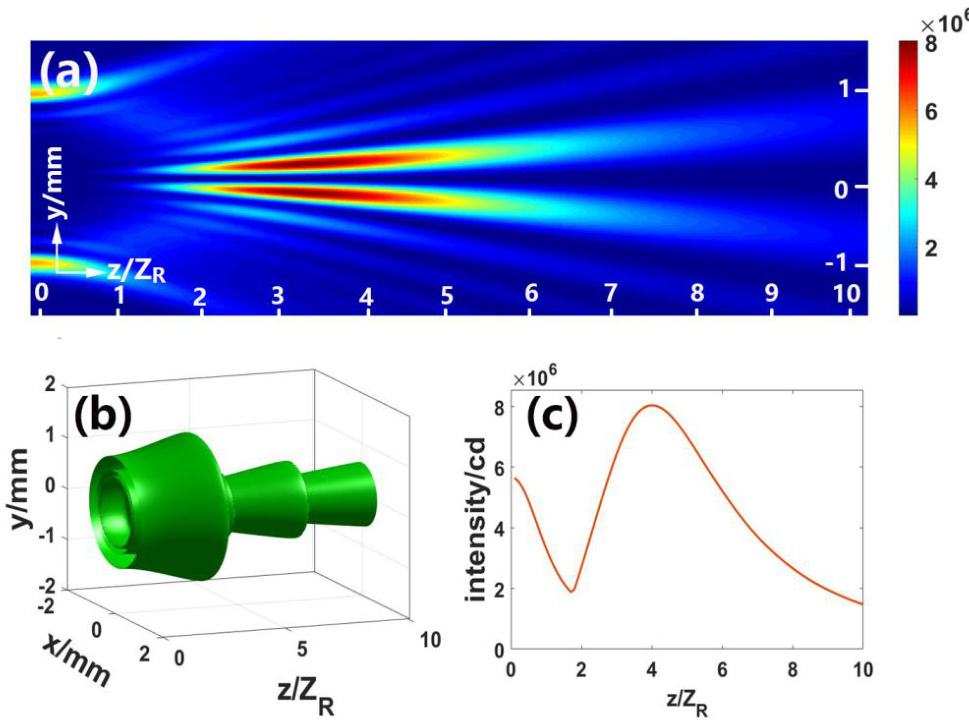
The framework diagram illustrates the intensity distribution of the beam as it propagates, with the color scale indicating the intensity level. The beam exhibits a gradual convergence followed by a sharp focus, which is characteristic of the abrupt autofocusing effect. The propagation distance is normalized by the Rayleigh distance ZR=kw2/2, allowing for a consistent comparison across different parameters. The results demonstrate that the autofocusing effect becomes weaker and the focusing length shorter with increasing α, while a larger distribution factor b leads to a longer autofocusing length. The topological charge m and input power also play significant roles in determining the beam's autofocusing properties, with higher values affecting the focusing dynamics and the formation of vortex structures. The off-axis CAGVBs with positive vortex pairs further exhibit complex propagation features, including autodefocusing behavior, which is captured in the intensity evolution plots.
Experiment
Numerical simulations utilizing the split-step Fourier method evaluate CAGVB propagation in a fractional nonlinear Schrödinger optical system, validating the fundamental interplay between fractional diffraction and nonlinear self-focusing effects. The on-axis experiments confirm that nonlinear optical forces counteract diffraction to produce sharp autofocusing with a persistent central hollow channel, while systematic variation of the Lévy index, distribution factor, and input power qualitatively modulates the focusing strength and focal distance. Complementary tests on outward acceleration and off-axis vortex pairs demonstrate that the system can reliably induce controlled autodefocusing and rotational beam dynamics while preserving orbital angular momentum stability. Collectively, these findings establish that the FNSE framework enables precise, parameter-driven manipulation of structured light, providing a versatile platform for optical communications and precision material processing.