Command Palette
Search for a command to run...
Please provide the title you would like me to translate.
Please provide the title you would like me to translate.
استقرار ديفيوزن الموجه بـ CLIP باستخدام Diffusers
الملخص
Please provide the title and abstract you would like me to translate.
One-sentence Summary
Using perturbed angular correlation of 111In/Cd to measure nuclear quadrupole relaxation, this study quantifies atomic jump frequencies in L12-structured rare-earth intermetallics and demonstrates that compositional scaling in In3(La1-xPrx) contrasts with a sharp frequency decrease in (In1-xSnx)3La, a divergence driven by sublattice-specific disorder, valence differences, and distinct diffusion mechanisms.
Key Contributions
- This work applies perturbed angular correlation spectroscopy to extract mean atomic jump frequencies from nuclear quadrupole relaxation in highly ordered L1₂ intermetallic compounds.
- New experimental data for ¹¹¹In/Cd probes in pseudo-binary In₃(La₁₋ₓPrₓ) and (In₁₋ₓSnₓ)₃La systems demonstrate linear compositional scaling for the rare-earth series and a sharp frequency reduction upon sp-element substitution.
- These results establish that jump frequency variations correlate with sublattice disorder location, end-member vacancy dominance, and valence differences between mixing atoms.
Introduction
Atomic diffusion in highly ordered L1₂ intermetallic compounds directly influences the thermal stability and mechanical reliability of advanced structural materials. Researchers typically measure atomic jump frequencies using perturbed angular correlation spectroscopy, which tracks nuclear quadrupole relaxation from probe atoms to quantify diffusivity. Prior work on binary line compounds successfully linked jump frequencies to dominant vacancy types, yet it could not fully explain why diffusion mechanisms shift across compositional series. Defect formation energy calculations frequently contradict experimental observations, and direct migration energy modeling remains computationally prohibitive. The authors leverage PAC spectroscopy to investigate atomic jumps in pseudo-binary L1₂ systems with randomly mixed sublattices. By comparing a rare-earth mixed system where both end members share the same diffusion mechanism against a sp-element mixed system with differing end-member mechanisms, they demonstrate that jump frequency scaling depends critically on sublattice disorder location, mechanism consistency across compositions, and valence differences between substituting atoms.
Dataset

Dataset Composition and Sources The authors compile a set of Perturbed Angular Correlation (PAC) spectra from pseudo-binary L1₂ alloy phases synthesized by arc-melting high-purity metal foils under argon. The dataset focuses on two substitution series alongside their pure end-member compounds.
Subset Details
- In₃(La₁₋ₓPrₓ) series: x values of 0.25, 0.50, and 0.75
- (In₁₋ₓSnₓ)₃La series: x values of 0.13, 0.25, 0.50, and 0.75
- End-members: In₃La, In₃Pr, and Sn₃La
- Filtering rules: Only samples with a slight excess of In or (In,Sn) were included. The x=0.50 composition for the Sn series was excluded from quantitative analysis due to severe inhomogeneous broadening. Nominal compositions may deviate by up to ±0.10 from target values due to mass loss during melting.
Data Usage and Processing The authors use the spectra to track atomic jump frequencies and quadrupole interactions across temperatures up to 900°C. Measurements are primarily analyzed in the slow-fluctuation regime, where the PAC perturbation function G₂(t) is modeled as an exponentially damped static function. For higher jump frequencies, the data reveals motional averaging of electric field gradients, which suppresses observable precession periodicity. Static quadrupole interaction frequencies are extracted at room temperature, and temperature-dependent spectral shifts are used to infer diffusion dynamics.
Metadata and Structural Validation Each data point is tagged with its nominal composition (x), measurement temperature, and crystallographic phase confirmation. The authors validate structural homogeneity using X-ray diffraction and PAC phase analysis, confirming that lattice parameters follow Vegard's law and that no secondary phases are present.
Method
The authors leverage a vacancy diffusion mechanism to model the composition dependence of jump frequencies in pseudo-binary systems, assuming that probe atoms exchange with neighboring vacancies on their respective sublattices. The model is grounded in localized atomistic jumps and assumes that mixed atoms are randomly distributed on their sublattices, leading to binomial probabilities for different local configurations. For the In₃(La₁₋ₓPrₓ) system, diffusion occurs via jumps of probe atoms into vacancies on the In-sublattice. The activation enthalpy for such a jump is assumed to depend on the number of Pr-atoms, n, surrounding the vacancy, where n ranges from 0 to 4. This dependence is captured by a function Qn(x), which represents the activation enthalpy for a jump into a vacancy with n neighboring Pr-atoms. The mean activation enthalpy, Q(x), is computed as a weighted average of Qn(x), with weights given by the binomial distribution:
Q(x)≡n=0∑NQn(x)(nN)xn(1−x)N−nHere, N is the number of relevant neighboring sites, and the binomial coefficients account for the probability of n solute atoms among N sites. The end-member values Q(0) and Q(1) correspond to Q0(0) and QN(1), respectively, and are determined from experimental data.
For the (In₁₋ₓSnₓ)₃La system, a similar approach is applied. In this case, the La-sublattice is fully occupied, and probe atoms jump on the (In,Sn) sublattice. The activation enthalpy depends on the number of Sn-atoms, n, within 12 nearest-neighbor sites surrounding both the jumping atom and the vacancy. Equation 2 is again used to compute the mean activation enthalpy, but with N=12 and a different set of functions Qn(x).
To incorporate explicit composition dependence, the authors assume a linear form for Qn(x):
Qn(x)=Q0(0)+n(NQ(1)−Q(0)−a(1−x))Here, a quantifies the strength of the composition-dependent term. This expression allows the activation enthalpy to vary not only with local configuration but also with the overall composition x. The parameter a is the only adjustable parameter for a given N, and it is optimized to match experimental data. For In₃(La₁₋ₓPrₓ), the best fit yields a=0.0, indicating no explicit composition dependence. For (In₁₋ₓSnₓ)₃La, the optimal value is a=+0.075 eV, reflecting a measurable composition-driven effect.

As shown in the figure below: the L1₂ crystal structure is depicted, with atoms on the (In,Sn) and (La,Pr) sublattices represented by small face-centered and large corner spheres, respectively. This structural configuration underpins the modeling of vacancy-mediated diffusion in both systems.
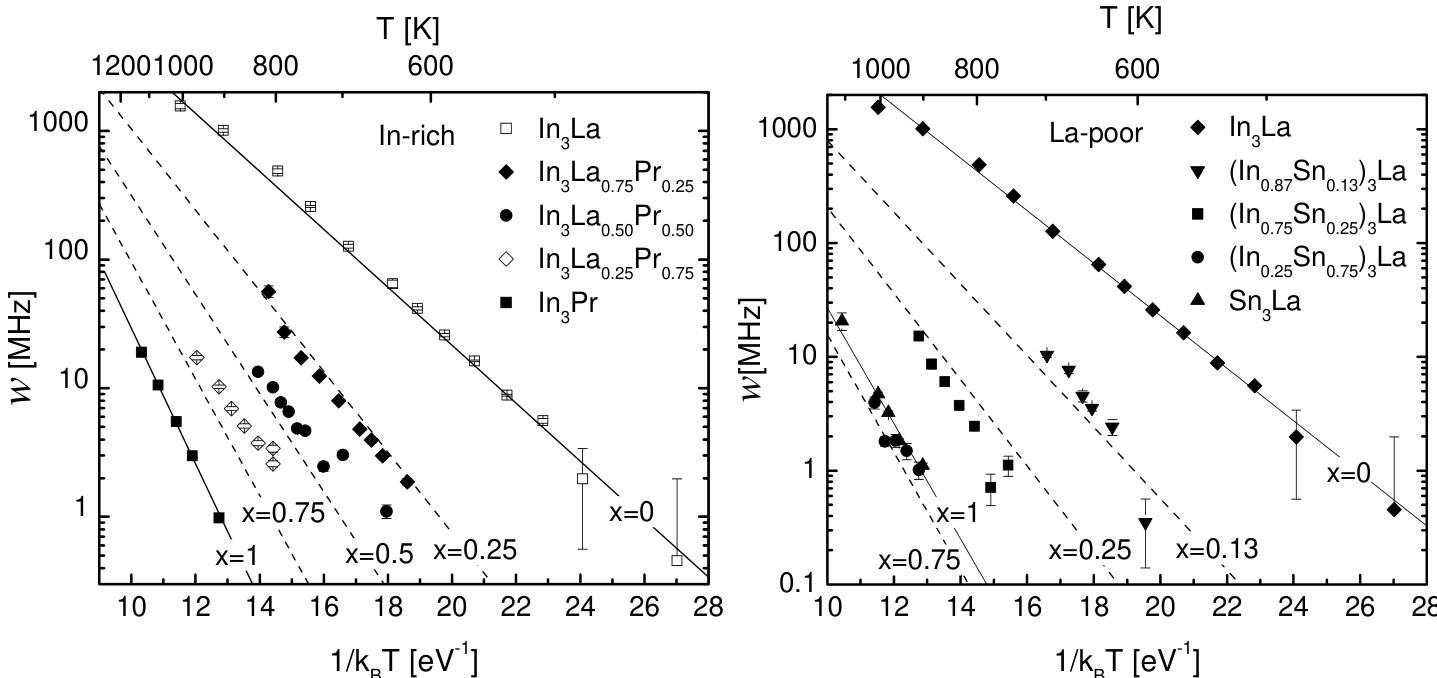
The mean activation enthalpy Q(x) is obtained by substituting Equation 3 into Equation 2, enabling direct comparison with experimental jump frequencies. The model predictions are compared to experimental data in Fig. 2, where dashed lines represent the simulated behavior for nominal compositions. The agreement is reasonably good for both systems, validating the framework.
Interpretation of the results is supported by Fig. 4, which illustrates the composition dependence of individual activation enthalpies Qn(x) for both systems. For In₃(La₁₋ₓPrₓ), with a=0, Qn(x) remains independent of x, and the mean activation enthalpy Q(x) increases linearly with x, with a slope of approximately 0.63 eV. This linear trend implies that the jump frequency scales as w(x)/w(0)∝(w(1)/w(0))x, indicating a benign effect of Pr substitution on diffusion.
In contrast, for (In₁₋ₓSnₓ)₃La, the mean activation enthalpy rises sharply at low x, with an initial slope of about 1.6 eV, and then plateaus at the value characteristic of the Sn₃La end-member for x≳0.6. This behavior suggests that Sn atoms in In₃La act as kinetic barriers, reducing jump rates in their vicinity. The authors attribute this to metal chemistry effects, particularly charge interactions between the Cd probe and impurities. In In₃La, the nominal valences imply an attraction between Cd (charge -1) and Sn (charge +1), which reduces jump frequencies. In Sn₃La, Cd (charge -2) and In (charge -1) are both negatively charged, leading to repulsion and minimal effect. Additionally, differences in vacancy types—La-vacancies in In₃La and Sn-vacancies in Sn₃La—may contribute to the observed complexity. The model accounts for these phenomena through the composition-dependent term a, which captures the influence of local chemical environment on diffusion kinetics.
Experiment
PAC spectroscopy measurements at elevated temperatures, calibrated against room-temperature static references, were conducted to validate how specific dopant substitutions influence atomic diffusion dynamics across two pseudo-binary alloy series. The results demonstrate that while both systems exhibit substantially lower jump frequencies than the highly conductive In3La end-member, their compositional dependencies diverge sharply. The Pr-substituted series displays a monotonic decline in atomic mobility with increasing dopant concentration, whereas the Sn-substituted series undergoes a rapid initial drop followed by non-monotonic variations. These contrasting diffusion behaviors underscore the complex role of dopant identity in modulating lattice transport and motivated the development of corresponding microscopic models.
The authors analyze jump frequencies in pseudo-binary alloys using Arrhenius plots derived from PAC spectra. Results show that jump frequencies are significantly higher for the In3La end-member phase compared to other compositions, with distinct trends observed between the two series: a monotonic decrease with Pr concentration in In3(La1-xPrx) and a non-monotonic, rapid decline with Sn substitution in (In1-xSnx)3La. The data reveal that the jump frequency for the Sn-rich composition is lower than that of the pure Sn3La phase. Jump frequencies are substantially higher for the In3La end-member phase than for In3Pr or Sn3La. In the In3(La1-xPrx) series, jump frequencies decrease monotonically with increasing Pr concentration. In the (In1-xSnx)3La series, jump frequencies drop rapidly and non-monotonically, with a lower frequency observed for the Sn-rich composition compared to pure Sn3La.
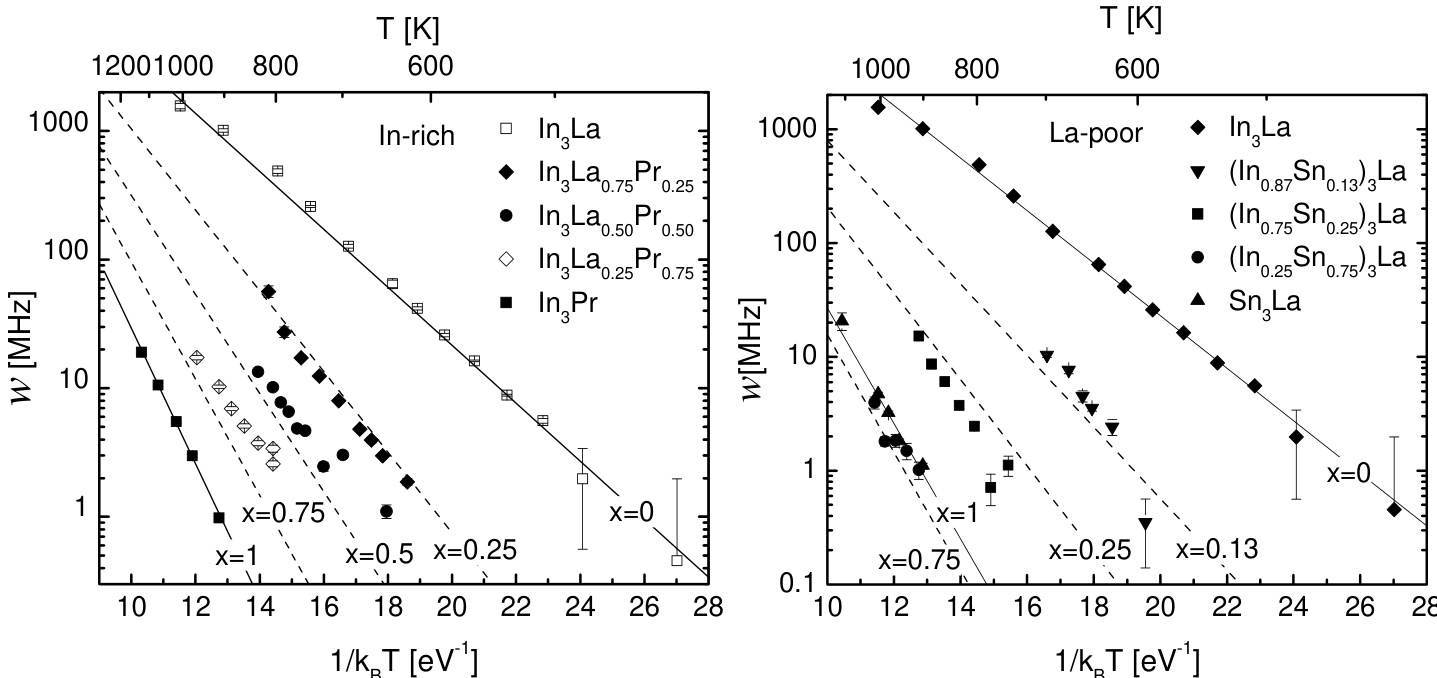
The study evaluates atomic jump frequencies in pseudo-binary alloys by analyzing Arrhenius plots derived from perturbed angular correlation spectra. The investigation of praseodymium-substituted phases validates a steady decline in atomic mobility with increasing concentration, while tin-substituted phases demonstrate a sharp, non-monotonic reduction in diffusion rates. These qualitative trends reveal that the In3La end-member maintains substantially higher mobility than related compositions, with tin incorporation significantly restricting atomic movement compared to pure end-members. Ultimately, the findings establish that specific elemental substitutions fundamentally dictate diffusion dynamics across the alloy series.