Command Palette
Search for a command to run...
إطار عمل مرن وآمن لنشر التطبيقات الموزعة
إطار عمل مرن وآمن لنشر التطبيقات الموزعة
Alan Dearle Graham Kirby Andrew McCarthy Juan Carlos Diaz y Carballo
نشر QwQ-32B-AWQ بنقرة واحدة
الملخص
يصف هذا الورقة نظاماً مُنفّذاً صُمّم لدعم نشر التطبيقات التي تقدّم خدمات موزعة، وتتألف من عدد من المكونات الموزعة. يتحقق ذلك من خلال إنشاء وصفات عالية المستوى للتوزيع والطوبولوجيا تقود الأدوات إلى نشر التطبيقات المكونة من مكونات تعمل على عدة مضيفين. يتناول النظام قضايا التباين من خلال توفير تجريدات فوق السمات الخاصة بكل مضيف، مما يؤدي إلى بيئة تشغيل موحدة يمكن نشر المكونات فيها. توفر بيئات التشغيل آليات ربط آمنة تسمح للمكونات المُنتشرة بالارتباط بالبيانات والخدمات المخزنة على المضيفين التي تعمل عليها.
One-sentence Summary
This paper describes an implemented deployment framework for distributed applications that uses high-level topology descriptions to drive multi-host component deployment, abstracts host-specific attributes into a homogeneous runtime environment, and provides secure binding mechanisms for components to access host-resident data and services.
Key Contributions
- Introduces an implemented system that automates the deployment of distributed applications comprising multiple components across heterogeneous hosts.
- Utilizes high-level placement and topology descriptions to drive deployment tools while abstracting host-specific attributes to yield a homogeneous runtime environment.
- Provides secure binding mechanisms that permit deployed components to connect to stored data and services on their respective execution hosts.
Introduction
Deploying distributed applications across heterogeneous infrastructure is a foundational requirement for modern cloud and edge computing, yet managing these deployments at scale remains notoriously difficult. Traditional approaches often depend on manual, low-level configuration scripts that struggle to abstract host-specific differences, complicating secure service binding and runtime maintenance. The authors leverage high-level placement and topology descriptions to automate the provisioning of distributed components across multiple hosts. Their framework normalizes infrastructure heterogeneity into a unified runtime environment and introduces secure binding mechanisms that safely connect deployed services to local data stores. This methodology significantly reduces operational overhead and creates a structured pathway for future autonomic adaptation.
Method
The authors leverage the Cingal computational model as the foundation for their deployment framework, which supports the dynamic and secure execution of distributed applications. At the core of this model, a thin server operates as a lightweight, secure host that complements conventional computing nodes. The thin server's primary role is to receive, authenticate, and execute bundles—self-contained units of code and data—on behalf of remote clients. As shown in the framework diagram, an OS process on a conventional host initiates execution by sending a bundle to a thin server via a TCP/IP channel. Upon arrival, the bundle is processed by the fire daemon, which authenticates it using digital signatures and certificates stored in a Valid Entity Repository (VER). Once authenticated, the fire daemon instantiates a new machine, a dedicated execution environment on the thin server, which runs the bundle's code and interacts with the machine infrastructure. This infrastructure provides essential services such as storage, binding, and inter-machine communication, and enforces security through a capability-based protection scheme.
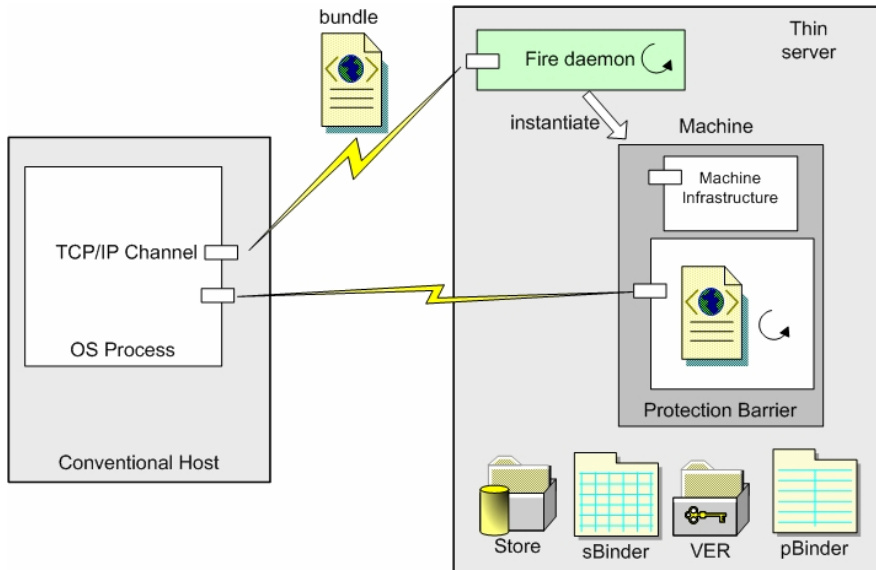
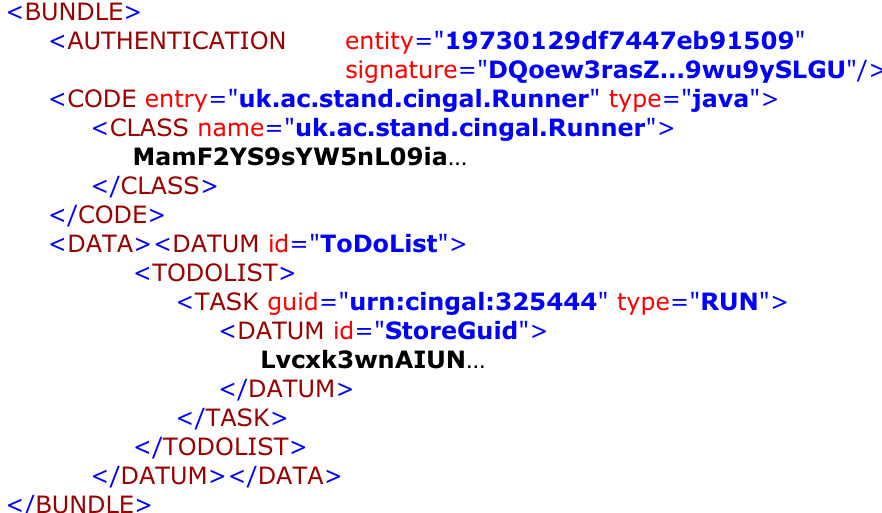
The framework's architecture is designed to support a homogeneous run-time environment, abstracting away host-specific details. This is achieved through the machine infrastructure, which includes a content-addressable store, symbolic name binders (sBinder for data and pBinder for processes), and a capability system for access control. Bundles, which are the fundamental units of deployment, are self-contained and can be signed using a globally unique identifier (GUID) and a digital signature. An example of a bundle's structure, as shown in the figure, includes an authentication element with an entity identifier and signature, a code section specifying the entry point and implementation language (e.g., Java), and a data section that can contain a to-do list and other payload bundles. This design enables the deployment of components written in various programming languages, provided the necessary run-time support is available.
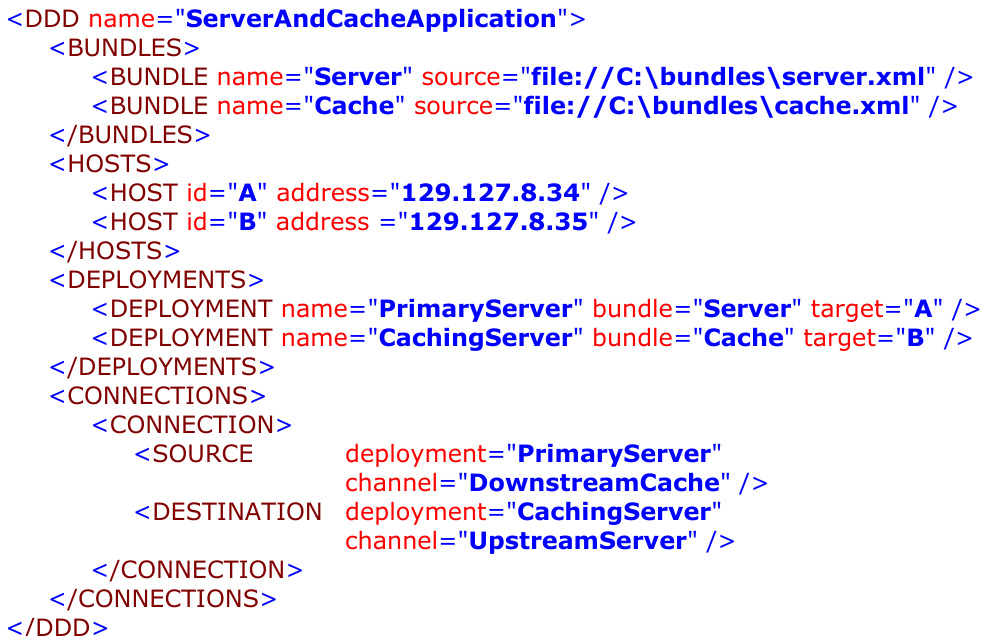
To describe and manage the deployment of distributed applications, the system introduces a high-level description language based on XML, known as Deployment Description Documents (DDDs). A DDD provides a static, declarative specification of the application's architecture, defining the software components, their deployment locations on specific hosts, and the interconnections between them. An example of a DDD is illustrated in the figure, which explicitly lists the bundles (e.g., Server, Cache), the hosts (A, B), the deployment assignments (e.g., Server on A), and the connections (e.g., DownstreamCache from PrimaryServer to CachingServer). This structured description allows for the automated realization of complex distributed systems.
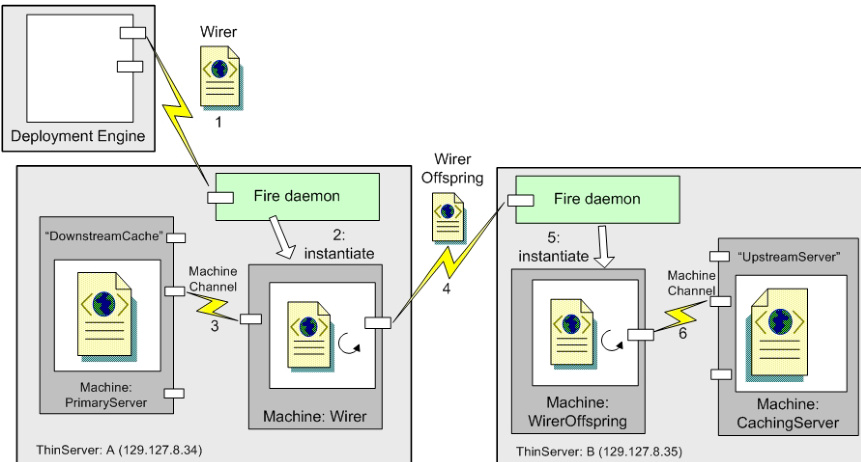
The deployment process is orchestrated by a deployment engine that takes a DDD as input and automates the deployment of components across the network. The process consists of three primary phases: installation, running, and wiring. In the installation phase, the deployment engine generates and deploys installer bundles to the target thin servers, which extract and store the component bundles in the local store. The running phase involves deploying runner bundles, which retrieve the installed bundles from the store and fire them to create executing machines. The final wiring phase connects the named channels between the running components to assemble the complete application topology. This is achieved by deploying wirer bundles that use the machine's machine channel to communicate with the connection manager, which manages the named channels. The process is illustrated in the figure, showing the deployment engine initiating the deployment, the installation of a bundle, the running of a component, and the creation of a connection between two machines.
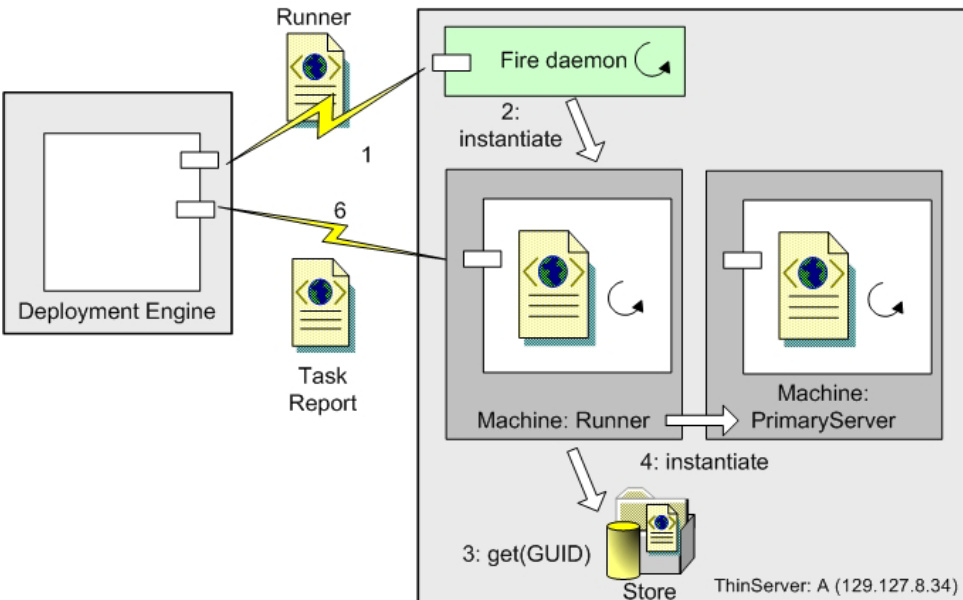
The system supports the dynamic evolution of deployed applications by enabling the reconfiguration of the interconnection topology. This is achieved through the manipulation of named channels, which allows components to be disconnected and reconnected without requiring a full redeployment. The wiring process can be initiated by the deployment engine or by the components themselves, enabling flexible and autonomous management of the application's architecture. This capability, combined with the ability to remotely update components and the use of a capability-based security model, ensures that the framework can support the continuous evolution of distributed services in a secure and controlled manner.