Command Palette
Search for a command to run...
강화학습은 대규모 언어 모델에서 베이스 모델을 뛰어넘는 추론 능력을 정말로 유도하는가?
강화학습은 대규모 언어 모델에서 베이스 모델을 뛰어넘는 추론 능력을 정말로 유도하는가?
Yang Yue Zhiqi Chen Rui Lu Andrew Zhao Zhaokai Wang Shiji Song Gao Huang
초록
검증 가능한 보상을 활용한 강화 학습(RLVR)은 최근 대규모 언어 모델(LLM)의 추론 성능, 특히 수학 및 프로그래밍 작업에서 상당한 성공을 거두었습니다. 전통적인 강화 학습이 에이전트가 새로운 전략을 탐색하고 학습하도록 돕는 것과 마찬가지로, RLVR은 LLM이 지속적으로 자기 개선하여 해당 기반 모델의 능력을 초과하는 새로운 추론 능력을 습득할 수 있게 한다고 널리 믿어지고 있습니다. 본 연구에서는 다양한 모델 계열, RL 알고리즘, 수학/코딩/시각 추론 벤치마크에 걸쳐 RLVR로 학습된 LLM의 추론 능력 한계를 체계적으로 탐구함으로써 RLVR의 현재 상태를 비판적으로 검토하며, 평가 지표로 큰 k 값에서의 pass@k를 사용했습니다. RLVR이 올바른 경로에 대한 샘플링 효율성을 향상시키지만, 놀랍게도 현재의 학습은 근본적으로 새로운 추론 패턴을 유도하지 않는다는 사실을 발견했습니다. RLVR로 학습된 모델은 작은 k 값(예: k=1)에서 기반 모델보다 성능이 우수하지만, k가 클 경우 기반 모델이 더 높은 pass@k 점수를 달성한다는 것을 관찰했습니다. 또한, RLVR 학습이 진행됨에 따라 LLM의 추론 능력 한계가 종종 좁아지는 것을 관찰했습니다. 추가적인 커버리지 및 퍼플렉시티 분석 결과, RLVR 모델이 생성한 추론 경로가 이미 기반 모델의 샘플링 분포에 포함되어 있음이 드러났으며, 이는 그들의 추론 능력이 기반 모델에서 유래하고 기반 모델에 의해 제한됨을 시사합니다. 이러한 관점에서 기반 모델을 상한으로 간주할 때, 정량적 분석 결과 6가지 인기 있는 RLVR 알고리즘은 유사한 성능을 보이며 기반 모델의 잠재력을 완전히 활용하는 데 있어 여전히 최적에서 멀리 떨어져 있습니다. 반면, 증류(distillation)는 교사 모델로부터 새로운 추론 패턴을 도입하여 모델의 추론 능력을 진정으로 확장할 수 있음을 발견했습니다. 종합하면, 본 연구의 발견은 현재의 RLVR 방법이 LLM에서 진정으로 새로운 추론 능력을 유도하는 RL의 잠재력을 완전히 실현하지 못했음을 시사합니다. 이는 이러한 잠재력을 해방하기 위해 지속적 확장 및 다중 턴 에이전트-환경 상호작용과 같은 개선된 RL 패러다임의 필요성을 강조합니다.
One-sentence Summary
Researchers from LeapLab at Tsinghua University and Shanghai Jiao Tong University use pass@k at large k to systematically probe RLVR-trained LLMs and find that RLVR narrows rather than expands reasoning capability boundaries, with all tested reasoning paths originating from the base model's sampling distribution, whereas distillation genuinely introduces novel reasoning patterns.
Key Contributions
-
This paper provides a systematic framework for evaluating reasoning capability boundaries of RLVR-trained large language models across model families, reinforcement learning algorithms, and math, coding, and visual reasoning benchmarks, using pass@k at large k values.
-
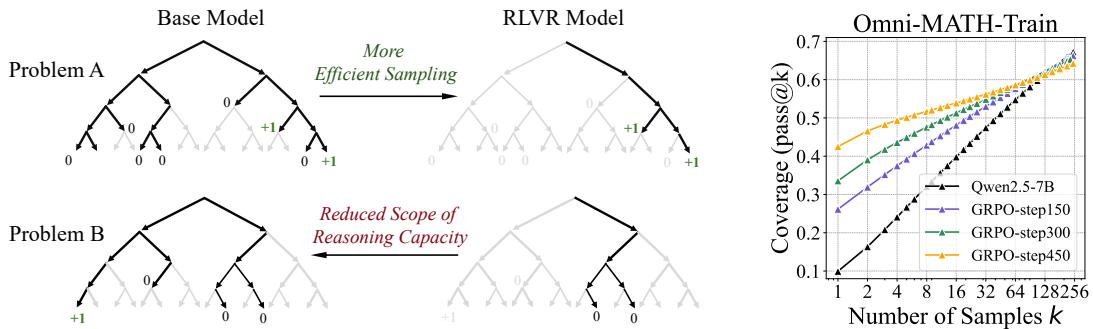
Empirical results indicate that current RLVR training improves sampling efficiency toward correct paths already present in base models, while base models can achieve higher pass@k scores at large k and RLVR-trained models often show narrowed reasoning boundaries.
-
A comparison of six popular RLVR algorithms against distillation shows that the RLVR algorithms perform similarly and remain far from fully leveraging the base model, whereas distillation introduces new reasoning patterns and expands reasoning capability.
Introduction
The authors study reinforcement learning with verifiable rewards, or RLVR, which has become important for improving large language models on reasoning-heavy tasks such as math and coding. In this setting, models are optimized using automatically verifiable feedback, such as final-answer correctness or passing unit tests, without relying on costly human annotations. Prior work has shown strong empirical gains, but it remained unclear whether RLVR genuinely teaches new reasoning strategies or merely makes better use of the base model’s existing capabilities. Previous analyses were often limited in scope and typically evaluated average-case performance, which can obscure a model’s true reasoning potential. The authors contribute a rigorous boundary evaluation using pass@k across multiple model families, sizes, tasks, and RLVR algorithms. They show that current RLVR improves sampling efficiency but does not fundamentally expand reasoning capacity, and that the successful reasoning paths found by RLVR models largely already exist in the base model.
Dataset
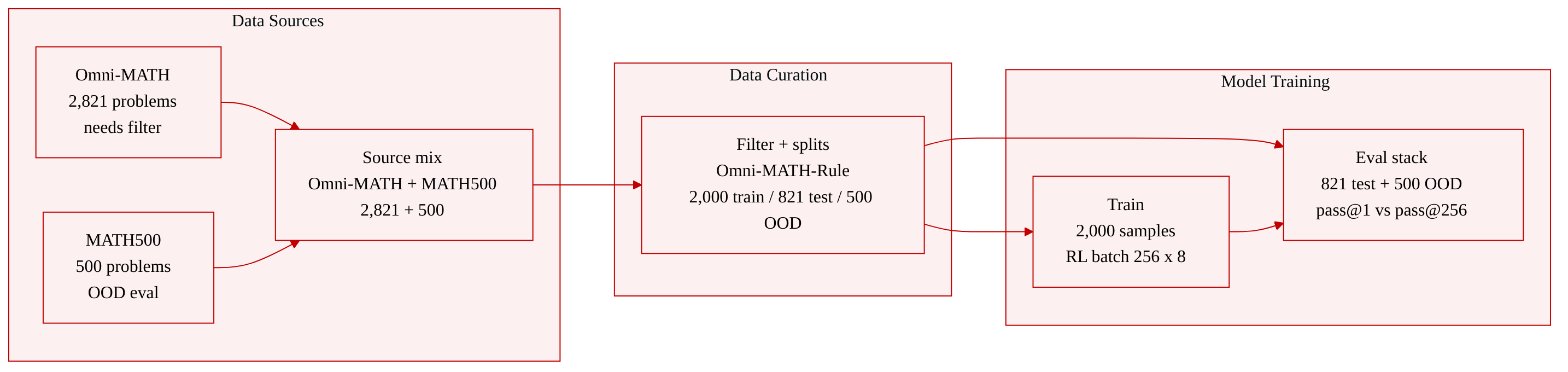
- The dataset is Omni-MATH-Rule, a subset of Omni-MATH selected to include math problems with verifiable answers.
- The authors split Omni-MATH-Rule into a 2,000-sample training set and an 821-sample in-domain test set.
- They use MATH500 as a separate out-of-domain benchmark for evaluating generalization.
- The data is used to study how different RL algorithms affect sampling efficiency, especially by comparing pass@1 with base-model pass@256.
- During evaluation, prompts are handled in batches of 256, with 8 candidate responses generated per prompt, under a maximum generation length of 8,192 tokens.
Method
The authors formulate reinforcement learning with verifiable rewards as an optimization problem over an LLM policy. Let πθ denote a language model with parameters θ that generates a token sequence y=(y1,…,yT) conditioned on a prompt x. A deterministic verifier V evaluates the generated output and returns a binary reward
r=V(x,y)∈{0,1},where r=1 if and only if the model’s final answer is exactly correct. In some settings, an additional format reward is used to encourage the model to separate its reasoning process from the final answer. The training objective is to maximize the expected reward over the prompt distribution D:
J(θ)=Ex∼D[Ey∼πθ(⋅∣x)[r]].The overall RLVR workflow, including prompt sampling, model generation, verifier scoring, and policy optimization, is summarized in the accompanying figure.
For policy optimization, the paper adopts Proximal Policy Optimization and its variants. PPO maximizes a clipped surrogate objective:
LCLIP=E[min(rt(θ)At,clip(rt(θ),1−ϵ,1+ϵ)At)],where
rt(θ)=πθold(yt∣x,y<t)πθ(yt∣x,y<t),and At is the advantage estimated by a value network Vϕ. The probability ratio rt(θ) measures how much the updated policy deviates from the old policy at each token position. The clipping operation limits the magnitude of this deviation, improving training stability compared with unbounded policy updates. An optional KL divergence term can also be added to constrain the optimized policy from drifting too far from the initial model.
PPO belongs to the broader policy gradient family of RL methods. These algorithms learn from on-policy samples, meaning the training data are generated by the current policy or an older version of it. In the verifiable-reward setting, the training signal is especially clean: samples whose final answers are correct receive positive feedback, while incorrect samples receive negative or zero feedback. Consequently, the policy gradient process increases the log likelihood of successful continuations and decreases the likelihood of unsuccessful ones.
The training protocol distinguishes between math tasks and coding or visual reasoning tasks. For math, the authors follow a zero RL setting, where RL is applied directly to a pretrained base model without prior supervised fine tuning. This setting is useful for isolating the effect of RLVR itself. For coding and visual reasoning, instruction-tuned models are typically used as starting points because zero RL from a pure pretrained model can be less stable. In those cases, the paper compares a supervised fine tuned model against its RLVR-trained counterpart to examine the incremental impact of reinforcement learning with verifiable rewards.
Experiment
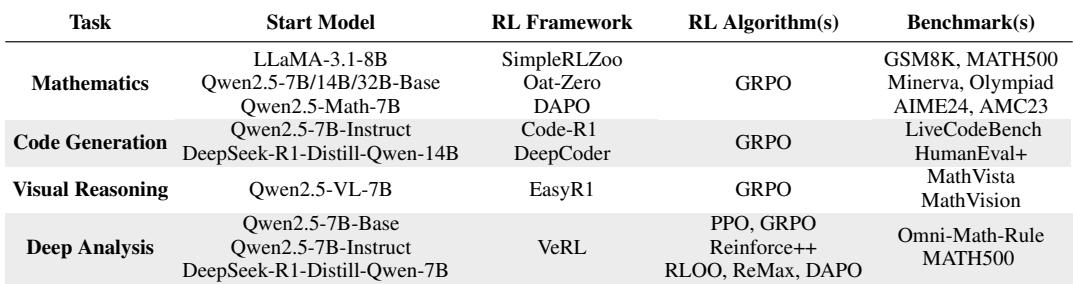
The experiments evaluate reasoning capacity boundaries across mathematical, coding, and visual reasoning benchmarks using pass@k with extensive sampling and consistent zero-shot prompts, comparing base, RLVR-trained, and distilled models. The results show that RLVR mainly improves sampling efficiency at small k, while base models often cover more solvable problems at larger k, indicating a narrower reasoning boundary after RL training. Analyses of coverage, perplexity, training settings, entropy, algorithm choice, and a near-frontier model suggest that current RLVR sharpens existing base-model reasoning paths rather than expanding them, whereas distillation can introduce new reasoning capabilities.
The experiments compare base and RLVR models across mathematics, code generation, and visual reasoning using matched zero-shot sampling settings. RLVR consistently improves low-budget pass performance, but its advantage narrows as the sampling budget increases, and larger near-frontier models show a similar boundary-limited pattern. The evaluation spans multiple model families, RL frameworks, and task domains, including mathematics, coding, and visual reasoning. Base and RLVR models use the same zero-shot prompt style to avoid confounding from few-shot examples. RLVR provides clear gains at low pass budgets, while base models catch up or outperform RLVR at higher pass budgets. KL regularization and entropy-matched generation do not remove the apparent narrowing of the RLVR reasoning boundary.
The base model and RLVR-trained model mostly solve the same problems, but the base model still solves many problems that the RLVR-trained model misses. The reverse case is rare, especially on AIME24, so the RLVR model's gains mainly reflect more reliable sampling on problems the base model can already solve. Both models fail on a notable fraction of AIME24 problems, while shared failures are much less common on MATH500. Most problems solved by the RLVR-trained model are also solvable by the base model. The base model covers a broader set of solvable problems than the RLVR-trained model. RLVR-trained models rarely solve problems that the base model cannot.
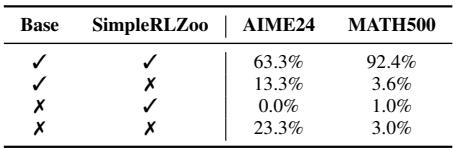
The experiments compare base and RLVR-trained models on mathematics, coding, and visual reasoning under matched zero-shot sampling across multiple model families and RL frameworks. They show that RLVR mainly increases reliability on problems the base model can already solve, yielding larger gains at low sampling budgets that narrow as budgets grow. The base model generally covers a broader set of solvable problems, while RLVR models rarely solve tasks beyond the base model's reach, suggesting reasoning boundary limitations rather than expanded capability.