Command Palette
Search for a command to run...
LLM은 문학적 번역에 실제로 얼마나 뛰어난가? 인간과 LLM을 통한 문학 번역 평가
LLM은 문학적 번역에 실제로 얼마나 뛰어난가? 인간과 LLM을 통한 문학 번역 평가
Ran Zhang Wei Zhao Steffen Eger
초록
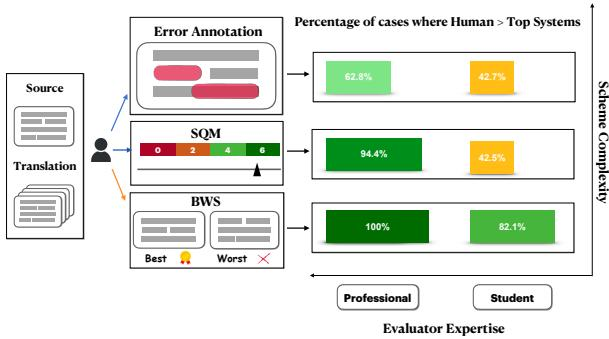
최근 연구는 기계번역(MT)의 새로운 과제으로서 문학적 기계번역에 주목해 왔다. 그러나 문학 MT의 평가는 여전히 미해결 과제로 남아 있다. 본 연구는 검증된 인간 번역과 9개 MT 시스템의 출력을 포함하는 문단 단위 평행코퍼스인 LITEVAL-CORPUS를 도입함으로써 이 논의를 발전시킨다. 이 코퍼스는 4개 언어쌍에서 총 2,000개 이상의 번역과 13,000개의 평가된 문장을 포함하며, 제작 비용은 4.5천 유로에 달한다. 본 코퍼스는 (i) 다양한 복잡도를 지닌 인간 평가 체계의 일관성과 타당성을 검토하고, (ii) 학생과 전문가의 평가를 비교하며, (iii) LLM 기반 지표와 (iv) LLM 자체의 효과를 평가할 수 있게 한다. 실험 결과, 인간 평가의 타당성은 두 가지 요인에 의해 조절됨이 밝혀졌다: 평가 체계의 복잡성(복잡할수록 타당성 감소)과 평가자의 전문성(전문성이 높을수록 더 타당성 높은 평가). 예를 들어, 복잡한 평가 체계이며 비문학 인간 MT 평가의 사실상 표준인 MQM(Multidimensional Quality Metrics)은 문학 번역 평가에 대해 상당 부분 부적절하다: 학생 평가자를 사용할 경우, 인간 번역의 약 60%가 기계 번역과 구별 불가능하거나 열등한 것으로 오분류된다. 반면, 훨씬 더 간단한 평가 체계인 BWS(Best-Worst Scaling)는 인간 번역을 80~100%의 비율로 식별한다. 자동 지표의 성능은 현저히 열악하여 최고 20%에 그친다. 종합적인 평가 결과, 출판된 인간 번역이 LLM 번역을 일관되게 상회하며, 가장 최신 LLM조차 인간에 비해 상당히 더 직역적이고 다양성이 부족한 번역을 생성하는 경향이 있다.
One-sentence Summary
Researchers from the University of Mannheim, University of Aberdeen, and University of Technology Nuremberg introduce LITEVAL-CORPUS, a 13$k$-sentence parallel corpus for literary translation evaluation across four language pairs, finding that simpler schemes like BWS identify human translations at 80–100%whilethecomplexMQMstandardmisjudgesnearly60%$$ as indistinguishable or inferior, and that LLM-generated translations are more literal and less diverse than human ones.
Key Contributions
- LITEVAL-CORPUS is introduced as a paragraph-level parallel corpus for literary machine translation evaluation, containing verified published human translations and outputs from nine MT systems, with more than 2,000 translations and 13,000 evaluated sentences across four language pairs.
- The paper presents a systematic comparison of human evaluation schemes and evaluator expertise, including Multidimensional Quality Metrics (MQM) and Best-Worst Scaling (BWS), and assesses the consistency and adequacy of LLM-based metrics and LLM-generated translations for literary texts.
- The results show that BWS identifies human translations at rates of 80 to 100 percent, while MQM with student evaluators misjudges nearly 60 percent of human translations as indistinguishable from or inferior to machine translations, and published human translations consistently outperform LLM translations, which tend to be more literal and less diverse.
Introduction
With large language models increasingly capable of translating literature, researchers are examining whether these systems can preserve authorial voice, cultural nuance, and aesthetic quality, especially for low resource languages. Literary translation is harder to evaluate than ordinary machine translation because linguistic accuracy is only one dimension and judgments must also account for creativity and target language acceptability. Prior automatic metrics have limited ability to separate high quality human literary translation from literal model output, while human evaluation frameworks such as MQM, SQM, and BWS have not been systematically compared for literary texts, and existing datasets are small, cover few systems, and often lack verified professional human translations. The authors address these gaps by releasing LITEVAL CORPUS, a verified paragraph level parallel corpus across four language pairs with nine translation systems, and by comparing human evaluation schemes and modern large language model based metrics to show which methods best identify human quality and to reveal that recent models still produce more literal and less diverse literary translations.
Dataset

Dataset: LITEVAL-CORPUS
-
The authors present LITEVAL-CORPUS, a paragraph-level literary translation evaluation dataset covering English, Chinese, and German. It spans four language directions: English to Chinese, German to English, English to German, and German to Chinese.
-
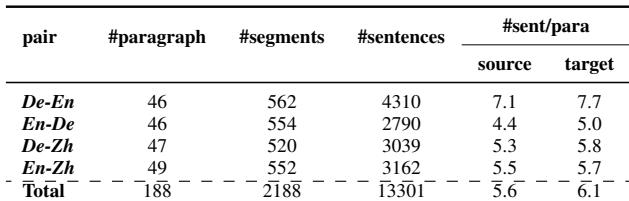
The corpus contains 188 source paragraphs, 2,188 paragraph-level translation segments, and more than 13k sentences. Source paragraphs average 5.6 sentences, while target paragraphs average 6.1 sentences.
-
The source and target paragraphs are collected from verified publications, including books from Project Gutenberg, published reading samples, and purchased materials. The dataset includes both classic and contemporary literary works. Classics are emphasized because they contain complex syntax, language change, and cultural references. Contemporary works are also included to reduce possible contamination from widely available texts already present in large language model pretraining corpora.
-
Quality filtering is based on verified publication status and human translation coverage. Classic works require at least two human translations for the target paragraph, while contemporary works require at least one human translation.
-
Dataset construction is divided into three steps: first, paragraph-level parallel corpora are selected and constructed; second, translation hypotheses are collected from machine translation and large language model systems; third, translation quality is assessed through human evaluation.
-
For classic German to English works, the authors reuse PAR3 samples. For contemporary German to English works and for all other language pairs, they build the corpus from scratch by manually aligning source and target paragraphs.
-
The dataset includes paragraph-level translation hypotheses from a broad set of generation systems. These include commercial systems such as Google Translate and DeepL, sentence-level transformer models such as NLLB-3.3B and M2M-100-1.3B, closed-source GPT-4o, and smaller open-source LLMs such as Llama 3, Qwen 2, Gemma 1.1, and TowerInstruct. LLM translation requests use a shared prompt template for literary text translation.
-
The evaluation subset is organized as paragraph-level comparisons. Each source paragraph is paired with multiple target translations, including human translations and model outputs, enabling direct comparison across systems and evaluation methods.
-
The authors use the data to construct human quality annotations with several evaluation schemes: guided error annotation based on MQM, free error annotation, SQM scalar rating, and best-worst selection. MQM annotations record error spans and classify errors into six categories: terminology, accuracy, fluency, style, locale convention, and non-translation. Each error is labeled as major or minor, and the MQM score is normalized by the number of sentences in the paragraph.
-
Human evaluation is divided by budget and role. Student evaluators perform MQM and SQM annotations for all segments, and also perform blind best-worst selection on samples. Professional translators perform free error annotation and SQM on samples, including comparisons involving human translations, GPT-4o, Google Translate, and DeepL, with Qwen used for pairs involving Chinese.
-
The dataset is processed at paragraph level rather than as isolated sentences. The authors do not describe sentence-level cropping for corpus construction; instead, paragraph alignment is used, and sentence counts are used for evaluation normalization and analysis.
-
The resulting dataset serves as a literary translation evaluation benchmark. It is used to generate system outputs, create translation comparison sets, collect span-level error annotations, record holistic quality judgments, and support analysis of paragraph-level literary translation quality across multiple systems and language pairs.
Method
The authors leverage a three-stage data construction pipeline for a literary translation corpus and benchmark. The process is designed around paragraph-level parallel data and combines curated human translation references, multiple machine translation outputs, and a final quality assessment step.
The first stage constructs paragraph-level parallel corpora for English, Chinese, and German, covering four language directions: English to Chinese, German to English, English to German, and German to Chinese. The authors select both classic and contemporary works to balance challenge and reliability. Classic texts are retained because they often contain complex syntax, historical language variation, and culturally specific references that are difficult for machine translation systems. At the same time, older human translations are valuable because they predate widespread machine translation use and are therefore less likely to contain machine translation traces. Contemporary works are also included to reduce the risk of contamination from texts that may already be present in the pretraining data of modern large language models.
To maintain high reference quality, the authors derive source and target paragraphs from verified publications, including books from Project Gutenberg, reading samples from published works, and purchased materials. For classic works, the target side contains at least two human translations, while contemporary works contain at least one. For classic German to English data, the authors use existing aligned samples from PAR3. For contemporary German to English data and the other three language pairs, the corpus is built manually, with the first author aligning source paragraphs to their human translations. This manual alignment step is a key quality-control component of the pipeline, especially for literary texts where paragraph-level equivalence may not be recoverable through automatic alignment alone.
The second stage selects machine translation systems and collects translation hypotheses for the same source paragraphs. The system selection is intentionally diverse, covering different model scales, deployment models, and training backgrounds. The authors include commercial systems such as Google Translate and DeepL, with DeepL being particularly relevant because it is widely used in translation workflows. They also include strong previous transformer models optimized for sentence-level translation, such as NLLB-3.3b and M2M-100-1.3b. In addition, the pipeline incorporates closed-source GPT-4o and several smaller open-source language models: Llama 3, Qwen 2, Gemma 1.1, and TowerInstruct. These models are selected to represent different parameter scales, language specializations, and instruction-following capabilities. For all large language models, the authors use the same prompt format to reduce prompt-induced variation across systems.
The third stage assesses translation quality over the collected hypotheses. This stage completes the workflow by evaluating the outputs produced from the curated source paragraphs and reference translations. Because the corpus is built at paragraph level and uses verified human references, the evaluation setting is suited for assessing how well machine translation systems handle literary and translation-specific phenomena such as long-range cohesion, stylistic nuance, and cultural adaptation.
Experiment
The study evaluates literary translation quality on LITEVAL-CORPUS using student and professional evaluators across guided MQM, free error annotation, SQM, and BWS, then compares these judgments with reference-free automatic metrics including GEMBA-MQM, XCOMET, and Prometheus. Human results show moderate to high consistency within schemes, with BWS giving the most reliable discrimination of human and top machine outputs, while student MQM and SQM are less adequate unless combined or guided by professional expertise. Automatic metrics correlate only moderately with human MQM and generally fail to distinguish high-quality human translations from strong LLM outputs, especially for fluency, style, and terminology. The findings also indicate that LLM-based translations are more literal and less diverse than human translations, and LLM evaluators may favor similar or their own outputs.
The corpus contains paragraph-level literary translations across four language pairs, with broadly comparable numbers of source paragraphs and translation segments but much larger sentence counts. Target paragraphs are generally more sentence-dense than source paragraphs, and the language pairs differ noticeably in average sentence load. German-to-English is the most sentence-heavy pair, while English-to-German is the most compact. German-to-English data shows the highest average sentences per source and target paragraph. English-to-German data is the most compact in sentence density, while Chinese-involving pairs fall between the extremes. Target text usually has more sentences per paragraph than source text, suggesting variation in sentence segmentation across languages.
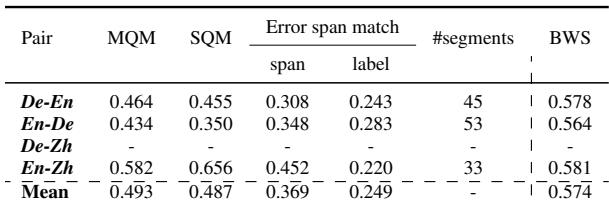
Student evaluator pairs show moderate agreement on overall translation scores, with MQM and SQM producing broadly similar Kendall's Tau agreement across the evaluated language pairs. Span and label agreement is lower than overall score agreement, especially when evaluators must match both error spans and labels, while BWS span agreement is comparatively higher. En-Zh generally yields the strongest score agreement, whereas En-De shows the weakest. MQM and SQM have similar average agreement among student evaluators. Label match is the weakest span-level agreement measure. BWS span agreement is higher than average MQM and SQM agreement.
Human evaluation schemes generally prefer human translations over other machine systems, but their judgments differ sharply for top models. Student MQM performs better against non-top systems than against top systems, while GEMBA-MQM versions rarely prefer human translations over top models. Professional SQM and combinations of student MQM with SQM show stronger human preference, indicating that evaluator expertise and scheme design matter. Human MQM and SQM frequently rank human translations above other systems. Student MQM is much less effective when top machine systems are included. Professional SQM shows a large improvement over student SQM in identifying human translations. GEMBA-MQM versions tend to prefer top machine outputs over human translations.
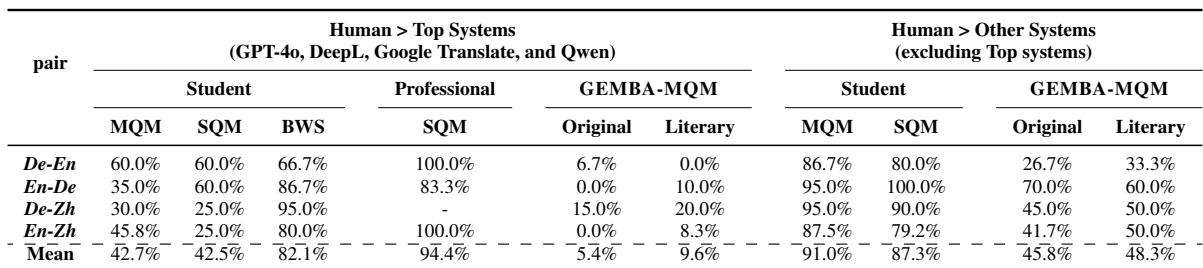
The experiments evaluate a paragraph-level literary translation corpus across four language pairs, an evaluator agreement study, and a human-evaluation system ranking study. The corpus analysis shows that target paragraphs are generally more sentence-dense than source paragraphs, with notable differences among language pairs in average sentence load. Agreement analysis indicates that student evaluators reach moderate consistency on overall scores, especially for En-Zh, while agreement is weaker when matching error spans and labels. System ranking results show that evaluation schemes with professional expertise and SQM-like design are more effective at preferring human translations, whereas LLM-based schemes can favor top machine outputs.