Command Palette
Search for a command to run...
LLM 파인튜닝의 학습 동역학
LLM 파인튜닝의 학습 동역학
Yi Ren Danica J. Sutherland
초록
학습 동역학은 특정 학습 사례의 학습이 모델의 다른 사례에 대한 예측에 어떤 영향을 미치는지를 기술하며, 심층 학습 시스템의 거동을 이해하는 데 강력한 도구를 제공한다. 우리는 상이한 반응 후보들 사이에서 영향력이 어떻게 축적되는지를 단계별로 분해하는 방식을 분석하여, 대규모 언어 모델의 다양한 유형의 파인튜닝 과정에서의 학습 동역학을 연구한다. 제안하는 프레임워크는 지시 튜닝과 선호 튜닝에 사용되는 주요 알고리즘의 학습에 관한 많은 흥미로운 관찰 결과들을 통일적으로 해석할 수 있게 한다. 특히, 파인튜닝 이후 특정 유형의 환각이 강화되는 이유에 대한 가설적 설명을 제시한다. 예를 들어, 모델이 질문 B에 대한 응답에서 사용된 구어나 사실을 질문 A의 답변에 사용하거나, 응답 생성 시 유사한 단순 구문을 반복적으로 사용하는 현상이다. 또한 오프-폴리시 직접 선호 최적화(off-policy DPO)에서 관측된 previously observed 현상, 즉 DPO를 과도하게 실행하면 원하는 출력의 확률까지 낮아지는 현상을 설명하기 위해 프레임워크를 확장하고, 독특한 '조임 효과(squeezing effect)'를 강조한다. 이 프레임워크는 온-폴리시 DPO 및 그 변형들의 이점이 어디서 비롯되는지에 대한 통찰도 제공한다. 본 분석은 LLM의 파인튜닝을 이해하는 새로운 관점을 제공할 뿐만 아니라, 정렬 성능을 개선하기 위한 단순하고 효과적인 방법을 고안하는 데 영감을 준다. 실험 코드는 https://github.com/Joshua-Ren/Learning_dynamics_LLM 에서 확인할 수 있다.
One-sentence Summary
University of British Columbia and Amii propose a framework for analyzing the learning dynamics of LLM finetuning by decomposing how influence accumulates among candidate responses, yielding a unified interpretation of hallucination strengthening, the squeezing effect in off-policy DPO, and the advantages of on-policy DPO, and inspiring a simple method to improve alignment performance.
Key Contributions
-
The paper develops a step-wise learning-dynamics framework for large language model finetuning that decomposes model prediction changes and unifies the analysis of instruction tuning, direct preference optimization and its variants, and reinforcement learning based methods.
-
The framework explains counterintuitive finetuning behaviors, including strengthened hallucinations, repeated simple phrases in generated responses, and the squeezing effect that makes desired outputs less likely during off-policy direct preference optimization.
-
Inspired by this analysis, the paper proposes a simple method for improving alignment performance and provides code for the experiments.
Introduction
Large language models are commonly aligned through instruction tuning and preference tuning so that they follow human directions and preferences more reliably. Prior analyses often focus on training objectives, endpoint behavior, or connections to reinforcement learning, but they explain less about how model predictions evolve step by step during finetuning. The authors leverage learning dynamics to derive a unified decomposition of how predictions change under supervised finetuning, DPO variants, and reinforcement learning based methods. Their framework explains counterintuitive behaviors such as repeating outputs, hallucination, and confidence decay in off-policy DPO, and they identify a squeezing effect from gradient ascent that motivates a simple method for better alignment.
Dataset
-
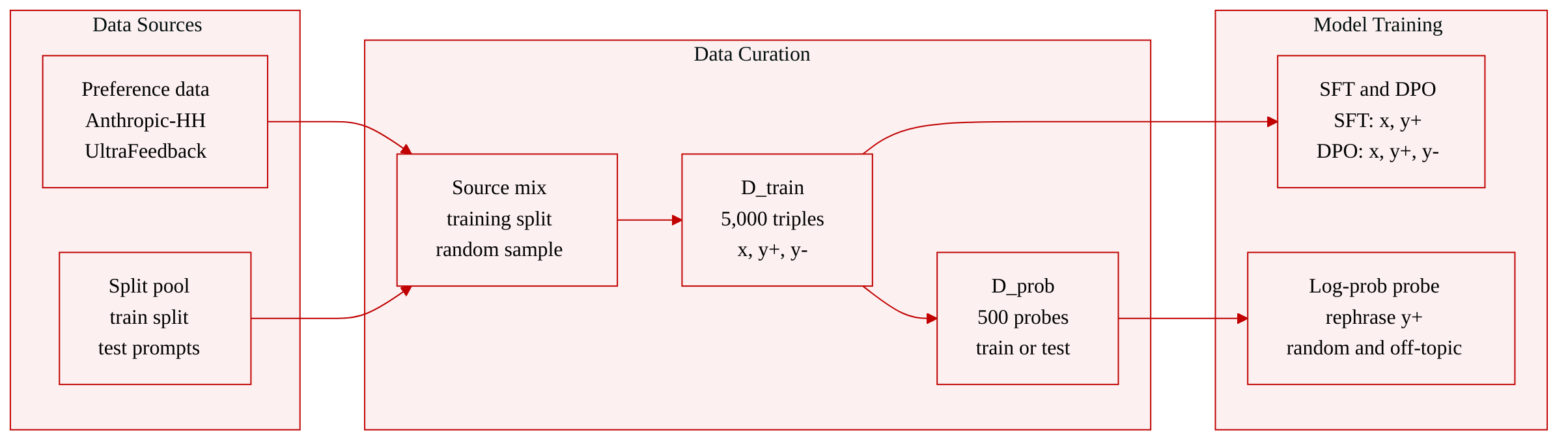
The authors use two human preference datasets, Anthropic-HH and UltraFeedback, to build a small training subset for experimental analysis.
-
The main training set, D_train, contains 5,000 examples randomly sampled from the training split. Each example has three components: a prompt or question x, a preferred response y+, and a less preferred response y-.
-
The paper uses the data in two ways. For supervised fine-tuning, only x and y+ are used. For DPO-style learning, all three fields are used: x, y+, and y-.
-
To study learning dynamics in more detail, the authors create a probing dataset, D_prob, by randomly sampling 500 examples from D_train.
-
For each probing prompt x, they generate several additional response types to inspect how the model assigns probabilities over different outputs. These include a rephrasing of y+, an irrelevant response to another question x', and a randomly generated English sentence with the same word length as y+.
-
In an appendix ablation, the authors also consider a probing variant where the prompts are taken from the test set.
-
The probing set is used to examine changes in log-probabilities across response types over training, giving a finer view of how predictions evolve beyond the standard training examples.
Method
The authors leverage a learning dynamics framework that connects one gradient update on an update example (xu,yu) to the change in predictions on an observing example xo. For a model that produces logits z=hθ(x) and then applies softmax to obtain πθ, a gradient descent step with learning rate η can be written as
Δθ=−η∇θL(fθ(xu),yu).The framework tracks the resulting change in the model’s confidence on another input by measuring
Δlogπt(y∣xo)≜logπθt+1(y∣xo)−logπθt(y∣xo).For a single prediction vector, this per-step change decomposes into three interpretable factors:
V×1Δlogπt(y∣xo)=−ηV×VAt(xo)V×VKt(xo,xu)V×1Gt(xu,yu)+O(η2).Here,
At(xo)=∇zlogπθt(y∣xo)=I−1πθt⊤(xo),so this term only depends on the current predictive distribution. The term
Kt(xo,xu)=∇θz(xo)∇θz(xu)⊤is the empirical neural tangent kernel of the logit network and acts as a model-specific local similarity between the update input and the observing input. The final term
Gt(xu,yu)=∇zL(xu,yu)is determined by the loss and supplies the direction and strength of the update. For cross entropy loss with a hard label, this term points from the current predicted distribution to the target one-hot distribution.
The analysis assumes that, during training, the relative influence of learning from xu on different observing inputs is reasonably stable. Under this assumption, the magnitude of Kt can be interpreted as a similarity signal. If ∥Kt∥F is large, learning from xu is expected to influence the model’s prediction on xo strongly. If it is small, the influence is weak. Refer to the MNIST illustration below for this intuition: an update on one digit pulls up the probability of the same digit, indirectly increases the probability of similar digits from other classes, and has little effect on dissimilar inputs.
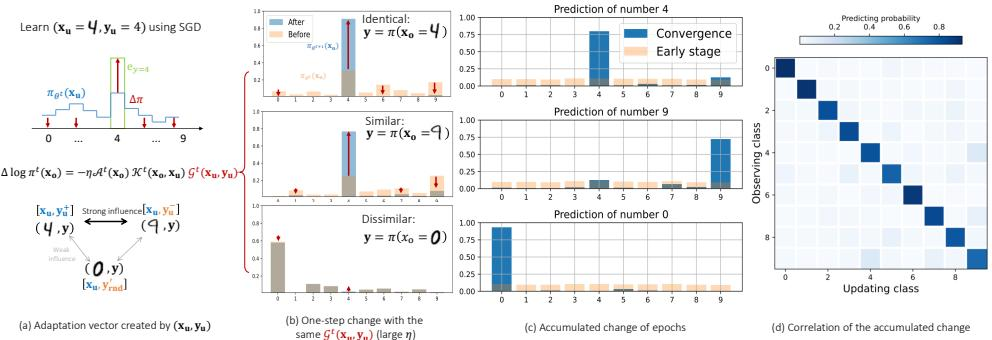
The same decomposition is extended to large language model finetuning by treating the prompt and response as one concatenated sequence. Let
χ=[x,y],where y=[y1+,…,yL+] is a completion of length L. The model outputs logits
z=hθ(χ),and each column of z is normalized by softmax to produce the conditional distribution over the next token. Causal masking ensures that the prediction of token l does not use future tokens y>l. With this construction, the empirical kernel becomes a tensor across token positions,
Kt(χo,χu)∈RV×V×L,and the change in the log probability of the m-th observed token can be written as
[Δlogπt(y∣χo)]m=−l=1∑Lη[At(χo)]m[Kt(χo,χu)]l[Gt(χu)]l+O(η2).For supervised finetuning, the loss is the negative log likelihood of the desired response:
LSFT(xu,yu+)=−l=1∑Llogπ(y=yl+∣y<l+,xu).The corresponding residual term is roughly the difference between the model’s current predictive distribution and the target token distribution. Therefore, supervised finetuning creates an upward pressure on the desired response yu+, a weaker indirect upward pressure on responses that are similar to yu+ under the empirical kernel, and a downward pressure on the remaining probability mass because the distribution must sum to one. The SFT dynamics below illustrate how different response types move under these combined pressures.

Preference finetuning changes the geometry of the update because it introduces both positive and negative gradients. For direct preference optimization, the loss compares the chosen response yu+ and the rejected response yu− relative to a reference policy πref:
LDPO(θ)=−E(xu,yu+,yu−)∼D[logσ(βlogπref(yu+∣χu+)πθt(yu+∣χu+)−βlogπref(yu−∣χu−)πθt(yu−∣χu−))].Under teacher forcing, the per-step update can be decomposed into two competing terms:
[Δlogπt(y∣χo)]m=−l=1∑Lη[At(χo)]m([Kt(χo,χu+)]lGDPO+t−[Kt(χo,χu−)]lGDPO−t)+O(η2).The residual terms are
GDPO+t=β(1−a)(πθt(y∣χu+)−yu+), GDPO−t=β(1−a)(πθt(y∣χu−)−yu−).The scalar a reflects how well the current policy already separates the chosen and rejected responses relative to the reference policy. As the margin grows, the update strength is automatically reduced. The coefficient β controls the regularizing effect: a larger β can strengthen the update when the model is behind the reference separation, but can also suppress the update when the model already achieves a positive margin. The diagram below summarizes the different updating vectors induced by supervised finetuning, direct preference optimization, and related preference methods.
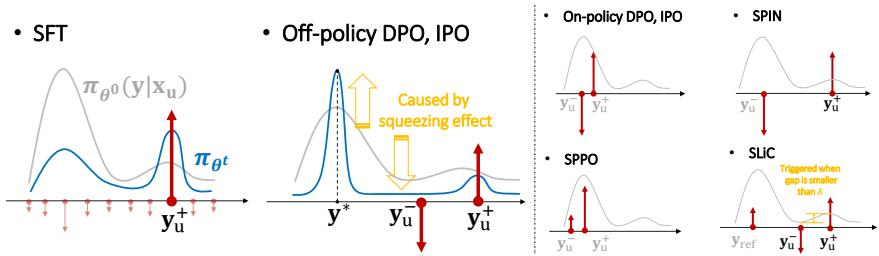
The key additional phenomenon introduced by preference finetuning is the squeezing effect. When a strong negative gradient is applied to a response yu− that has low probability under a peaked pretrained distribution, the softmax normalization redistributes the removed probability mass toward the output that was already most confident. Let
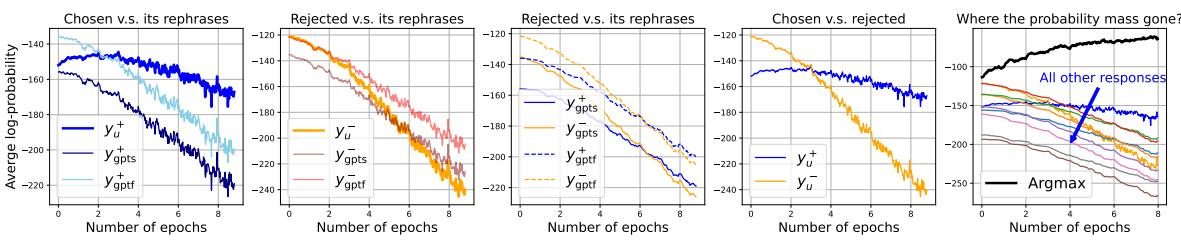
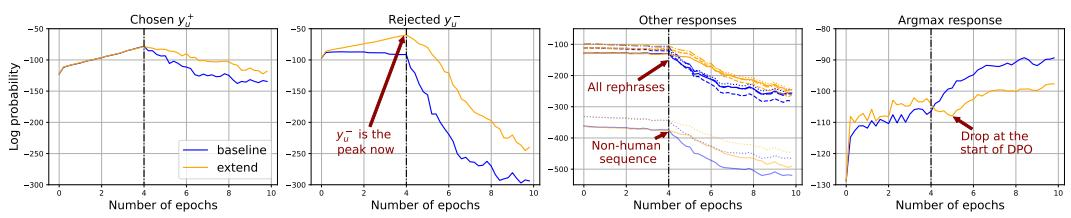
y∗=argi∈[V]∖{yu−}maxπθt(y=i).Then the update guarantees that πθt+1(y=yu−) decreases, while a large portion of the removed mass is squeezed into πθt+1(y=y∗). This produces a rich get richer pattern: high probability regions tend to increase, low probability regions tend to decrease, and a peakier initial distribution intensifies the effect. In practical preference finetuning, many tracked responses, including chosen responses, rejected responses, and rephrases, can all decay in log probability, while the probability mass accumulates in the current argmax or greedy decoded response. The off-policy DPO curves below make this probability mass flow visible.
Based on this mechanism, the authors propose an extended finetuning pipeline. Instead of performing supervised finetuning only on [xu;yu+], the pipeline also trains on [xu;yu−] during the supervised stage. This raises the likelihood of the rejected response and its local neighborhood before the preference optimization stage begins. Consequently, when direct preference optimization later applies a negative gradient to yu−, that gradient acts on a more reasonable region of the distribution rather than on an extremely low-probability valley. The resulting supervised finetuning stage pulls up both the chosen and rejected regions, and the subsequent preference stage can push down the rejected response with a weaker squeezing effect. The learning dynamics below compare the baseline pipeline with this extended training design.
Experiment
The experiments use preference datasets and several small language models, alongside a probing dataset of representative responses, to examine how SFT and DPO update likelihoods over different response types. They confirm that SFT directly reinforces preferred responses while indirectly affecting similar responses, and that unrelated training targets can increase cross-question confidence, offering a mechanism for hallucination-like behavior. The DPO analysis shows that gradients on preferred and dispreferred responses propagate to neighboring responses and produce a growing preference margin, while also revealing a squeezing effect that can sharpen overly confident degenerate outputs. An augmented SFT stage that includes dispreferred responses mitigates this squeezing effect and leads to better generation quality after subsequent DPO training.
During DPO, the extended SFT pipeline becomes preferred over the baseline by both ChatGPT and Claude, despite starting with lower win rates before DPO. The improvement appears after DPO training, with the strongest advantage at an intermediate epoch and a later reduction that still leaves it ahead of the baseline. These results support the idea that including negative responses during SFT can mitigate the squeezing effect and improve final preference performance. The extended SFT pipeline starts behind the baseline in judge preferences before DPO. After DPO, it gains a consistent preference advantage against the baseline for both ChatGPT and Claude. The advantage is largest at an intermediate DPO epoch, then decreases but remains favorable.
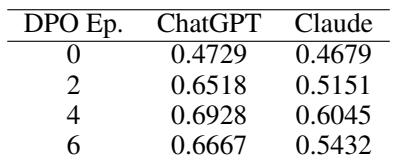
The experiments compare an extended SFT pipeline that includes negative responses against a baseline using preference judgments from ChatGPT and Claude during DPO. Although the extended pipeline is less preferred before DPO, it becomes consistently preferred after DPO, with its strongest advantage at an intermediate training epoch followed by a partial decline. These qualitative results suggest that incorporating negative responses during SFT can reduce the squeezing effect and lead to better final preference outcomes.