Command Palette
Search for a command to run...
처음부터 학습하지 말라: 장기 시퀀스 모델의 공정한 비교에는 데이터 기반 사전 분포가 필요하다
처음부터 학습하지 말라: 장기 시퀀스 모델의 공정한 비교에는 데이터 기반 사전 분포가 필요하다
Ido Amos Jonathan Berant Ankit Gupta
초록
시퀀스 전반에 걸친 장기 의존성 모델링은 기계 학습의 오랜 목표였으며, 이는 긴 시퀀스에서 Transformer를 압도적으로 능가하는 상태 공간 모델(State Space Models)과 같은 아키텍처의 발전으로 이어졌습니다. 그러나 이러한 인상적인 경험적 성과는 주로 모델이 무작위로 초기화되고 입력 시퀀스로부터 대상 레이블을 예측하도록 학습되는 벤치마크(예: Long Range Arena)에서 입증되었습니다. 본 연구에서는 무작위 초기화가 아키텍처 간 차이를 과도하게 과대평가하게 만든다는 것을 보여줍니다. 또한 다운스트림 작업 데이터만을 사용하여 표준 노이즈 제거 목적 함수로 사전 학습하면 여러 아키텍처에서 극적인 성능 향상이 이루어지며, Transformer와 상태 공간 모델(SSM) 간의 격차가 매우 작아진다는 것을 입증합니다. 기존 연구들과 대조적으로, 우리는 적절히 사전 학습된 경우 기본 Transformer가 Long Range Arena에서 S4의 성능과 동등함을 발견했으며, PathX-256 작업에서 SSM의 기존 최고 보고된 결과를 절대값 20포인트 개선하였습니다. 이후, 우리는 SSM을 위해 이전에 제안된 구조화된 매개변수화의 유용성을 분석하고, 사전 학습을 통해 얻은 데이터 기반 초기화가 존재할 경우 이러한 매개변수화가 대부분 불필요해진다는 것을 보여줍니다. 본 연구는 지도 학습 작업에서 다양한 아키텍처를 평가할 때, 사전 학습을 통해 데이터 기반 사전 지식을 통합하는 것이 신뢰할 수 있는 성능 추정에 필수적이며 이를 효율적으로 수행할 수 있음을 보여줍니다.
One-sentence Summary
Random initialization grossly overestimates architectural gaps between Transformers and state space models on benchmarks like Long Range Arena, whereas pretraining with denoising objectives using only downstream task data allows vanilla Transformers to match S4 and improves SSM results on PathX-256 by 20 absolute points.
Key Contributions
-
This paper shows that random initialization on long-range benchmarks can grossly underestimate architecture differences and proposes supervised pretraining with standard denoising objectives on downstream task data to learn data-driven priors for reliable evaluation.
-
On Long Range Arena, pretraining improves vanilla Transformers by more than 30% in mean absolute performance, enabling them to match state-of-the-art SSMs such as S4 without architectural changes, and improves S4 on five of six tasks, including a 20-point gain on PathX-256 from 67 to 87.
-
This work analyzes structured SSM parameterizations and finds they become mostly redundant once pretraining learns data-driven initialization, providing competitive Long Range Arena results with Transformers and diagonal linear RNNs and using learned convolution kernels to reveal learned long-range priors.
Introduction
Self-supervised pretraining is widely used in machine learning, and downstream models are typically finetuned from pretrained checkpoints to obtain strong performance. This is especially important for modeling long-range dependencies, where benchmarks such as Long Range Arena have suggested that standard Transformers struggle, motivating new architectures with hand-crafted inductive biases. However, training these architectures from scratch can conflate performance differences caused by architecture choices with the absence of a useful pretraining objective. The authors show that this discrepancy largely comes from training and evaluation practices, and they introduce self pretraining, a simple data-driven approach that applies denoising objectives directly on the downstream training data. This produces better inductive biases without requiring large pretrained corpora or architectural modifications, improving Transformers and state space models on Long Range Arena and showing that many manual biases become unnecessary.
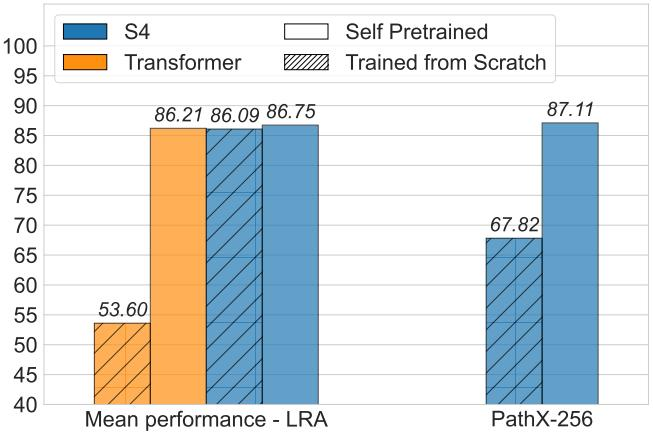
Experiment
The experiments evaluate Transformers and state space models on long-range sequence tasks, including Long Range Arena and additional modalities, primarily by comparing models trained from scratch with models self-pretrained on task-specific data. The results show that self-pretraining substantially improves the reliability of comparisons and reveals that Transformers can learn effective long-range dependencies without specialized architectural assumptions. Across model choices, data scales, and modalities, the findings indicate that data-driven priors are often competitive with or more effective than manually designed biases for capturing sequence structure.
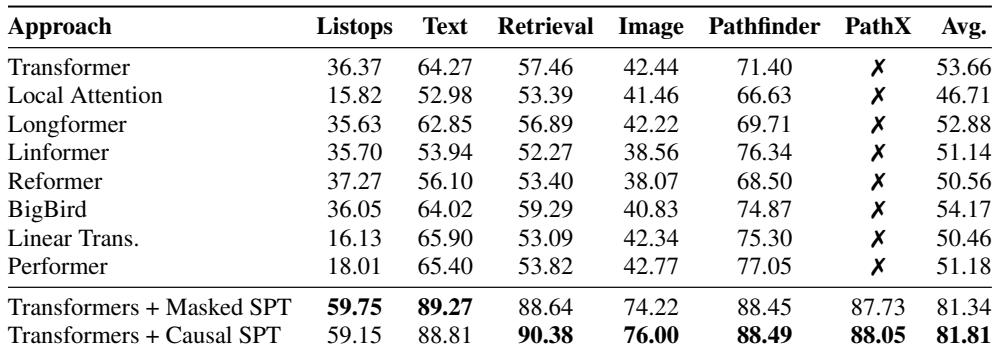
Self-pretraining Transformers on task data before finetuning produces much larger gains than training from scratch on Long Range Arena, increasing average accuracy by roughly 30%. These improvements appear for both causal and masked objectives, including tasks such as LISTOPS where context may not strongly support token prediction, indicating that learned priors from self-pretraining are central to more reliable evaluation. Self-pretraining substantially improves Transformer performance across Long Range Arena tasks compared with random initialization. Causal and masked self-pretraining lead to similar gains, even on tasks where causal models offer no clear advantage. Transformer baselines trained from scratch show uneven results and remain at chance accuracy on PathX.
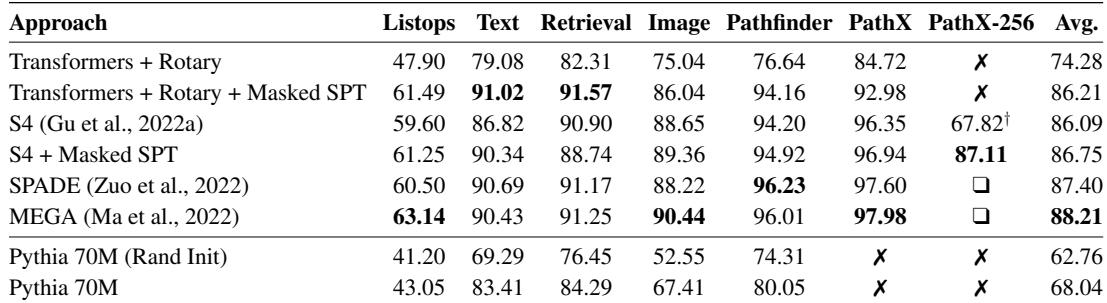
Self pretraining substantially strengthens Transformers on sequence modeling tasks, closing the gap with strong structured sequence models and showing that much of the needed inductive bias can be learned from data. S4 also benefits from self pretraining, especially on the longest Pathfinder task, while text pretrained Transformers remain useful but less effective than pretraining directly on the target modality. The results support pure attention models as competitive when trained with task-specific pretraining. Masked self pretraining produces broad gains for rotary Transformers across the benchmark. Self pretraining helps S4 modestly overall and strongly on the longest Pathfinder task. Text pretrained Pythia improves over random initialization but lags behind Transformers pretrained on the task data.
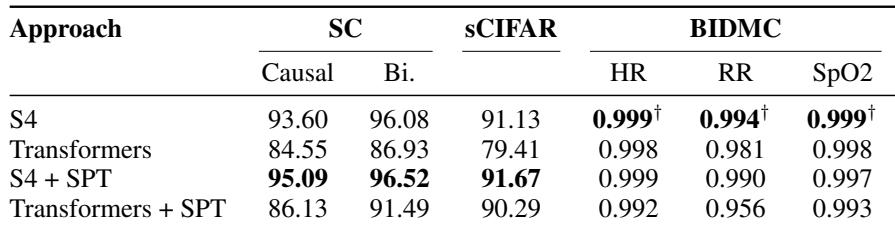
Across Speech Commands and sequential CIFAR, SPT produces large improvements for Transformers and smaller gains for S4. The method also narrows the gap between trained from scratch Transformers and S4, and reduces the difference between causal and bidirectional S4 on speech. On BIDMC regression tasks, all models are already near ceiling, so the benefit of SPT is difficult to observe. SPT gives Transformers large gains on Speech Commands and sequential CIFAR. SPT modestly improves S4 and narrows Transformer versus S4 performance gaps. BIDMC scores are very high for both model families, limiting visible SPT improvements.
The experiments evaluate task-specific self-pretraining before finetuning on Long Range Arena, sequence modeling, Speech Commands, sequential CIFAR, and BIDMC, comparing randomly initialized Transformers, S4 variants, and text-pretrained models. They show that pretraining on the target task data substantially strengthens Transformers and makes learned priors central to reliable evaluation, while causal and masked objectives perform similarly. Self-pretraining also narrows gaps between Transformers and stronger structured sequence models, gives S4 modest or task-dependent gains, and outperforms text-based pretraining, whereas near-ceiling BIDMC results limit visible improvements.