Command Palette
Search for a command to run...
확산 모델의 일반화는 기하구조 적응형 조화 표현에서 비롯된다
확산 모델의 일반화는 기하구조 적응형 조화 표현에서 비롯된다
Zahra Kadkhodaie Florentin Guth Eero P. Simoncelli Stéphane Mallat
초록
영상 노이즈 제거를 위해 훈련된 심층 신경망은 스코어 기반 역확산 알고리즘을 통해 높은 품질의 표본을 생성할 수 있다. 이러한 인상적인 능력은 차원의 저주를 벗어난 것처럼 보이지만, 최근 훈련 데이터 집합에 대한 기억에 대한 보고가 나오면서, 이러한 네트워크가 데이터의 "진짜" 연속 밀도를 학습하고 있는지에 대한 의문이 제기되었다. 본 연구에서는 데이터 집합의 겹치지 않는 부분집합으로 훈련된 두 개의 심층 신경망이 훈련 이미지 수가 충분히 클 때 거의 동일한 스코어 함수, 즉 동일한 밀도를 학습함을 보인다. 이 강한 일반화 영역에서, 확산 생성 이미지는 훈련 집합과 구별되며 시각적 품질이 높아, 심층 신경망의 귀납적 편향이 데이터 밀도와 잘 정렬되어 있음을 시사한다. 우리는 학습된 노이즈 제거 함수를 분석하여, 귀납적 편향이 원본 이미지에 적응하는 기저에서의 축소 연산으로 나타난다는 것을 보인다. 이 기저를 조사하면 윤곽선을 따라 그리고 균일한 영역에서 진동하는 조화 구조가 드러난다. 우리는 학습된 노이즈 제거기가 기하구조 적응형 조화 기저에 귀납적으로 편향되어 있음을 보이는데, 이는 네트워크가 사진 이미지로 훈련될 때뿐 아니라 조화 기저가 최적이지 않은 저차원 다양체 위에 지지된 이미지 클래스로 훈련될 때에도 이러한 기저가 나타나기 때문이다. 마지막으로, 최적의 기저가 기하구조 적응형이자 조화적이라고 알려진 규칙적인 이미지 클래스로 훈련될 때, 네트워크의 노이즈 제거 성능이 준최적임을 보인다.
One-sentence Summary
Researchers at NYU, Flatiron Institute, and Collège de France demonstrate that generalization in diffusion models arises because DNN denoisers learn geometry-adaptive harmonic bases, showing that networks trained on disjoint subsets converge to the same score function and that this inductive bias yields near-optimal denoising on regular image classes.
Key Contributions
-
The paper shows that diffusion-model training exhibits a phase transition: two DNNs trained on large, non-overlapping subsets learn nearly the same score function, and hence nearly the same density, while diffusion samples remain distinct from the training set and are of high visual quality.
-
Analysis of trained denoisers reveals an inductive bias that performs shrinkage of noisy coefficients in a geometry-adaptive harmonic basis adapted to image contours and homogeneous regions. This basis appears for photographic images and also for image classes supported on low-dimensional manifolds, indicating that it is intrinsic to the learned denoisers.
-
Evaluation on image classes with known optimal bases demonstrates near-optimal denoising when the optimal basis is geometry-adaptive and harmonic, such as C^alpha images with bandlet-like bases, while manifold-supported classes show suboptimal residual noise along additional GAHB components. This contrast supports the hypothesis that the GAHB inductive bias of DNN denoisers explains both strong performance and limited performance.
Introduction
Diffusion generative models use deep neural network denoisers to estimate the score of noisy image distributions and produce new samples through reverse diffusion, making them central to high-quality image generation. A key challenge is that learning a continuous density in a high-dimensional space is difficult, and prior results show that when training sets are small relative to model capacity, these models memorize training samples rather than generalizing. The authors show that with sufficiently large datasets, DNN denoisers converge to nearly the same denoising function on non-overlapping training sets and generate nearly identical images, providing direct evidence of strong generalization. They also leverage the link between denoising and density estimation to reveal a geometry-adaptive harmonic basis inductive bias, in which the denoisers perform shrinkage of noisy coefficients in bases adapted to image geometry.
Method
The authors leverage a score-based generative pipeline in which the model does not approximate the clean image density directly. Instead, it learns the score of noise corrupted image distributions. Starting from an unknown clean density p(x), the method observes noisy images
y=x+z,z∼N(0,σ2Id),so that the noisy density is a Gaussian convolution of the clean density,
pσ(y)=∫p(y∣x)p(x)dx=∫gσ(y−x)p(x)dx.The family {pσ} forms a scale space representation of p(x), analogous to the evolution of a diffusion process. The learned object is a score model sθ(y)≈∇logpσ(y) at different noise levels. These scores define a reverse diffusion process and therefore an induced model pθ(x) for the clean data distribution. The quality of the generative model is controlled by the integrated score error,
DKL(p(x)∥pθ(x))≤∫0∞Ey[∥∇logpσ(y)−sθ(y)∥2]σdσ.To learn the score, the method uses the identity
∇logpσ(y)=σ2Ex[x∣y]−y.This makes score learning equivalent to learning a denoiser fθ(y) that approximates the posterior mean Ex[x∣y]. The training objective is the mean squared error
MSE(fθ,σ2)=Ex,y[∥x−fθ(y)∥2],and the estimated score is recovered from the denoiser output as
sθ(y)=σ2fθ(y)−y.The resulting density approximation satisfies the bound
DKL(p(x)∥pθ(x))≤∫0∞(MSE(fθ,σ2)−MSE(f⋆,σ2))σ−3dσ,where f⋆(y)=Ex[x∣y] is the optimal denoiser. This shows that generative modeling accuracy is governed by denoising optimality across all noise levels.
The training workflow is analyzed by comparing denoising performance on training and test samples as the training set size grows. The figure below shows output PSNR against input PSNR for multiple training set sizes. For very small datasets, the model memorizes the training samples, giving high train performance but poor test performance. As the dataset size increases, test performance improves and eventually matches train performance, indicating that the denoiser has entered a generalization regime rather than a memorization regime.
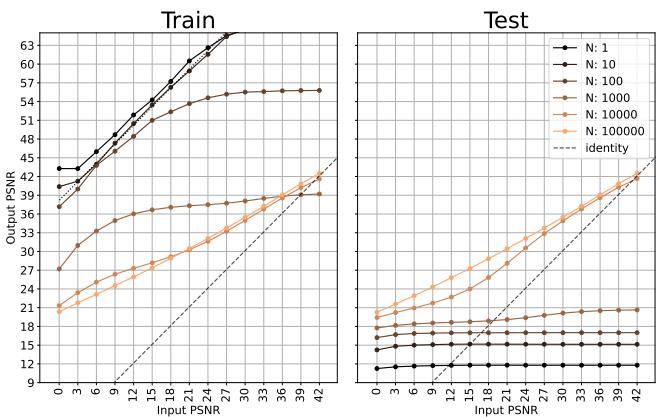
This generalization behavior is central to the framework because high dimensional density estimation is otherwise impossible without strong inductive biases. The learned denoiser, for example a UNet, acts as the core generative module. Its architecture and optimization procedure constrain the score estimates it can represent. When these constraints align with the structure of images, the denoiser learns scores that generalize well and produce diverse generated samples. When they do not, the model may either memorize limited data or introduce substantial model bias in the learned density.
The method then examines the internal structure of the denoiser through a local Jacobian analysis. Given a denoising estimator x^=f(y), the authors study ∇f(y). If the network has no additive bias parameters, the mapping is piecewise linear, and the denoiser can be expressed through the eigendecomposition of its Jacobian as
f(y)=∇f(y)y=k∑λk(y)⟨y,ek(y)⟩ek(y).Here λk(y) are eigenvalues and ek(y) are eigenvectors. This representation reveals the central mechanism of the method: denoising is interpreted as shrinkage in an adaptive basis. The eigenvectors define a local coordinate system, while the eigenvalues determine how much of each local component is retained or suppressed. Both the basis and the shrinkage factors depend on the noisy image y.
The MSE objective naturally enforces this shrinkage behavior. Using Stein’s unbiased risk estimate, the denoising error can be written as
MSE(f,σ2)=Ey[2σ2tr∇f(y)+∥y−f(y)∥2−σ2d].Minimizing MSE requires a tradeoff between the rank of the Jacobian, measured by the sum of eigenvalues, and the residual denoising error. The denoiser therefore behaves locally like a soft projection onto a subspace whose dimensionality corresponds to the Jacobian rank. For the optimal denoiser, the Jacobian has a direct probabilistic interpretation:
∇f⋆(y)=Id+σ2∇2logpσ(y)=σ−2Cov[x∣y].Thus the optimal adaptive basis is tied to the posterior covariance of the clean image given the noisy observation. The optimal MSE satisfies
MSE(f⋆,σ2)=σ2Ey[k∑λk⋆(y)],so a low denoising error corresponds to an approximately low rank Jacobian with many small eigenvalues.
The authors also connect this local basis viewpoint to classical sparse denoising. In a fixed orthonormal basis ek, an oracle shrinkage rule is
λk(x)=⟨x,ek⟩2+σ2⟨x,ek⟩2.This acts as a soft threshold: coefficients whose signal energy dominates the noise are preserved, while weak coefficients are suppressed. If the coefficients of x decay as k−(α+1), the resulting denoising error scales as σ2α/(α+1), which corresponds to a PSNR slope of α/(α+1). The analysis extends this idea to adaptive bases selected from a dictionary, where adaptivity can yield sparser representations and better asymptotic denoising rates.
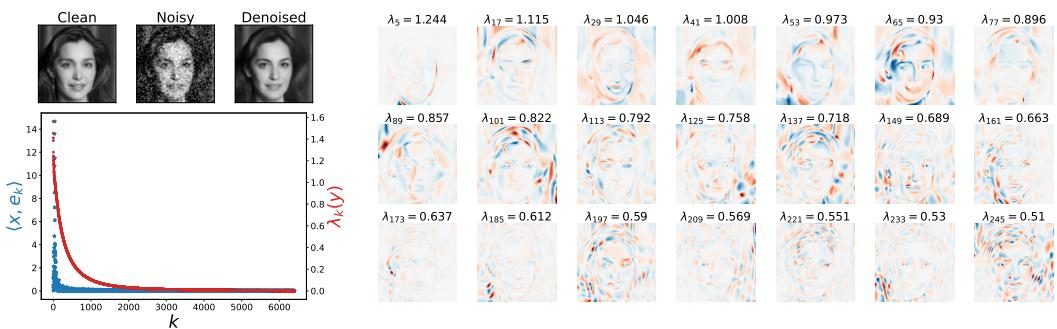
The empirical design analysis studies whether learned DNN denoisers exhibit such adaptive sparse behavior. For a denoiser trained on face images, the Jacobian eigenvectors contain oscillating patterns that align with image contours and smooth regions. The eigenvalues decay rapidly, and the clean image coefficients in this basis are sparse. This indicates that the denoiser uses a geometry adaptive harmonic basis, a local basis that adapts to both shape structure and regional smoothness.
As shown in the figure below, the top panel compares clean, noisy, and denoised images, while the lower panel plots the decay of shrinkage factors and signal coefficients. The basis vectors shown on the right display harmonic like oscillations along facial contours and within smoother regions. Their frequencies increase as the shrinkage factors decrease.
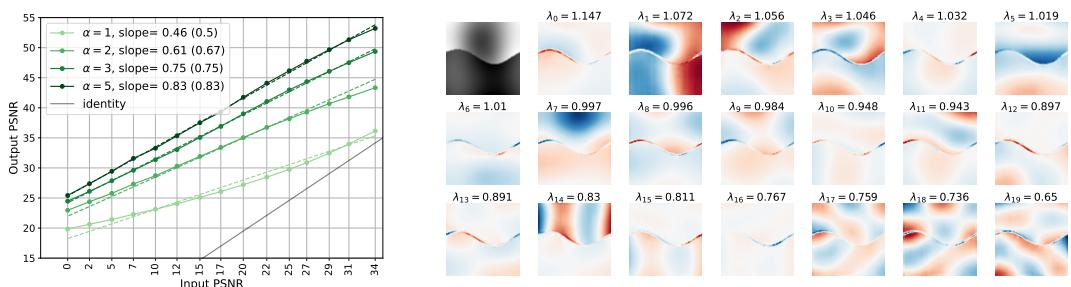
To evaluate whether this basis structure reflects a favorable inductive bias, the authors test geometric image classes for which optimal sparse representations are known. In the geometric Cα setting, images contain regular contours on regular backgrounds, with regularity controlled by α. The optimal sparse representation for this class is obtained with bandlet bases, where coefficient decay leads to the asymptotic PSNR slope α/(α+1). When UNet denoisers are trained on such synthetic data, their PSNR curves approach the theoretical optimal slopes for different values of α. The learned eigenvectors resemble bandlets, with harmonic structure along regions and across boundaries, but with a more flexible geometry.
The figure below shows PSNR curves for several regularity levels and the corresponding leading eigenvectors for a Cα image. The empirical slopes track the theoretical values, and the basis vectors display region based harmonics with increasing frequency.
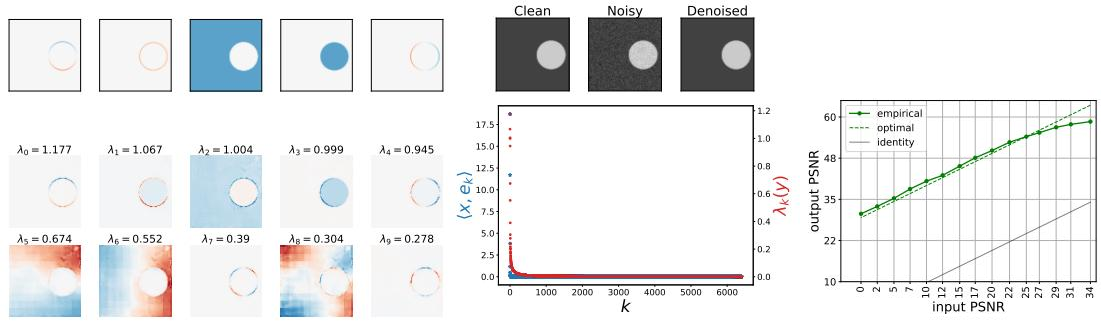
The authors also examine cases where the data distribution lies on a low-dimensional manifold, such as disk images with variations in position, size, and intensity. In the small noise limit, the optimal denoiser should project onto a local tangent space, producing only a few non-negligible eigenvalues and a PSNR slope of 1.0. The trained denoiser does recover some tangent directions, but it also generates additional nonzero eigenvalues whose eigenvectors have geometry adaptive harmonic structure. These extra components increase the effective rank of the Jacobian and lead to a suboptimal PSNR slope below the theoretical optimum.
The figure below presents clean, noisy, and denoised disk images, the decay of shrinkage factors and coefficients, the first eigenvectors of the learned basis, and the denoising performance curve. The first learned basis vectors correspond closely to the tangent space of the disk manifold, while later vectors follow contour and background oscillations rather than purely low-dimensional manifold directions.
Experiment
Experiments comparing denoisers trained on small to large image subsets validate a transition from memorization to generalization: small training sets yield training-data-specific samples and poor test performance, whereas larger sets produce matched training and test behavior and near-identical generations across disjoint subsets, indicating convergence to a common score function. Additional experiments analyze learned denoising bases and test them on geometrically structured synthetic image classes. They show that DNN denoisers learn contour-aligned oscillatory bases that match the regularity assumptions of natural images, achieving near-optimal behavior on geometrically regular synthetic data, but becoming suboptimal when the data structure conflicts with these harmonic inductive biases.