Command Palette
Search for a command to run...
Claude를 이용한 자율적 de novo 단백질 결합제 설계
Claude를 이용한 자율적 de novo 단백질 결합제 설계
Amir Shanehsazzadeh
초록
단백질 구조 생성, 서열 설계, 구조 예측을 위한 딥러닝 방법은 이제 수십 개의 설계만으로도 다양한 표적에 대한 de novo 결합제 설계를 가능하게 한다. 그럼에도 불구하고 설계 캠페인은 표적 생물학, 구조 모델링, 빠르게 변화하는 계산 도구 전반에 걸친 전문성과 더불어 소프트웨어 및 컴퓨팅 자원을 조율하는 데 수일이 소요되는 노동력을 요구한다. 우리는 이러한 전문성과 노동력을 AI 에이전트가 어느 정도까지 대체할 수 있는지 질문을 던졌다. 결합제 설계 캠페인의 실무 지식을 단일 프로토콜 프롬프트로 작성하였으며, 이 프롬프트는 어떤 표적에 대해서도 에피토프, 스캐폴드, 서열을 명시하지 않는다. 이 프롬프트를 기반으로, 그리고 어떠한 설계 결정에도 인간의 개입 없이 Claude Opus 4.8과 Mythos Preview가 16개 표적을 대상으로 24시간에서 48시간 동안 캠페인을 수행하였다. 이들은 각 표적을 조사하고, 에피토프를 선택하고, 오픈소스 단백질 설계 및 구조 예측 모델을 설치·실행하고, 후보를 인실리코로 최적화하고, 표적당 30개의 순위화된 설계를 산출하였다. 두 독립적인 위탁연구기관이 전달된 모든 설계를 그대로 합성하고 결합을 측정하였으며, 16개 표적 중 15개에서 해석 가능한 측정값을 얻었다. Claude는 그중 14개 표적에 대한 결합제를 설계하였고, 1,320개 설계 중 354개가 결합하여 적중률 27%를 기록하였다. 각 캠페인에서 표적별 1순위로 선정된 설계 중에서는 49%가 결합하였다. 단일 48시간 세션에서 모든 표적을 동시에 설계한 경우 Mythos Preview와 Opus 4.8은 각각 26.7%와 22.6%의 적중률을 달성했고, 24시간 세션에서 표적을 하나씩 설계한 경우 Mythos Preview의 적중률은 35.1%였다. 최근 공개 설계 경진대회의 대상이었던 E3 리가아제 소단위체 RBX1의 경우, 245개의 de novo 설계 중 9개가 결합했던 반면 Claude의 90개 설계 중 28개가 결합하였다. 가장 강하게 결합한 설계는 KD 3.9 nM을 기록하여, 동일 플레이트에서 재합성·측정된 경진대회 우승작의 45 nM보다 우수하였다. 교차 종 반응성은 프롬프트의 부차적 목표에 불과했음에도, 표적의 마우스 오솔로그를 대상으로 시험한 233개 결합제 중 130개가 마우스 오솔로그에도 결합하였다. Claude가 사용한 모든 모델은 오픈소스이므로, 이러한 유형의 캠페인은 모든 연구실에서 수행 가능한 범위에 있다. 우리는 프롬프트, 1,440개 설계 전체의 계산 모델, 그리고 신뢰할 수 있는 측정값이 확보된 1,320개 설계의 결합 데이터를 재현 가능한 자율적 결합제 설계 프로토콜이자 해당 분야를 위한 벤치마크 데이터셋으로 공개한다.
One-sentence Summary
Anthropic researchers demonstrate that Claude Opus 4.8 and Mythos Preview, guided by a single protocol prompt with no human input into any design decision, autonomously performed de novo binder design campaigns against 16 targets using open-source protein design and structure-prediction models, achieving a 27% hit rate (354 of 1,320 designs) and 49% binding among top-ranked designs, including a KD of 3.9 nM on RBX1, and released the prompts, computational models of all 1,440 designs, and binding data for the 1,320 designs with reliable measurements.
Key Contributions
- The paper introduces an autonomous protein binder design protocol based on a single frozen prompt specifying no epitope, scaffold, or sequence, in which Claude Opus 4.8 and Mythos Preview researched targets, chose epitopes, ran open-source design and structure-prediction tools, and delivered ranked de novo binders without human input into any design decision.
- Experimental validation by two independent contract research organizations across 15 interpretable targets identified binders for 14 targets, with 354 of 1,320 synthesized designs binding (27% hit rate) and 49% of first-ranked designs binding; on RBX1, 28 of 90 designs bound and the tightest KD was 3.9 nM versus 45 nM for the competition's winning entry.
- The study releases the prompts, computational models of all 1,440 designs, per-design provenance, and binding measurements for 1,320 designs, establishing a reproducible protocol and benchmark dataset for autonomous binder design.
Introduction
The design of de novo protein binders is important for therapeutics and diagnostics, but typical campaigns depend on expert scientists to choose targets, select epitopes, run design tools, and rank candidates. Prior AI-assisted pipelines and agent systems have supported parts of this workflow, yet they still rely on substantial human intervention and are rarely tested at scale with complete experimental reporting. The authors address this gap by showing that Claude, given only a written protocol and open-source tools, can autonomously carry out binder design campaigns across 16 targets, making every design decision from target construct to final ranking and producing experimentally validated binders on most targets.
Method
The authors leverage a single, comprehensive protocol prompt to guide an AI agent through autonomous protein binder design campaigns. This prompt, approximately 16,000 words in length, is loaded as the system prompt for every agent instance. It encapsulates the knowledge of an expert designer, defining the campaign stages, available tools, and selection criteria while leaving specific decisions to the agent. The agent autonomously researches target biology, selects modeling regions and epitopes, and chooses from a pre-cleared menu of open-source backbone generation and sequence design tools. It filters candidates for novelty and sequence composition before committing compute to scoring.
Refer to the framework diagram for the detailed anatomy of this protocol.
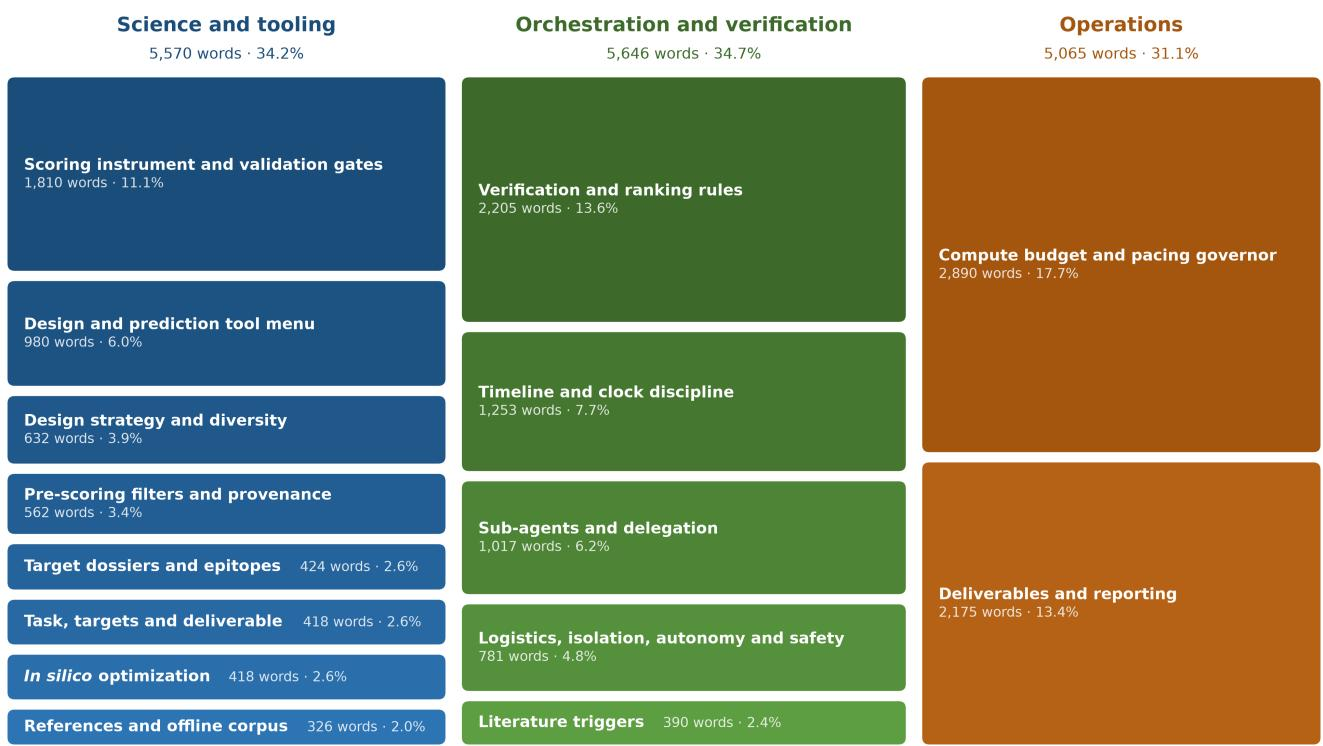
The prompt is structured into three primary thematic blocks. The "Science and tooling" block (34.2%) provides the working knowledge for design, including target dossiers, epitope selection, design tool menus, pre-scoring filters, and the specific ranking score. The "Orchestration and verification" block (34.7%) enables sustained autonomy over 24 to 48 hours by defining sub-agent delegation, timeline discipline, and verification rules. The "Operations" block (31.1%) manages the compute budget, pacing governor, and final reporting deliverables.
To evaluate and select the top 30 designs per target, the agent employs a specific ranking score based on an ensemble of structure predictors.
As shown in the figure below, the authors determined that ensembling scores from Protenix v2, ESMFold2, and ESMFold2-Fast yielded the highest macro-averaged precision for distinguishing binders from non-binders.
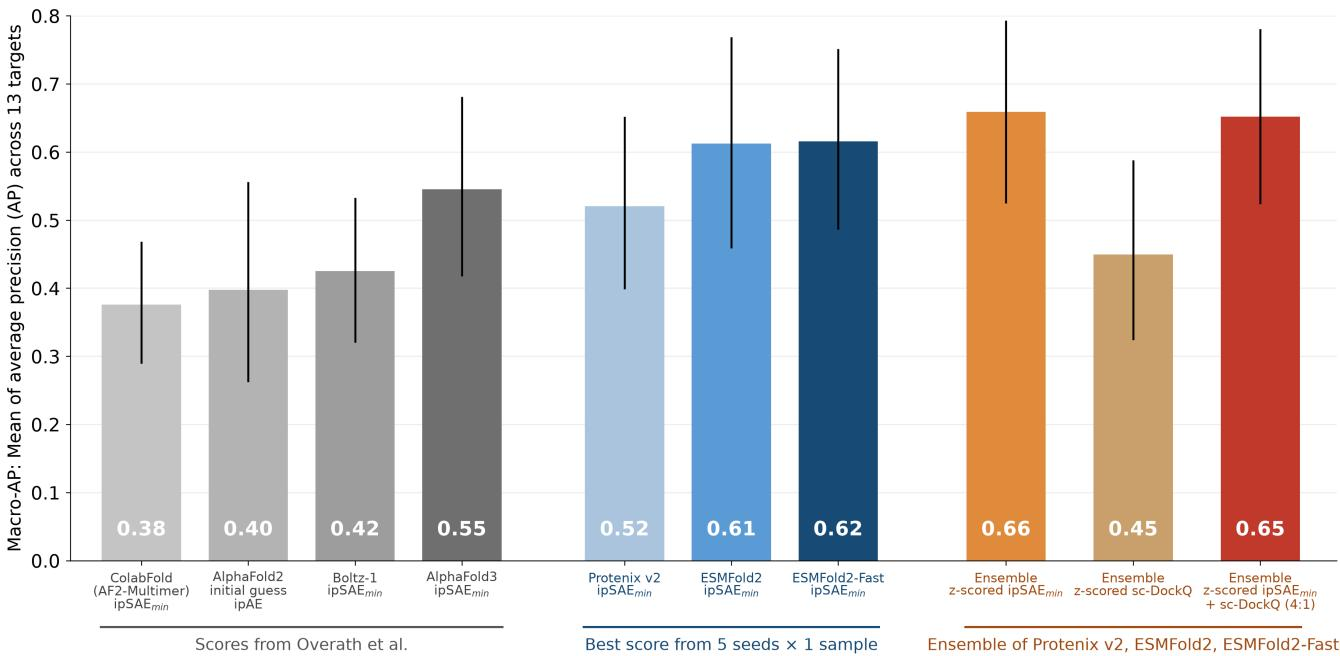
The ranking score combines the z-scored ipSAEmin (interaction predicted Structural Alignment Error) from these three predictors with self-consistency DockQ (sc-DockQ) terms added at one-quarter weight. The sc-DockQ terms serve as a check to ensure the predicted pose matches the designed complex, although they do not significantly change discrimination.
Following the autonomous campaigns, the authors applied a standardized re-scoring protocol independent of the wet lab work. Every ordered design was evaluated using ten publicly available co-folding predictors under uniform settings. The maximum ipSAEmin from five seeds per predictor was recorded.
The calibration of these re-scored confidence values against experimental binding hit rates is presented in the figure below.
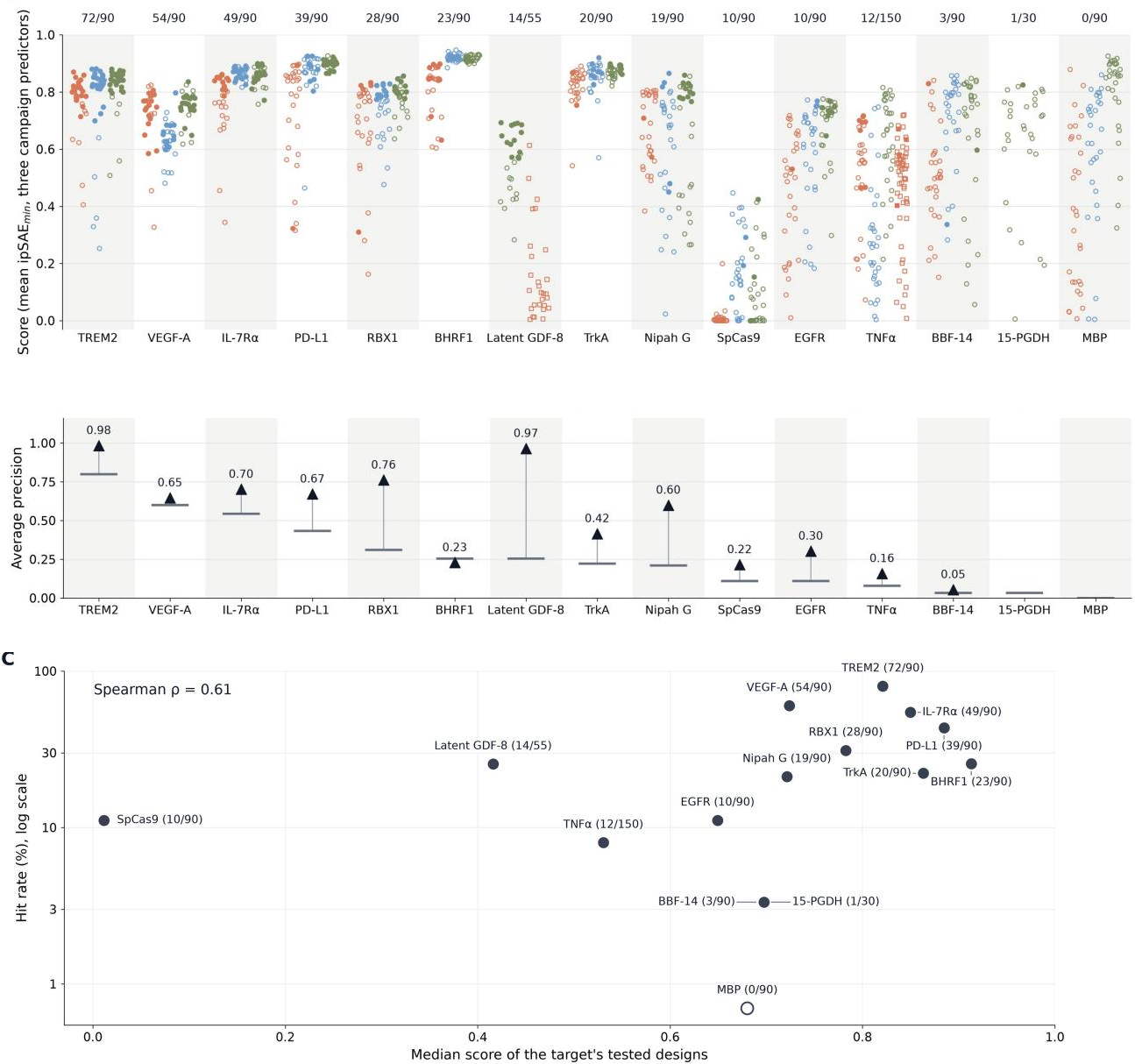
The mean ipSAEmin across the three campaign predictors shows a strong correlation with hit rates across targets. To validate the designs experimentally, the authors utilized two independent contract research organizations (CROs), Adaptyv Bio and Twist Bioscience. Adaptyv Bio expressed designs via cell-free synthesis and measured binding using surface plasmon resonance (SPR) or bio-layer interferometry (BLI). Twist Bioscience expressed designs as Fc fusions in HEK293 cells and used high-throughput SPR arrays. The authors developed an automated labeling rule to integrate the distinct readouts from both CROs. A design was classified as a binder if it met specific criteria in the Adaptyv Bio traces, or if both blind trace grades were positive, or if the Twist Bioscience label was positive and Adaptyv Bio data was uninformative. This rigorous dual-validation pipeline ensured robust classification of the tested designs.
Experiment
The study tested whether an autonomous AI agent could run complete protein-binder design campaigns, from target research to a ranked set of designs, by synthesizing and measuring 1,320 designs across 15 interpretable targets with two independent CROs and assigning each design an integrated binder call. The experiments showed that the agent produced binders for most targets, that its top-ranked designs were enriched for binding, and that co-folding scores separated binders from nonbinders within targets but gave little warning of the least successful targets. Further validations found the agent's designs were competitive with open protein-design competition entries on shared targets, included species cross-reactive and beta-sheet-containing binders, and identified clear failures such as no binders against MBP and only rare weak binders against BBF-14 and 15-PGDH, while the overall evidence remains limited to binding and ranking rather than structure or function.
Design rank was calibrated with binding: considering more of the highest-ranked designs per target increased the number of targets with at least one binder. The single-target campaign reached its maximum shown coverage early, while multi-target campaigns improved more gradually as more designs were included. The top-ranked design per target already yielded binders for roughly half of targets in each campaign. Coverage increased with additional top designs, reaching 10 of 13 targets for the multi-target campaigns and 11 of 15 for the single-target campaign by the top 15 designs. MBP did not produce a binder in any shown campaign, and TNFα did not produce a binder in either Mythos Preview campaign.
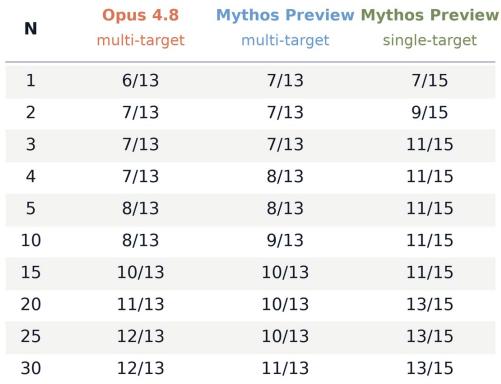
This experiment examined how design ranking relates to binding by tracking target coverage as more top-ranked designs were included. The highest-ranked design per target yielded binders for roughly half of targets, and coverage increased with additional top designs, reaching 10 of 13 targets for multi-target campaigns and 11 of 15 for the single-target campaign by the top 15 designs. The single-target campaign reached its maximum coverage early, while multi-target campaigns improved more gradually. MBP produced no binders in any shown campaign, and TNFα produced no binders in either Mythos Preview campaign.