Command Palette
Search for a command to run...
HATEDAY: 트위터 하루의 대표성을 지닌 글로벌 혐오 발언 데이터셋에서 얻은 통찰
HATEDAY: 트위터 하루의 대표성을 지닌 글로벌 혐오 발언 데이터셋에서 얻은 통찰
Manuel Tonneau Diyi Liu Niyati Malhotra Scott A. Hale Samuel P. Fraiberger Victor Orozco-Olvera Paul Röttger
초록
온라인 혐오 발언이라는 글로벌 과제에 대응하기 위해 선행 연구에서는 소셜 미디어에서 해당 콘텐츠를 식별하기 위한 탐지 모델을 개발해 왔다. 그러나 평가 데이터셋의 체계적 편향으로 인해, 이러한 모델의 실제 환경에서의 효과, 특히 지역 간 효과는 여전히 불분명한 실정이다. 본 연구는 소셜 미디어 환경을 대표하는 최초의 글로벌 혐오 발언 데이터셋인 HATEDAY를 소개한다. HATEDAY는 2022년 9월 21일에 게시된 모든 트윗의 무작위 표본으로 구성되며, 8개 언어와 4개 영어권 국가를 포함한다. HATEDAY를 활용하여 언어 및 지역 간 혐오 발언의 빈도와 구성에서 상당한 차이를 발견하였다. 학술 데이터셋에 대한 평가가 실제 탐지 성능을 크게 과대평가함을 보였으며, 실제 성능은 매우 낮은 것으로 확인되었다. 특히 비유럽 언어에서 그러하다. 본 분석은 이 격차의 주요 요인을 식별하였는데, 여기에는 모델이 혐오 발언과 공격적 발언을 구별하는 데 어려움을 겪는 점과 학술 데이터셋에서 강조되는 대상 집단과 실제 세계에서 가장 빈번하게 표적이 되는 집단 간의 불일치가 포함된다. 저조한 모델 성능은 공개 모델을 자동 혐오 발언 콘텐츠 중재에 부적합하게 만들며, 높은 중재율은 상당한 수준의 인간 감독 하에서만 달성 가능함을 확인하였다. 본 연구의 결과는 실제 소셜 미디어의 복잡성과 다양성을 반영하는 데이터로 탐지 시스템을 평가할 필요성을 강조한다.
One-sentence Summary
Researchers at the University of Oxford, World Bank, and other institutions introduce HATEDAY, the first globally representative hate speech dataset constructed from a random sample of all tweets posted on September 21, 2022 across eight languages, demonstrating that academic evaluation datasets greatly overestimate real-world detection performance, particularly for non-European languages.
Key Contributions
- HATEDAY is introduced as the first global hate speech dataset built from 240,000 annotated tweets randomly sampled from all tweets posted on September 21, 2022, spanning eight languages and four English-speaking countries.
- Using HATEDAY, the study shows that standard academic datasets greatly overestimate real-world detection performance, especially for non-European languages, and identifies causes such as difficulty distinguishing hate from offensive speech and mismatched target groups between academic data and real discourse.
- The moderation assessment shows that fully automatic use of publicly available models is too error-prone, while human review of flagged content can achieve higher moderation rates across languages and countries but requires substantial oversight.
Introduction
Social media platforms increasingly rely on automated hate speech detection to moderate content that can escalate into offline harm, making model performance on real feeds a practical safety concern. Prior work provides an incomplete picture because platform models are often opaque, academic benchmarks use biased and imbalanced datasets, and most resources are English only, which limits generalization and comparisons across languages. The authors also note that grouping content only by language can hide important differences between countries that share a language. To address these gaps, they introduce HATEDAY, a global Twitter dataset of 240,000 tweets sampled across eight languages and four English speaking countries, and use it to compare hate prevalence, evaluate public detection models, and test moderation workflows. Their evaluation shows that standard academic benchmarks overestimate real world performance, public models perform poorly in deployed settings, especially for non European languages, and fully automated moderation is too error prone, while human review can improve moderation at substantial manual cost.
Dataset
-
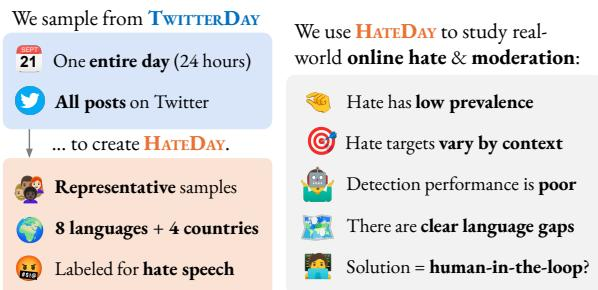
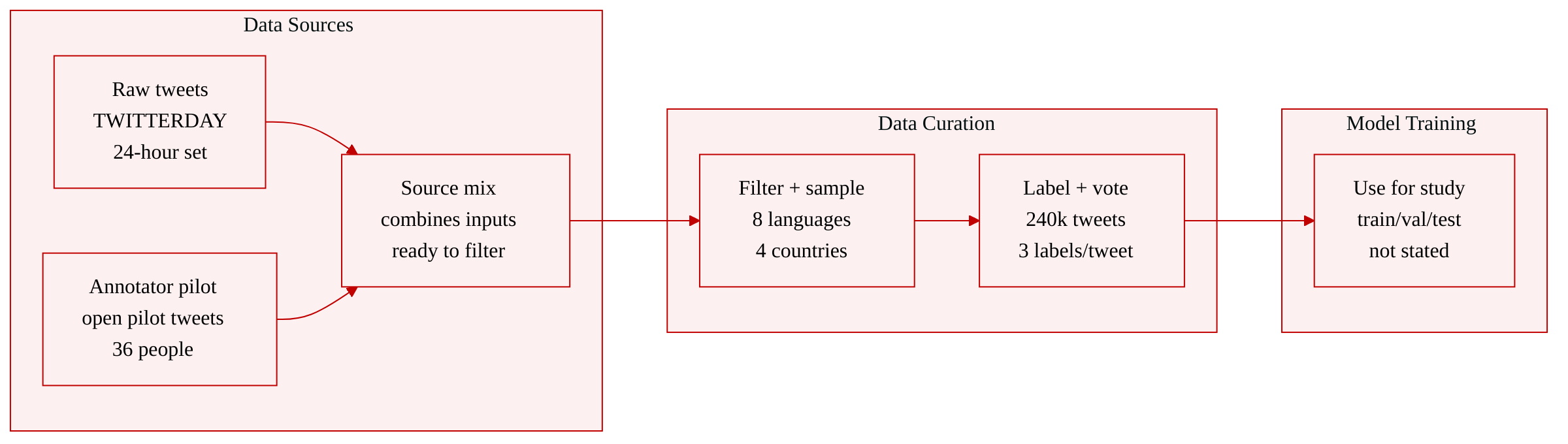
The authors build the HATEDAY dataset from the TWITTERDAY collection, which contains all Twitter posts from a 24-hour period starting on September 21, 2022, totaling about 375 million tweets from roughly 40 million users.
-
The dataset is constructed by applying language-level and country-level filters to TWITTERDAY:
- Language filter: The authors retain eight widely used languages with available hate speech detection resources: Arabic, English, French, German, Indonesian, Portuguese, Spanish, and Turkish.
- Country filter: For English, they additionally focus on four English-dominant Twitter markets: India, Kenya, Nigeria, and the United States.
-
User country is inferred from self-reported profile locations using the Google Geocoding API, with the authors noting that this approach has limitations.
-
Before sampling, the authors remove retweets so the dataset emphasizes original user content.
-
The final HATEDAY dataset consists of 240,000 annotated tweets:
- 20,000 tweets are randomly sampled for each of the eight retained languages.
- 20,000 tweets are randomly sampled for each of the four retained countries.
- These samples are intended to represent real-world Twitter activity within each language and country context.
-
The annotation setup includes 36 annotators, with three annotators assigned per language or country.
- For globally spoken languages such as English, Arabic, and French, the authors try to increase the geographic diversity of annotators.
-
Tweets are labeled into three categories:
- Hateful: posts that promote violence or directly attack, abuse, or threaten individuals or groups based on perceived identity characteristics.
- Offensive: posts that are objectionable but not hateful, including insults, threats, profanity, or swear words.
- Neutral: posts that are neither hateful nor offensive.
-
For hateful tweets, annotators also record the targeted group as free-text metadata.
-
Each annotator first completes a pilot phase, labeling 100 tweets drawn from open-source hate speech datasets on Hugging Face, repeated until inter-annotator agreement reaches a Krippendorff’s alpha threshold of 0.7.
-
Each tweet in the final sample is labeled by three annotators, and the final label is decided by majority vote. Agreement statistics show full agreement on 93.4% of tweets, partial agreement on 6.4%, and full disagreement on only 0.2%.
-
The authors use the resulting dataset to study the prevalence and nature of harmful content on Twitter.
- Hate speech is rare overall, averaging about 0.7% of posts and staying below 2% across languages and countries.
- Offensive content is much more common than hateful content, by factors ranging from 2.5 times in French to 19 times in Portuguese.
-
The annotated data also supports analysis of hate speech targets.
- The most common targets are political, racial, and gender-related groups.
- Context-specific patterns emerge, such as high religious hate speech in India, strong political hate speech in Germany, and forms like casteism appearing primarily in India.
Method
The authors leverage a structured annotation pipeline to produce consistent and subjectivity controlled labels for hate speech detection. The workflow begins by assigning each tweet to one of three semantic classes. A tweet is labeled as hateful if it promotes violence or contains a direct attack, abuse, or threat against an individual or a group based on perceived characteristics such as gender or race. A tweet is labeled as offensive if it contains potentially objectionable language that is not hateful, including insults, threats, profanity, or swear words. A tweet is labeled as neutral if it is neither hateful nor offensive. For tweets classified as hateful, annotators also provide a free text label identifying the targeted group, which creates a richer annotation signal beyond a single class assignment.
The annotation process is designed to reduce annotator subjectivity through prescriptive instructions and quality controlled training. A team of annotators is organized by language or country, and annotators working on globally spoken languages are selected to maximize diversity of origin. All annotators follow extensive guidelines that describe the hate speech taxonomy and clarify the boundary between hateful, offensive, and neutral content. Before annotating the main sample, each annotator completes a pilot phase using posts from previously open sourced annotated datasets. In this phase, annotators label 100 posts, and the process is repeated until interannotator agreement, measured by Krippendorff’s α, reaches a threshold of 0.7.
Once annotators pass the pilot phase, they label a random sample of 20,000 tweets for their assigned language or country. Each tweet is independently annotated by three annotators, and the final label is determined by simple majority vote. This multi annotator design creates redundancy and allows noisy individual judgments to be resolved through consensus. The resulting agreement statistics indicate a highly aligned annotation process: the three annotators agree on 93.4% of tweets, two annotators agree in an additional 6.4% of cases, and all three annotators disagree in only 0.2% of cases. The workflow therefore combines a predefined taxonomy, guided training, repeated agreement checks, redundant labeling, and majority voting to construct a reliable supervised signal for downstream model training.
Experiment
The experiments evaluate supervised hate-speech detectors, a widely used toxicity API, and zero-shot large language models on representative HATE-DAY social media data, alongside academic datasets and functional tests. They validate that real-world detection is far weaker than benchmark evaluations suggest, with supervised methods generally outperforming zero-shot models and the API often leading, while performance varies across languages and countries. Further analyses attribute the gap to offensive false positives, missing context, target misalignment between academic datasets and real-world hate prevalence, and the high human-review burden of moderation, implying that fully automated moderation is not viable.
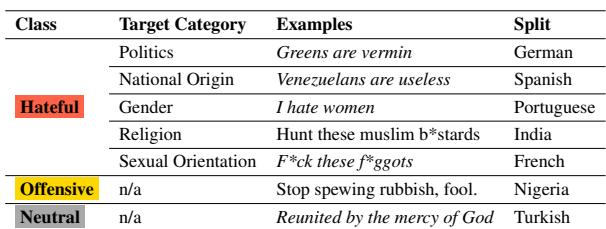
The examples distinguish hateful tweets, which target specific groups such as political, national, gender, religious, or sexual orientation groups, from offensive tweets that contain objectionable language but no specified target. They also show neutral tweets as ordinary language that is neither hateful nor offensive. This suggests that target identification is central to the hateful category, while offensive tweets are defined more by tone and profanity than by a group target. Hateful examples are tied to concrete target categories, including politics, nationality, gender, religion, and sexual orientation. Offensive and neutral examples have no target, with offensive tweets marked only by insulting or profane language.
Models perform substantially better on academic hate speech datasets and functional tests than on the representative real-world dataset. Across languages and countries, real-world detection remains limited, with stronger results for European languages and Indian data and weaker results for non-European languages and several other contexts. Supervised models generally score better than zero-shot open-source models, while the Perspective API shows strong functional-test performance and often higher real-world detection than open-source hate speech models. Detection performance drops sharply on real-world data compared with academic and functional test settings. European languages and Indian tweets generally show higher real-world accuracy than non-European languages and other countries. Supervised open-source models and the Perspective API often outperform zero-shot open-source models on real-world detection.

Across countries, model performance is much lower on real-world evaluation than on academic evaluation. Open-source models show the strongest real-world results in Nigeria, while the Perspective API performs relatively higher in the United States and India. Kenya lacks open-source supervised models for direct comparison, highlighting a coverage gap. Academic evaluation precision is consistently higher than real-world precision for both open-source and API models. The Perspective API outperforms open-source models on real-world data in the United States and India, while open-source models are strongest in Nigeria. No open-source supervised models are available for the Kenyan context, limiting model comparison there.
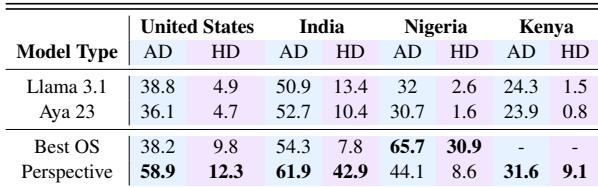
The examples clarify that hateful tweets depend on attacks against specific target groups, whereas offensive tweets are characterized mainly by insulting or profane language without a specified target. Experiments comparing academic tests with real-world, multilingual data show that hate speech detection is much harder in real-world settings, with generally stronger performance for European-language and Indian contexts and weaker performance for several non-European languages and regions. Supervised open-source models and the Perspective API typically outperform zero-shot models, though model strengths vary by country and coverage gaps remain.