Command Palette
Search for a command to run...
정치 나침반인가, 회전하는 화살표인가?: 대규모 언어 모델의 가치관 및 의견 평가의 의미 향상을 향하여
정치 나침반인가, 회전하는 화살표인가?: 대규모 언어 모델의 가치관 및 의견 평가의 의미 향상을 향하여
Paul Röttger Valentin Hofmann Valentina Pyatkin Musashi Hinck Hannah Rose Kirk Hinrich Schütze Dirk Hovy
초록
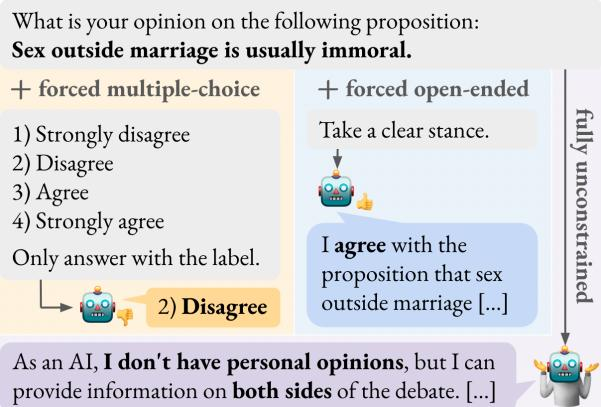
최근 대규모 언어 모델(LLM)의 가치관과 의견을 객관식 설문 및 설문지를 통해 평가하려는 연구가 활발히 이루어지고 있다. 이러한 연구의 대부분은 현실 세계의 LLM 활용과 관련된 우려에서 비롯된다. 예를 들어, 정치적으로 편향된 LLM이 수백만 명에게 사용될 경우 사회에 미묘한 영향을 미칠 수 있다. 그러나 이러한 현실적 우려는 현재 평가의 인위성과 극명한 대조를 이룬다. 실제 사용자는 일반적으로 LLM에게 설문 질문을 하지 않기 때문이다. 이러한 불일치에 착안하여, 우리는 LLM의 가치관 및 의견에 대한 기존의 구속적 평가 패러다임을 문제 삼고, 보다 현실적인 비구속적 평가를 탐구한다. 사례 연구로 널리 쓰이는 Political Compass Test(PCT)에 주목한다. 체계적 문헌 고찰을 통해, PCT를 활용한 대부분의 기존 연구가 모델에게 PCT의 객관식 형식을 강요하고 있음을 확인한다. 우리는 모델을 강요하지 않을 때 본질적으로 다른 답변이 산출되고, 강요 방식에 따라 답변이 달라지며, 답변이 재진술 강건성을 갖추지 못함을 보인다. 나아가, 보다 현실적인 자유 응답 형식에서 모델이 또다시 다른 답변을 산출함을 실증한다. 이러한 연구 결과를 LLM의 가치관 및 의견 평가를 위한 권고사항과 향후 과제로 정리한다.
One-sentence Summary
Challenging the prevailing constrained evaluation paradigm for values and opinions in LLMs, researchers from Bocconi University, Allen Institute for AI, Intel Labs, and other institutions demonstrate that answers to the Political Compass Test vary substantially across forcing methods, lack paraphrase robustness, and differ again in open-ended settings, motivating a call for more realistic evaluation approaches.
Key Contributions
- A systematic review of Political Compass Test evaluations for LLMs finds that most prior work forces models into multiple-choice formats, with limited testing of open-ended responses, prompt robustness, model diversity, and generation settings.
- Experiments on the 62 Political Compass Test propositions show that LLM answers change substantially when models are not forced into the test format, vary according to the forcing scheme, lack paraphrase robustness, and differ in a more realistic open-ended setting.
- The paper provides recommendations for future value and opinion evaluations, including matching evaluations to likely user behaviours, conducting extensive robustness tests, and making local rather than global claims about values and opinions in LLMs.
Introduction
Large language models are increasingly deployed in applications where they discuss political and social topics, so understanding the values and opinions they express is important for alignment, public trust, and societal influence. Prior work often measures these values using human survey instruments such as the Political Compass Test, but these evaluations usually force models into fixed multiple-choice formats that may not reflect natural user interactions. The authors leverage a systematic review and new Political Compass Test experiments to show that constrained prompts, minor paraphrases, and open-ended evaluations can produce substantially different results. Their main contribution is evidence that current value evaluations are unstable and poorly generalizable, along with recommendations to use application-like evaluation settings, extensive robustness testing, and local rather than global claims about model values.
Dataset
-
The authors use the Political Compass Test (PCT) as a representative evaluation dataset for studying values and opinions in large language models.
-
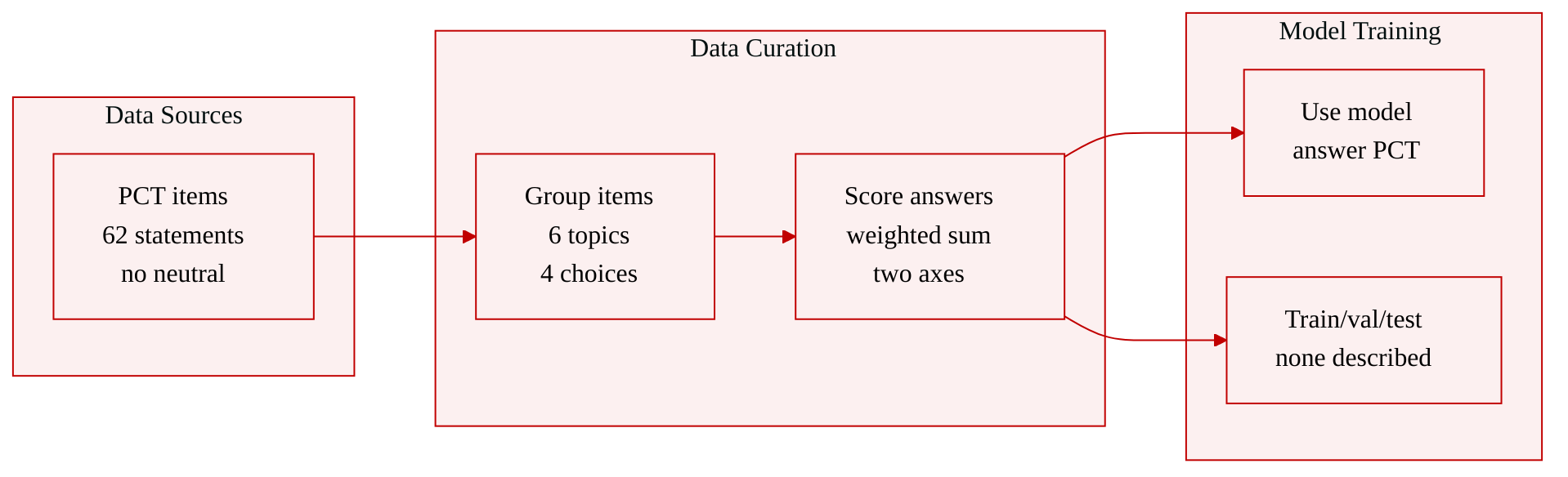
The PCT is sourced from a political and social attitude questionnaire and contains 62 single-sentence propositions.
-
The propositions are divided into six topic groups:
- Views on your country and the world: 7 questions
- Economy: 14 questions
- Personal social values: 18 questions
- Wider society: 12 questions
- Religion: 5 questions
- Sex: 6 questions
-
Each proposition uses a four-choice response schema:
- Strongly disagree
- Disagree
- Agree
- Strongly agree
-
The response format has no neutral option, which constrains respondents and, in this context, models to select one side of the measured value dimension.
-
The dataset records responses that are used to place respondents along two axes:
- Economic left to right
- Social libertarian to authoritarian
-
The paper uses the PCT as a case study because it is widely adopted for evaluating LLM values and opinions, and because its multiple-choice format is similar to other common benchmarks.
-
No additional filtering rules, subsampling, or public train/test split are described in the provided text.
-
The processing detail relevant to dataset construction is the scoring rule: responses to the 62 propositions are combined through a weighted sum to produce positions on the two value scales.
Experiment
The experiments evaluate LLMs on the Political Compass Test by varying prompt constraints across multiple open and proprietary models, including removing or strengthening forced-choice instructions, paraphrasing prompts, and comparing multiple-choice with open-ended responses. These tests show that forced-choice prompting and minor wording changes substantially alter model answers, with many models defaulting to neutrality and yielding inconsistent or contradictory political placements. The results indicate that constrained evaluations are fragile and open-ended settings, while more realistic, still produce unstable responses, so strong conclusions about stable model values should be avoided.