Command Palette
Search for a command to run...
미션 임파서블 언어 모델
미션 임파서블 언어 모델
Julie Kallini Isabel Papadimitriou Richard Futrell Kyle Mahowald Christopher Potts
초록
촘스키(Chomsky)를 비롯한 연구자들은 대규모 언어 모델(LLM)이 인간이 학습할 수 있는 언어와 학습할 수 없는 언어를 동등하게 습득할 수 있다고 직접적으로 주장해 왔다. 그러나 이러한 주장을 뒷받침하는 공개된 실험적 증거는 매우 부족한 실정이다. 본 연구에서는 서로 다른 복잡도를 가진 합성 불가능 언어 집합을 개발하였으며, 각 언어는 비자연적 어순과 문법 규칙을 체계적으로 적용하여 영어 데이터를 변형한 것이다. 이 언어들은 불가능성 연속체(impossibility continuum)상에 위치한다. 한쪽 끝에는 영어 단어의 무작위 및 비가역적 혼열(irreversible shuffle)과 같이 본질적으로 불가능한 언어가, 다른 쪽 끝에는 직관적으로는 불가능하지 않을 수 있으나 언어학에서 흔히 불가능한 것으로 간주되는 언어, 특히 단어 위치에 기반한 규칙을 가진 언어들이 위치한다. 본 연구에서는 이견의 여지없이 불가능한 언어들을 GPT-2 small 모델이 학습하는 능력을 평가하기 위한 광범위한 실험을 수행하였으며, 핵심적으로 각 언어의 학습 과정을 비교하기 위해 학습의 여러 단계에서 평가를 수행한다. 핵심 결과는 통제 조건인 영어와 비교할 때 GPT-2가 불가능한 언어를 학습하는 데 어려움을 보인다는 것이며, 이는 핵심 주장을 반박한다. 더욱 중요한 것은, 본 연구의 접근법이 다양한 LLM 아키텍처를 대상별로 불가능 언어에 대해 테스트하여 LLM이 인지적 및 유형론적 조사의 도구로 어떻게 활용될 수 있는지를 탐구하는 생산적인 연구 방향을 열기를 기대한다는 점이다.
One-sentence Summary
Researchers at Stanford University, UC Irvine, and UT Austin create synthetic impossible languages with systematically altered word orders and grammar rules to test whether GPT-2 learns them as readily as English, finding that it struggles with these languages and thereby challenging claims that LLMs are equally capable of learning human-possible and impossible languages, while proposing this framework as a tool for cognitive and typological linguistic investigation.
Key Contributions
- A controlled set of synthetic impossible languages is constructed by transforming English data with unnatural word orders and grammar rules, spanning random or irreversible word shuffles to position-counting rule systems.
- An experimental framework evaluates GPT-2 small models on these languages against natural English, comparing performance across multiple checkpoints during training.
- Results show that GPT-2 learns the impossible languages less effectively than English, challenging the claim that LLMs learn possible and impossible languages equally and supporting LLMs as tools for studying linguistic learnability.
Introduction
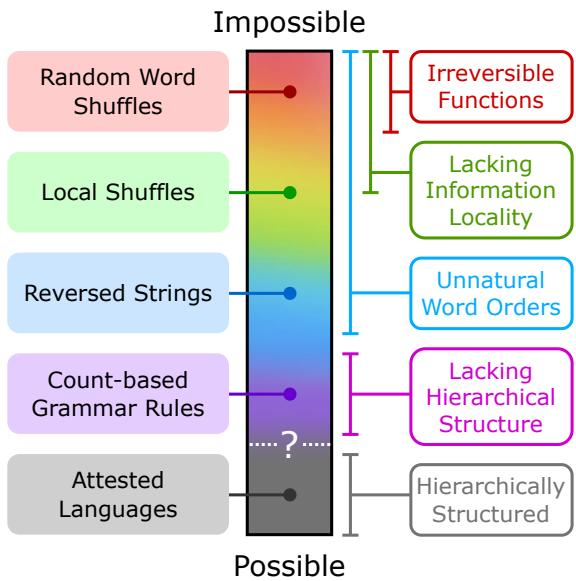
Large language models are increasingly used as experimental tools for linguistic theory, but some researchers argue that they cannot distinguish human-possible languages from impossible ones. If true, this would weaken the case that LLMs can inform models of human language learning.
The main challenge is that linguists do not share a precise definition of possible versus impossible languages, and prior evidence for this strong claim was limited, especially for modern LLMs.
The authors address this by creating a suite of synthetic impossible languages with varying intuitive complexity and testing GPT-2 models trained on BabyLM data. They find that the models learn natural languages more efficiently, react more strongly to unnatural count-based grammar patterns, and use modular internal representations that do not fully capture these impossible rules. This evidence challenges the claim that LLMs are equally good at learning possible and impossible languages, while also showing that model architecture and tokenization choices shape their linguistic preferences.
Dataset

-
The authors use BabyLM English sentences as the source data and synthesize impossible language datasets by applying deterministic or random perturbation functions to each sentence.
-
The dataset is organized into three language families: SHUFFLE, REVERSE, and HOP. Each family includes a control language that is close to normal English and several perturbed languages that vary in locality, reversibility, and grammatical rule counting.
-
SHUFFLE languages operate on tokenized sentences:
- NOSHUFFLE keeps the original token order and serves as an English control.
- NONDETERMINISTICSHUFFLE randomly shuffles tokens independently for each sentence, destroying order information.
- DETERMINISTICS HUFFLE uses a fixed shuffle pattern based on token sequence length and a chosen random seed.
- LOCALSHUFFLE shuffles tokens only within fixed-length local windows.
- EVENODDSHUFFLE places all even-indexed tokens before all odd-indexed tokens.
-
REVERSE languages insert a special marker token and reverse all or part of the sentence:
- NOREVERSE inserts a marker at a fixed position across the dataset and keeps token order unchanged.
- PARTIAL REVERSE inserts a marker and reverses tokens after the marker.
- FULL REVERSE inserts a marker and reverses the entire token sequence.
- Marker positions are controlled across languages to isolate the effect of reversal rather than marker randomness.
-
HOP languages modify verb agreement information to test counting-based grammar rules:
- NOHOP lemmatizes third-person present tense verbs and places a singular or plural marker immediately after the verb.
- TOKENHOP places the same marker four tokens after the verb.
- WORDHOP places the marker four words after the verb, skipping punctuation.
- The markers use special tokens to encode number and tense information.
-
The provided text does not give exact sentence or token counts for the BabyLM dataset.
-
The authors apply each perturbation function to every BabyLM sentence to create a transformed dataset for that impossible language.
-
The data schema is primarily a token sequence produced from English input, with additional special marker tokens used in REVERSE and HOP languages.
-
Language-specific filtering and preprocessing are used to enforce each language definition, though the precise filtering rules are not detailed in the provided excerpt.
-
The authors use the resulting datasets to train GPT-2 small models on causal language modeling, producing five model runs per language using different random seeds.
-
The main experiments use GPT-2 small models with absolute positional encodings, and the authors also train models with positional encodings removed to compare how word order is learned from the language modeling objective alone.
Method
The method introduces the *HOP languages as controlled perturbations of English text to test whether GPT‑2 can learn grammar rules that depend on positional counting. The transformation pipeline focuses on third-person present-tense verbs, replacing their surface inflection with a lemmatized verb and an explicit grammatical marker that encodes number. The model is then evaluated on how well it can predict or process this controlled representation.
For each input sentence, the pipeline first identifies all third-person present-tense verbs. Each identified verb is lemmatized, and a special marker is inserted to represent the verb’s number. Singular verbs receive a special token, for example S, and plural verbs receive another special token, for example P. This design removes normal English inflectional cues and replaces them with artificial markers whose placement depends on the chosen *HOP rule.
The three variants differ only in where the marker is placed relative to the verb.
-
NoHOP places the marker immediately after the lemmatized verb in token space. If the verb occupies token position t, the marker is inserted at position t+1. This version most closely resembles English word order, since the number cue remains directly adjacent to the verb.
-
TOKENHOP applies the same verb lemmatization and marker assignment as NoHOP, but the marker is placed four tokens after the verb. In this case, the marker is associated with the verb even though intervening words, spaces, punctuation, or subword fragments may separate them. This forces the model to rely on token-distance counting rather than local adjacency.
-
WORDHOP also uses the same transformation of verbs and markers, but places the marker four words after the verb while skipping punctuation. Here, the counting unit is linguistic words rather than model tokens. Punctuation is ignored when measuring distance, so the marker’s placement depends on a word-level count that may not align with the tokenizer’s token boundaries.
As a compact formulation, for a verb v and its number marker mv∈{S,P}, NoHOP inserts mv at pos(v)+1, TOKENHOP inserts mv at postoken(v)+4, and WORDHOP inserts mv at the position following four intervening words after v, with punctuation excluded from the count.
The purpose of this module is to create a family of grammars in which syntactic agreement is encoded through variable offsets. NoHOP tests whether a marker adjacent to a verb can be learned as a conventional local dependency. TOKENHOP tests whether GPT‑2 can learn fixed token-counting rules, where the distance between verb and marker is defined in the tokenizer’s space. WORDHOP tests whether the model can learn word-counting rules that operate at a level coarser than tokens and ignore punctuation. Together, these languages probe whether a transformer language model can represent grammatical rules that require counting positions across separated elements.
Experiment
GPT-2 models were trained on synthetic impossible language variants of BabyLM and evaluated through perplexity, surprisal-based verb-marker tests, and causal interventions to examine how well they learn unnatural grammars compared with natural controls. Across the experiments, models learned possible language patterns more easily and reliably than impossible ones, with natural verb-marking rules and more local or deterministic perturbations producing clearer learning signals. Probing the models’ internal mechanisms showed that they can form functional agreement representations even for unnatural count-based rules, but do so less robustly and more slowly than for natural grammar, indicating a bias toward informationally local, natural linguistic structure.
The examples contrast English-like control outputs with synthetic variants that reorder or scramble tokens, illustrating an impossibility continuum from familiar patterns to more complex artificial sequences. In the GPT-2 experiments, models trained on these languages diverge in perplexity, with nondeterministic shuffling producing the highest perplexity and deterministic shuffling yielding more learnable patterns. English-like control languages preserve recognizable word order and token patterns. Deterministic shuffle languages remain more learnable than nondeterministic shuffle languages because their token rearrangements follow consistent rules.
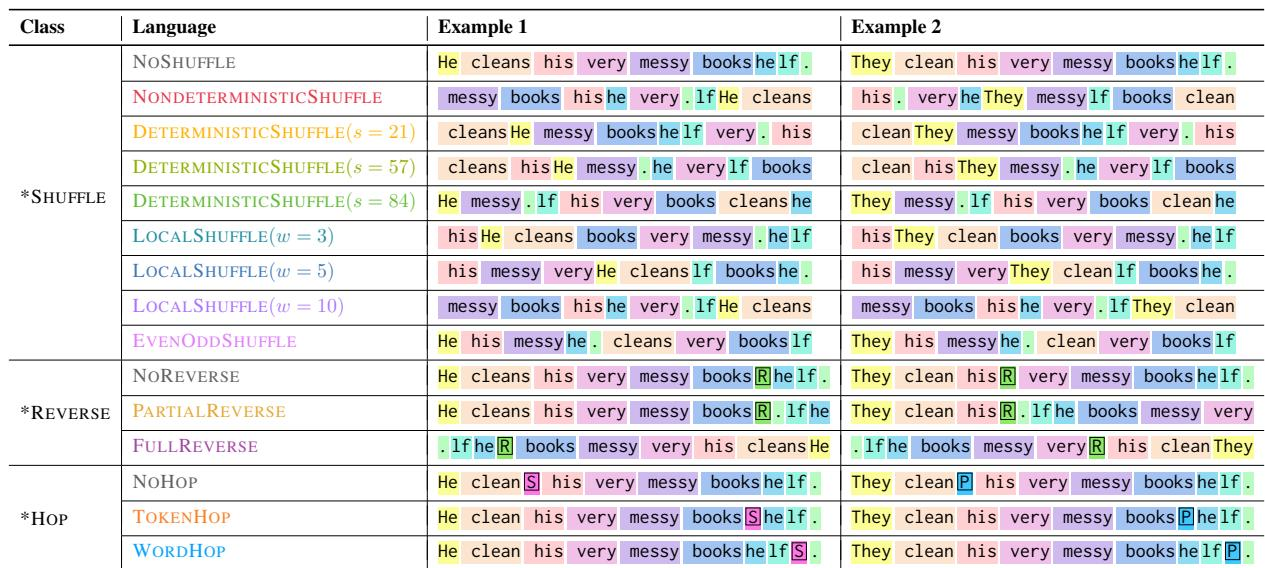
Experiments evaluate GPT-2 models trained on English-like languages and synthetic variants that impose controlled token reorderings, ranging from recognizable patterns to scrambled sequences. The results show that familiar English-like order is most learnable, deterministic shuffling remains learnable when rules are stable, and nondeterministic shuffling is hardest because its patterns are inconsistent. This supports the view that syntactic consistency and predictable token relationships shape model difficulty.