Command Palette
Search for a command to run...
활동 중심 RGB-열영상에서의 멀티모달 손-입 동작 인식 (학생 초록)
활동 중심 RGB-열영상에서의 멀티모달 손-입 동작 인식 (학생 초록)
Glenn Fernandes Meixi Lu Farzad Shahabi Jiayi Zheng Aggelos Katsaggelos Nabil Alshurafa
초록
과식 및 흡연과 같은 건강 위험 행동은 공공 보건에 심대한 영향을 미치므로, 이러한 행동의 모니터링과 완화는 매우 중요하다. 착용형 RGB-열영상 카메라는 손-입(HTM) 동작을 포착하여 이러한 행동을 모니터링하는 데 활용되고 있다. 그러나 단일 모달리티, 즉 RGB 또는 열영상에만 의존하는 탐지 모델은 조명 조건에 대한 민감도나 열영상 차폐와 같은 센서의 본질적 한계로 인해 과식 또는 흡연과 관련된 모호한 동작을 정확히 구분하는 데 어려움을 겪는다. 본 연구에서는 RGB와 열영상 비디오 데이터를 통합하는 융합 모델 계열을 제시한다. 조기 융합, 결정 융합, 그리고 본 연구가 제안하는 새로운 중간 융합 아키텍처인 RGB-Thermal Fusion Video Network(RTFVNet)를 포함한다. RTFVNet은 과식 및 흡연과 관련된 HTM 동작의 인식을 향상하도록 설계되었다. 평가 결과, 결정 융합이 가장 높은 F1 점수 88%(0.44 TFLOPs)를 달성하였으나, RTFVNet은 과식, 흡연, 비동작 활동의 동작 분류에서 성능(85%)과 복잡도(0.37 TFLOPs) 간 최적의 균형을 제공한다.
One-sentence Summary
Northwestern University proposes RTFVNet, a novel mid-fusion architecture within a family of early-, decision-, and mid-fusion RGB-Thermal models that recognizes hand-to-mouth gestures for eating and smoking monitoring in wearable footage, achieving an optimal balance between 85% F1-score and 0.37 TFLOPs computational cost.
Key Contributions
- An RGB-Thermal video dataset of 441.9 hours captured in free-living environments is provided for multi-class hand-to-mouth gesture recognition of eating, smoking, and non-gesture activities.
- A family of early-, mid-, and decision-fusion models combines RGB visual detail with thermal heat cues to distinguish confounding eating, smoking, and non-gesture hand-to-mouth gestures.
- RGB-Thermal Fusion Video Network (RTFVNet), a novel mid-fusion architecture, is presented for multi-class hand-to-mouth gesture recognition in activity-oriented camera footage; RTFVNet reaches 85% F1 at 0.37 TFLOPs, offering an optimal balance of accuracy and computational complexity compared with decision fusion at 88% F1 and 0.44 TFLOPs.
Introduction
RGB-Thermal wearable Activity-Oriented Camera systems are necklace-mounted devices that monitor health-risk behaviors such as eating and smoking from a non-egocentric perspective. This matters because reliable detection of hand-to-mouth gestures can support behavior tracking, health monitoring, and intervention. Prior work usually relied on RGB or thermal data alone, but RGB struggles in low light while thermal can be affected by ambient temperature changes and occlusions. To address these limitations, the authors contribute a large free-living RGB-Thermal video dataset, a family of fusion models for distinguishing eating, smoking, and non-gesture activities, and RTFVNet, a mid-fusion architecture designed for efficient multi-class gesture recognition.
Dataset

-
Dataset source: The authors collected the dataset using HabitSense, a neck-worn RGB-Thermal camera system designed to record activity-oriented video from the wearer’s face.
-
Dataset scale and composition: The dataset contains 441.9 hours of paired RGB and thermal video, collected from 7 smokers.
-
Modality setup: Each sample includes synchronized RGB and Thermal streams, reflecting the RGB-Thermal nature of the sensing system.
-
Annotation schema: The dataset is annotated with start and end points for eating and smoking gestures, providing temporal segment labels for these target actions.
-
Subset details: The provided text describes a single RGB-Thermal dataset rather than multiple labeled subsets, with participant information limited to the number of subjects.
-
Data usage in evaluation: The authors use the dataset for gesture recognition experiments and evaluate models using leave-one-participant-out cross-validation.
-
Training/validation strategy: Under this protocol, data from one participant are held out for testing, while the remaining participants are used for training and validation.
Method
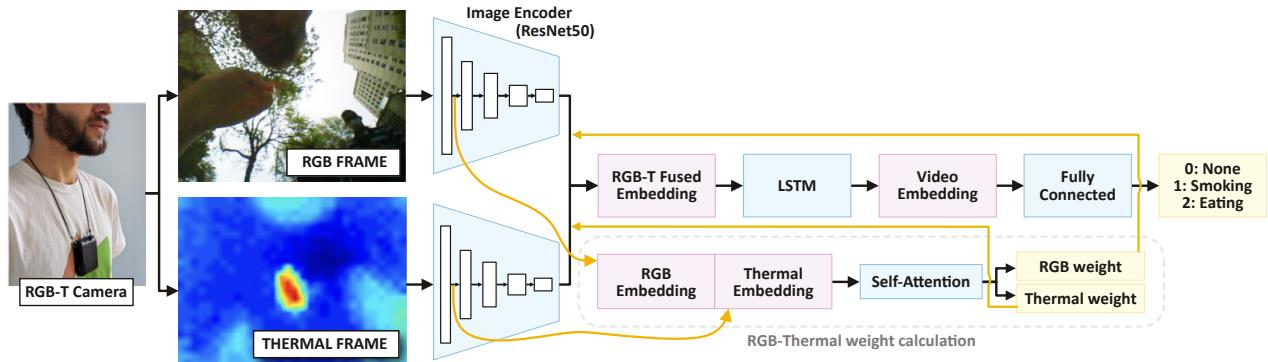
The proposed framework uses three fusion strategies to distinguish eating, smoking, and non gesture activities from paired RGB and thermal video streams. For decision fusion, the authors train two independent TimeSformer classifiers, one on the RGB stream and one on the thermal stream, then combine their predicted class outputs. For early fusion, RGB and thermal frames are concatenated before being input into a single TimeSformer model, allowing the video transformer to process the combined visual signal from the beginning.
The core contribution is RTFVNet, a novel mid fusion architecture adapted for multiclass gesture classification. The design is inspired by RGB thermal segmentation networks, but it removes the shortcut connections that transfer thermal encoder features into the RGB encoder. This modification allows each encoder branch to specialize in extracting features from its own modality, reducing cross modal interference before fusion and improving the use of modality specific evidence.
As shown in the architecture diagram:
In this module, RGB and thermal frames are first processed by separate early ResNet50 encoders. These encoders extract spatial embeddings from each modality independently. The RGB and thermal embeddings are then concatenated to form a joint representation. A self attention mechanism estimates the relative importance of the RGB and thermal streams for each frame pair. If zRGB and zT denote the latent features and wRGB and wT denote the learned modality weights, the fused representation can be expressed as:
z=wRGBzRGB+wTzTThe weighted features are then combined and passed through an LSTM layer to capture temporal dependencies across frames. A fully connected layer finally maps the resulting video embedding into three classes: none, smoking, or eating. The complete model family is trained and evaluated using leave one participant out cross validation, with performance assessed through classification metrics and computational cost.
Experiment
The experiments evaluate RGB-Thermal eating and smoking gesture recognition on a multi-participant dataset collected with a neck-worn HabitSense system, using leave-one-participant-out validation to compare single-modality and fusion approaches. These tests show that thermal and RGB streams each capture useful but incomplete cues, while decision fusion can improve accuracy at the expense of much higher computation. The proposed mid-fusion RTFVNet is validated as a more efficient alternative that retains strong recognition performance without the heavy cost of decision-level fusion.
The results compare single-modality RGB and thermal models with early, mid, and decision fusion approaches for detecting gestures. Decision fusion achieves the highest overall accuracy but has the highest computational cost, while mid fusion with RTFVNet provides a strong balance of performance and efficiency. RGB-based models generally outperform thermal-only models in the reported metrics. Decision fusion gives the best F1-score but requires about twice the compute of the single-modality models. Mid fusion with RTFVNet improves on RGB, thermal, and early fusion while using less compute than decision fusion. Thermal-only modeling has the lowest reported performance among the compared architectures.
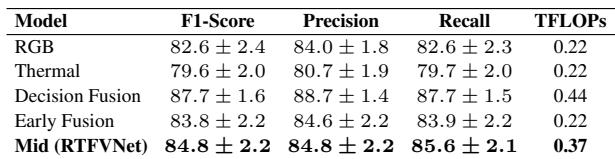
The experiments evaluate RGB, thermal, and fused models for gesture detection, comparing early, mid, and decision fusion. Decision fusion achieves the best overall accuracy and F1-score but requires roughly twice the compute of single-modality models. Mid fusion with RTFVNet provides a stronger performance efficiency balance than RGB, thermal, and early fusion, while RGB models generally outperform thermal-only models, which show the weakest results.