Command Palette
Search for a command to run...
Sage-Med: 의료 멀티모달 지능의 확장
Sage-Med: 의료 멀티모달 지능의 확장
초록
의료 멀티모달 대규모 언어 모델(MLLM)을 위한 효과적인 확장 법칙을 수립하는 것은 여전히 지속적이고 근본적인 도전 과제로 남아 있다. 본 연구의 체계적 평가에 따르면 기존 의료 MLLM은 다양한 의료 과제에서 최첨단 범용 MLLM에 비해 성능이 낮은 경향이 있으며, 모델 크기를 확장하더라도 멀티모달 인식보다는 주로 텍스트 능력만 향상되고 추론 모드를 활성화해도 이러한 시각적 격차를 해소하지 못하는 것으로 나타났다. 의료 멀티모달 지능이 실제로 어떻게 확장되는지 조사하기 위해, 우리는 3B 활성 파라미터를 갖는 35B 파라미터 규모의 의료 멀티모달 모델인 Sage-Med-Preview를 소개한다. 이 모델은 3억 2,270만 건의 후보 기록에 대한 단계별 큐레이션과 의료 사전학습, 단계적 지도 미세조정, 적응형 강화학습을 아우르는 점진적 학습 커리큘럼을 결합하여 구축되었다. 이 커리큘럼 전반에 걸쳐 점진적 지도 정제와 적응형 강화학습은 단계별로 일관된 성능 향상을 가져왔으며, 전문적 시각 이해와 의료 언어 능력을 모두 크게 발전시켰다. 40개 이상의 모달리티에 걸친 61개 공개 및 13개 비공개 다기관 벤치마크의 238개 임상 과제에서 77개 경쟁 모델과 비교 평가한 결과, Sage-Med-Preview는 31개 공개 멀티모달 벤치마크에서 평균 58.26%의 점수를 달성했다. 이는 최첨단 오픈소스 의료 모델인 Hulu-Med-235B-A22B의 50.99%와 범용 과학 모델인 Intern-S2-Preview의 52.24%를 능가하는 성능이며, 포괄적 멀티모달 이해, 보고서 생성, 시각적 그라운딩 등 여러 과제에서 최신 독점 모델인 GPT-6.2-Sol에 근접한 수준이다. 복잡한 의료 추론과 다단계 임상 워크플로우에는 여전히 상당한 과제가 남아 있지만, 본 보고서는 확장 가능한 임상 멀티모달 지능을 향한 실증적 증거, 실행 가능한 데이터 및 학습 레시피, 그리고 엄격한 벤치마크를 제공한다.
One-sentence Summary
Shanghai Artificial Intelligence Laboratory, Shanghai Jiao Tong University, and their collaborators introduce Sage-Med-Preview, a 35B-parameter medical multimodal model with 3B activated parameters that combines stage-specific curation over 322.7 million candidate records with a progressive training curriculum spanning medical pretraining, staged supervised fine-tuning, and adaptive reinforcement learning, achieving 58.26% on 31 public multimodal benchmarks and outperforming Hulu-Med-235B-A22B at 50.99% and Intern-S2-Preview at 52.24%.
Key Contributions
- A systematic evaluation of 77 models across 238 clinical tasks spanning 61 public and 13 private multi-center benchmarks in more than 40 modalities shows that existing medical MLLMs underperform frontier general-purpose MLLMs, and that scaling model size or enabling reasoning modes alone does not close the medical visual perception gap.
- Sage-Med-Preview is introduced as a 35B-parameter medical multimodal model with 3B activated parameters, built from stage-specific curation over 322.7 million candidate records and a progressive curriculum of medical pretraining, staged supervised fine-tuning, and adaptive reinforcement learning.
- The training recipe achieves an average score of 58.26% on 31 public multimodal benchmarks, outperforming Hulu-Med-235B-A22B at 50.99% and Intern-S2-Preview at 52.24%, and generalizes to unseen multi-center clinical cohorts with 57.72% versus 51.24% for GPT-6.2-Sol. It also approaches GPT-6.2-Sol on multimodal understanding, report generation, and visual grounding and supplies data and training recipes for scalable clinical multimodal intelligence.
Introduction
Medical image interpretation remains a rate-limiting step in diagnostic care, with specialist shortages concentrated where disease burden is highest; closing that gap requires models that combine visual perception and clinical language. Text-only large language models have reached expert-level diagnostic dialogue, but image models have developed one specialty at a time, and current medical multimodal large language models still show uneven gains, possible overreliance on text, and limited real-world validation. Key challenges include scarce high-quality image-text supervision, unclear adaptation recipes for specialist medical skills, and benchmarks that do not fully reflect clinical workflows. The authors introduce Sage-Med-Preview, a 35B-parameter medical multimodal model with 3B activated parameters, built through stage-specific curation of 322.7 million candidate records and a progressive curriculum of medical pretraining, supervised fine-tuning, and adaptive reinforcement learning. In evaluations across 77 models and 238 clinical tasks, prior medical MLLMs still trail general-purpose MLLMs on 29 of 31 public multimodal benchmarks, while Sage-Med-Preview becomes the strongest open-source model and outperforms the proprietary GPT-6.2-Sol on public and private multi-center clinical evaluations.
Dataset
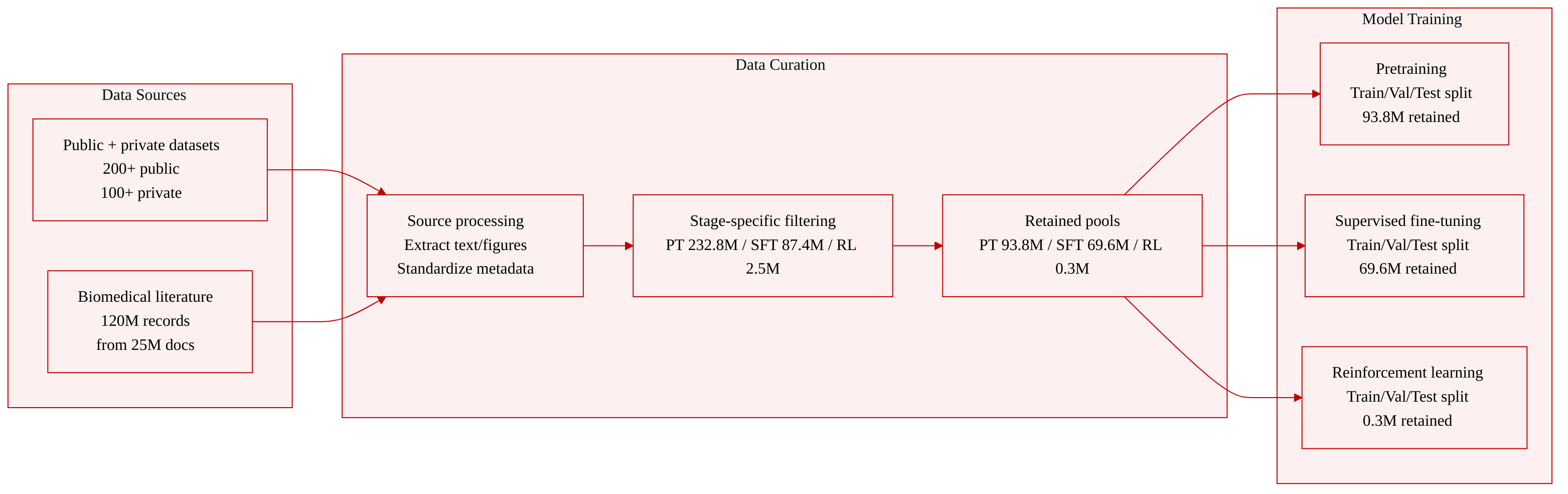
The authors use a stage-indexed medical training inventory built from public datasets, biomedical literature, and private resources.
-
Overall scale
- 322.7 million candidate records before stage-specific filtering
- 232.8 million candidates for pretraining
- 87.4 million candidates for supervised fine-tuning
- 2.5 million candidates for reinforcement learning
- 233.8 million multimodal records and 88.9 million text-only records
-
Data sources
- More than 200 public medical datasets
- More than 120 million biomedical literature records derived from 25 million source documents, including PDFs, books, and web pages
- More than 100 private data resources
- Sources span image-text pairs, task collections, and specialty imaging resources
-
Source processing and metadata
- PDFs and web pages are processed with MinerU to extract text and figures
- Extracted figures are associated with original legends, in-text references, and surrounding passages
- Existing multimodal collections are standardized by checking media references, image-text pairing structure, metadata, annotations, and source context
- Text-only and task-oriented resources retain references, source links, and supervision targets
- Metadata for modality, anatomical region, and medical concepts is preserved where available
- Supervision is organized into image descriptions, question answering and reasoning, report generation, and visual grounding
- Report supervision preserves section structure such as clinical history, findings, and impression
- Visual grounding requires localization references or annotations
-
Pretraining subset
- 232.8 million candidate records processed
- Filtering includes visual and textual usability checks, medical-content selection, textual and visual deduplication, image-text consistency assessment, caption rewriting and rechecking, and image-quality assessment
- Text-only records bypass image-dependent checks
- Estimated retained pool: 93.8 million records
-
Supervised fine-tuning subset
- 87.4 million candidate instruction-response records processed
- Filtering includes rule-based screening, deduplication, language-model-assisted quality scoring, length and format checks, task and reasoning verification, and retained-pool consolidation
- Main scoring branch requires at least 3 on a five-point scale, with source-specific acceptance rules
- Estimated retained pool: 69.6 million records
-
Reinforcement learning subset
- 2.5 million candidate records processed
- Filtering includes prompt and schema checks, task typing, reference validation, blind rollouts and task evaluation, difficulty-based routing, semantic checks, and replay routing
- Closed-answer prompts use eight responses per prompt for initial difficulty estimation
- Difficulty routing prioritizes prompts with two to six correct responses
- Estimated retained pool: about 0.3 million records
-
Coverage statistics
- The annotated image-reference subset covers 15 modality groups and 10 anatomical categories
- Pathology, MRI, and CT are the most prevalent modality groups
- Head and neck, thorax, and abdomen/pelvis are the most frequent anatomical categories
-
Use in training
- The inventory creates stage-specific candidate pools for pretraining, supervised fine-tuning, and reinforcement learning
- Retained pools provide candidates for later curriculum selection and training-stage allocation
- Selected record counts are reported separately in the supplementary material
- No explicit mixture ratios or image cropping strategy are described in this section
Method
The authors build Sage-Med on Intern-S2-Preview, a 35-billion-parameter scientific multimodal foundation model, and organize training into three successive phases: medical adaptation, progressive supervised fine-tuning, and adaptive reinforcement learning. The overall pipeline moves from broad medical knowledge and visual-semantic alignment toward instruction following and reward-guided policy refinement.
Before training, the authors apply stage-specific data curation to a large candidate inventory. For pretraining, the filtering pathway performs visual and textual usability checks, medical-content selection, textual and visual deduplication, image-text consistency assessment, caption rewriting with rechecking, and image-quality assessment. Text-only records bypass image-dependent checks. For supervised fine-tuning, the pathway includes rule-based screening, instruction deduplication, language-model-assisted quality scoring, length and format checks, task and reasoning verification, and retained-pool consolidation. For reinforcement learning, the curation pipeline establishes valid task specifications, assigns task families and evaluators, validates reference targets, computes blind rollout performance, routes prompts by success rate, and applies semantic checks before assigning records to RL task families or supervised replay.
Medical adaptation consists of two stages. Continual pretraining uses medical image-text pairs, document-derived evidence, textual medical knowledge, and supplementary scientific content to link visual data with medical concepts and terminology. Mid-training then introduces task structure by combining medical task data and knowledge-and-reasoning examples with sampled pretraining records and general scientific examples. This shifts the mixture toward explicit question-response learning before fine-tuning begins.
Progressive supervised fine-tuning is organized around three curriculum stages. The first stage focuses on instruction alignment, covering text-only, single-image, and multi-image inputs with tasks such as medical question answering, report generation, visual grounding, and selected reasoning problems. The second stage emphasizes task diversification by adding broader image-conditioned medical tasks while retaining text-based instruction learning and replaying selected Stage 1 examples. The third stage performs selective refinement by adding difficult-example supervision and chain-of-thought reasoning while keeping direct-answer examples and replay from earlier stages. Across stages, medical and general-purpose supervision remain present, and earlier examples are selectively incorporated into later mixtures.
Adaptive reinforcement learning uses group relative policy optimization and combines policy-dependent difficulty assessment, task-specific rewards, adaptive sampling, and independent reference replay. For closed-form tasks, task-specific verifiers compare model responses with reference targets to estimate prompt-level success rates. For open-ended tasks such as report generation and explanatory responses, a fixed judge applies task-specific rubrics using reference answers and supporting evidence. These assessments are kept separate from auxiliary reward components so that formatting improvements alone do not affect medical correctness estimates. Sampling priorities are updated according to the current policy: closed-form tasks use smoothed success estimates to balance correct and incorrect rollouts, while open-ended tasks use within-group rubric score variation with uniform sampling when reliable calibration is unavailable. Sampling is also adjusted by exposure-based downweighting and a uniform exploration component. Alongside adaptive RL, independent reference replay supplies teacher-forced supervision on reference responses sampled from a separate distribution, and its loss is combined with the GRPO loss to update the same policy while remaining outside the adaptive sampler.
Experiment
The study benchmarks Sage-Med-Preview against 77 general and medical models across 238 clinical tasks from public and private benchmarks spanning many modalities. Broader evaluations show that medical MLLMs still trail frontier general-purpose models, with substantial performance heterogeneity across task types and little consistent benefit from reasoning mode for multimodal perception. Sage-Med-Preview then demonstrates broad advantages over open-source and several proprietary models in multimodal understanding, medical text knowledge, hallucination identification, report generation, visual grounding, and clinical workflow, with private multi-center results supporting generalization. Training analyses attribute these gains to selective modality-balanced pretraining, progressive supervised refinement plus reinforcement learning, favorable base-model initialization, and balanced text and response-length composition.