Command Palette
Search for a command to run...
게으른 에이전트는 자신의 신념에 반하여 답한다: 검증 가능한 신념을 이용한 강화학습이 자신이 믿는 바에 따라 행동하도록 가르친다
게으른 에이전트는 자신의 신념에 반하여 답한다: 검증 가능한 신념을 이용한 강화학습이 자신이 믿는 바에 따라 행동하도록 가르친다
Richmond Sin Jing Xuan Peilin Feng Wenbin Wang Soujanya Poria
초록
긴 과제를 수행하는 AI 에이전트는 종종 너무 일찍 멈추어 충분한 증거를 확보하기 전에 답을 확정하는데, 이러한 행동을 흔히 게으름이라고 부른다. 우리의 평가에서 에이전트는 자신이 진술한 신념이 여전히 여러 가능한 답을 언급하고 있는 동안에도 답을 확정하는 경우가 빈번했다. 매 턴마다 에이전트는 추가 단계를 진행할지 아니면 답을 확정할지 결정한다. 에피소드 종료 시의 결과 보상은 최종 답만을 평가한다. 이 보상은 어떤 턴이 도움이 되었는지 보여주지 않으며, 운 좋은 추측이 증거에 의해 뒷받침된 답과 동일한 보상을 받기 때문에 에이전트에게 언제 답을 확정해야 하는지 가르칠 수 없다. 그러나 훈련 중에는 시뮬레이터가 숨겨진 답과 증거를 연결하는 규칙을 알고 있으므로, 매 단계마다 답에 대한 정확한 사후 확률을 계산하여 증거가 이미 충분한지 판별할 수 있다. 우리는 검증 가능한 신념을 이용한 강화학습(RLVB)을 제안하며, 이 방법은 이 사후 확률을 증거에 의해 뒷받침되는 신념으로 간주한다. RLVB는 이 신념이 여전히 여러 답을 허용하는 동안 추가 단계를 진행한 에이전트에게, 그리고 증거가 충분해지면 답을 확정한 에이전트에게 보상을 부여한다. 이 보상은 에이전트가 수집한 증거에만 의존하며 판정자, 비평가 또는 보상 모델이 필요하지 않다. 각 행동 전에 에이전트가 작성하는 신념 문장을 읽지 않지만, 업데이트는 이 문장을 행동과 함께 훈련시킨다. 또한 에이전트가 작은 창을 통해 넓은 세계를 관찰하고 언제 답을 확정할 만큼 충분한 시각적 증거를 확보했는지 결정해야 하는 시각 퍼즐 벤치마크인 Pro-Worlds를 소개한다. 세 가지 벤치마크에서 세 가지 시각-언어 모델을 평가했으며, 그중 두 가지는 훈련에서 본 적이 없다. RLVB는 아홉 가지 모든 설정에서 기본 모델을 개선했으며, 평균 17.1%, 기대값 최대화(EM)를 학습기로 사용했을 때는 10.4% 개선했다. 결과 보상 하에서 GRPO와 PPO는 평균적으로 기본 모델보다 낮은 성능을 보였다. RLVB는 또한 LLM 판정자의 과정 보상을 사용하는 PPO보다 평균 9.3% 더 우수한 성능을 보이면서 GPU 시간은 1.6배 적게 사용했다. 이러한 성능 향상의 원인을 찾기 위해 에이전트가 답할 때 보유한 증거에 따라 답을 분류했다. 훈련된 에이전트는 세 가지 벤치마크에서 에피소드의 51%, 12%, 74%에서 충분한 증거를 가지고 답한 반면, 기본 모델은 8%, 0.4%, 36%에 그쳤다. 모든 방법에서 충분한 증거를 가지고 제시된 답의 6692%가 정답이었다. 따라서 훈련된 에이전트의 정확도 향상은 높은 증거 수준에서 더 자주 답하는 데서 비롯되며, 동일한 증거 수준에서는 그 답이 기본 모델의 답보다 더 정확하지 않다. 신념 문장은 훈련된 에이전트가 어떻게 이러한 증거에 도달하는지 보여준다. 즉, 자신의 신념에 따라 행동한다는 것이다. 증거가 불충분하고 신념 문장이 여전히 여러 답을 언급하는 턴에서 답을 확정하는 비율은 0.12.2%에 불과한 반면, 동일한 문장을 가진 기본 모델은 3~68%에 달했다. 전체 턴에 걸쳐 훈련된 에이전트의 신념 문장이 기본 모델보다 일관되게 더 정확하지는 않으며, 각 단계에서 추가하는 증거의 양도 기본 모델의 단계와 비슷하다. 훈련된 에이전트가 자신의 신념에 따라 행동하기 때문에, 증거를 더 잘 읽는 능력이 더 나은 답으로 이어질 것으로 기대한다.
One-sentence Summary
Researchers from DeCLaRe Lab, Nanyang Technological University propose Reinforcement Learning with Verifiable Beliefs (RLVB), which uses simulator-derived posterior beliefs to reward evidence gathering and timely commitment without a judge, critic, or reward model, and introduce Pro-Worlds, a benchmark of visual puzzles where an agent views a large world through a small window; RLVB improves three vision-language models on three benchmarks by 17.1% on average and by 10.4% with expectation maximization (EM) as the learner, outperforms PPO with an LLM-judge process reward by 9.3% on average while using 1.6 times fewer GPU-hours, and leaves GRPO and PPO under outcome reward below the base model on average.
Key Contributions
- Reinforcement Learning with Verifiable Beliefs (RLVB) uses the simulator's exact posterior over hidden answers as a verifiable belief and assigns turn-level rewards for continuing while evidence still supports multiple answers and for committing once evidence is sufficient, requiring no judge, critic, or reward model.
- Pro-Worlds is introduced as a benchmark of visual puzzles in which an agent views a large world through a small window and must decide when it has enough visual evidence to commit.
- Across three vision-language models and three benchmarks, two of which are unseen during training, RLVB improves the base model in all nine settings, by 17.1% on average and by 10.4% with expectation maximization as the learner; it also outperforms PPO with an LLM-judge process reward by 9.3% on average while using 1.6 times fewer GPU-hours, with gains attributed to answering more often with sufficient evidence and acting on the stated belief.
Introduction
Long-horizon agents in games, embodied settings, and interactive environments must gather sufficient evidence before answering, but current models often stop too early and guess even when their own stated belief still leaves several answers open. This matters because users usually cannot check how an agent reached its answer, so reliability requires answers to be both correct and backed by sufficient evidence. Outcome-based reinforcement learning struggles here because a final answer reward cannot credit individual steps, and it can reinforce lucky guesses while penalizing careful but unsuccessful search. Process reward models and LLM judges can provide step-level credit, but they are expensive and may still reward lucky guesses. The authors introduce Reinforcement Learning with Verifiable Beliefs, or RLVB, which uses the simulator's privileged information to compute the exact posterior belief after every step and converts that belief into a process reward, requiring no judge, critic, or reward model.
Dataset
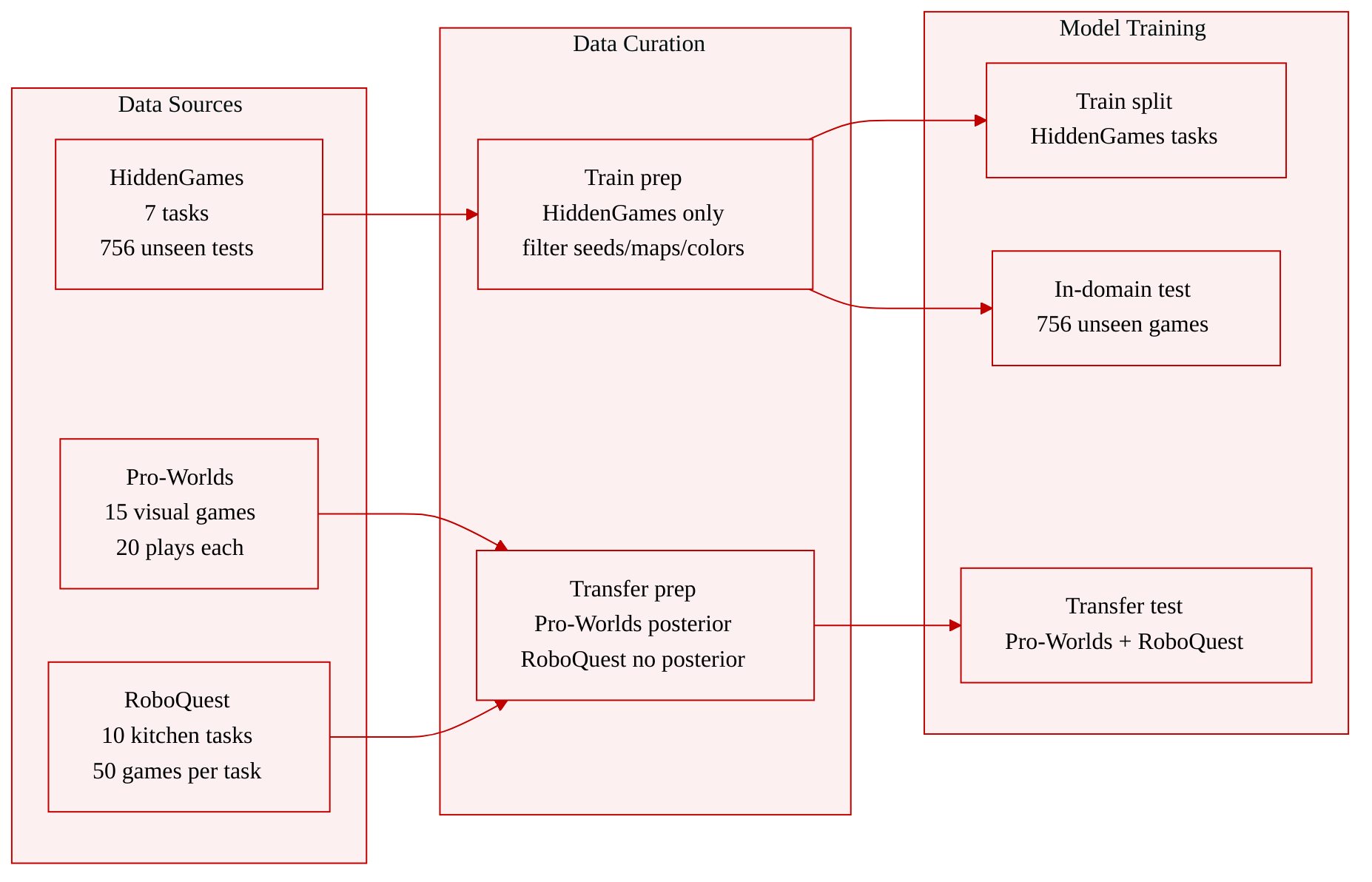
The authors use three benchmark suites, all with hidden answers that require the agent to collect evidence and decide when to answer.
- HiddenGames: combines seven tasks from existing agent benchmarks: MineSweeper, MiniGrid KeyCorridor, FrozenLake, Sokoban, and three Tabletop tasks rendered in ManiSkill3. The authors train on these tasks and test on 756 games with seeds, maps, and colors never seen in training.
- Pro-Worlds: a new out-of-domain visual benchmark with 15 games, 20 plays each: Face, Jigsaw, Kaleido, Bird, Fish, Recipe, Turtle, Balloon, Rocket, Bell, Bee, Candle, Sailboat, Barn, and Lantern. In each game, the agent sees a larger world through a small movable window, can make at most 35 moves, and then selects one of eight candidates, except Jigsaw which has ten candidates. Exact posterior distributions are computed from the game engine; a teacher using this posterior solves every game in 14.7 moves on average.
- RoboQuest: ten mobile manipulation tasks in simulated kitchens. It includes search, inspection, and interactive testing, such as finding an odd parcel by weighing. The authors test on 50 games per task.
Usage: HiddenGames provides the training and in-domain test data. Pro-Worlds and RoboQuest are used as transfer benchmarks to test visual evidence gathering and tasks without an exact posterior. Mixture ratios and additional filtering rules are not reported.
Method
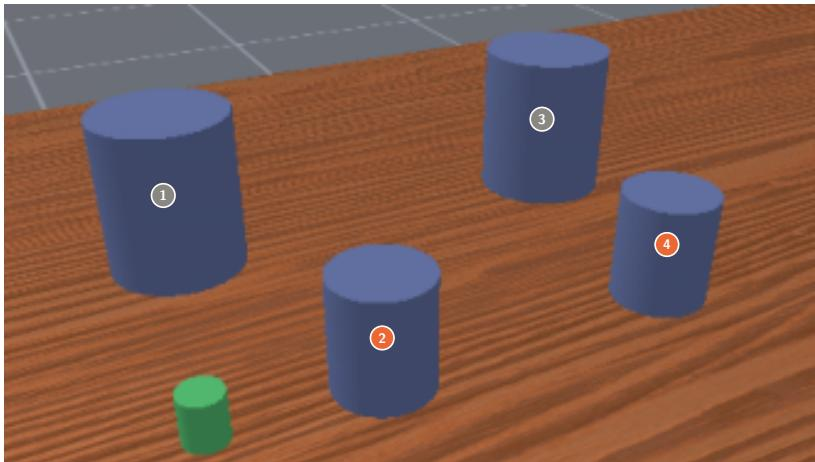
The authors propose RLVB, a reinforcement learning framework that trains vision-language agents to act based on verifiable beliefs in partially observable environments. The environment, such as the cups task shown below, involves a hidden target and evidence-gathering actions.
In this setup, the simulator computes an exact posterior over the hidden target based on the evidence gathered so far. The agent is a vision-language model that generates a turn consisting of reasoning, a belief line stating the set of possible answers, and an action. The objective is formulated as a partially observable Markov decision process where the agent must decide when to commit to an answer.
To guide the agent, the authors design a posterior teacher that operates on the exact posterior. This teacher values each action by computing the expected value of the posterior after the action, defining an optimal teacher policy. The teacher's stopping rule adapts to the agent's accuracy, encouraging more evidence gathering when the agent is unreliable.
The core of the method is the posterior process reward, which evaluates each turn at a given history. The reward function consists of an action term and a belief term. The action term scores the agent's action against the teacher policy based on the exact posterior, heavily penalizing premature answers while lightly discounting extra steps. This teaches the agent to commit only when the evidence is sufficient. The belief term directly checks the agent's stated belief line against the exact posterior, combining a log score, a penalty for overly wide beliefs, and a decision score. The full reward is expressed as R(h,x)=logπ∗(u∣b)+Sdec+η(S+W).
Refer to the framework diagram for a comparison of RLVB with other reinforcement learning approaches.
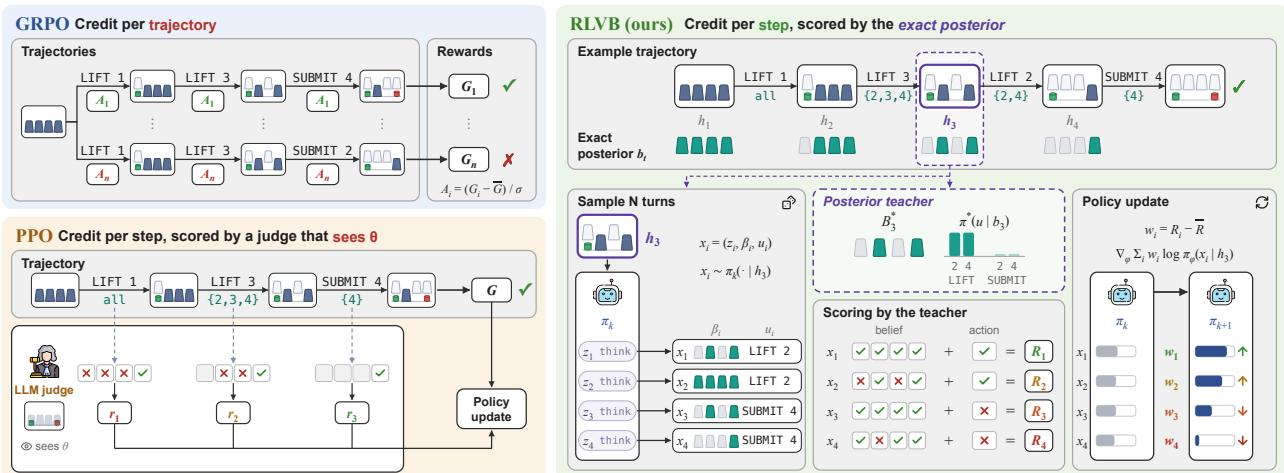
The policy update is performed step-by-step rather than over entire trajectories. Training occurs in phases where a fixed policy generates episodes, and at each history, multiple turns are sampled and scored. The update uses a group-relative weighting scheme similar to GRPO, but the group consists of the sampled turns at a single history. The weights are proportional to the reward minus the mean reward of the group. This ensures that each decision is credited only against alternatives under the exact same evidence, avoiding the credit assignment issues of trajectory-based methods. The model is updated via gradient steps on the weighted log likelihood, moving toward an improved policy while keeping the KL divergence within a threshold.
Experiment
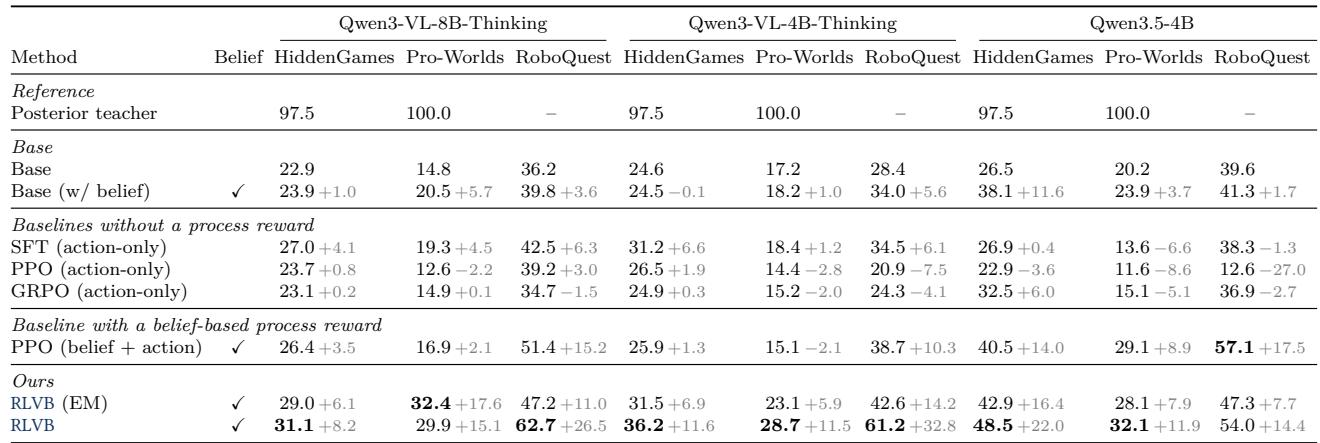
The experiments evaluate agents on HiddenGames, Pro-Worlds, and RoboQuest, where answers are hidden and models must gather evidence before committing. They train open vision-language models with baselines using outcome rewards, belief-augmented PPO, and the proposed RLVB, which rewards turns against an exact posterior. RLVB achieves the highest accuracy and transfers to unseen benchmarks mainly by acting on its own belief line, committing less often when that line still names multiple answers and therefore gathering more evidence, even though its belief reading is not consistently better. Ablations show the posterior-based action term, rather than belief-line rewards, drives the gain, while limitations include relying on known rules and still performing below the posterior teacher.
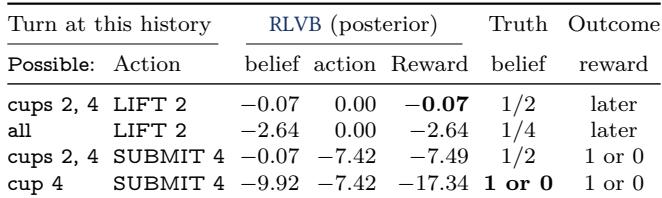
After the agent has lifted two cups, the target is equally likely under one of the two remaining cups. RLVB scores the next decision by combining a belief term and an action term, and it treats further evidence gathering as lower cost while heavily penalizing premature guesses, especially when the guessed cup is not confirmed. The pattern shows RLVB prefers further observation over premature commitment in this state. Lifting an unresolved cup can receive a zero action component and a relatively small belief penalty compared with submitting a guess. Submitting a guess under uncertainty is penalized more heavily than lifting, and the penalty grows further when the candidate cup is not confirmed. Exact posterior truth assigns equal probability to the two remaining cups, while final outcomes for submitted guesses are binary depending on whether the guessed cup hides the target.
Three vision-language models were evaluated on three benchmarks spanning training tasks and unseen environments. Stating a belief before actions improves accuracy without training, but the main and most transferable gains come from the posterior process reward used by RLVB. RLVB and RLVB (EM) outperform outcome-reward, imitation, and judged process-reward baselines in nearly all settings and reduce premature answers by acting on the belief line. Stating a belief improves accuracy in eight of nine settings without training, but it does not prevent early answers; RLVB’s posterior reward yields the strongest gains and reduces premature answers. Outcome rewards provide little or negative average improvement, while posterior process rewards transfer to unseen benchmarks and make RLVB or RLVB (EM) the best method in eight of nine settings.
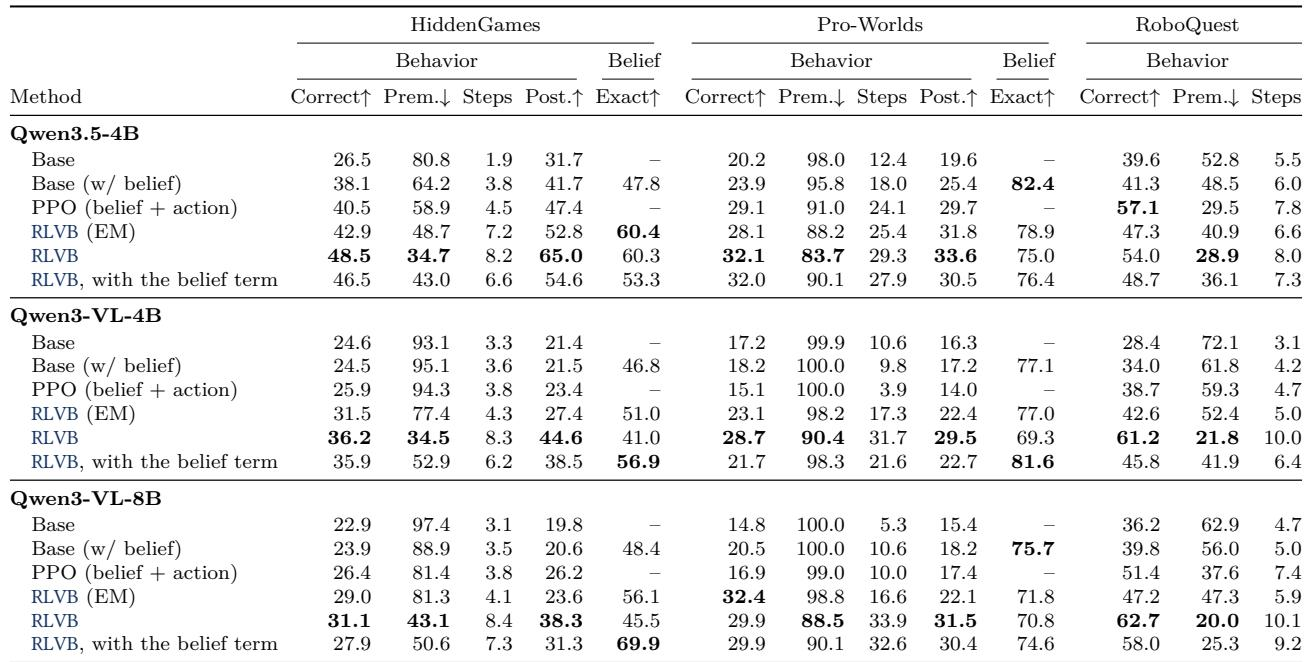
RLVB shows the most metacognitively consistent behavior among the evaluated agents, producing the fewest premature answers and taking the most evidence-gathering steps across all nine settings. On HiddenGames its premature answer rate is much lower than for PPO with belief and action or the base model with belief, even though its belief line is not the most often exactly aligned with the exact posterior. The improvement appears to come from acting on the stated belief, since the agent rarely commits while its belief line still names several answers. Across all nine settings, RLVB records the fewest premature answers and the highest number of evidence-gathering steps per episode. On HiddenGames, RLVB answers prematurely less often than PPO with belief and action or the base model with a belief line. RLVB rarely commits while its belief line still names multiple possible answers, linking its gain to acting on belief. Stating a belief alone does not prevent early answers, as base models with a belief line still commit on 3 to 68% of insufficient-evidence turns where their belief names several answers.
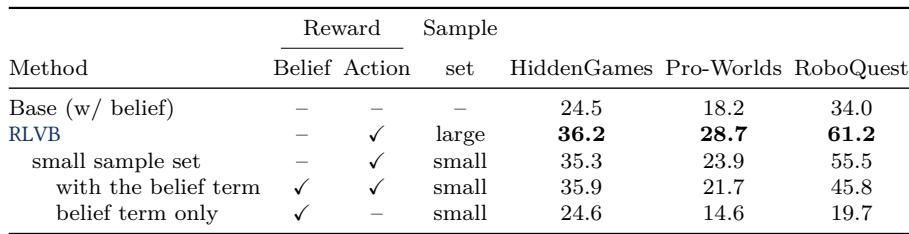
An ablation on Qwen3-VL-4B-Thinking shows that RLVB's gains are driven mainly by the action reward rather than the belief reward. Reducing the sample set from large to small leaves HiddenGames nearly unchanged but lowers accuracy on Pro-Worlds and RoboQuest, indicating the larger sample helps on benchmarks not seen in training. Adding the belief term to the action reward does not improve performance, and a belief-only reward performs at or below the base model. The action reward is the main source of RLVB gains; belief-only training matches or underperforms the base model across all three benchmarks. Using a large sample set mainly helps Pro-Worlds and RoboQuest, where the small sample set reduces accuracy. Adding the belief term to the action reward with a small sample set leaves HiddenGames nearly unchanged but lowers accuracy on Pro-Worlds and RoboQuest. Removing the action term causes performance to fall below the base model on Pro-Worlds and RoboQuest and to match the base model on HiddenGames.
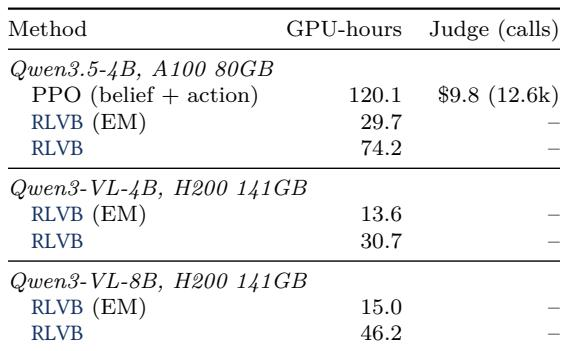
Training cost differs sharply by method. On the same model and GPU, PPO with belief and action is the most expensive setting and the only one with reported LLM judge calls, while RLVB runs are cheaper and RLVB EM runs are cheaper still. RLVB runs also stopped early after 20 to 35 updates because of a step KL limit, which contributes to their lower cost. Within Qwen3.5-4B runs, RLVB uses less GPU time than PPO, and the EM variant uses roughly a quarter of PPO's GPU time. The table reports no judge calls for RLVB variants, whereas PPO includes 12.6k judge calls costing $9.8. RLVB runs end before the planned 50 updates due to a step KL limit, reducing their compute cost.
The experiments evaluate RLVB in a sequential cup-search setting and across three vision-language benchmarks spanning training and unseen environments. RLVB's posterior process reward favors further evidence gathering over premature guessing, yielding the fewest premature answers and the most evidence-gathering steps, while belief statements alone improve accuracy but do not prevent early commitment. Ablations show the action reward, not the belief term, drives RLVB gains, larger sample sets help unseen benchmarks, and training cost is lower than PPO, especially for the EM variant.