Command Palette
Search for a command to run...
물리적 행위 주체성 벤치마킹
물리적 행위 주체성 벤치마킹
Xinyang Zhou Qi Li Xinchao Wang
초록
AI 시스템은 이제 블렌더를 조작하고, 복잡한 비디오 게임의 지시를 따르며, 로봇 팔로 물체를 다룰 수 있다. 오늘날의 AI 시스템이 자율적으로 달성할 수 있는 물리적 목표의 범위는 어디까지인가? 이 질문에 답하려면 지각, 기억, 계획, 행동의 서로 다른 조합을 요구하는 과제에서 시스템을 시험해야 한다. 우리는 로봇의 궤적으로부터 각 과제의 물리적 목표를 향한 진척도를 측정함으로써 60개의 시뮬레이션 로봇 과제로 구성된 공통 집합에서 AI 시스템을 비교하는 벤치마크인 WorldLeague를 소개한다. 로봇은 WorldSeek에서 증거를 수집하기 위해 장면을 탐색하고, WorldShape에서 물체를 재배치하며, WorldShift에서 변화에 적응한다. 이러한 목표를 단일 제어 인터페이스에 묶으면 비교할 수 있는 AI 시스템의 범위가 제한된다. WorldLeague에서는 시각-언어 모델(VLM)이 목표와 동작을 선택하는 반면, 시각-언어-행동 모델(VLA)과 세계-행동 모델(WAM)은 자체 제어 방식을 사용한다. 여섯 가지 능력 차원 각각에 대해 시스템이 목표를 향해 얼마나 진척했는지(상호작용 점수)와 목표를 얼마나 자주 달성했는지(물리적 성공률)를 측정한다. 이 두 측정값이 함께 시스템의 물리적 행위 주체성 프로파일을 구성한다. 대표적인 13개 AI 시스템 중 Claude Fable 5.2는 60개 목표 중 13개를 달성하고 가장 높은 평균 상호작용 점수(28.58/100)를 획득했다. Fable은 네 가지 차원에서 선두를 차지했으며, GPT-6.1-Sol과 GPT-6-Astra는 규칙 준수 과제에서 공동 1위를 기록했다. VLM이 모든 최종 질문에 정확히 답한 경우에도 해당 에피소드의 71.8%에서 상호작용 점수가 0으로 나타났다. WorldLeague는 체화 AI, 물리 AI, 에이전트 AI에 물리적 목표를 향한 부분적 진척부터 완전한 목표 달성까지 AI 시스템이 자율적으로 성취하는 바를 비교할 수 있는 공통 기반을 제공한다.
One-sentence Summary
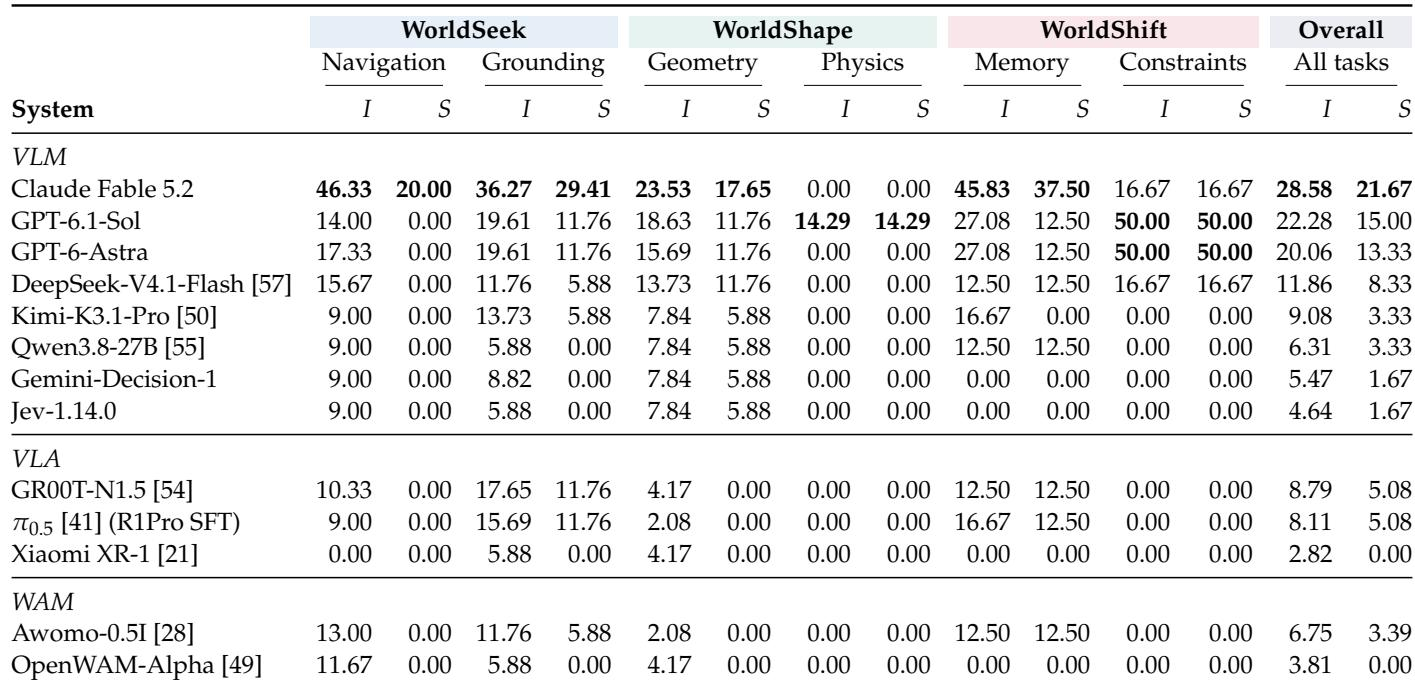
Researchers at xML Lab, National University of Singapore, introduce WorldLeague, a 60-task simulated robot benchmark that compares vision-language models (VLMs), vision-language-action models (VLAs), and world-action models (WAMs) by measuring trajectory progress toward physical goals in WorldSeek, WorldShape, and WorldShift to produce Interactive Score and physical success rate profiles, with Claude Fable 5.2 earning the highest mean Interactive Score (28.58/100) and leading in four of six capability dimensions.
Key Contributions
- WorldLeague is a benchmark of 60 simulated robot tasks spanning exploration (WorldSeek), physical transformation (WorldShape), and adaptation (WorldShift), measuring progress toward each task's physical goal from robot trajectories and supporting vision-language models, vision-language-action models, and world-action models through their respective control interfaces.
- The benchmark defines a Physical Agency Profile that combines an Interactive Score for partial progress toward each goal with a physical success rate across six capability dimensions.
- Across 13 representative AI systems, Claude Fable 5.2 achieves the highest mean Interactive Score (28.58/100) and completes 13 of 60 goals, leading on four dimensions, while GPT-6.1-Sol and GPT-6-Astra tie for first on rule-following tasks; 71.8% of vision-language model episodes with full terminal QA credit receive zero physical operation credit.
Introduction
Foundation models have expanded robot capabilities in both digital and physical environments, but embodied AI systems differ in how they connect perception to action: vision-language models choose targets and parameters through an action interface, vision-language-action models produce actions directly, and world-action models jointly predict future observations and actions. Existing robot benchmarks often organize evaluation around household activities, which can obscure the specific demands being tested and allow the same activity label to hide untested capabilities such as temporal memory, geometric reasoning, or recovery from disturbances. The authors introduce WorldLeague, a validated benchmark of 60 simulated tasks that evaluates 13 embodied AI systems across six capability dimensions using shared goals, constraints, and physical success criteria, revealing large gaps between task understanding and physical goal achievement.
Dataset
The authors describe WorldLeague as a benchmark with 60 embodied AI tasks, grouped by their primary physical challenge.
-
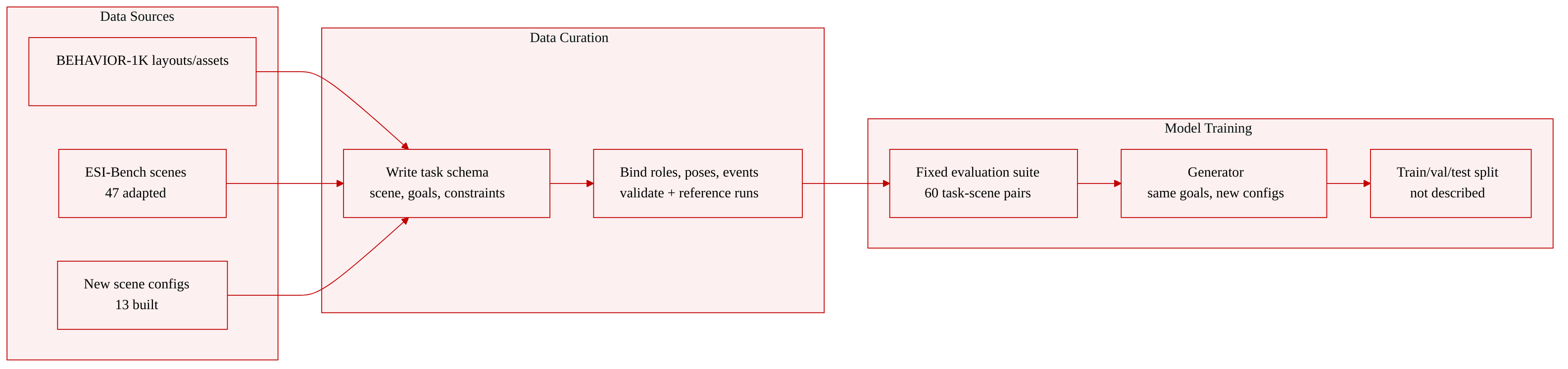
Sources and scale
- 60 fixed task-scene pairs form the evaluation suite.
- The goals are instantiated with BEHAVIOR-1K layouts and assets.
- 47 scenes adapt ESI-Bench scene records.
- 13 scenes use newly built scene configurations.
- InteractiveWorld informed the design of nine challenges.
-
Task tracks
- WorldSeek: ordered six-room pickup and hidden-object search. These tasks require spatial navigation, exploration, and goal grounding.
- WorldShape: object rearrangement in furnished rooms, including geometric reconfiguration and stable stacking. These tasks require physical reasoning about reach, clearance, and support.
- WorldShift: temporal memory and constraint management under scene changes. These tasks require detecting changes and revisiting completed steps when necessary.
-
Task schema and processing
- Each task is written as a tuple containing the physical scene, initial conditions, public goal, constraints, goal predicates, and interaction budget.
- The authors write the public instruction, specify constraints, and define physical predicates for each goal requirement.
- Object roles are bound to scene entities, object poses and the robot starting pose are set, and task events are configured.
- The evaluator uses the same object bindings to check private predicates.
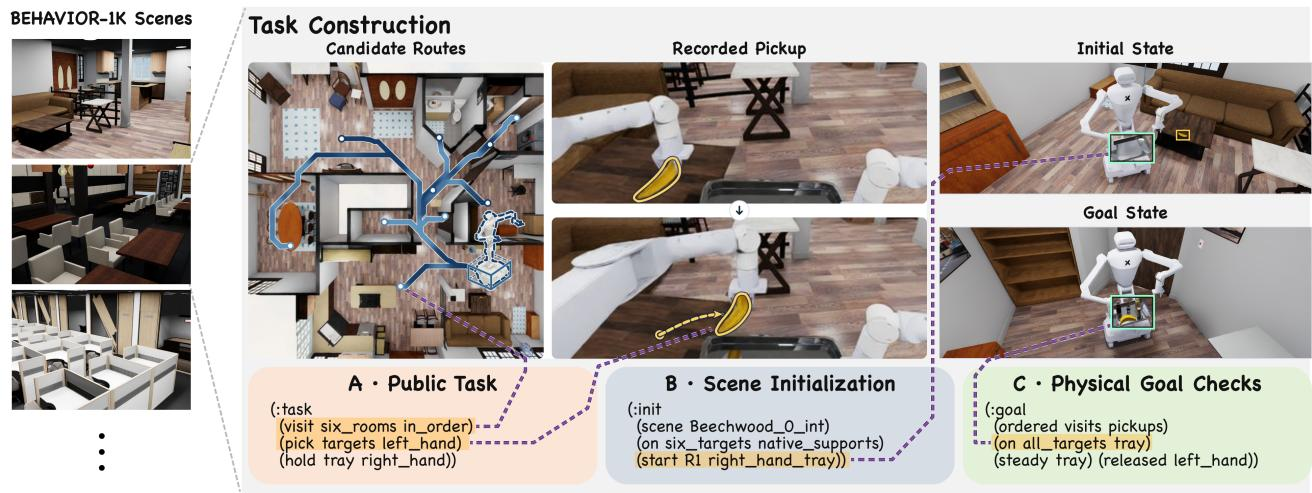
- For example, in the six-room pickup task, room visits are encoded as room-entry events, and collection requires the designated objects to remain stable on the tray after release.
-
Validation and filtering
- All 60 task-scene pairs were manually inspected.
- Reference runs were verified to satisfy the goals and constraints.
- Scoring thresholds were checked against the task specifications.
-
How the data is used
- The fixed instances are used as the evaluation suite.
- A generator can instantiate the same goals in new configurations by varying objects, layouts, robot starts, and task events while preserving the scoring predicates.
- Training split or mixture ratios are not described in this excerpt.
Method
The authors construct executable tasks by translating high-level goals into structured specifications that include public instructions, physical constraints, and goal predicates. For each task, they bind object roles to scene entities, define initial poses for both objects and the robot, and configure specific task events. The evaluator then uses these bindings to verify private predicates, ensuring that conditions such as visit sequences and object stability are met upon completion.
To evaluate how a vision-language model pursues these goals, the framework employs a decision-preserving action abstraction that separates high-level action selection from low-level motor execution. In this setup, the model is responsible for choosing targets, determining motion parameters, and deciding on recovery strategies if an action fails, while a lower-level controller handles the fine-grained sensorimotor feedback required to execute the chosen action.
WorldHarness implements this abstraction by adapting existing harness architectures to bridge the model and the physical environment. Given the public goal, camera observations, and retained history, the model selects commands for the base, arm, trunk, or gripper. The controller executes the motion and returns feedback, allowing the model to revise its subsequent commands. The evaluator simultaneously records the resulting physical states and task events to score performance.
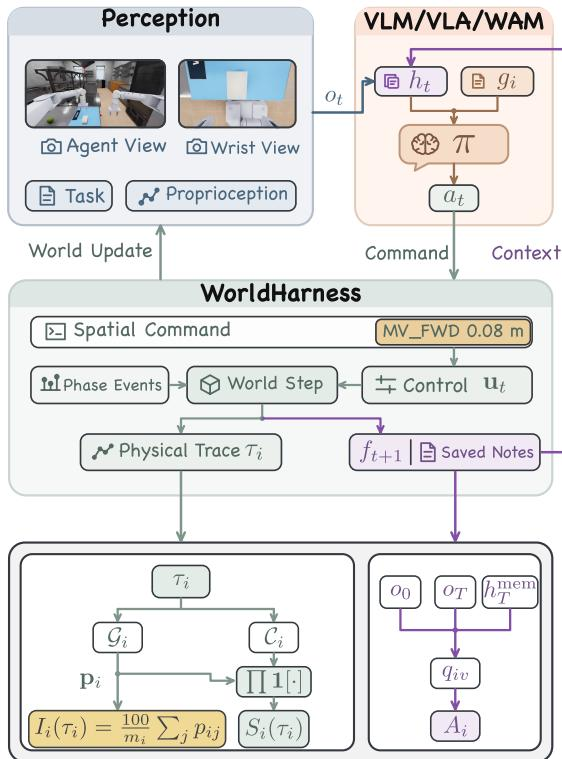
Physical goal achievement is measured using the episode's timestamped trajectory of states, controls, and events. For each goal predicate, the evaluator assigns a progress value, which can be fractional or binary depending on the task definition. The Interactive Score is computed as the mean credit across all goal items, scaled to 100. Additionally, a binary physical success indicator checks whether all goal predicates and constraints are satisfied simultaneously. For vision-language models, the physical outcome is paired with a terminal question-answering phase. After the interaction ends, the physical result is frozen, and the model is asked to answer questions about the initial scene, final state, and interaction history, providing a separate measure of scene understanding and memory.
Experiment
The experiments evaluate 13 embodied AI systems, including VLM-guided robots and continuous-control policies, on 60 WorldLeague tasks that demand navigation, physical reconfiguration, and adaptation to changing scenes. Across systems, most goals are not achieved, and partial progress often coexists with unmet constraints or outright failure, with navigation attempts being common but completions rare and many physical reasoning tasks remaining unsolved. VLM systems can sometimes answer questions about an episode correctly even when physical execution fails, while decision validity, motion completion, and termination behavior strongly influence success. Run-to-run variation and computational cost further show that current systems are far from reliable physical goal achievement.
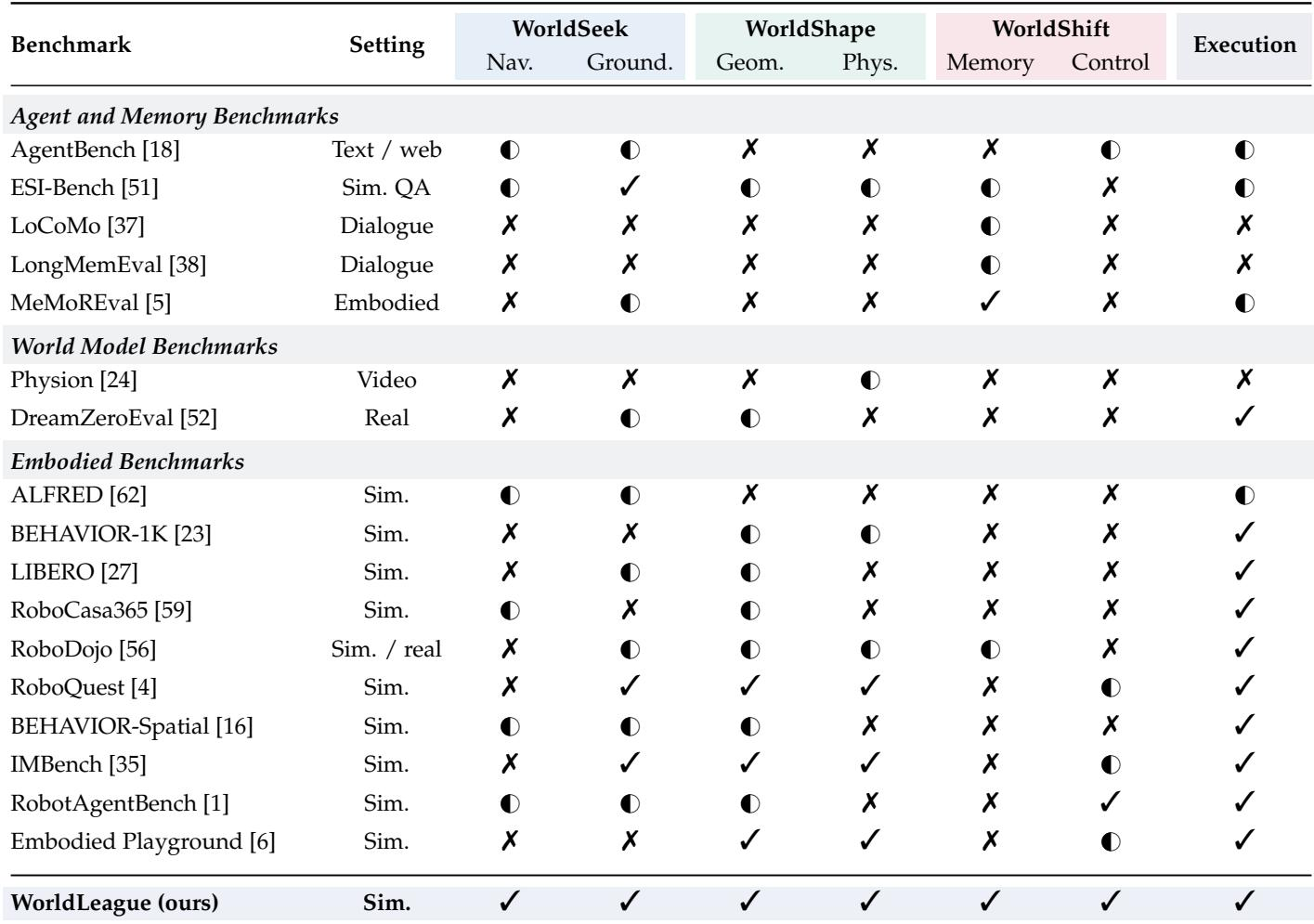
The comparison shows that existing benchmarks cover only partial slices of the six WorldLeague dimensions, often leaving physical scene change or full execution control untested. WorldLeague is designed to close this gap by evaluating all six dimensions through physical goal achievement, so the same system can be compared on finding and manipulating a target and on tracking it as the scene changes. This broader setup contrasts with dialogue, text, or QA benchmarks that focus on narrower capabilities such as memory or passive answering. LoCoMo and LongMemEval show marked coverage only in memory among the compared dimensions. MeMoREval has an embodied, memory-focused design but only partial coverage across the six dimensions. WorldLeague is designed to evaluate all six dimensions through physical goal achievement, unlike the partial coverage seen in the compared benchmarks. The execution marks distinguish feedback-guided robot motion, delegated or active actions, and passive QA or prediction.
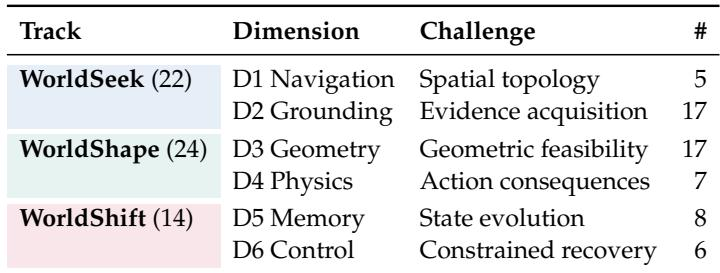
WorldLeague organizes 60 embodied AI tasks into three tracks by primary challenge: WorldSeek, WorldShape, and WorldShift. WorldShape is the largest group, and evidence acquisition plus geometric feasibility account for most tasks overall. Smaller task groups cover spatial topology, physics, state evolution, and constrained recovery. WorldSeek includes 22 tasks, with more tasks assigned to evidence acquisition than to spatial topology. WorldShape is the largest track with 24 tasks, dominated by geometric feasibility tasks. WorldShift includes 14 tasks, with state evolution tasks slightly outnumbering constrained recovery tasks. Correct terminal reporting can coexist with zero physical progress: many VLM episodes earn full terminal question-answering credit but zero Interactive Score.
Physical goal completion remains rare across systems, with the leading VLM earning the highest interactive score but succeeding on only a minority of tasks. Complementary strengths appear in constraint management and an isolated physical-reasoning success, while continuous-control policies earn partial credit in some dimensions without completing navigation or geometric reconfiguration tasks. Claude Fable 5.2 has the highest overall interactive score and leads in navigation, goal grounding, geometric reconfiguration, and temporal memory. Across the shared evaluation, the 13 systems complete only 16 goals total; among VLMs, Fable, Sol, and Astra achieve the most individual goals. Sol and Astra share the strongest constraint-management performance, each completing half of the constraint tasks with two successes in common and one unique success each. Sol is the only system that completes the three-object tower physical-reasoning task at seed 0. Among continuous-control policies, GR00T and pi_0.5 complete the most goals, all five policies earn geometric reconfiguration credit, and none completes a navigation or geometric reconfiguration task.
Across the 59 common tasks, no system earns any progress on nearly half, at least one system earns only partial progress on another group, and at least one system reaches physical success on a similar share. Navigation is the only category where every task receives some progress, though only one navigation task is completed. Physical reasoning and constraint tasks reveal gaps: most WorldShape physical-reasoning tasks get zero credit from all systems, and full item credit on constraint tasks can still leave an underlying constraint unmet. Fewer than one-third of the common tasks are physically solved by at least one system, while nearly half receive zero progress from every system. All navigation tasks receive at least some progress, but most remain unsolved; physical-reasoning tasks in WorldShape largely get zero progress from all systems.

The experiments present WorldLeague as a benchmark that spans all six dimensions of physical goal achievement, in contrast to existing dialogue, memory, and QA benchmarks that cover only partial slices, and they organize tasks into WorldSeek, WorldShape, and WorldShift with evidence acquisition and geometric feasibility as the largest groups. Evaluation separates terminal question answering from interactive physical progress, showing that physical goal completion remains rare while leading vision language models display complementary strengths in navigation, constraint management, and isolated physical reasoning, and continuous-control policies earn partial geometric reconfiguration credit without completing navigation or reconfiguration tasks. Across shared tasks, many receive zero progress, navigation is the only category where every task gets some progress yet remains largely unsolved, and constraint task credit can be obtained even when the underlying physical constraint is unmet.