Command Palette
Search for a command to run...
컴퓨터 사용 에이전트를 위한 자기 진화형 평가 환경
컴퓨터 사용 에이전트를 위한 자기 진화형 평가 환경
Wenhao Wang Panrong Tong Quyu Kong Pengxiang Li Haowen Yang Chenglin Cai Siheng Chen Yue Wang
초록
컴퓨터 사용 에이전트(CUA)는 빠르게 발전하고 있으나, 이들의 평가는 여전히 대체로 정적이다. 기존 벤치마크는 견고한 기반을 제공하지만, 고정된 난이도 상한, 제한된 기능 범위, 그리고 거친 종합 점수는 변별력과 진단적 가치를 점차 약화시킨다. 본 연구는 롤아웃 증거로부터 과제와 실행 가능한 검증기를 공진화시키는 폐루프 평가 환경인 CUA-SEE를 소개한다. CUA-SEE는 세 가지 목표를 분리한다. 벤치마크 진화는 코호트 보정 난이도와 커버리지 성장을 통해 평가 범위를 확장하고, 진단적 진화는 에이전트 조건부 능력 경계 탐침을 통해 해상도를 높이며, 검증기 진화는 변화하는 요구사항을 적대적 검증을 거친 상태 기반 체크포인트로 변환하여 정밀도를 향상시킨다. 여러 에이전트, 애플리케이션, 라운드에 걸쳐 CUA-SEE는 프로세스 수준의 증거를 보존하면서 도전적이고 측정 가능한 과제를 생성한다. 본 연구 결과는 적응형 평가를 진화하는 CUA에 대응하는 확장 가능한 짝으로 자리매김하여, 에이전트가 무엇을 할 수 있고 그 경계가 어디에 있으며 진전이 얼마나 신뢰성 있게 측정되는지를 지속적으로 추적한다.
One-sentence Summary
Alibaba Token Hub, Alibaba Group, Zhejiang University, and Shanghai Jiao Tong University introduce CUA-SEE, a closed-loop evaluation environment that co-evolves tasks and executable verifiers from rollout evidence, disentangling benchmark, diagnostic, and verifier evolution to generate challenging, measurable tasks while continuously tracking computer-use agents' capabilities, boundaries, and progress.
Key Contributions
- CUA-SEE is a closed-loop evaluation framework that co-evolves tasks and executable verifiers from rollout evidence, jointly updating task demands, measurement instruments, and validity-filtered evidence across rounds.
- Two complementary task-evolution operators are introduced: a cohort-grounded benchmark operator that expands difficulty and coverage, with exact feature coverage expanding by 3.65 times over four rounds, and an agent-conditional diagnostic operator that probes capability boundaries to expose agent-specific and software-specific weaknesses.
- A requirement-preserving verifier evolution pipeline converts evolving task requirements into state-grounded checkpoints with adversarial cross-review, achieving 84.0% agreement with human trajectory judgments across five state-of-the-art agents while macro-average scores shift from 60.6 to 47.5 over four rounds.
Introduction
Computer-use agents are evaluated by verifying success against intricate software-specific states and multi-step task requirements, which makes their evaluation more difficult than scoring textual answers or binary code outputs. Existing benchmarks rely on manually curated tasks and task-specific verifiers, but this static, one-shot construction is costly, imposes a fixed difficulty ceiling, covers only a small fraction of the software feature space, and cannot track emerging weaknesses or shortcuts. The authors propose CUA-SEE, a self-evolving evaluation environment formulated as a closed loop in which tasks, executable verifiers, and validity-filtered agent rollout evidence are updated jointly over rounds. The system expands measurable scope through cohort-grounded benchmark evolution, increases diagnostic resolution through agent-conditional capability-boundary probes, and improves measurement precision through state-grounded verifier evolution.
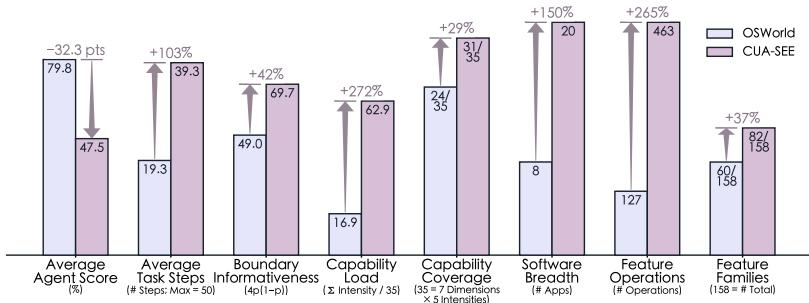
Method
The authors design CUA-SEE to co-evolve tasks and verifiers through a closed loop fueled by evidence from agent-environment rollouts. This framework ensures that as task demands increase, the measurement instruments remain faithful and executable.
As shown in the figure below:
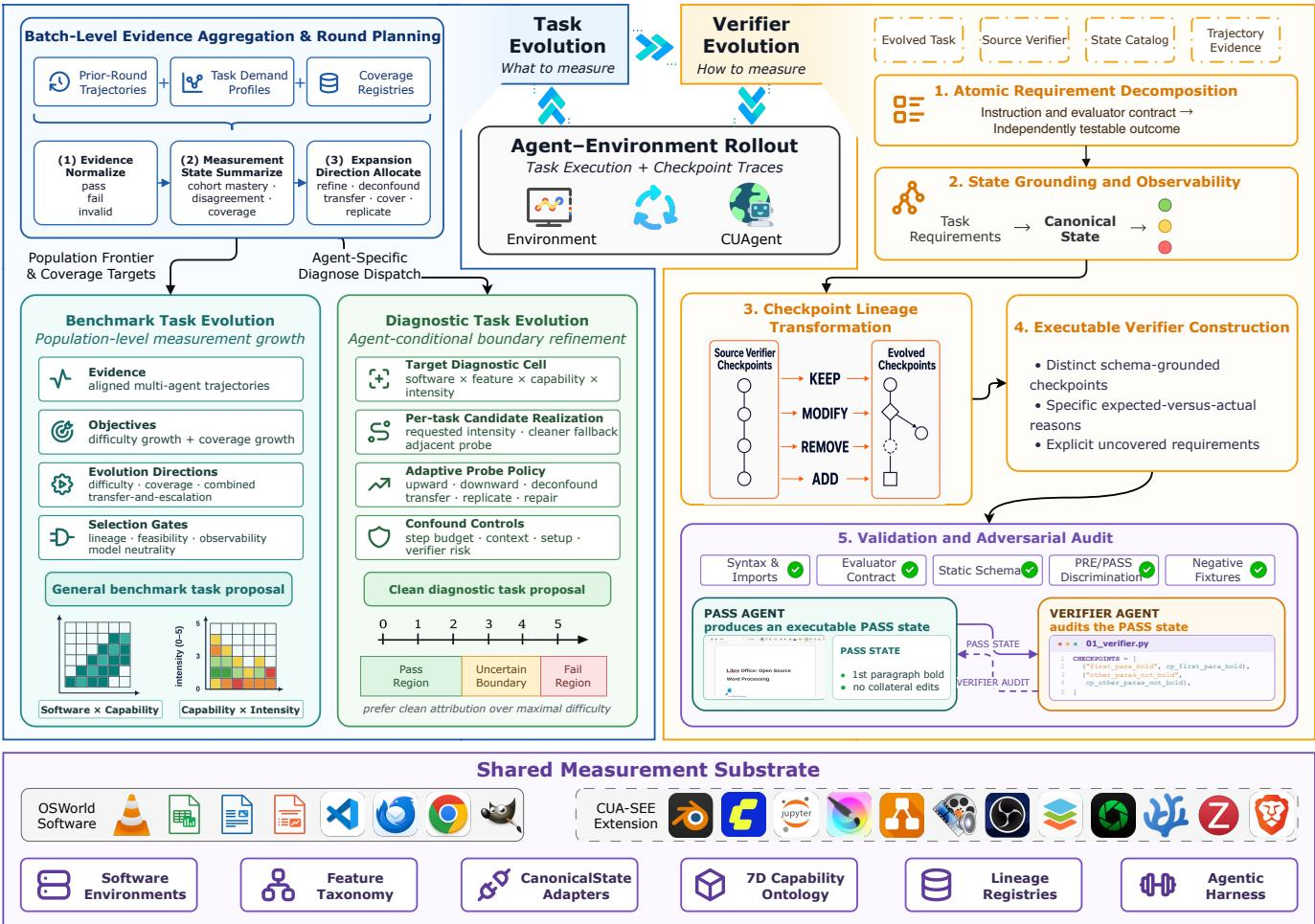
The task evolution module operates on two complementary fronts to expand the measurable difficulty frontier and refine agent-specific capability boundaries. First, benchmark task evolution focuses on population-level measurement growth. The system aggregates aligned multi-agent trajectories and normalizes evidence to classify source lineages. A bi-objective round planning mechanism jointly optimizes difficulty-frontier and feature-coverage growth. Evolution directions are lineage-anchored, meaning candidates must preserve the semantic demand of the source task while introducing measurable escalations in precision, procedural depth, or verification requirements. Candidate selection gates then filter proposals based on feasibility, verifiability, and model neutrality.
Second, diagnostic task evolution increases the resolution of evaluation around an individual agent's capability boundary. A batch-level planner converts longitudinal rollout evidence into agent-specific diagnostic dispatches, targeting specific diagnostic cells defined by software, feature, primary capability, and intensity. The per-task evolver constructs a local neighborhood of candidates using a KNN-inspired approach, generating requests for specific intensities alongside cleaner fallbacks and adjacent probes. An adaptive probe policy directs the evolution based on clean passes or failures, adjusting intensity or triggering corrective actions like deconfounding. Confound-controlled candidate selection ensures that capability demand is factorized from nuisance variables, favoring cleanly attributable probes over overly complex tasks.
To ensure increased task demand remains faithfully observable, the unified verifier evolution module co-evolves the measurement instrument with each task. The process begins with requirement-centric contract decomposition, reconstructing the evolved task contract as a set of independently testable outcome requirements. State grounding and observability mapping ensures each requirement maps to an observable state field, explicitly identifying coverage gaps rather than relying on unsound surrogates. Checkpoint-lineage transformation applies explicit operations such as KEEP, MODIFY, REMOVE, or ADD to source verifier checkpoints. The executable verifier construction phase compiles the transformed contract into distinct schema-grounded checkpoints using task-agnostic adapters that probe native state-export interfaces. Finally, a rigorous validation and adversarial audit separates static and behavioral gates. An information-isolated pass agent produces an executable state, while a verifier agent audits whether that state genuinely satisfies the task, exposing trivial checkpoints and missing obligations through adversarial cross-review.
Underpinning these processes is a shared measurement substrate that expands the supported applications into verifiable desktop environments. This substrate integrates software environments, a feature taxonomy, CanonicalState adapters, a 7D capability ontology, lineage registries, and an agentic harness to support all stages of the evaluation loop.
Experiment
The experiments evaluate the benchmark and diagnostic evolution framework on eight core OSWorld applications using lineage-aligned task groups across five SOTA agents, with three agents driving evolution and two held out for generalization. Evolved benchmarks become more demanding and broader in feature coverage, and diagnostic evolution shifts saturated tasks toward informative pass/fail boundaries that expose agent-specific capability, operation, feature, and software profiles. Verifier validation shows strong human agreement and high atomic requirement coverage, while held-out agents track the same difficulty progression without verifier drift. Efficiency results indicate verifier evolution is stable and benchmark evolution is mainly limited by shared context construction.
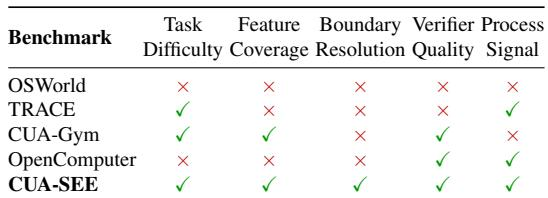
CUA-SEE is the only benchmark in the comparison that supports all five evolvable properties: task difficulty, feature coverage, boundary resolution, verifier quality, and process signal. Other benchmarks provide partial support, while OSWorld lacks all five compared properties. This combination enables CUA-SEE to expand task difficulty and capability coverage without losing verifier and process signals. CUA-SEE is the only benchmark with full support across task difficulty, feature coverage, boundary resolution, verifier quality, and process signal. CUA-Gym supports feature coverage and verifier quality but lacks boundary resolution and process signal, while TRACE and OpenComputer support process signal but lack feature coverage and boundary resolution. Evolved verifiers stay aligned with task contracts, with broad atomic requirement coverage and rising human agreement over evolution rounds.
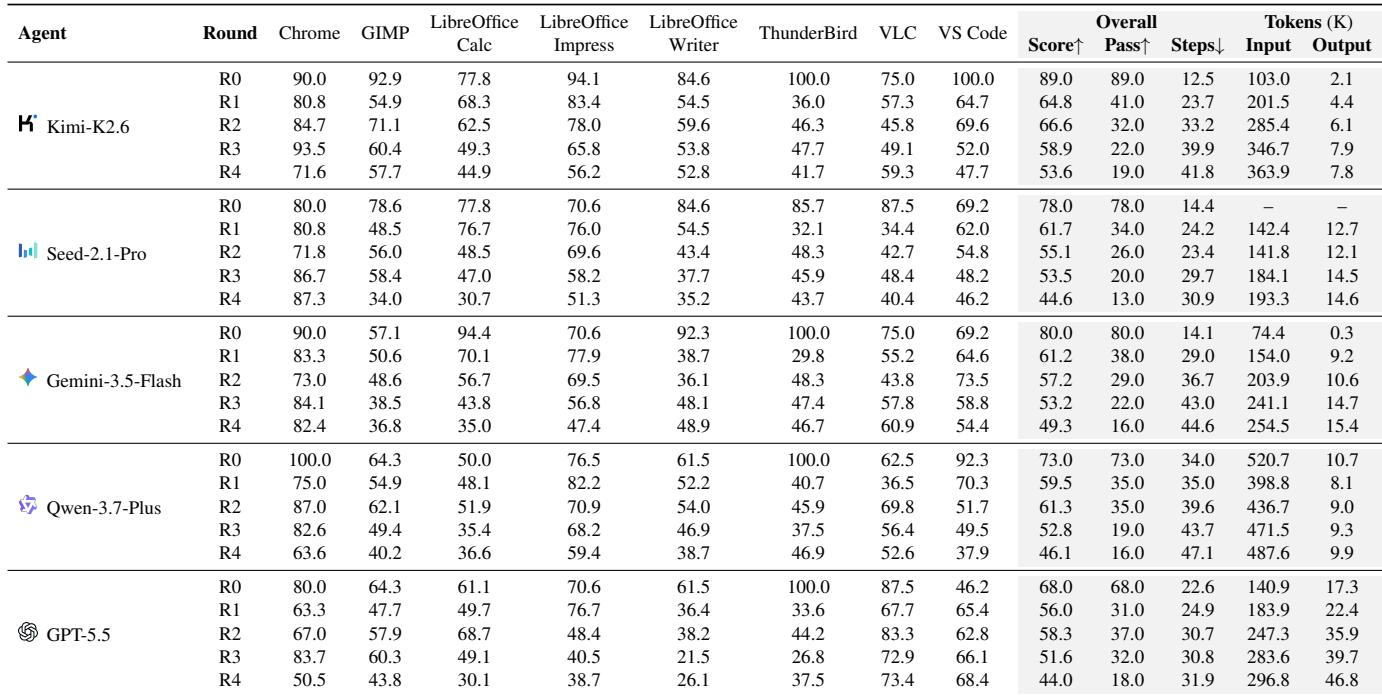
Evolved benchmark rounds become progressively harder, with overall scores declining and trajectories and token inputs growing across agents. The trend is not perfectly monotonic for every agent, but longer interaction chains persist even when scores rebound slightly. Difficulty also shifts unevenly by application, leaving Chrome comparatively easy while GIMP, Calc, and Writer show larger score reductions. Overall scores decline across rounds while average trajectory length and input token counts increase. Some agents have slightly higher scores in an intermediate round but still require longer interactions. Difficulty varies by application, with Chrome remaining easier and GIMP, Calc, and Writer showing larger declines.
Successive benchmark evolution rounds steadily broaden functional and operational coverage across all eight applications. Exact feature operations increase roughly 3.65-fold from the initial round to the fourth round, with consistent growth in feature families and categories. Capability coverage reaches full coverage by the second round and remains saturated thereafter. Every application gains exact feature operations across evolution rounds, indicating broad expansion rather than concentration in a few software domains. Feature family and category coverage increase steadily alongside operational growth, while cumulative capability coverage becomes complete by the second round.

The evaluation compares CUA-SEE with other benchmarks on evolvable properties and examines how successive evolution rounds affect difficulty, agent behavior, and coverage. CUA-SEE uniquely supports all five properties, while evolved rounds become harder overall, with longer trajectories, growing token inputs, and uneven difficulty shifts across applications. Repeated evolution also steadily broadens functional and operational coverage across all eight applications, increasing exact feature operations about 3.65-fold and reaching complete capability coverage by the second round.