Command Palette
Search for a command to run...
잠들지 말고 계속 지켜보라: 컴퓨터 사용 에이전트를 위한 능동적 인지
잠들지 말고 계속 지켜보라: 컴퓨터 사용 에이전트를 위한 능동적 인지
Jiaqi Su Jie-Jing Shao Yichen Liu Long-Kai Huang Haiyan Yin
초록
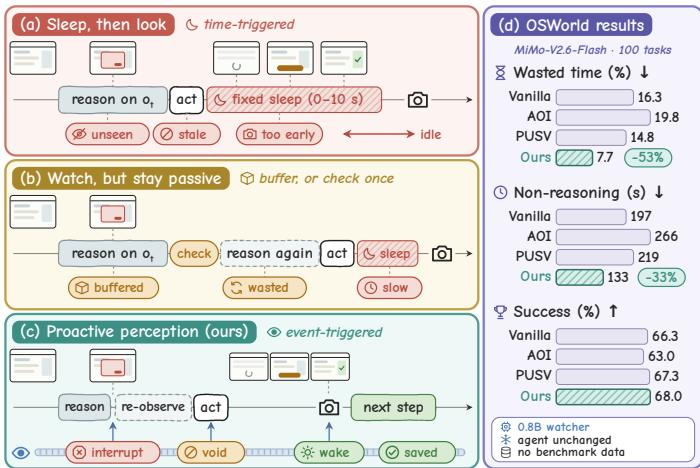
비전-언어 모델(VLM) 기반 컴퓨터 사용 에이전트(CUA)는 화면이 스스로 계속 변화하는 실제 데스크톱, 웹, 모바일 환경에서 장기간의 과업을 수행하도록 점차 신뢰를 얻고 있다. 그러나 현재의 CUA는 실시간 상황 인식 능력이 부족하다. 이들은 이산적인 스냅샷을 통해 환경을 인지하는데, VLM의 상당한 추론 지연 시간과 매우 동적인 인터페이스가 결합되어, 관찰된 상태가 해당 행동이 실행되기 전에 자주 낡은 것이 되어버리는 인지-행동 간극이 발생한다. 이러한 간극을 해소하기 위해, 우리는 에이전트의 모델, 프롬프트, 행동 공간을 변경하지 않고도 모든 CUA에 연속적이고 시간적으로 정합된 인지 능력을 부여하는 플러그 앤 플레이 프레임워크인 NightWatch를 제시한다. NightWatch는 VLM 에이전트를 경량 System-1 모델인 NightWatch-0.8B와 결합하여 인터페이스 상태에 대한 스트리밍 모니터링을 수행하고, 낮은 계산 비용과 지연 시간으로 에이전트가 변화하는 환경과 동기화되도록 유지한다. 이를 통해 각 결정이 낡은 스냅샷이 아닌 현재 상태에 기반하도록 하여, 과업 성공률을 유지하면서 낡은 행동과 유휴 대기를 모두 줄인다. 데스크톱 및 동적 웹 환경(OSWorld-Verified 및 DynaCU-Bench)에서의 실험 결과, 단 0.8B 매개변수의 감시자에 의해 구동되는 NightWatch는 OSWorld에서 비추론 월클록 시간을 33%, 낭비 시간을 53% 줄이면서 과업 성공률을 동등하게 유지했고, 대형 VLM 에이전트와 함께 DynaCU-Bench에서 성공률을 39.5%에서 44.2%로 향상시켰다. 또한 동일한 스크린샷 전용 입력 하에서 AOI 및 PUSV와 같은 수동적 감시 기준선보다 효율적이며, 30배 이상 큰 System-1 의사결정 모델보다도 효율적이다. 전반적으로 NightWatch는 인지의 시점이 그 내용만큼이나 중요함을 입증하며, 에이전트가 환경을 차례마다 인지하는 대신 지속적으로 인식하도록 나아가는 한 걸음을 보여준다.
One-sentence Summary
Researchers from the National University of Singapore, A*STAR Centre for Frontier AI Research, SenseTime, and Hong Kong Baptist University propose NightWatch, a plug-and-play framework that endows any computer-use agent with continuous, temporally grounded perception via NightWatch-0.8B, a lightweight System-1 streaming monitor, reducing OSWorld non-reasoning wallclock time by 33% and wasted time by 53% while keeping task success on par, and raising DynaCU-Bench success from 39.5% to 44.2% with the large VLM agent.
Key Contributions
- NightWatch is a plug-and-play framework that couples an unmodified vision-language computer-use agent with NightWatch-0.8B, a lightweight System-1 visual watcher, to provide continuous, temporally grounded perception of dynamic desktop and web interfaces.
- The watcher performs streaming, frame-level monitoring and uses fixed thresholds to issue interrupts, voids, and wake signals, keeping the agent synchronized with the evolving screen without changing its model, prompt, or action space.
- On OSWorld-Verified and DynaCU-Bench, NightWatch reduces non-reasoning wallclock time by 33% and wasted time by 53% on OSWorld while keeping task success on par, raises success on DynaCU-Bench from 39.5% to 44.2% with the large VLM agent, and outperforms AOI, PUSV, and a System-1 decision model more than 30× its size.
Introduction
Computer-use agents built on vision-language models now operate real desktops, browsers, and phones, but most still rely on a reactive observe-reason-act loop with a fixed post-action sleep. Because screens change on their own through page loads, popups, notifications, and animations, this time-triggered loop leaves agents blind between screenshots, creates stale observations before dispatch, and uses hand-tuned delays that may capture half-rendered transitions or miss transient feedback. Recent methods such as AOI and PUSV watch frames passively or wait on DOM/text signals, but they do not let the screen decide when the agent should look or stop reasoning that has become obsolete. The authors propose NightWatch, a plug-and-play proactive perception framework that places a lightweight visual watcher in front of an unmodified agent. The watcher answers generic event questions from the frame stream, and deterministic rules turn its answers into interrupts, voids, and wake signals. NightWatch-0.8B is trained without benchmark data and reduces non-reasoning wall-clock time on OSWorld-Verified while maintaining success, and improves success on dynamic web tasks.
Method
The authors propose NightWatch, a lightweight watcher operating at the harness level between an unmodified Vision-Language Model agent and its environment. Instead of relying on a fixed time-triggered loop, the system introduces a proactive perception policy that dynamically decides when the agent should observe the screen and whether its ongoing reasoning or pending actions remain valid.
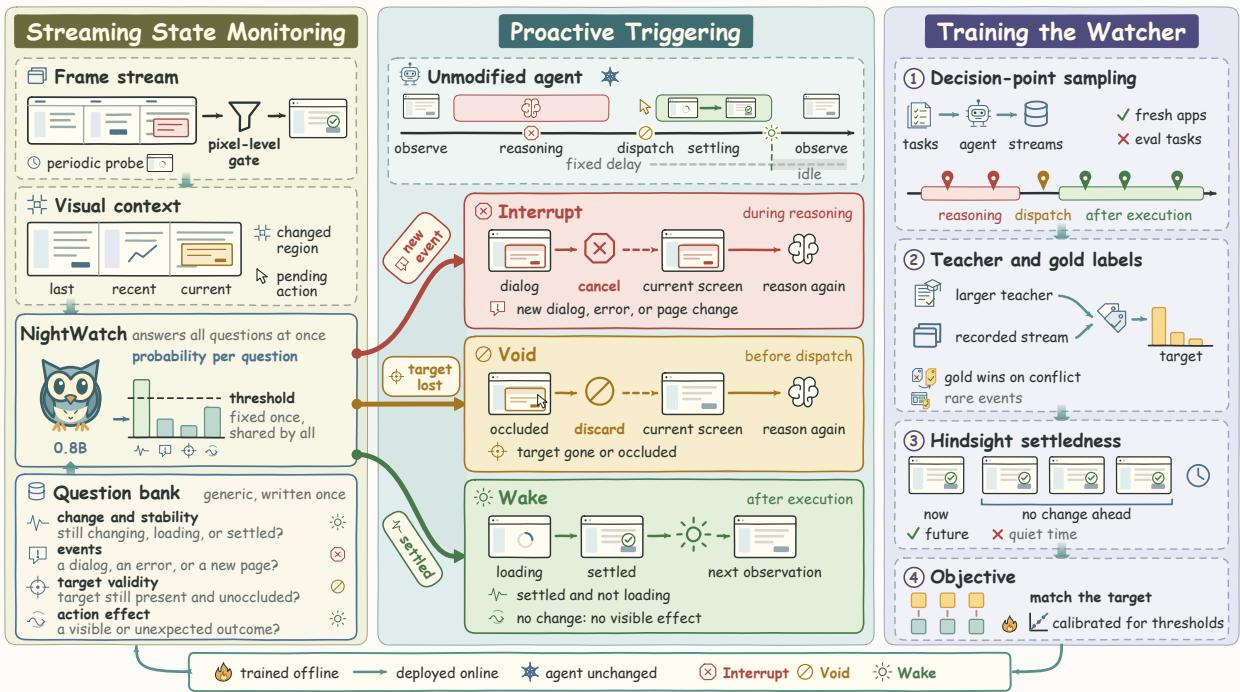
To monitor the environment efficiently, the watcher functions as a System-1 decision model that answers typed questions about the interface without generating a full reasoning trace. The visual context fed into the model at any given time comprises the agent's last observation, a recent frame, the current frame, a crop of the changed region, and the text of the pending action. The model evaluates a fixed, generic question bank covering four categories: change and stability, unexpected events, target validity, and action effects. During streaming inference, a pixel-level gate triggers evaluations only when the frame changes significantly, while a periodic probe monitors static loading screens. The visual encoder processes the context once per request to compute probability distributions over the answer options for the relevant subset of questions.
These probabilities are then passed to a proactive triggering module, which applies fixed thresholds to execute three specific interventions on the unmodified agent. First, an Interrupt mechanism monitors for new events, such as dialogs or page changes, during the agent's reasoning phase. If the probability of an event exceeds a threshold, the current generation is canceled and the step restarts from the updated screen. Second, a Void mechanism checks target validity right before action dispatch. If the target is occluded or lost, the pending action is discarded to prevent stale executions. Third, a Wake mechanism replaces the fixed delay after action execution with an online estimate of the screen's ready time. It combines a pixel-quiescence gate with the watcher's assessment of whether the stillness is final, waking the agent as soon as the interface settles.
The watcher is trained offline on decision points sampled from the trajectories of the unmodified agent. The training data includes frames captured during reasoning, right before dispatch, and at various delays after execution. The target labels are derived by combining the predictions of a larger teacher decision model with gold labels extracted from the recorded frame stream. For instance, gold labels indicate if a target remained unchanged or if no events occurred. For the settledness question, the authors employ a hindsight settledness label, which defines the ground truth based on future frames to determine if the screen truly stopped changing. The training objective minimizes a combination of cross-entropy and Brier score losses:
L(θ)=Ei∼D[CE(yi,pθ,i)+λ∥yi−pθ,i∥22]The Brier term is crucial for preserving the probability calibration required by the fixed thresholds in the proactive triggering module. A final temperature scaling is applied to ensure accurate thresholding across different applications.
Experiment
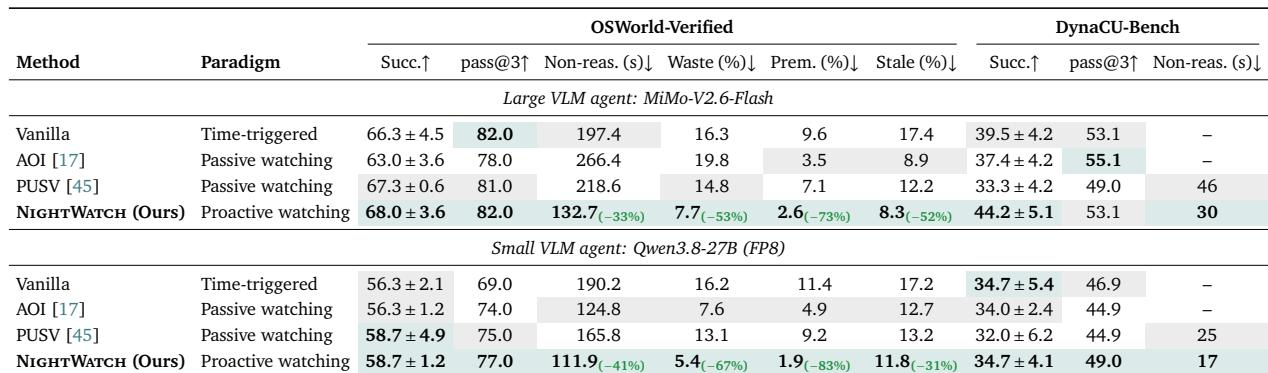
The experiments evaluate NightWatch on OSWorld-Verified desktop tasks and DynaCU-Bench dynamic web tasks using the same agent, prompt, action space, and step budget as time-triggered and passive-watching baselines, with both a large hosted VLM and a small open-weight VLM. NightWatch matches or improves task success while substantially reducing non-reasoning time, wasted time, premature observations, and stale actions, with the largest dynamic-web gains on live dashboards and other changing interfaces. Ablations confirm that the learned watcher is faster than pixel-rule and larger API-based schemes, that each intervention helps without harming success, and that judging stillness as final rather than waiting for pixel quiescence drives the savings. Cost results show end-to-end speedups with only minimal API cost increase, and qualitative cases illustrate how interrupt, void, and early wake interventions correct or accelerate agent behavior.
NightWatch maintains or improves task success while reducing loop overhead relative to time-triggered and passive watching baselines. With a large VLM agent, it cuts non-reasoning time by about a third and reduces idle, premature, and stale step shares by roughly half to three quarters. On dynamic tasks, it achieves the highest success among the compared methods while using the least reported non-reasoning time. With the large VLM agent on OSWorld-Verified, NightWatch reaches the lowest non-reasoning time while matching the best pass@3 and posting a higher mean success than Vanilla. It records the lowest waste, premature observation, and stale action shares in its block, with large relative reductions against the time-triggered baseline. On DynaCU-Bench, NightWatch attains the highest success rate among compared methods and the lowest reported non-reasoning time. Passive watching baselines can reduce some stale or premature actions but often increase loop overhead or lower dynamic-task success, whereas NightWatch avoids that trade-off.
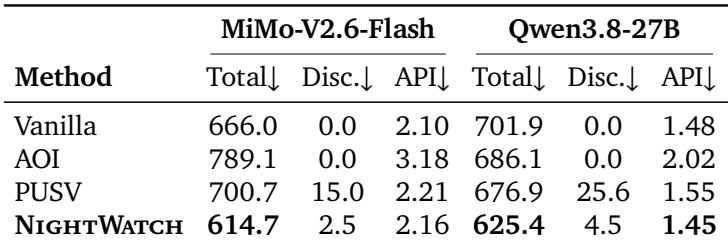
NightWatch achieves the lowest end-to-end task time for both agents on OSWorld-Verified, with only a small amount of discarded generation and agent API cost close to Vanilla. In contrast, AOI adds notably higher API cost because keyframes increase input token counts per call. The watcher itself runs locally and does not add API calls. NightWatch is the fastest method for both tested agents, reducing total loop time by roughly a tenth versus Vanilla. Its discarded generation time remains only a few seconds per task, and its agent API cost stays within a few percent of Vanilla. AOI increases agent API cost by 37 to 52 percent relative to Vanilla because each call carries larger keyframe inputs. PUSV discards more generation time than NightWatch but remains closer to Vanilla in API cost than AOI.
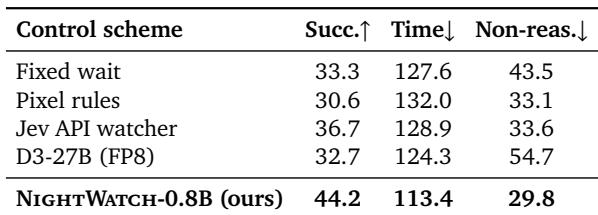
Across control schemes, NightWatch-0.8B is the most effective, achieving the highest success rate, the lowest total time per task, and the lowest non-reasoning time. The other schemes show lower success and comparable or higher task times, with the much larger D3-27B incurring the greatest non-reasoning overhead. Switching the decision layer to pixel rules, fixed waits, or an API watcher does not match NightWatch's end-to-end performance. NightWatch-0.8B leads all compared control schemes in success rate, total time per task, and non-reasoning time. Fixed wait, pixel rules, Jev API watcher, and D3-27B all trail NightWatch, with D3-27B showing the highest non-reasoning overhead despite its larger scale. The results isolate the decision layer and show that the lighter NightWatch model provides more efficient control than fixed timing, pixel differences, API-based checks, or a larger FP8 decision model.
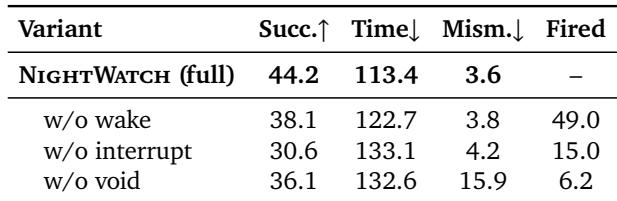
On DynaCU-Bench, removing any single intervention from NightWatch lowers success and increases task time. Interrupt removal causes the largest slowdown and the lowest success, while void removal sharply raises mismatched actions. Replacing wake with pixel quiescence also adds time without improving outcomes. Removing interrupt has the largest cost among the single-removal variants, with longer task time and the lowest success. Without void, mismatched actions rise from 3.6% to 15.9%, indicating that void suppression prevents stale targeted actions. Wake is the most frequently triggered intervention, firing on about half of steps, and replacing it with pixel quiescence slows tasks without matching full NightWatch.
The experiments evaluate NightWatch on dynamic benchmarks such as OSWorld-Verified and DynaCU-Bench against time-triggered, passive watching, fixed-wait, pixel-rule, API watcher, and larger decision-model baselines. NightWatch consistently improves or maintains task success while reducing loop overhead, end-to-end task time, idle and stale actions, and API cost compared to these alternatives. Ablations show that each intervention contributes to efficiency, with interrupt removal causing the largest slowdown and void removal increasing mismatched actions, confirming that the lightweight local watcher avoids the trade-offs of fixed or passive control schemes.