Command Palette
Search for a command to run...
Duopra: 전이중 대화에서 전이중 에이전시로
Duopra: 전이중 대화에서 전이중 에이전시로
초록
전이중 상호작용 모델은 강한 대화 에이전시를 보여주며, 자연스럽고 낮은 지연 시간의 턴테이킹, 백채널, 끼어들기를 가능하게 한다. 그러나 작업을 완수하려면 추가로 작업 에이전시가 필요하다. 즉, 사용자 수정에 따른 적시의 도구 호출과 인자 수정이 요구된다. 프론트엔드-백엔드 에이전트는 개시와 실행을 분리하는데, 프론트엔드는 요청 여부와 내용을 결정하고 백엔드는 실행 방법을 결정한다. 실행은 오프로드될 수 있지만, 전송되지 않은 요청은 실행될 수 없고 불완전한 요청은 백엔드를 오도할 수 있다. Full-Duplex-Bench v3(FDB v3)에서 우리의 스트리밍 파이프라인에 포함된 Realtime-Venus-Audio + Harness의 실패 대부분은 도메인 도구가 실행되기 전에 발생한다. 우리는 대화 제어와 함께 작업 실행을 학습하는 전이중 상호작용 모델인 Duopra를 소개한다. Duopra는 백엔드를 도구로 취급하여 자기 완결적인 자연어 요청을 받아들인다. 직접 호출과 백엔드 위임은 충실한 개시와 올바른 실행을 위한 동일한 행동 인터페이스와 요구 사항을 공유한다. 3단계 학습은 프로토콜 SFT, 적시의 완전한 실행에 보상하는 전이중 RL, 그리고 thinker 업데이트 후 talker 조건화의 projector 전용 복구를 결합한다. 동일한 백엔드에서 Pass@1은 4.7%에서 44.7%로 상승하며, Duopra는 도구를 직접 호출하여 47.7%(SFT 후 26.0%), DeepSeek 백엔드로 49.3%를 달성한다. 기본 모델 대비 세 가지 FDB v1.0 인수율이 향상된다. 이러한 결과는 작업 에이전시가 핵심적인 대화 에이전시와 공존할 수 있음을 보여준다.
One-sentence Summary
Researchers from Shanghai Jiao Tong University et al. propose Duopra, a full-duplex interaction model that learns task execution alongside conversational control by treating the backend as a tool and sharing an action interface between direct calls and delegation, with three-stage training combining protocol SFT, full-duplex RL, and projector-only repair, raising Pass@1 from 4.7% to 44.7% and direct calls to 47.7%.
Key Contributions
- This work identifies frontend initiation as a key bottleneck in full-duplex task execution and introduces Duopra, a model that treats the backend as a tool and unifies direct domain-tool calls with natural-language backend delegation through a shared action interface.
- The model is trained with a three-stage procedure combining protocol supervised fine-tuning, execution-based full-duplex reinforcement learning that rewards timely and complete execution, and projector-only repair of talker conditioning after thinker updates.
- On Full-Duplex-Bench v3, Pass@1 rises from 4.7% to 44.7% with the same backend; direct tool calling reaches 47.7% (26.0% after SFT), a DeepSeek backend reaches 49.3%, and three FDB v1.0 takeover rates improve over the base model.
Introduction
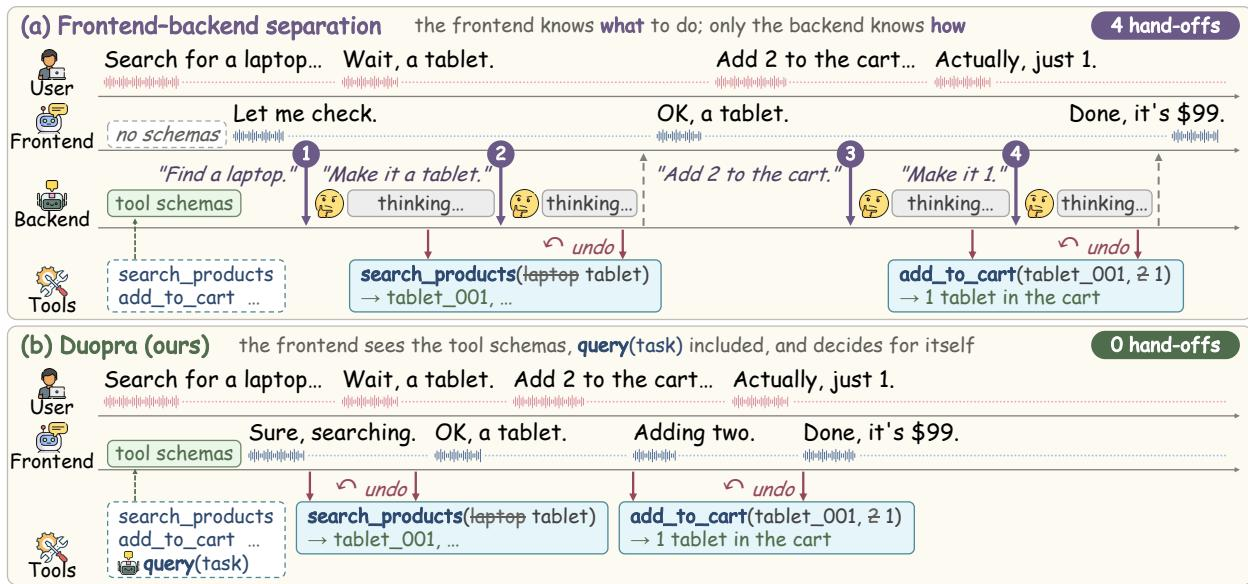
Full-duplex spoken interaction systems must coordinate conversational agency, such as turn-taking and interruptions, with task agency, such as deciding when to act and completing multi-step requests. In frontend-backend agents, execution is offloaded to a tool-using backend, but the speech frontend still must decide when information is sufficient, incorporate corrections, and issue faithful requests; prior work shows this initiation stage can cap overall success. For example, the RV-Audio+Harness baseline delegates in only 11.0% of FDB v3 sessions and passes 4.7%, indicating a frontend initiation bottleneck rather than a general limit on delegation. The authors introduce Duopra, a full-duplex model built on RV-Audio that unifies direct tool calls and backend delegation through a query(task) natural-language action interface. It is trained with protocol supervised fine-tuning, execution-based full-duplex reinforcement learning, and projector-only repair, raising Pass@1 from 4.7% to 44.7% with the same backend while improving takeover rates for turn-taking, pauses, and interruptions.
Method
The authors introduce Duopra, a full-duplex interaction model built on RV-Audio that unifies conversational and task agency within a single causal streaming policy. Instead of relying on a separate dispatcher or free-text delegation, the model processes user audio arriving in units x1,x2,… of length Δ. At each unit t, the frontend reads the audio xt and injected observations et, which include tool schemas and previous call results. It then emits a tuple yt=(mt,wt,at), where mt∈{listen, speak} represents the turn state, wt denotes the text tokens to be voiced, and at is a private action that is never voiced. The causal policy is defined as:
πθ(yt∣x≤t,e≤t,y<t).Conversational agency governs mt and wt to manage turn-taking, while task agency determines at, selecting which tool to call and with what arguments. The framework supports a unified action space where domain tools and a backend delegation tool, query(task), coexist. This allows the model to dynamically choose between direct tool calling and request-based delegation without architectural changes.
As illustrated in the framework diagram, when domain schemas are hidden from the frontend, the system requires multiple hand-offs to convey evolving user requests, complicating the preservation of corrections and tool dependencies. By exposing the tool schemas directly to the frontend, Duopra can issue corrected domain-tool calls immediately, eliminating unnecessary hand-offs while retaining the query(task) option for complex delegations.
The training pipeline for Duopra consists of three distinct stages, as outlined in the figure below:
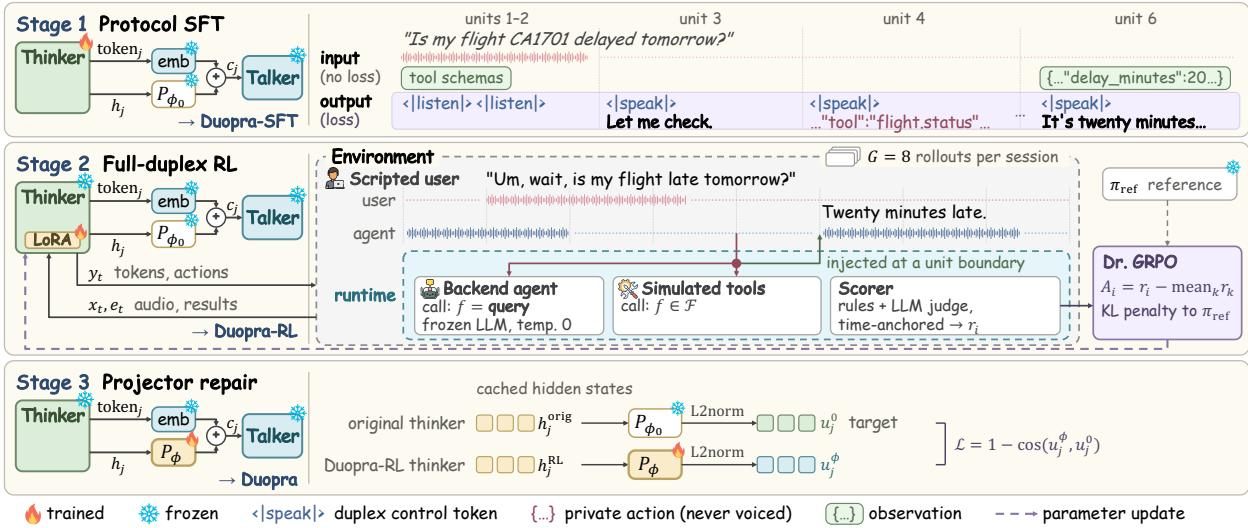
In Stage 1, Protocol Supervised Fine-Tuning, the authors fine-tune the thinker component on a mixture of tool-use demonstrations and capability-retention dialogues formatted as streams of 1-second units. The training objective minimizes the cross-entropy loss over the thinker's reference output positions, which encompass public text, private actions, and duplex control tokens:
LSFT=−Ed[∣M(d)∣∑j∈M(d)logπθ(zj∗∣Hj∗)]During this phase, only the thinker's transformer layers and final normalization are updated, while the embeddings, output head, audio encoder, and speech generation modules remain fixed. This yields the Duopra-SFT checkpoint.
Stage 2 introduces Full-Duplex Reinforcement Learning to refine task and conversational agency. The system generates G=8 streaming rollouts per training task within a sandbox environment. A runtime executes direct calls against simulated tools or delegates to a frozen backend, injecting the resulting observations back into the stream. A scorer evaluates the logged calls against gold standard calls C∗ and measures action timing, while a judge assesses the groundedness of spoken claims. The training curriculum progresses from Stage 2a, focusing on direct calls and conversational interruptions, to Stage 2b, which incorporates dependent calls and backend delegation. The rollout reward r(τ) is determined by the task family, combining penalties for timing violations and incorrect arguments with bonuses for grounded answers. The authors update the thinker's LoRA adapters using Dr. GRPO, maximizing the objective:
JRL(θ)=E∣I∣L1i∈I∑j∈M(τi)∑sijwhere sij=min(ρijAi,ρˉijAi)−βKij, with Ai representing the advantage and Kij the per-token KL estimator against the Duopra-SFT policy.
Finally, Stage 3 performs Projector-Only Talker Repair to address intelligibility degradation caused by the altered hidden states from RL training. The authors align the projected hidden states of the Duopra-RL thinker with the reference directions from the original RV-Audio model. By caching the hidden states hjorig and hjRL from the base and RL thinkers respectively, they compute the target uj0=L2norm(Pϕ0(hjorig)) and the trainable output ujϕ=L2norm(Pϕ(hjRL)). The projector weights ϕ are optimized using:
Lproj=Ej[1−cos(ujϕ,uj0)]+λ∥ϕ−ϕ0∥22This cosine alignment term, combined with an L2-SP regularization term, restores speech intelligibility without modifying the trained thinker, producing the final Duopra model.
Experiment
The study evaluates full-duplex spoken agents on FDB benchmarks and simulated APIs with a streaming protocol, comparing Duopra checkpoints against frontend-backend baselines under Direct, Backend, and Both tool exposures with frozen Qwen or DeepSeek backends. The results show that Duopra acquires task agency in the frontend, succeeding through native tool calls or delegation, and its improvement comes mainly from initiating requests that baselines never execute. Training first increases tool-call initiation and then converts it into complete execution, while remaining errors concentrate on wrong argument values. Conversational and speech evaluations confirm that task agency can coexist with turn-taking control and intelligible speech, although spontaneous backchanneling remains unrecovered.
Duopra gains task agency primarily by initiating domain-tool calls that the RV-Audio + Harness baseline leaves unserved, leading to a large Pass@1 improvement with the same backend. It performs comparably whether executing tools directly or delegating through a backend, and when both routes are visible it succeeds through its own domain calls. On conversational metrics, Duopra improves all three takeover rates relative to RV-Audio, though interruption response remains below the RL1 checkpoint and backchannels are absent. With the same backend, Duopra raises Pass@1 over RV-Audio + Harness mainly by increasing call initiation rather than improving conditional execution success. Duopra performs comparably in direct and delegated configurations, and nearly all successes occur through its own domain calls when both tool routes are visible. Duopra improves turn-taking relative to RV-Audio across all three takeover rates, taking turns more after user finishes, less during pauses, and more after interruptions. Against published reference points, Duopra is comparable to Gemini Live 2.5 but trails GPT-Realtime and Gemini Live 3.1.
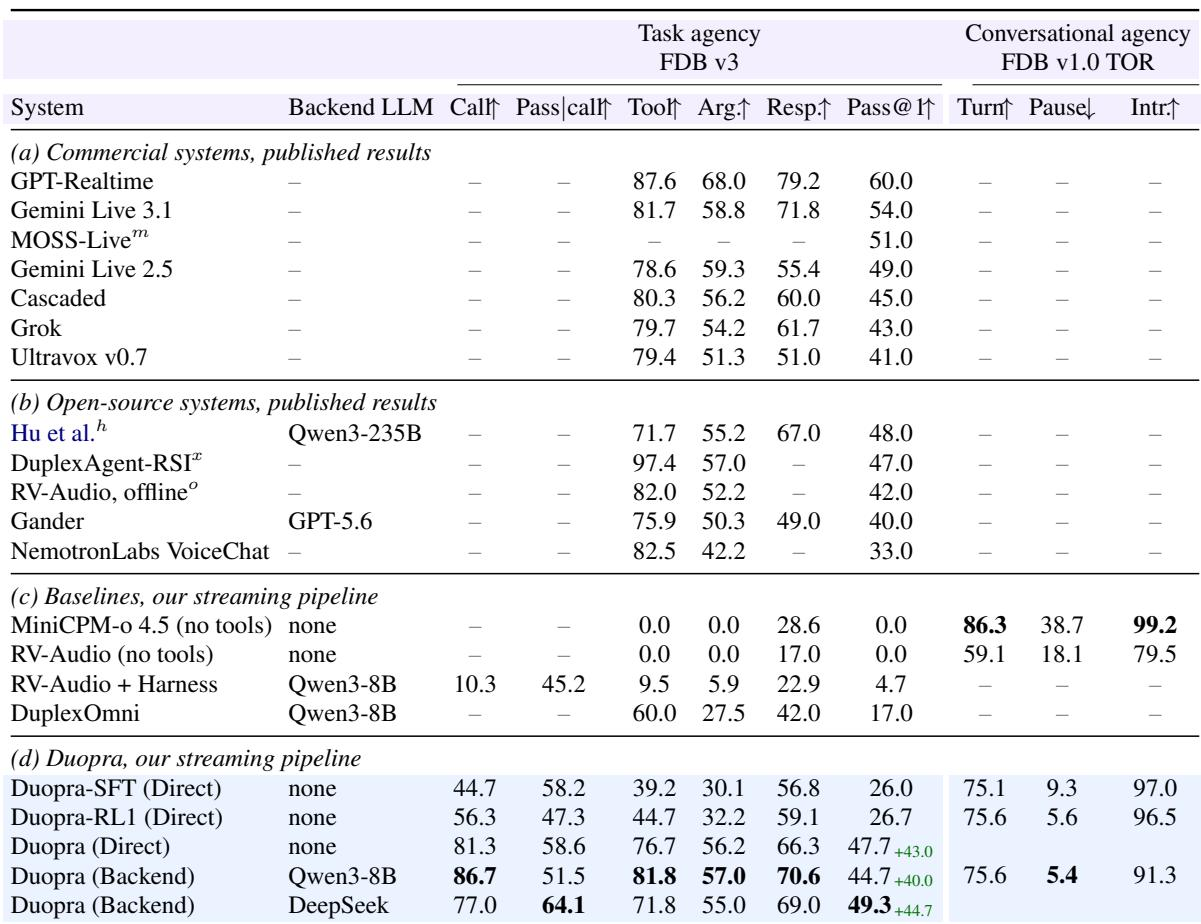
The experiments evaluate Duopra's task agency and conversational turn-taking against an RV-Audio baseline. With the same backend, Duopra improves task success primarily by initiating domain-tool calls that the baseline leaves unserved, and it performs comparably whether executing tools directly or delegating through a backend, with most successes coming from its own domain calls. Duopra also improves all three turn-taking takeover rates relative to RV-Audio, though interruption response remains below the RL1 checkpoint and backchannels are absent. Against published reference points, Duopra is comparable to Gemini Live 2.5 but trails GPT-Realtime and Gemini Live 3.1.